Literature

Paratext
Paratext refers to the elements surrounding a literary work, such as the title, preface, footnotes, and cover design. These components provide context and influence the reader's interpretation of the text. Paratext can shape expectations, guide understanding, and contribute to the overall experience of the literary work.
Written by Perlego with AI-assistance
Related key terms
1 of 5
12 Key excerpts on "Paratext"
 eBook - PDF
The Life of Texts
An Introduction to Literary Studies
- Ann Rigney, Kiene Brillenburg Wurth(Authors)
- 2019(Publication Date)
- Amsterdam University Press(Publisher)
This general summary, presumably writ-ten by the publisher, is followed by a series of quotes from reviewers in by and large ‘quality’ newspapers telling us, for example, that Immortality is a TEXTS AND INTERTEXTUALITY 87 Figure 3.2: Abraham’s sacrifice, anonymous manuscript from the 14th century; collection Árni Mag-nússon Institute. ‘banquet for the brain’ ( Observer ), that it is ‘an important and memorable book’ ( Guardian ) and that the author ‘can be ranked among the greatest novelists of post-war Europe’ ( Sunday Telegraph ). Blurbs like this are also part of the reading experience and may even be a reader’s first encounter with the work. This leads us to the concept of Paratext , derived from the Greek para , meaning ‘alongside.’ Paratext is an umbrella term for those bits of infor-mation that appear ‘alongside’ the author’s text when it is presented in book form. The term refers first and foremost to expressions in language, but can also be used more broadly to indicate all those elements accompa-nying the author’s text that carry meaning (including images). In addition Paratext THE LIFE OF TEXTS 88 to the jacket text (as in the example above), this includes the cover, publi-cation details, possibly a foreword, footnotes, and illustrations. Although each of these textual elements communicates information, they fall ‘outside’ the primary text. The seminal work by Gérard Genette (1930-2018) on the phenomenon of Paratext is aptly called ‘thresholds’: French Seuils (1987), translated as Paratexts : Thresholds of Interpretation (1997). The metaphor of the threshold indicates that textual boundaries are not sharply defined, and that in order to gain access to the author’s text, readers must first climb over all manner of other texts which play a role in shaping their expecta-tions. No longer available |Learn more
- Daniel Schäbler(Author)
- 2014(Publication Date)
- Universitätsverlag Winter(Publisher)
According to Genette, Paratexts “manipulate” the reader towards the interests of the author and should be regarded as “accessory” to the text (Genette 1987 [1997], 410). However, with regard to the research quoted above this reductive notion is not tenable as Paratexts are highly relevant for the adequate understanding of the literary text as a whole. Furthermore, both form and function of prefaces are historically variable (cf. ibid ., 11) and context-bound, and an assessment of their forms and functions in the case of a particular text thus contributes significantly to the project of a cultural narratology. Three of the four novels analysed in this study (namely Walpole’s The Castle of Otranto , Mary Shelley’s Frankenstein , and Thorpe’s Hodd ) feature prefaces – more precisely termed by Genette as belonging to the public Paratext alongside the book’s cover, title, publisher’s information, and overall layout (cf. Genette 1987 [1997], 10-11) –, which facilitate the reader’s transition from the world outside the text to the textual story-world. 28 Paratexts occupy a paradoxical position in that they are macrotypo-graphically separate from the main text, but nevertheless fulfil important functions for the main text. 29 MacLachlan/Reid summarize the functions of the Paratext, which they term circumtext: The circumtext can also serve as a kind of advertising space, exploited for its seductive potential in targeting a particular readership. But there are other functions as well. Being a liminal or threshold phenomenon, the circumtext mediates our passage from everyday reality to the highly organized space of a fictional world. (MacLachlan/Reid 1994, 93) My thesis will focus on the way Paratexts form a passage into the main text and thus influence the reader’s transition from the extratextual world to the ontologically separate intratextual story-world. eBook - ePub
- Kathryn Batchelor(Author)
- 2018(Publication Date)
- Routledge(Publisher)
Seuils , Genette declares: ‘the Paratext is what enables a text to become a book and to be offered as such to its readers and, more generally, to the public’ (1), something which ‘ensure[s] the text’s presence in the world’ (1). Even in antiquity, when texts ‘often circulated . . . in the form of manuscripts devoid of any formula of presentation’ (3), Genette argues that the notion of Paratext is still relevant, since ‘the sole fact of transcription . . . brings to the ideality of the text some degree of materialization’ (3). The Paratext, then, is what turns a text – defined by Genette as ‘a more or less long sequence of verbal statements that are more or less endowed with significance’ (1) – into a physical, material thing, capable of being sold, distributed, read: it is the format of a book and its binding, as well as the various elements that are placed around the text proper in the process of turning the text into a book (title page, cover, blurbs etc.). This emphasis on the physical aspect of the Paratext finds expression in the series of metaphors on which Genette draws to further explain the concept: the Paratext is a ‘threshold’ (2), a ‘vestibule’ (2), an undefined ‘zone’ (2) between the inside and the outside, an ‘edge’ (2), a ‘fringe’ (2), a ‘privileged place of a pragmatics and a strategy’ (2). This physical definition is the one most commonly used by scholars in translation studies, as we will see in the next chapter.p.9However, at several points in the discussion, Genette evokes the possibility of the immateriality of the Paratext. For example, when setting out his approach to the study of Paratexts, Genette (4) states: ‘A Paratextual element, at least if it consists of a message that has taken on material form , necessarily has a location ’ (bold added; italics in original). In this scenario, Genette suggests that we can identify something as a Paratextual element even if it is invisible, and indicates that the Paratext is not a physical thing, but a ‘message’. That we are to conceive of the Paratext as a ‘message’ rather than a material element is given further support when Genette describes the proliferation of peripheral elements (‘the jacket, the band, and the slipcase’ (32)) not as an expansion of the Paratext, but as ‘an expansion – some will say an inflation – of at least the opportunities (that is, of the possible supports) for a Paratext’ (32). The difference between what Genette might have said and what he does say here is significant, for with this wording he asserts that the Paratext is not the peripheral element itself; such material elements simply provide opportunities for a Paratext – a Paratext being, by implication, something else. With this statement, then, Genette appears to complicate his earlier assertion that the Paratext is ‘what enables a text to become a book’ (1), for in a hypothetical situation in which the material elements surrounding a text carried no Paratextual message (a situation which Genette’s description of peripheral elements as mere opportunities for Paratexts would appear to allow), there would be no Paratext. It is not clear what the logical conclusion of this position would be. (Would the text fail to become a book? What should we call the material thing that we hold between our hands as we read?) In actual fact, Genette’s careful analysis of the various messages conveyed through peripheral or ephemeral elements – however minor or innocuous those elements first appear – means that a hypothetical situation of this kind could never become a reality. As Genette confidently asserts, ‘a text without a Paratext does not exist and never has existed’ (3). Still, the question of what exactly a Paratext is eBook - PDF
The Roman Paratext
Frame, Texts, Readers
- Laura Jansen(Author)
- 2014(Publication Date)
- Cambridge University Press(Publisher)
‘More than a boundary or a sealed border’, Genette announces in his introduction to Paratexts, the Paratext is, rather, a threshold, or – a word [Jorge Luis] Borges used apropos of a preface – a ‘vestibule’ that offers the world at large the possibility of either stepping inside or turning back. It is an ‘undefined zone’ between the inside and the outside, a zone without any hard and fast boundary on either the inward side (turned toward the world’s dis- course about the text), an edge, or, as Philippe Lejeune put it, ‘a fringe of the printed text which in reality controls one’s whole reading of the text’. Indeed, this fringe, always the conveyor of a commentary that is authorial or more or less legitimated by the author, constitutes a zone between text and off-text, a zone not only of transition but also of trans- action . . . (author’s emphasis). (Genette, Paratexts (1997b), 1–2) This formulation of the Paratext, especially as a space for liminal mediation between inside and outside categories and as a ‘contractual fringe of the text’, has informed the central strands of thinking in this volume about the way in which audiences, both ancient and modern, might approach Roman textuality. From this perspective, each of the contributions (outlined in the next section) focuses on Paratexts as sites of reception where readers or viewers are prompted to (re)negotiate trajectories of plotting meaning or (re)consider their own construction as audiences. To give some examples of this procedure in the volume, Roy Gibson invites us to contrast two kinds of reading strategies in Pliny the Younger’s letters: one that excludes and one that includes the index of addressees found in a late fifth-century manuscript of the work, which, Gibson argues, probably goes back to Pliny’s own hand (Chapter 2). eBook - PDF
Bible as Notepad
Tracing Annotations and Annotation Practices in Late Antique and Medieval Biblical Manuscripts
- Liv Ingeborg Lied, Marilena Maniaci(Authors)
- 2018(Publication Date)
- De Gruyter(Publisher)
In the preface of a multi-author volume entitled Para-text and Megatext as Channels of Jewish and Christian Traditions , August Hollander, Ulrich Schmid and Willem Smelik recognise the limits of Genette’s author-focused definition. In practice, they include in their concept of Paratext and “megatext” a wide range of written elements, from punctuation to translations, including of course accompanying elements such as prefaces, headings and illustrations.19 In the first decade of twenty first century, research on Paratextuality in printed books was an important topic in Italy, particularly in the journal “Paratesto” and in the scholarly initiatives of Marco Santoro, Maria Gioia Tavoni and Maria Antonietta Terzoli, among others. In this context, several Italian scholars have also worked on Paratextuality in ancient manuscripts. For example, Mariangela Regoliosi gives a grand tour of the Paratextual elements in ancient manuscripts, which she understands primarily as the written elements around the main text, such as the frontispieces, the dedicatory pieces, the titles, the marginal “notabilia” of the scribe, and the index.20 She also includes the marginal notes of the readers. Sim-ilarly, Giorgio Montecchi has compared various aspects of the layout in manuscripts and early printed books and discussed in some places the “Paratextual value” of these physical features.21 Eric Scherbenske, first in a 2010 article and again, in greater detail, in his 2013 monograph Canonizing Paul: Ancient Editorial Practice and the Corpus Paulinum , explores the “making of an edition” in ancient biblical manuscripts. He uses the term “Paratext” to indicate the 18 Fredouille et al. (eds.) 1997; see the use of the word by Michelle Fruyt, p. 31; Simone Déléani, pp. 399, 421, 425; Pierre Petitmengin, pp. eBook - PDF
- Miranda Remnek(Author)
- 2017(Publication Date)
- University of Toronto Press(Publisher)
Il’f and Petrov’s Ostap Bender Novels 255 Robert Jauss’s idea of looking at readers who emulate fictional heroes; the treasure troves Jonathan Rose found in autobiographies; Roger Chartier’s examination of fictional portrayals of readers and reading; and Robert Darnton’s sifting through readers’ diaries and letters to editors. 7 Inspired partly by Western theorists such as McKenzie and Chartier, and partly by the Russophone textological tradition empha-sizing scholarly attention to the accumulation of textual variants over time due to varying levels of censorship, the present essay suggests the peritext (or editional apparatus) as another, usually overlooked source of information about what real readers thought about a text. Most readers are by now familiar with the concept of a Paratext , which is more or less any text secondary to what I will call its main text, the text on which it comments or about which it gives supple-mental information. Gérard Genette, the most important theorist of the Paratext, describes it as a textual space surrounding, but not part of, its main text. It is a ‘fringe, always the conveyor of a commentary that is authorial or more or less legitimated by the author […]: a privileged place of a pragmatics and a strategy, of an influence on the public, an influence that – whether well or poorly understood and achieved – is at the service of a better reception for the text and a more pertinent read-ing of it (more pertinent, of course, in the eyes of the author and his allies).’ 8 The idea of the Paratext as exerter of influence on the reader is central to Genette’s definition. Genette also separates all Paratexts into two categories, peritexts and epitexts, based on where they appear: if an individual Paratext is included somewhere in a book edition along with the main text, it is a peritext , while if it appears outside a book, such as in a newspaper or letter, then it is an epitext . eBook - PDF
- Laura Jansen(Author)
- 2021(Publication Date)
- Bloomsbury Academic(Publisher)
The positioning of such material, and allusions within them to other creative work, as well as the forms these Paratexts adopt are quite representative of Carson’s overall outlook. They further support an argument about how this inf(l)ected criticism is an integral part of, and results from, a poet -translator’s approach to originals. Blurred boundaries between classical translation, critical commentary and poetry as observed here also exist as textualization of more intense and subjective negotiation of this material. Scrutiny of the several other Paratexts Carson has authored belongs to a more extensive, future study – not least as we already see ample evidence of her translating side connecting with themes and structures that pervade her work as a poet. Paratextual selves and imagined voices We should remind ourselves that the notion of ‘Paratext’, of the text ‘beside’ the text, can itself be problematic in terms of what it encompasses and overlap with other categories. In Seuils , 9 the tome that drew our attention towards the liminal devices and textual The Paratextual Cosmos 121 conventions influencing how a book connects with its readers, Gérard Genette proposes that these ‘thresholds’, be they titles/subtitles, prefaces, dedications, epigraphs, pseudonyms, reviews as found both within and outside the book (in that case: peritexts and epitexts respectively), are undefined zones ‘without any hard or fast boundary on either the inward side (turned toward the text) or the outward side (turned toward the world’s discourse about the text)’. 10 When a translation is offered, things become further complicated – not least because ‘according to this model’, as Kathryn Batchelor has argued in her study on Translation and Paratexts , ‘the author of the translated text is the author of the original text’. 11 In this sense, the translation itself is already a Paratext. eBook - PDF
Yearning for (Dis)Connections
Fictions and Frictions of Coexistence in Postcolonial Cameroon
- Hassan Yosimbom(Author)
- 2023(Publication Date)
- Langaa RPCIG(Publisher)
201 Chapter 7 Mapping Postcolonial Paratextuality in Francis B. Nyamnjoh’s Mind Searching 14 Introduction: The Genettean Conception of Paratextuality and Paratextual Aesthetics In multilingual communities like Cameroon, literary works move across linguistic and cultural boundaries not on their own but through cultural mediators, including translators, editors, publishers, and critics who contribute to the rewriting, the accretions, the Paratextuality, and the palimpsests of those works. The term “Paratextuality” could be situated within Genette’s general poetics of palimpsests (Genette, 1997a). Genette (1997b: 1-2) defines Paratextuality by identifying four cardinal qualities of a Paratext: its functions as a threshold, a vestibule, a zone of transition, and a zone of transaction. He argues that the Paratext is more than a boundary or a sealed border because it is a threshold, a “vestibule”, “that offers the world at large the possibility of either stepping inside or turning back”. To him, it is “an ‘undefined zone’ between the inside and the outside, a zone without any hard and fast boundary on either the inward side (turned toward the text) or the outward side (turned toward the world’s discourse about the text), an edge”. Because of its inward/outward duality, the Paratext is “a fringe of the printed text which in reality controls one’s whole reading of the text.” As a fringe, it is “always the conveyor of a commentary that is authorial or more or less legitimated by the author, it constitutes a zone between text and off-text, a zone not only of transition but also of transaction: a privileged place of a pragmatics and a strategy, of an influence on the public”. Genette’s identification of Paratextuality as a threshold, a vestibule, a zone of transition, and a zone of transaction indicates that Paratextual aesthetics deploys a vast array of contemporary and historical forms.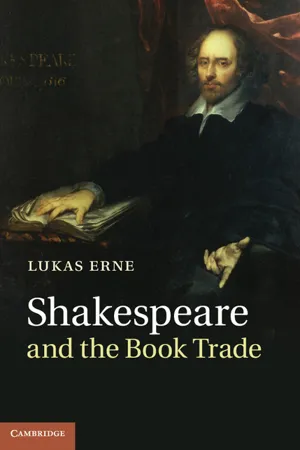 eBook - PDF
- Lukas Erne(Author)
- 2013(Publication Date)
- Cambridge University Press(Publisher)
The makeup of Shakespeare’s books – ‘what size, what kind and quality of paper, what typeface, what kind of title-page, what Paratext’ – was shaped by the economic imperatives of publishers who counted on the saleability of such books for their livelihood. 2 1 ‘Morphology and the Book from an American Perspective’, 4. 2 Taylor, ‘Making Meaning Marketing Shakespeare 1623’, 59–60. 90 Gérard Genette has defined Paratext as a ‘zone between text and off-text, a zone not only of transition but also of transaction: a privileged place of a pragmatics and a strategy, of an influence on the public’. 3 For publishers, Paratext is the locus in which they can intervene between producer and receiver, between author and potential reader, to make of the potential reader a customer. ‘Whatever you do, buy,’ Heminge and Condell urge in their prefatory address in Shakespeare’s First Folio. In one sense, it is the chief role of all Paratext to do the same. 4 Most of us now read Shakespeare in modern editions which precisely conceal the Paratextual features and bibliographic makeup of the books in which Shakespeare’s plays and poems were first disseminated. The makeup of today’s Shakespeare books carries no less cultural meaning than did that of their early modern counterparts, although the meaning has undergone substantial change, in keeping with the change in status of ‘Shakespeare’ since the early modern period: erudite introductions and annotation reflect classic status; insertion in prestigious series (the Arden Shakespeare; the Oxford Shakespeare in the World’s Classics series) indicates canonical prestige; the omnipresence of Shakespeare’s name and iconic representa- tions bespeak their saleability. The makeup of Shakespeare’s early modern books includes none of these features. Shakespeare books were different cultural objects in his time from what they are today, reflecting Shakespeare’s different status then from what it is now. eBook - PDF
The Late-Career Novelist
Career Construction Theory, Authors and Autofiction
- Hywel Dix(Author)
- 2017(Publication Date)
- Bloomsbury Academic(Publisher)
To put this another way, Genette uses the term ‘intimate’ Paratext when writ-ing about the addressee of a text even in cases where the text ostensibly lacks an addressee and is given rather towards authorial introspection. The intimate Paratext is the one the author addresses to himself, sometimes through the workaday materials associated with the business of being an author such as dia-ries, journals and research notes, and sometimes by developing a new portrait of himself in fiction. This iterative process has the effect of relativizing our notions of completion and finality: ‘the work and the oeuvre are always to a greater or lesser extent in progress’ and ‘the cessation of this labour, like death itself, is always to some degree accidental’. 11 Genette’s method in Paratexts is of an inductive (as opposed to deductive) sci-entific nature. It is a form of classification that starts by identifying as many dif-ferent varieties of Paratext as possible at the theoretical level, and then searching Intimate Paratexts 93 93 for examples of texts (primarily, though not exclusively, fictional) which instan-tiate each variety. In other words, the method behind Paratexts is based not so much on the observation of known textual phenomena as on the creation of theoretically postulated categories for which observable textual examples may or may not exist in practice. Having set up all those categories he then uses them for two different purposes. One is to classify the examples of Paratexts he has observed during the course of his reading and research. The other is to make predictions by way of scientific hypotheses for kinds of textual Paratexts that could exist in theory without his having identified particular examples of them in practice. In turn, the undiscovered examples might be undiscovered because they exist only in texts with which he is unfamiliar, or because no such examples have yet been written.
- Patrycja Podgajna(Author)
- 2021(Publication Date)
- Peter Lang Group(Publisher)
Palimpsests (1997a) and Paratexts (1997b)� In his book Palimpsests, Genette introduces a general poetics of “transtextuality” 4 with five textual categories: intertextuality, Paratextuality, metatextuality, hypertextuality and architextuality (Palimpsets 1)� In his taxonomy, inter- textuality is no longer dependable on prior cultural codes, but becomes a 4 According to Gérard Genette, transtextuality is “all that sets the text in relation- ship, whether obvious or concealed, with other texts” and it “covers all aspects of a particular text” (Palimpsests 1)� It constitutes a more comprehensive and inclusive concept than intertextuality� eBook - PDF
Against a Sharp White Background
Infrastructures of African American Print
- Brigitte Fielder, Jonathan Senchyne, Brigitte Fielder, Jonathan Senchyne(Authors)
- 2019(Publication Date)
- University of Wisconsin Press(Publisher)
Creating an anthology, then, has meant not only picking which texts to include but also producing a Paratextual apparatus that can hold all those collected texts together. This apparatus includes footnotes, tables of contents, endorsements, section headings, contextual prefaces to individual entries, and visual accompaniments to explain and justify why the anthology is shaped the way it is. There is thus a deep archive of Paratexts connected with the practice of canon formation performed by anthologies, and while it is impossible for me to engage with the entirety of that archive—indeed, one could write a whole essay on only The Norton Anthology of African American Literature, for example—I turn to a select few examples in order to mine Paratexts for the ways these texts perform in relation to law and history. In particular, I mine prefaces and introductions, since these Paratextual elements functionally come before the “body” of the anthology as a whole, defining the inflection of the “text(s) proper” that follow(s). In this way, prefaces are like pre- fixes in language, a grammatical and functional relation I explore with the tools of performance studies as I try to understand how anthologization might be a meeting point between postblack discourse and critical discourse on the law. Adusei-Poku begins her essay with the line, “Blackness was and is en vogue in the beginning of the twenty-first century, not only in popular culture but also in the arts,” and I follow her lead, as well as the precedent set by Touré’s emphasis on contemporaneity in the subtitle to his popular book, Who’s Afraid of Post-Blackness: What It Means to Be Black Now, by asking, what does it mean in this
Index pages curate the most relevant extracts from our library of academic textbooks. They’ve been created using an in-house natural language model (NLM), each adding context and meaning to key research topics.

