Physics

Medical Tracers
Medical tracers are substances used in medical imaging to track the distribution and behavior of specific molecules within the body. These tracers are often labeled with a radioactive or fluorescent tag, allowing them to be detected and visualized using imaging techniques such as PET scans or fluorescent microscopy. Medical tracers play a crucial role in diagnosing and monitoring various medical conditions.
Written by Perlego with AI-assistance
Related key terms
1 of 5

12 Key excerpts on "Medical Tracers"
 eBook - PDF
- Joseph D. Bronzino, Donald R. Peterson, Joseph D. Bronzino, Donald R. Peterson(Authors)
- 2014(Publication Date)
- CRC Press(Publisher)
1987. Physics in Nuclear Medicine. New York, Grune & Stratton. Steigman, J. and Eckerman, W.C. 1992. The Chemistry of Technetium in Medicine. Washington, National Academy Press. Stocklin, G. 1992. Tracers for metabolic imaging of brain and heart: radiochemistry and radiopharmacol-ogy. Eur. J. Nucl. Med. 19: 527. 14.2 Instrumentation Thomas F. Budinger 14.2.1 Background The history of positron-emission tomography (PET) can be traced to the early 1950s, when workers in Boston first realized the medical imaging possibilities of a particular class of radioactive substances. It was recognized then that the high-energy photons produced by annihilation of the positron from positron-emitting isotopes could be used to describe, in three dimensions, the physiologic distribution of “tagged” chemical compounds. After two decades of moderate technological developments by a few research cen-ters, widespread interest and broadly based research activity began in earnest following the development of sophisticated reconstruction algorithms and improvements in detector technology. By the mid-1980s, PET had become a tool for medical diagnosis and for dynamic studies of human metabolism. Today, because of its million-fold sensitivity advantage over magnetic resonance imaging (MRI) in tracer studies and its chemical specificity, PET is used to study neuroreceptors in the brain and other body tissues. In contrast, MRI has exquisite resolution for anatomic (Figure 14.4) and flow studies as well as unique attributes of evaluating chemical composition of tissue but in the millimolar range rather PET MRI FIGURE 14.4 The MRI image shows the arteriovenous malformation (AVM) as an area of signal loss due to blood flow. The PET image shows the AVM as a region devoid of glucose metabolism and also shows decreased metabo-lism in the adjacent frontal cortex. This is a metabolic effect of the AVM on the brain and may explain some of the patient’s symptoms. eBook - ePub
- Frank Rösch(Author)
- 2016(Publication Date)
- De Gruyter(Publisher)
Tobias L. Ross and Frank Roesch12Life sciences: Nuclear medicine diagnosis
Aim: Molecular imaging in nuclear medicine uses radionuclides attached to relevant molecules in order to illuminate ongoing biological, biochemical or physiological processes on-line, noninvasively and as quantitatively as possible. In order to register the radiation originating from the radiolabeled molecule (then named “tracer”), electromagnetic emissions are needed – in this case photons. The photons are created either by de-excitation of excited nuclear states as a consequence of a primary transition in terms of emission of a single photon, or following a primary positron emission with subsequent annihilation. This defines the tomographic technology used for imaging, i.e. single photon emission computed tomography (SPECT) or positron emission tomography (PET), respectively.This chapter introduces the concept of a radiotracer. It identifies the photonemitting radionuclides of interest. The great opportunities provided by molecular imaging using radiopharmaceuticals are exemplified for the quantitative measurement of energy consumption in the human body, which is the glucose consumption in terms of g per ml and minute. This is achieved by synthesizing and utilizing an 18 F-labeled glucose analog: 2-deoxy-2-[18 F]fluoroglucose, 2-18 FDG.Next, the different chemical approaches to attach these radionuclides to different biomolecules are introduced for covalent 11 C-, 18 F-, and 123 I-labeling as well as for coordinative chemistry needed for e.g. 99m Tc and 68 Ga, 111 In, etc. radiometal labeling.Finally, the most relevant clinical concepts are highlighted for noninvasive diagnosis in patients.12.1Introduction
Molecular imaging is a general approach contributing to addressing two fundamental question of life: What does a certain molecule “do” in the human body, i.e. what kind of biochemical process is it involved in? This question significantly contributes to the principle understanding of how life “works”. One of the most impressive aspects is to “see” how signal transduction proceeds in the living human brain. Once the role of a certain molecule is understood: Could a radiolabeled version of the molecule be used to report on the current status of a biochemical and physiological process for an individual human? If the current status is affected by a disease, the approach will provide diagnostic information. Finally, this will hopefully have consequences for the treatment of that disease. eBook - ePub
- Suzanne Amador Kane, Boris A. Gelman(Authors)
- 2020(Publication Date)
- CRC Press(Publisher)
By taking successive images a fixed time apart, changes of the radioactive tracer’s distribution over time also can be measured quantitatively. The time behavior of the tracer molecule in the body can be mathematically modeled, allowing physicians to extract the rate of important physiological processes. For example, scans of the kidneys and urinary tract can determine how effectively radionuclides introduced into the bloodstream are properly filtered out and excreted. The filtration rate of the radioactive tracers gives a measure of kidney function for detecting blockages, monitoring the organs’ general health, or seeing whether transplanted organs are working properly.These procedures can provide a lower-cost alternative to more expensive imaging techniques such as MRI. A large signal for imaging can be achieved with extremely small amounts – typically billionths of a gram – of the radiolabeled tracer. Since these minute amounts correspond to concentrations too small for drug activity, the radiopharmaceuticals do not affect body function, although they still must meet federal standards for drug purity and safety. Chapter 7 addresses in more detail how to determine safe levels for the radiation doses resulting from radionuclide imaging.6.5 Emission Tomography with Radionuclides: SPECT and PETA major drawback of radionuclide imaging with a gamma camera is that it only offers a single projection of the body’s structures, rather than giving a three-dimensional picture. Every point on the gamma camera image corresponds to an entire line within the person being imaged (Figure 6.7a ). Radionuclides at many different depths within the body cause only one detector above to respond. This means that planar gamma camera images contain no depth information, and so cannot resolve overlapping structures. This also means that the shape of a structure can be very unclear in a gamma camera image (Figure 6.7 eBook - PDF
- Anthony B. Wolbarst, Robert G. Zamenhof, and William R. Hendee(Authors)
- 2006(Publication Date)
- Medical Physics Publishing(Publisher)
The essential characteristic of a good agent is that it be organ- or compartment-specific, preferably with a differential uptake between normal and pathologic tissues; it must also be readily attachable to a suitable radionuclide (preferably Tc-99m), non-toxic, etc. 106 ADVANCES IN MEDICAL PHYSICS – 2006 Figure 4–5. Positron emission tomography (PET). Two positron annihilation photons travel from the site of the electron-positron col- lision in opposite directions. For them to trigger both detectors in coincidence, they must have originated simultaneously and at a point somewhere along the line between them. By keeping track of many such photon pairs, the spatial distribution of a radiophar- maceutical in the brain can be imaged. To help with anatomic interpretation, the PET information is now almost always superim- posed on a rendering of the subject’s brain, obtained separately with CT or MRI. There are a number of processes by which agents distin- guish among and concentrate in particular organs. Reticu- loendothelial cells recognize minute (0.1 mm), radiolabeled sulfur colloid particles as being foreign objects, for example, and remove them from the bloodstream through phagocyto- sis; this allows imaging of the liver, spleen, and bone marrow. Similarly, examination of perfusion of the blood vessels of the lungs is made possible through a temporary capillary blockade of a small fraction (about 0.1%) of the fine pul- monary vessels by radioactively tagged macroaggregated albumin (MAA); these microscopic lumps of protein, slightly larger than erythrocytes, break down soon thereafter, and are flushed out of the lung. Pulmonary ventilation, on the other hand, can be examined through compartment filling of the lungs with Xe-133 gas, say, or an aqueous mist of Tc- 99m–labeled particles.
- Darin D. Dougherty, Scott L. Rauch, Jerrold F. Rosenbaum, Darin D. Dougherty, Scott L. Rauch, Jerrold F. Rosenbaum(Authors)
- 2008(Publication Date)
- American Psychiatric Association Publishing(Publisher)
The collimators are generally made of lead and contain thousands of small holes. These holes have a small diameter so that only photons that are traveling in a relatively parallel trajectory may pass through to the detector. The data that do reach the radiation de- tectors are constructed into an image by means of to- mographic techniques similar to those used for PET studies. Many photons are deflected or filtered out and thus do not reach the detector, and it is this cir- cumstance that is responsible for the limited sensitiv- ity of SPECT. Radiopharmaceuticals In essence, a radiopharmaceutical is any molecule in- volved in a biological process of interest that can be effectively coupled with a radionuclide. For example, H 2 O or CO 2 can be labeled with 15 O to be used as a marker of blood flow, fluorodeoxyglucose can be la- Table 3–2. Radionuclides used in SPECT studies Radionuclide Half-life 99m Technetium 6.0 hours 123 Iodine 13.0 hours 133 Xenon 5.3 days Note. SPECT=single photon emission computed tomography. Figure 3–2. Basic components of a single-photon imaging system. NaI=sodium iodide; PM=photomultiplier; PHA=pulse height analyzer. Source. Reprinted from Fischman AJ, Alpert NM, Babich JW, et al.: “The Role of Positron Emission Tomography in Pharmacoki- netic Analysis.” Drug Metabolism Review 29(4):923–956, 1997. Copyright 1997, Marcel Dekker, Inc. Used with permission. Position logic circuits X-Position signal Y-Position signal PHA Computer Collimator Nal crystal Patient Image PM tubes Energy information 78 ESSENTIALS OF NEUROIMAGING FOR CLINICAL PRACTICE beled with 18 F to measure glucose metabolism, and a number of radionuclides can be used in the synthesis of radiopharmaceuticals that bind to different neuro- receptors. Both PET and SPECT studies can be used to study dynamic processes by sequential imaging fol- lowing the introduction of the radiopharmaceutical of interest.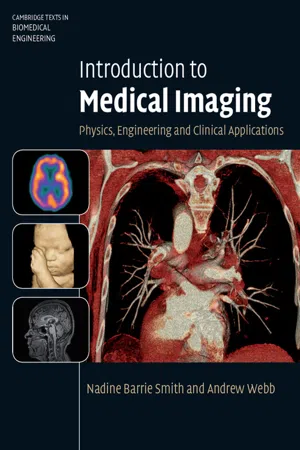 eBook - PDF
Introduction to Medical Imaging
Physics, Engineering and Clinical Applications
- Nadine Barrie Smith, Andrew Webb(Authors)
- 2010(Publication Date)
- Cambridge University Press(Publisher)
3 Nuclear medicine: Planar scintigraphy, SPECT and PET/CT 3.1 Introduction In nuclear medicine scans a very small amount, typically nanogrammes, of radio-active material called a radiotracer is injected intravenously into the patient. The agent then accumulates in specific organs in the body. How much, how rapidly and where this uptake occurs are factors which can determine whether tissue is healthy or diseased and the presence of, for example, tumours. There are three different modalities under the general umbrella of nuclear medicine. The most basic, planar scintigraphy, images the distribution of radioactive material in a single two-dimensional image, analogous to a planar X-ray scan. These types of scan are mostly used for whole-body screening for tumours, particularly bone and meta-static tumours. The most common radiotracers are chemical complexes of techne-tium ( 99m Tc), an element which emits mono-energetic c -rays at 140 keV. Various chemical complexes of 99m Tc have been designed in order to target different organs in the body. The second type of scan, single photon emission computed tomography (SPECT), produces a series of contiguous two-dimensional images of the distribution of the radiotracer using the same agents as planar scintigraphy. There is, therefore, a direct analogy between planar X-ray/CT and planar scintig-raphy/SPECT. A SPECT scan is most commonly used for myocardial perfusion, the so-called ‘nuclear cardiac stress test’. The final method is positron emission tomography (PET). This involves injection of a different type of radiotracer, one which emits positrons (positively charged electrons). These annihilate with elec-trons within the body, emitting c -rays with an energy of 511 keV. The PET method has by far the highest sensitivity of the three techniques, producing high quality three-dimensional images with particular emphasis on oncological diagnoses. eBook - PDF
- Raymond Taillefer, Iraj Khalkhali, Alan D. Waxman, Hans J. Biersack, Raymond Taillefer, Iraj Khalkhali, Alan D. Waxman, Hans J. Biersack(Authors)
- 2021(Publication Date)
- CRC Press(Publisher)
4 Breast Imaging with Positron Emission Tomography HANS BENDER, HoLGER PALMEDO, and HANS J. BIERSACK University of Bonn, Bonn, Germany AxEL SCHOMBURG Roentgeninstitut. Dusseldorf. Germany I. INTRODUCTION A. Historical Background Positron emission tomography (PET) is a cross-sectional, nuclear medicine imag- ing technique that provides functional images of the body (e.g., by visualization of metabolic processes, expression of transporters, receptors, etc.). PET combines a series of characteristics/abilities that could not be realized in standard nuclear medicine applications: 1. Quantitation: While gamma rays can not be focused like visible light, the collimator technology allows a sufficient but limited substitute. The major limitation is due to the fact that gamma rays can not be stopped but only attenu- ated. By this way, the assumed volume of an imaged lesion is related to the accu- mulated activity. Thus, the higher the accumulated activity within a defined vol- ume, the larger it appears on the display unit. 2. Resolution: The above-mentioned physical limitation of single-gamma ray imaging does not only limit true/accurate volume estimates but also limits the resolution of the system. In addition, deeply located and small lesions are signifi- cantly masked by attenuation and scatter, while the detected size seems to increase with the distance of the object from the collimator. 3. Production of biologically identical tracers: Certain positron emitters (1 1 C, ' 5 0, 13 N) are the building blocks of organic compounds as they are used in 147 148 BENDER ET AL. living organisms. Substitution of the stable isotope by its radioactive form allows the production of biologically identical substances, which are substrate and tracer of a pertaining and highly specific metabolic pathway at the same time. eBook - PDF
Reviews Of Accelerator Science And Technology - Volume 2: Medical Applications Of Accelerators
Volume 2: Medical Applications of Accelerators
- Alexander Wu Chao, Weiren Chou(Authors)
- 2009(Publication Date)
- World Scientific(Publisher)
The advent of clinical PET for cancer diagnosis makes use of sophisticated tracers to unravel cancer biology. 4.2. Radionuclides for imaging Nuclear medicine imaging differs from other types of radiological imaging, in that the radiotracers used in nuclear medicine map out the function of an organ system or metabolic pathway and, thus, imaging the concentration of these agents in the body can reveal the integrity of these systems or pathways. This is the basis for the unique infor-mation that a nuclear medicine scan (described in Table 3) provides with various scanning proce-dures for the various organ/functional systems of the body. Table 3. Typical radioisotopes and their uses for imaging. Radioisotope Half-life Uses Technetium-99m 6 h derived from 99 Mo parent 66 h Used to image the skeleton and heart muscle, in particular; but also for the brain, thyroid, lungs (perfusion and ventilation), liver, spleen, kidneys (structure and filtration rate), gall bladder, bone marrow, salivary and lachrymal glands, heart blood pool, infection and numerous specialist medical studies. Cobalt-57 272 d Used as a marker to estimate organ size and for in vitro diagnostic kits. Gallium-67 78 h Used for tumor imaging and localization of inflammatory lesions (infections). Indium-111 67 h Used for specialist diagnostic studies, e.g. brain, infection, and colon transit studies. Iodine-123 13 h Increasingly used for diagnosis of thyroid function, it is a gamma emitter without the beta radiation of 131 I. Krypton-81m 13 s from 81 Rb 4.6 h 81m Kr gas can yield functional images of pulmonary ventilation, e.g. in asthmatic patients, and for the early diagnosis of lung diseases and function. Rubidium-82 65 h Convenient PET agent for myocardial perfusion imaging. Strontium-92 25 d Used as the “parent” in a generator to produce 82 Rb. Thallium-201 73 h Used for diagnosis of coronary artery disease and other heart conditions, such as heart muscle death and for location of low-grade lymphomas. eBook - PDF
Radiochemistry and Nuclear Chemistry
2nd Edition of Nuclear Chemistry, Theory and Applications
- Gregory Choppin, Jan-Olov Liljenzin, Jan Rydberg, JAN RYDBERG(Authors)
- 2016(Publication Date)
- Butterworth-Heinemann(Publisher)
Later, after discovery of induced radioactivity, de Hevesy and Chiewitz in 1935 synthesized 32P (ß~ tyn 14.3 d) and used this tracer in biological studies. In the same year de Hevesy and co-workers also carried out activation analyses on rare 239 240 Radiochemistiy and Nuclear Chemistiy earths. Despite the demonstration of the value of the tracer technique by these early studies the technique did not come into common use until after World War II when relatively large amounts of radionuclides became available through the use of nuclear reactors. While it is not necessary to use radioactive isotopes for tracer studies, in general, the use of radioactivity is simpler and less expensive than the use of stable isotopes. Research with the latter requires rather sophisticated and expensive measuring devices such as mass spectrometers, cf. §2.3.2. We restrict our discussion to the use of radioactive tracers. Among the advantages of using radiotracers we can list the following: (a) radiotracers are easy to detect and measure with high precision to sensitivities of 1016 to 106 g; (b) the radioactivity is independent of pressure, temperature, chemical and physical state; (c) radiotracers do not affect the system and can be used in nondestructive techniques; (d) if the tracer is radiochemically pure, interference from other elements is of no concern (common in ordinary chemical analyses); (e) for most radioisotopes the radiation can be measured independently of the matrix, eliminating the need for calibration curves. 9.1. Basic assumptions for tracer use In some experiments answers to scientific questions which require knowledge of the presence and concentration of a specific element or compound at a certain place and at a certain time can be obtained only through the use of a radioactive tracer. For example, self diffusion of metal ions in solutions of their salts cannot easily be studied by any other technique. eBook - PDF
- Andrew Webb(Author)
- 2022(Publication Date)
- Wiley-IEEE Press(Publisher)
An example of a nuclear medicine study using both of these 99m Tc-labeled agents is shown in Figure 3.18. 3.10 Positron Emission Tomography The second major modality used in a nuclear medicine department is PET, which is the most sensitive in vivo imaging technique for studying metabolism and physiology. The fundamental difference between PET and SPECT is that the injected radiotracer used in PET emits a positron (a positively charged electron) rather than a γ-ray. This positron travels a short distance (∼1 mm) in tissue in a random direction before annihilating with an electron. This annihilation results in the formation of two γ-rays, each with an energy of 511 keV, which travel in opposite directions at an angle of almost exactly 180 ∘ with respect to one another. e + + e − → 𝛾 + 𝛾 114 3 Nuclear Medicine (a) (b) Figure 3.19 (a) Two γ-rays produce signals in two detectors, thereby defining a line along which the source of radioactivity must be located. (b) By analyzing the time difference between the arrival of each γ-ray, time-of-flight (TOF) PET improves the event localization along this line. A higher timing resolution translates into higher effective sensitivity due to improved localization of each event. Since two “anti-parallel” γ-rays are produced, and both are detected, a PET sys- tem consists of a complete ring of detectors (scintillation crystals) surrounding the patient, as shown in Figure 3.19. Since the two γ-rays are created simultaneously, both are detected within a certain time-window (the coincidence time), the value of which is determined by the diameter of the detector ring and the location of the radiotracer within the body. The location of the two crystals which detect the two anti-parallel γ-rays defines a line-of-response (LOR), along which the annihilation must have occurred, as shown in Figure 3.19a. This process of line-definition is referred to as annihilation coincidence detection (ACD). eBook - ePub
- Andrew Webb(Author)
- 2022(Publication Date)
- Wiley-IEEE Press(Publisher)
- (ii) Scan time is relatively long, approximately 20–30 min. Patient preparation is also quite long, since there needs to be significant time between radiotracer injection and imaging in order for the radiotracer to accumulate in tissue,
- (iii) Injection of even a small amount of radioactivity is an invasive procedure.
(a) Schematic of a three‐camera SPECT scanner and (b) associated brain scan from an injected 99 Tc‐labeled radiotracer. (c) Schematic of one ring of a PET scanner and (d) PET scan of the brain showing the uptake of injected 18 F‐deoxyglucose.Figure 3.1The two main nuclear medicine techniques are single‐photon emitted computed tomography (SPECT ) and positron emission tomography (PET ). Both of these modalities are integrated with a CT scanner, which provides both an anatomical image overlay and images which can be used to correct for the attenuation of radioactivity within the body, which improves quantitation. Figure 3.1 a shows the basic principles and instrumentation for SPECT/CT. The particular radiotracer accumulates in a specific organ and radioactive decay produces γ‐rays, which are emitted in all directions. A collimator is placed between the patient and the detector, so that only γ‐rays which have a trajectory close to 90° to the detector‐plane are recorded. In each detector (there are usually either two or three), a large scintillation crystal converts the energy of the γ‐rays into light. These light photons are in turn converted into an electrical signal by photomultiplier tube s (PMT s). Newer systems use solid state scintillators for direct conversion of γ‐ray energy into electrical signals. After a sufficient number of γ‐rays have been detected, the detectors are rotated to the next position, and data acquisition continues. After full sampling, iterative reconstruction methods very similar to those described in the previous chapter are used for image reconstruction. Figure 3.1 eBook - PDF
Radioisotopes
Applications in Bio-Medical Science
- Nirmal Singh(Author)
- 2011(Publication Date)
- IntechOpen(Publisher)
This new guideline prompted the pharmaceutical industry to identify and quantify drug metabolites in humans in the early phases of drug development. In microdose studies PK data are obtained after administration of a trace subpharmacologic quantity to human subjects (Lappin et al., 2006). The ultrasensitive analytic technique of accelerator mass spectrometry (AMS) has been used to quantify the low plasma concentrations anticipated after microdose administration. These studies do not provide information about the safety and tolerability of the drug. Requirements for microdose studies have been summarized by the EMEA, FDA and others (EMEA, 2003; FDA, 2006; Bergstrom et al., 2003; Marchetti et al., 2007). 3. PET imaging 3.1 Principles of PET PET is a nuclear imaging technique used to map biological and physiological processes in living subjects following the administration of positron emitting radiopharmaceuticals. The technique is based on the detection of photons released by annihilation of positrons emitted by radioisotopes. Positron-emitting radionuclides are produced in a cyclotron by bombarding target material with accelerated protons. In the body, these radionuclides emit positrons that undergo annihilation with nearby electrons, resulting in the release of two photons. These so-called annihilation photons are detected by imaging and the resulting data can be used to reveal the distribution of the radiotracer in the body. Unlike conventional imaging modalities, such as magnetic resonance imaging (MRI) or computed tomography (CT), which mainly provide detailed anatomical images, PET can measure biochemical and physiological aberrations that occur prior to macroscopic anatomical signs of a disease, such as cancer (Chen et al., 2011). Currently, many positron emitting isotopes are available with different characteristics (see Table 1).
Index pages curate the most relevant extracts from our library of academic textbooks. They’ve been created using an in-house natural language model (NLM), each adding context and meaning to key research topics.
