Politics & International Relations

John Maynard Keynes
John Maynard Keynes was a British economist whose ideas revolutionized economic theory and policy. He is best known for his advocacy of government intervention in the economy to mitigate the effects of economic recessions and depressions. Keynesian economics, which emphasizes the role of aggregate demand in driving economic activity, has had a profound impact on economic policymaking worldwide.
Written by Perlego with AI-assistance
Related key terms
1 of 5


7 Key excerpts on "John Maynard Keynes"
 eBook - ePub
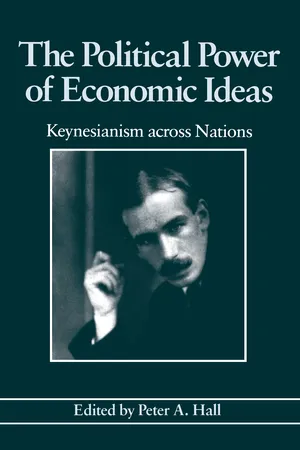
The Political Power of Economic Ideas
Keynesianism across Nations
- Peter A. Hall, Noam Lupu(Authors)
- 2020(Publication Date)
- Princeton University Press(Publisher)
This chapter uses the case of Keynesian ideas to address such questions. Its purpose is to develop a broad view of the factors that conditioned the progress of Keynesian ideas from theoretical expression to implementation as policy and to identify the historical elements that rendered Keynesianism more influential in some nations than others. The analysis proceeds in three stages. In the section that follows, I distinguish three dimensions of Keynesian thought: Keynes’ reformulation of fundamental economic concepts, his contribution to a new view of the activist state, and his specific proposals for countercyclical demand management. I argue that each dimension of Keynesian thought became influential in a different way. We can learn much from this case about the multiple roles that ideas play in the political world. Next, I present an overview of the considerations influencing policy makers’ judgments about Keynesian ideas. This overview is designed to summarize some of the most important points made in preceding chapters in this book. The policy makers’ response to Keynesian ideas seems to have been conditioned not only by the economic viability of those ideas, but by their administrative and political viability as well. Finally, I turn to the problem of explaining why Keynesian ideas about demand management acquired influence over policy in some national settings but not in others. Four kinds of factors seem to have affected the influence of Keynesian proposals: the orientation of the governing party, the structure of the state and state-society relations, the nature of national political discourse, and the events associated with World War II.THE INFLUENCE OF KEYNESIAN IDEAS
John Maynard Keynes was one of the most imaginative thinkers of our century. Even the ideas associated with The General Theory, on which this book focuses, were multifaceted; and, like many doctrines, his did not have to be accepted in toto to be accepted at all. Moreover, there were many dimensions to Keynesian thought and each became influential in a different way. At the risk of some oversimplification, we can say that there were at least three dimensions to Keynesian doctrine.7First, Keynes introduced a new set of concepts into macroeconomic analysis based on the balance between aggregate demand and supply. These were the ideas later integrated by John Hicks and others into what is usually termed the “neoclassical synthesis.”8 They ultimately revised the very terms through which economists saw the macroeconomy.Second, Keynes also provided a rationale for more active government management of the economy. Keynes broke with classical views of the polity and economy as separate spheres and with the related view that the market economy was fundamentally stable or likely to function best when free from state intervention. By arguing that private markets were inherently unstable but susceptible to correction through discretionary government action, Keynes provided a powerful justification for increased state intervention in the economy and contributed to a redefinition of the accepted boundaries between the public and private spheres in society.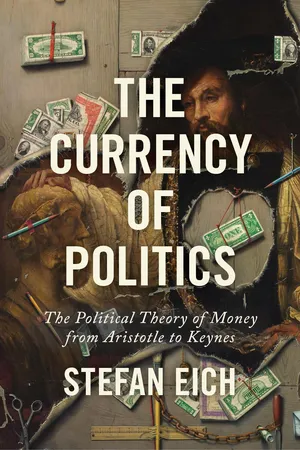 eBook - ePub
The Currency of Politics
The Political Theory of Money from Aristotle to Keynes
- Stefan Eich(Author)
- 2022(Publication Date)
- Princeton University Press(Publisher)
General Theory further deepened the repercussions of this revisionist understanding of money by extending it to the rest of the productive realm, in the process inverting the existing theory of production as a special case to be actively brought about rather than to be taken for granted. Monetary policy and an appreciation for the constitutional quality of the monetary system did not disappear from these considerations, but they were now tied to a supplementary role for fiscal policy as well as a comprehensive call for the socialization of the level of investment with the ultimate goal of reducing the return on rentier capital to zero.Despite his critique of the gold standard and his pathbreaking articulation of national macroeconomic policy during the 1930s, Keynes nonetheless shared a keen sense of economic internationalism as well as an appreciation of the liberal desirability of economic depoliticization. Even where he sought to recover the lost need to manage money by placing it anew on a constitutional footing, he remained at the same time acutely attuned to the challenges that democratic politics could pose for monetary and fiscal steering, which after all relied on expertise over opinion. Keynes was keenly aware of both sides of the argument: of the vision of money as a political institution whose naturalistic pretentions had to be stripped away in the search for political justification, and of Lockean arguments insisting on the need to remove money from direct political interference. In order to reconcile the insights of these seemingly incompatible positions, Keynes proposed a distinct kind of constitutionalization of money, both domestically and internationally.
- J. E. King(Author)
- 2015(Publication Date)
- Edward Elgar Publishing(Publisher)
77 7 Why it all matters: economic policy Post Keynesian politics Keynes was never greatly interested in economic theory for its own sake, and instead regarded economics as a policy science, or perhaps as an art. Post Keynesians share these practical concerns, and have developed a distinctive approach to both the targets and the instru- ments of macroeconomic policy. Thus their views on a very wide range of economic policy questions differentiate them very clearly from the mainstream, and they have not forgotten the classic advice of Jan Tinbergen (1956): make use of at least as many policy instruments as you have policy targets, but do not attach specific instruments rigidly to particular targets. Post Keynesians advocate four targets, or policy objectives: full employment; a low but positive inflation rate; a fair distribution of income and wealth; and financial stability. The third and fourth objec- tives are entirely ignored by the mainstream, and the first features only indirectly, through the gap between actual and potential output; a specific numerical unemployment target is rarely mentioned. Accordingly, Post Keynesians need a significantly wider range of policy instruments than the mainstream (Arestis 2013). I shall discuss these instruments under five headings: monetary policy; fiscal policy; prices and incomes policy; international economic policy issues; and environmental policies. First, however, something needs to be said about politics. Do Post Keynesians really share a common political position? I think it would be generally agreed that, as a general rule, they are left of centre, more so today than previous generations were. (The political centre has, of course, shifted a long way to the right in the last 40 years.) Keynes him- self was – to a rather limited extent – a man of the left, though just how far to the left remains a matter of contention. His biographer refers approvingly to Keynes’s “middle way” (Skidelsky 2009, chapter 7), and eBook - PDF
- Richard Mason(Author)
- 1994(Publication Date)
- Cambridge University Press(Publisher)
John Maynard Keynes simply do not know'. 4 This distinction and understanding permeated the whole of his economic reasoning, especially in relation to the formation of expectations, decisions concerning investment expendi- ture and the formation of portfolios, including the holding of money. In this Keynes was both drawing on and deepening greatly the tradition in which he was brought up and which he himself taught, Cambridge economics as dominated by Alfred Marshall. Marshall had a wide and detailed knowledge of 'mankind in the ordinary business of life' and he framed his own principles of economics so as to illuminate the behaviour of sensible people doing the best they could - as business people, as consumers, as workers - in environ- ments characterised by uncertainty. This led Shove to apply to Marshall, Wildon Carr's dictum that 'it is better to be vaguely right than precisely wrong' 5 - a dictum which is even more applicable to Keynes. Next, to stress the obvious, Keynes, as well as being an intellectual, was a deeply practical person, well versed in the ways of the world, wanting his philosophy and his economics to be applicable to practical issues of explanation and policy, and right behaviour. Robert Skidelsky has charted this development in his first two volumes of biography, showing how Keynes's friendships and experiences in the First World War brought this particular member of the Bloomsbury set from being a superbly clever (but perhaps too flippant, too brilliant) all-rounder to becoming a deeply serious and committed political economist. Keynes was outraged by the behaviour of the politicians at Versailles and determined to speak up for decent, humane values, not only because to do so was morally correct but also because it was intelligent Realpolitik as well. Keynes's system of thought started from observations on, and intuitions and conjectures concerning, reality as such. eBook - PDF
- R. Leeson(Author)
- 2010(Publication Date)
- Palgrave Macmillan(Publisher)
Nonetheless, the ‘agreement on the broad lines of both theory and policy [among contempor- ary economists] is the true measure of Keynes’ influence on modern economic thought’ (1952b, 177). During the rest of his period in Cambridge, Johnson’s contributions to mac- roeconomics centred largely around discussions of the revival monetary policy in Britain after November 1951 and its subsequent conduct, although there were by-products of his never-completed Harvard thesis on changes in British banking between 1930 and 1950. 8 These papers had an existence that was seemingly inde- pendent from his monetary theory. The only exception came in ‘Some General Aspects of Monetary Policy’, a paper delivered to the Association of University Teachers of Economics on 4 January 1954 (Box 33, Writing 1953). From a longer-term perspective, the most interesting section of the AUTE paper was the second where he started with the premise that ‘the post-War experience which has led to the revival of monetary policy emphasises certain shortcomings of the Keynesian analysis’ (8) which was worth examining even though ‘there can be no possibility of dismissing Keynesian theory as a temporary aberration of the 1930s’ (9). He also made what he regarded as ‘the obvious point’ that the Keynesian prejudice against monetary policy ... is less the work of Keynes himself ... than of some of his critics, and even more of those of his followers who did not share his expressed desire to save free enterprise from itself. (9) As he summarized his argument [T]he Keynesian theory tends to understate the scope for monetary policy, by imparting a spurious impression of precision and stability to the determina- tion of the level of income in the short run; while the theory of liquidity preference – which incidentally illustrates many of the disadvantages of the two-dimensional Marshallian tradition – is too narrowly conceived to provide an adequate approach to the theory of how monetary policy works. eBook - PDF
Keynes for the Twenty-First Century
The Continuing Relevance of The General Theory
- M. Forstater(Author)
- 2008(Publication Date)
- Palgrave Macmillan(Publisher)
In Keynes and international monetary relations, ed. A. P. Thirlwall. London: Macmillan. Keynes, J. M., 1971–1989. The collected writings of John Maynard Keynes (CWK). Ed. D. Moggridge. London: Macmillan, and New York: Cambridge Univer- sity Press, for the Royal Economic Society. CWK 7, The general theory of employment, interest and money. CWK 9, Essays in persuasion. CWK 13, The General Theory and after. Part I: Preparation. CWK 14, The General Theory and after. Part II: Defence and development. CWK 17, Activities 1920–1922: Treaty revision and reconstruction. KEYNES AND PERSUASION 39 CWK 23, Activities 1940–1943: External war finance. CWK 24, Activities 1944–1946: The transition to peace. CWK 25, Activities 1940–1944: Shaping the post-war world: The clearing union. CWK 26, Activities 1941–1946: Shaping the post-war world: Bretton Woods and reparations. Marcuzzo, M. C. 2002. The collaboration between J. M. Keynes and R. F. Kahn from the Treatise to The General Theory. History of Political Economy 34 (2): 421–47. ———. 2004. From market imperfections to market failures: Some Cambridge challenges to laissez-faire. Annals of the Society for the History of Economic Thought 45:1–10. Marcuzzo, M. C., and A. Rosselli. 2005a. Introduction. In Economists in Cam- bridge: A study through their correspondence, 1907–1946, ed. M. C. Marcuzzo and A. Rosselli. London: Routledge. ———, ed. 2005b. Economists in Cambridge: A study through their correspon- dence, 1907–1946. London: Routledge. Moggridge, D. 1992. Maynard Keynes: An economist’s biography. London: Rout- ledge. Pressnell, L. S. 2003. Keynes and wartime finance: A clarification. History of Political Economy 35:679–84. Robbins, L. 1932. An essay on the nature and significance of economic science. Lon- don: Macmillan. Sanfilippo, E. 2005. Keynes’s valuable opponent and collaborator: The corre- spondence between Keynes and Robertson. In Economists in Cambridge: A study through their correspondence, 1907–1946, ed. eBook - PDF
Maynard's Revenge
The Collapse of Free Market Macroeconomics
- Lance Taylor(Author)
- 2011(Publication Date)
- Harvard University Press(Publisher)
9 Keynesianism and the Crisis This chapter presents a Keynesian analysis of the crisis of 2007–2009 and its possible aftermath. With a little help from the rest of the book (passages from the other chapters, tables, and diagrams), it is largely self-contained. The macroeconomics created by Keynes and his closest followers pro-vides the only plausible path toward understanding the huge changes that engulfed the world economy in the latter part of the twentieth century. The neoliberal political economy that led into the crisis took shape in the 1970s and 1980s. Reasons why it broke down can be read from the data, with major shifts in behavior on the real and financial sides of the U.S. and global economies playing crucial roles. Redistribution of income and wealth among socioeconomic groups was especially important. In George Soros’s terminology introduced in Chapter 1, economic actors’ imperfect cognitive perceptions about the economic system combined with their limited ability to manipulate it to produce the near collapse of the neo-liberal system. Toward the future, cognition and manipulation will mutate in ways that are impossible to foresee. The political economy that emerges in the 2010s will differ markedly from the one in place during the late twentieth and early twenty-first centuries. At the level of mere macroeconomics, Keynes-ian principles are the only tools available to help guide the system through a fraught transition to a new regime whose nature is hidden by what Maynard called “the dark forces of time and ignorance which envelop our future” (7:155). Turning to the broad contours of history, the first part of the chapter is about long-term shifts from a political economic perspective. I then review 337 the major macroeconomic changes that took place after around 1980.
Index pages curate the most relevant extracts from our library of academic textbooks. They’ve been created using an in-house natural language model (NLM), each adding context and meaning to key research topics.

