Politics & International Relations

Libertarian Party
The Libertarian Party is a political party in the United States that advocates for individual liberty, free markets, and limited government intervention in people's lives. It was founded in 1971 and has since become the third-largest political party in the country. The party's platform includes issues such as gun rights, drug legalization, and non-interventionist foreign policy.
Written by Perlego with AI-assistance
Related key terms
1 of 5

4 Key excerpts on "Libertarian Party"
 eBook - PDF
- Alexander Moseley(Author)
- 2007(Publication Date)
- Continuum(Publisher)
CHAPTER 6 LIBERTARIANISM Standing on the edge of anarchy with its full expression of freedom but not desiring to give up government entirely is libertarianism. The libertarian ideal of maximal individual freedom with a minimal state has long been part of political philosophy, although rarely has it been a dominant ideology either in mainstream thinking or in popular culture. We hear liberalism’s echoes concerning the inherent dignity of the individual or the freedom to live life as the individual chooses, and certainly libertarianism is most intimately connected to the moral and political primacy of the individual. But it distinguishes itself from modern liberalism (sometimes calling itself classical lib-eralism), which it criticizes for being too statist and interventionist in presumption and prescription. Libertarianism emerged as a modern doctrine with the Leveller movement under John Lilburne in the seventeenth century, but its most influential time in history was in the late eighteenth to mid-nineteenth century. For many libertarians the American Constitution and the Bill of Rights stand as the political epitome of the libertar-ian ideal. The second half of the nineteenth century saw the classical liberal ideal give way to the emerging socialist and statist philoso-phies; two world wars promoted a resurgence of liberalism’s general ideals of freedom, especially in the human rights movements and the free trade doctrine of the postwar global institutions. Elements of it certainly rise to the fore every now and again in domestic politics, when voters believe that government is overstepping its legitimate boundaries in enforcing statist policies or prohibiting or curtailing individual rights. The driving force behind political libertarianism is self-ownership, from which all other rights are deduced. ‘Every man has Property in 82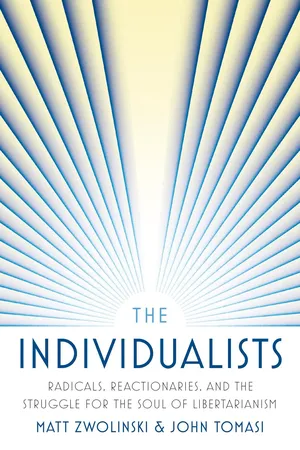 eBook - ePub
The Individualists
Radicals, Reactionaries, and the Struggle for the Soul of Libertarianism
- Matt Zwolinski, John Tomasi(Authors)
- 2023(Publication Date)
- Princeton University Press(Publisher)
In its strict sense, libertarianism refers to a radical political view which holds that individual liberty, understood as the absence of interference with a person’s body and rightfully acquired property, is a moral absolute and that the only governmental activities consistent with that liberty are (if any) those necessary to protect individuals from aggression by others. Strict libertarianism emerged as a radicalized form of classical liberalism in the middle of the nineteenth century in the work of theorists such as Herbert Spencer, Fr é d é ric Bastiat, and Lysander Spooner. But the term “libertarian” is also used—sometimes by libertarians themselves and almost always in public discussions of libertarianism—in a broad sense to refer to anyone within what we have called the Liberty Movement: that loose group of intellectuals and activists united in their support of the broad goals of free markets and limited government. Friedrich Hayek, for example, is not a strict libertarian due to his philosophical methodology (broadly Humean and empiricist) and his policy positions (moderate and not radically anti-statist). But he is a libertarian in the broad sense. Murray Rothbard, by contrast, is a libertarian in both senses of the term. “Classical liberalism” likewise varies in common use, referring to both a historical and a contemporary ideology. In the former sense, it denotes a view developed in the sixteenth through nineteenth centuries by figures such as John Locke, David Hume, and John Stuart Mill. That view, as we have seen, adheres to a strong but defeasible presumption of liberty and holds this presumption to impose strict (but not radical) limits on the proper scope of government eBook - ePub
Selfish Libertarians and Socialist Conservatives?
The Foundations of the Libertarian-Conservative Debate
- Nathan W. Schlueter, Nikolai G. Wenzel(Authors)
- 2016(Publication Date)
- Stanford Economics and Finance(Publisher)
CHAPTER TWO What Is Libertarianism? NIKOLAI G. WENZEL IT IS USEFUL FOR ME TO PAINT A PICTURE of the contemporary American political landscape before I define libertarianism.Years ago, I examined a chart of presidents under Mexico’s one-party dictatorship of the Institutional Revolutionary Party (Partido Revolucionario Institucional, or PRI), which ruled the country for roughly seventy years. The presidents in this chart veered from left to right and back, all within one party. From the libertarian perspective, the United States has lapsed into similar political seesawing within one de facto party, the “Republicrats.” George W. Bush, who rode into the White House as a free-market–leaning “compassionate conservative,” gave us the biggest nonmilitary increase in spending since Lyndon Johnson’s Great Society. Jimmy Carter, a “man of the people,” has also been dubbed the greatest free-market economist in the twentieth century, for leading (or allowing) the successful deregulation of trucking, airlines, and telecommunications. Barack Obama has blithely continued with the corporate welfare and failed drug war he inherited from his predecessor. Deficits and unfunded mandates soar.A back-of-the envelope calculation indicates that at least 60 percent of federal spending today is not authorized by the Constitution (if you have any doubt about this, compare the enumerated powers of Article 1, Section 8, with actual spending). Instead of constitutional constraint, we have big government. The national debt now stands at more than 100 percent of annual production (as Margaret Thatcher famously (if perhaps apocryphally) quipped, “The problem with socialism is that, eventually, you run out of other people’s money to spend”). Governments at all levels directly control about half of national economic activity (if we consider that 40 percent of gross domestic product (GDP) is made up of government spending at all levels, to which we can add another estimated 10 percent of GDP in compliance costs or stifled economic activity due to the tens of thousands of pages of regulations that are churned out every year).1 eBook - PDF
- Jacob H. Huebert(Author)
- 2010(Publication Date)
- Praeger(Publisher)
Thanks in part to prodding by so-called ‘‘left-libertarians’’ who empha- size these points, libertarians do not rush to the defense of big business or extol business leaders’ virtues to the extent they once did. 1 Another theme we have emphasized is that libertarianism is only a political philosophy, and is only concerned with aggression against peaceful people. This point seems critical to libertarians’ success because, as Ron Paul emphasized in his campaign, ‘‘freedom brings people together.’’ Libertarianism does not require anyone to alter his or her views on religion, lifestyles, charity, or anything else. It only requires people to agree to disagree peacefully about such issues. America may have the strongest libertarian tradition of any country, but it also has a strong Puritan streak (which eventually became its so-called ‘‘Progressive’’ streak), which seeks to use government to reform others. 2 If liberty is to tri- umph, Americans’ libertarianism will have to overcome their Puritanism. Another important theme is that libertarianism today is both radical and pop- ulist. During the 1980s and 1990s, the movement’s public face trended in the opposite direction. Well-funded Washington, DC think tanks obtained a modicum (but only a modicum) of Establishment respectability by downplaying certain taboo issues (money, drugs, war) and pitching ‘‘public policy’’ solutions to the Washington elite. This strategy reached its pinnacle of ‘‘success’’ when the Bush Adminis- tration briefly embraced the idea of supposedly ‘‘private’’ social security accounts by 240 Conclusion proposing a program (long urged by the Cato Institute and others) that would have allowed Americans to put a portion of their Social Security contributions into indi- vidual accounts, investing the money in stocks and bonds. Many libertarians outside Washington criticized this proposal for two main reasons.
Index pages curate the most relevant extracts from our library of academic textbooks. They’ve been created using an in-house natural language model (NLM), each adding context and meaning to key research topics.

