Politics & International Relations

Sinn Féin
Sinn Féin is an Irish republican political party that advocates for the reunification of Ireland and has historically been associated with the Irish Republican Army (IRA). It has evolved from a fringe party to a major force in Irish politics, particularly in Northern Ireland. Sinn Féin's platform includes policies on social justice, Irish language rights, and anti-austerity measures.
Written by Perlego with AI-assistance
Related key terms
1 of 5
7 Key excerpts on "Sinn Féin"
- E. Tannam(Author)
- 1998(Publication Date)
- Palgrave Macmillan(Publisher)
In the traditional school of thought, consent is not a necessary condi- tion for the achievement of a united Ireland. Protestant permission to attain unification is not necessary. Consequently, traditional national- ism in Northern Ireland legitimates the right to use force to achieve the aim of Irish unity. The Sinn Fein party is best described as a hybrid of traditional nation- alism and socialism. Sinn Fein has its headquarters in Dublin and has elected representatives in both Donegal and Dundalk in the Republic. However, its main support base is in Northern Ireland and, conse- quently, it is best treated as a Northern Irish party. Sinn Fein is com- monly perceived to be the political wing of the IRA, although recently the party has, arguably, detached itself more from the IRA's activities. Sinn Fein was banned until 1974. In that year, it was legalised. The Brit- ish aimed to encourage paramilitary supporters to relinquish arms in favour of constitutional politics. As it turned out, Sinn Fein leaders did not believe that violent and constitutional politics had to be mutually exclusive activities. In their heady days of the early 1980s, when the H- Block hunger-strikers increased Sinn Fein's support, the policy of the ballot-box and the Armalite was announced by Danny Morrison at the Sinn Fein Ard-Fheis (annual conference) with the chilling explanation that 'while not everyone can plant a bomb, everyone can plant a vote' (Arthur and Jeffrey, 1988, p. 40). In the 1993 local elections, Sinn Fein increased its vote share. How- ever, support for Sinn Fein has generally waned since 1983, despite its self-confident entrance into the constitutional arena. This factor, com- bined, perhaps, with the party's exclusion from the Anglo-Irish all-party talks, produced an alteration in Sinn Fein's policy towards the use of violence in the early 1990s (Chapter 2). eBook - ePub
- Jonathan Tonge(Author)
- 2013(Publication Date)
- Polity(Publisher)
5The Politics of Sinn Fein ————The most remarkable feature of Northern Ireland politics in recent decades has been the emergence of Sinn Fein as a strong political force. Since contesting elections in 1982, Sinn Fein has grown to be a formidable party, its role as IRA cheerleader replaced by a dominant position within the republican movement. This process has involved abandoning an ‘ourselves’ approach, based upon purist principles and political isolation, in favour of a more pragmatic approach which has shifted republican tactics and, more contentiously, principles.The representative of most nationalists in Northern Ireland, Sinn Fein has also become a significant party in the Irish Republic, capable of helping form a coalition government. Yet, although the party had briefly represented the will of the majority of the Irish people from 1918 to 1920, most of the subsequent period, a brief revival in the 1950s notwithstanding, had been marked by isolation and irrelevance. Accordingly, the formation of Provisional Sinn Fein in January 1970, pledging allegiance to the Irish Republic proclaimed in the rebellion of 1916, was not seen as a landmark at the time. The focus of attention had been the street disturbances of summer 1969, not internecine feuding within largely dormant Irish republican circles. The emergence of Provisional Sinn Fein followed the split in the IRA and, for the first decade of the Troubles, Sinn Fein’s primary role was to act as a support network and political cheer-leader for the PIRA. Sinn Fein’s role was unsurprising, given that the party, all but extinct by the 1940s, had come under direct IRA orders since 1948, a move that had rescued a party in desperate straits and at least given it a role as a ‘political ancillary’ to armed republicans (Feeney 2002: 189). As Sinn Fein was re-launched at the start of the 1970s, amid a deteriorating political situation, it remained subordinate, and was ‘looked down upon as the “poor relations” of the republican movement, containing those unable or unwilling to join PIRA’ (Danny Morrison, quoted in Feeney 2002: 260). Sinn Fein also had to operate underground, being banned as a political party by the British government, although this ban was lifted in 1974 in an attempt to steer republicanism in a more political direction.
- Eoin Ó Broin(Author)
- 2009(Publication Date)
- Pluto Press(Publisher)
But more important, and particularly since the 1960s and 1970s, is the belief that politics should not be reduced to the institutions of representative democracy. Contemporary Sinn Féin views politics as a popular process of engagement, empowerment and participation, of which the formal party structure is only a part. That Sinn Féin continues to refuse the privileging of elected repre-sentatives over non-elected activists is one manifestation of this. Through the century the themes of class, gender and nation have troubled republicans. For Griffith nationalist unity came before all else, including support for labour. For de Valera the imperative of nationalist unity was paramount, to the ultimate detriment of both gender equality and social and economic justice. Much of his social conservatism continued to influence Sinn Féin right through to the 1960s. However in different ways the three phases of post-1950s leadership represented by Goulding, Ó Brádaigh and Adams have attempted to grapple with these issues, with varying responses and degrees of success. For Goulding Marxism provided the basis for addressing all three. For Ó Brádaigh, federalism and Christian socialism provided the foundation. Since the 1980s Sinn Féin has evolved increasingly sophisticated discourses and mechanisms to address each in turn, although with less success that it clearly desired, to which I will return in the conclusion. Finally, in terms of impact, Sinn Féin is arguably the most important political organisation in modern Irish political history. The two major southern political parties, Fianna Fáil and Fine Gael, trace their origins to Griffith’s Sinn Féin, and the first 30 years of the southern state were based in large part on the political and economic policies of Griffith and de Valera.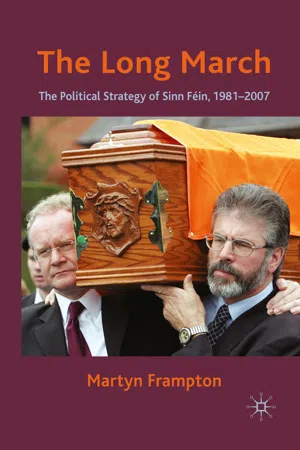 eBook - PDF
The Long March
The Political Strategy of Sinn Fein, 1981-2007
- M. Frampton(Author)
- 2016(Publication Date)
- Palgrave Macmillan(Publisher)
At the same time, Sinn Féin was evolving rapidly in this period and making itself ever more credible as a mainstream political party. The growing sophis- tication of its policy agenda, coupled with the respectability it had gained from its role in the peace process (and in the Northern Irish Executive), had ensured that the party could no longer be dismissed as being politi- cally lightweight. On the contrary, it had, not altogether fanciful, designs on establishing itself as the effective opposition in southern Irish politics and entering government there at some point in the not-too-distant future. Even so, Sinn Féin’s developing countenance as a potential ‘party of government’ 156 The Long March continued to be balanced by its self-image as a ‘party of protest’. With regards to the latter, an integral facet of the party’s identity continued to be the notion that it offered something different to the other major political parties in the Republic of Ireland. The success of this Janus-faced political appeal, when operating in the favourable environment created by the peace process, was such that in the 2004 European elections, Sinn Féin captured over 11 per cent of the vote in the Republic of Ireland. This, for a party that only seven years previously had won less than 3 per cent of the national vote, was no mean achievement. In addition, the same electoral contest saw Mary Lou McDonald elected as Sinn Féin’s first MEP in the Republic. 148 Simultaneously, Bairbre de Brun won the party’s first ever European seat in Northern Ireland. 149 The sym- bolism of this dual victory, in the only elections to be held concurrently in both jurisdictions, was undoubtedly not lost on the republican leadership; for it appeared to signify the ever-upward trajectory of both Sinn Féin and its political project. eBook - ePub
- Robert Mitchell Henry(Author)
- 2010(Publication Date)
- Perlego(Publisher)
There is hardly a writer in Ireland to-day of any promise in either prose or verse who does not owe a heavy debt to the work of the Gaelic League. The Gaelic League proceeded upon the assumption that Irishmen possessed and ought to possess an interest in the language of their own country. It did not argue the point or indulge in academic discussions upon the utility of Gaelic as a medium of communication or upon the psychology of language. Its simple appeal to a natural human feeling found a response wider than could have been evoked by a learned controversy or effected as the fruit of a dialectical victory. But language is only a part of nationality and the attachment of a human being to the language of his country is only a special case of his attachment to the nation. This, though the Gaelic League held aloof from all politics (in the narrow sense of the word), is what gave to the work of the Gaelic League a real political importance. The stimulation of national sentiment in one department gave a stimulus to the same sentiment in other departments, and the new and vigorous national sense which it fostered was bound to lead sooner or later to expression in political action. But even after this political activity began to be manifest, the League confined itself to its original work, and held as much aloof from politics infused by its own spirit as from the forms of political action which held the field when its work began. Sinn Fein is an expression in political theory and action of the claim of Ireland to be a nation, with all the practical consequences which such a claim involves. It differs from previous national movements principally in the policy which it outlines for the attainment of its ultimate end, the independence of Ireland: though it should be understood that nearly every point in the Sinn Fein political programme had been at least suggested by some previous Irish Nationalist thinker eBook - PDF
Party Politics in a New Democracy
The Irish Free State, 1922-37
- Mel Farrell(Author)
- 2017(Publication Date)
- Palgrave Macmillan(Publisher)
Therefore, by the time Sinn Féin sat down to negotiate CHAPTER 1 Introduction: The Politics of Independent Ireland © The Author(s) 2017 M. Farrell, Party Politics in a New Democracy, Palgrave Studies in Political History, DOI 10.1007/978-3-319-63585-9_1 4 M. FARRELL a workable solution, capable of reconciling British imperialism and Irish national aspirations, feelings had hardened. Failure to deliver satisfactory terms would cause those who had borne the brunt of the guerrilla cam- paign to ask if this was ‘what we fought for’? 1 What is now universally accepted as an Irish revolution, defined as a quest for political independence rather than significant social change, 2 had, after all, been about fundamentals. While the pre-war British gov- ernment had been willing to grant Home Rule to Irish nationalists, secession from the United Kingdom was a step further than it was pre- pared to go. In 1912, Home Rule leader John Redmond was in alliance with Liberal Prime Minister H.H. Asquith. By 1921, the new Liberal Prime Minister David Lloyd George led an unstable coalition domi- nated by the Conservatives, a party committed to the union of Great Britain and Ireland. Preserving Northern Ireland’s right to remain in the United Kingdom, and securing the continued allegiance of Ireland to the crown and empire, was of fundamental importance to the Conservatives. By the time Sinn Féin representatives met the British at the negotiating table in October 1921, the two sides were at polar opposites: the crown and empire on one end and Sinn Féin’s isolated republic on the other. What solution, then, could reconcile two posi- tions that were so fundamentally opposed? More importantly, what compromise could Sinn Féin make while still preserving the unity of the revolutionary movement? If part of Ireland was to leave the United Kingdom, the British would require that it formally join the self-gov- erning dominions of the empire: Australia, Canada, New Zealand and South Africa.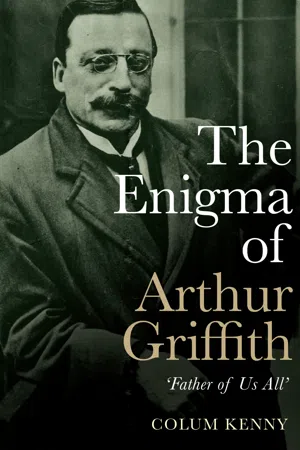 eBook - ePub
The Enigma of Arthur Griffith
‘Father of Us All’
- Colum Kenny(Author)
- 2020(Publication Date)
- Merrion Press(Publisher)
United Irishman in 1900 was not yet convinced that Irish youth was up to it, writing paradoxically ‘Self-help alone deserves exterior aid and Irish manhood is in such a rudimentary stage that it knows scarce how to help itself.’16 In 1902 nationalists in Co. Meath launched a short-lived review entitled Sinn Féin , which trumpeted the words ‘Sinn Féin, Sinn Féin, amháin’ that the paper reported having seen on a banner in Dublin at the Gaelic League’s ‘Imtheachta an Oireachtais’ cultural gathering.17When the United Irishman closed in 1906, following a libel action by a priest, Griffith named its immediate weekly successor Sinn Féin . Through this he promoted Sinn Féin policies such as those urging the withdrawal of Irish MPs from Westminster and the appointment of Irish consuls abroad, the latter policy being endorsed by the first Dáil in 1919 when adopting its ‘democratic programme’.Aodh de Blacam in 1921 neatly described Sinn Féin as ‘the impulse of the new generation’:Initially, Sinn Féin was not a party: it was the amorphous propaganda of the Gaelicised young men and women. The principles of this journalistically-united Intelligentsia might be well summed up in Bishop Berkeley’s famous query: ‘Whether it would not be more pertinent to mend our state than to complain of it; and how far this may be in our power ?’ [Italics in original]18The Green Hungarian BandThe great majority of voters, when the franchise was more restricted than it would be for the election of 1918, chose Irish MPs who sought only limited Irish self-government, or ‘Home Rule’, within the United Kingdom. Griffith was more ambitious. He recalled that Ireland had appeared to prosper in the decades prior to the Act of Union of 1800 when it and Britain each had a separate parliament under the same king and when that Irish parliament became assertive. The model of king, lords and a house of commons with greater powers than those envisaged under ‘Home Rule’ appealed to this Dubliner, who saw around him the continuing effects of an industrial and administrative decline and urban decay that had followed the abolition of the Irish parliament. Sovereignty in substance, rather than the form of a republic over a monarchy, was his priority. After all, had not Parnell been styled ‘the uncrowned king of Ireland’, not the president-in-waiting? Thus it was that Griffith’s Resurrection of Hungary in 1904 earned him a reputation to this day of being a monarchist. For he proposed in it a relationship between Britain and Ireland based loosely on that between Austria and Hungary, two countries that shared one crown. His economic ideas in the pamphlet derived from those of the German economist Frederick List (1789–1846). He also admired the Hungarian statesman Ferenc Deák. His argument was strategic, using the Austro-Hungarian example like he did the example of Grattan’s and Flood’s pre-Union Irish parliament in order to galvanise political support as best he could in the circumstances of his time. He ‘mythologised or simplified both for distinctly presentist purposes’, as Kelly recently observed.19
Index pages curate the most relevant extracts from our library of academic textbooks. They’ve been created using an in-house natural language model (NLM), each adding context and meaning to key research topics.

