Politics & International Relations

The Personal is Political
"The Personal is Political" is a feminist slogan and concept that highlights the interconnectedness of personal experiences and larger political structures. It emphasizes that individual experiences, such as relationships, family dynamics, and personal choices, are influenced by and have implications for broader social and political systems. This perspective encourages the recognition of personal experiences as important political issues and motivates individuals to engage in activism and social change.
Written by Perlego with AI-assistance
Related key terms
1 of 5

9 Key excerpts on "The Personal is Political"
 eBook - ePub
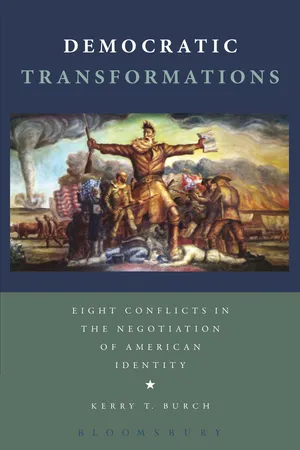
Democratic Transformations
Eight Conflicts in the Negotiation of American Identity
- Kerry T. Burch(Author)
- 2012(Publication Date)
- Continuum(Publisher)
CHAPTER EIGHT The Personal is PoliticalThe Personal is Political achieved iconic status in the late 1960s and 1970s as a defining symbol of the second wave of the American feminist movement. It is important to appreciate why these four simple yet incendiary words, strung together as a slogan, galvanized millions of feminists across the nation into a potent cultural and political force. At a practical level, the phrase lent thematic coherence to the idea that women were oppressed by dint of having to assume the heaviest burden of labor within the private domestic sphere—notably housework and childcare. Proceeding on this general theory, radical feminists declared that henceforth all of the oppressive hierarchies enacted on a daily basis in the private sphere, enactments which had eluded political scrutiny in the past, including issues pertaining to sexuality, would no longer be immune from critique and potential transformation.The Personal is Political thus encouraged feminists to critically theorize and challenge the interlocking web of hidden power relations characteristic of the patriarchal order. Carole Pateman discusses how this defining feminist insight worked to trouble the conventional boundaries separating public from private: “Feminists have emphasized how personal circumstances are structured by public factors, by laws about rape and abortion, by the status of ‘wife,’ by policies on child-care and the allocation of welfare benefits and the sexual division of labor in the home and workplace. ‘Personal’ problems can thus be solved only through political means and political action.”1 It should be noted that most feminist political theorists do not argue that the public/private distinction should be abandoned altogether. Rather most of these thinkers insist on radically reconfiguring the distinction by extending analyses of power relations to include the private domestic sphere; moreover, they contend that the fulfillment of democracy demands that they do so.2 eBook - ePub
Political Science in South Africa
The Last Forty Years
- Peter Vale, Pieter Fourie(Authors)
- 2016(Publication Date)
- Routledge(Publisher)
Thus today we discuss poverty not as a development issue, but as a security issue in the so-called security-development nexus which gained currency in the 1990s under the concept of human security, championed by the United Nations Development Programme (UNDP) (see, for example, the UNDP (1994), Human Development Report). When I follow the United Nations conferences on environmental security, sustainable development, HIV/AIDS, human rights and other non-traditional ‘hard politics’ issues, with the ease of cross border communications, it seems that there is a willing global audience even for those issues that were usually left to the domestic or totally ignored. These days, the corrective rape of black lesbians in South African townships has resulted in an international outcry from thousands of citizens across the world through various online petitions, pressuring the South African government to punish the perpetrators harshly. Zakaria in The Post-American World (2009) shows that the minute to minute broadcasting of everyday international life can give one the illusion that the world today is perhaps more violent than it was decades ago. This moment of the ‘international’ seems to be a noisy place that is difficult to escape. The feminist claim that if the ‘personal is the political’, then inevitably, the ‘personal is also international’, becomes difficult to challenge, whether you call it ‘globalisation’ or ‘interdependence’. But what does all that mean? Enloe argues that accepting that the personal is the international ‘multiplies the spectators … [in IR], it especially adds women to the audience, [it however] fails to transform what is going on stage’ (Enloe 1989, 196) (emphasis added). Enloe goes on to argue that ‘the implications of a feminist understanding of international politics are thrown into sharper relief when one reads ‘the personal is international’ the other way round: the international is personal eBook - ePub
The Provocation of Levinas
Rethinking the Other
- Robert Bernasconi, David Wood, Robert Bernasconi, David Wood(Authors)
- 2002(Publication Date)
- Routledge(Publisher)
.4. The Personal is Political: Discursive Practice of the Face-to-FaceNOREEN O’CONNOR
Introduction
The slogan ‘The Personal is Political’ constitutes a challenge to traditional notions of the human as political. Human rights theories, utilitarianism, contract theories, emotivist ethico-political theories retain the notion of interpretation as fundamental, thereby continuing the Aristotelian view of the relationship of man to the world—that is, the rational animal who has a capacity for political activity. What is stressed here is the notion of the individual who is fundamentally reasonable and through the exercise of his reason can direct his actions and be responsible for them. Justice is based on a notion of equality of persons and is to be achieved by the liberation of the person to be himself. The basic, operative assumption is that of a fixed, given, human essence or nature which can, in principle, be known.The model of the human construed as fundamentally rational self-consciousness is subject to numerous reversals, refutations and critiques by contemporary European philosophers; particularly by Marxists and post-structuralists. In this chapter I shall focus on two philosophers whom I consider to offer radical contestations to foundationalist, logocentric notions of the ‘human’ and ‘society’. Both Foucault and Levinas argue against the notions of the universality of reason, the unity of truth, the teleology of reason, time as gathered into ‘presence’, the human as self-conscious subject; positively, they stress disjunctions, differences, gaps, dispersions in time and knowledge which are refractory to unification or totalization. Philosophy, since Kant, has identified itself with transcendental reflection; that is, with the theme of origin and recuperation by which, as Foucault maintains, we avoid the differences of our present. Philosophy has avoided differences by focusing all questions on man’s being and in doing this neglected the analysis of practice.1 eBook - ePub
Ideologies in Action
Morphological Adaptation and Political Ideas
- Mathew Humphrey, David Laycock, Maiken Umbach(Authors)
- 2020(Publication Date)
- Routledge(Publisher)
The political is personal: an analysis of crowd-sourced political ideas and images from a Massive Open Online Course Mathew Humphrey, Maiken Umbach and Zeynep ClulowABSTRACT
The analysis of ideology at the vernacular level requires access to peer-to-peer political discussions amongst non-specialists. It is in these discursive exchanges that political views are articulated, refined, and revised. Such exchanges are, however, difficult for the researcher to capture. Here we take c.25,000 learner comments (along with several hundred image uploads) from a Massive Open Online Course, co-produced by the University of Nottingham and the British Library, as a source of such peer-to-peer political discussions. From five topics we have selected 'Freedom', 'Justice', and 'Community' for close analysis. The idea of 'freedom' generated by far the most learner discourse, being both positively appraised and highly personalized. 'Justice' was generally seen as something to be delivered by political institutions, although accounts of injustice were frequently personalised. Accounts of 'community' often focused on the trappings of nationhood, but some comments, and many images in particular, highlighted moments of ephemeral and more personal, self-chosen communities. Overall, both comments and images show that, in their interpretation of the conceptual vocabulary of politics, people frequently frame their understanding through personal experience in a very direct manner. It is not only true that the 'personal is political', but also, for many, that the 'political is personal'.Introduction
So freedom for all is not possible without politics, but nor is complete freedom possible with politics1The quote above is from a text in political thought. It is not however, a conventional work of political theory, but rather a comment from a learner on a 'massive open online course' (MOOC) on Propaganda and Ideology in Everyday Life, eBook - ePub
Breaking Out Again
Feminist Ontology and Epistemology
- Liz Stanley, Sue Wise(Authors)
- 2002(Publication Date)
- Routledge(Publisher)
personal appeal, or it means very little except as an intellectual exercise. But to what, we ask in something like despair, does ‘expert’ and abstract theorizing appeal? The answer, we are told, is that it appeals to the need to analyse in greater depth, and more sophistication, women’s liberation. But we don’t believe that such a form of analysis can do this because within it theory is provided ‘for us’ by an elite among feminists. This kind of work uses exceedingly conventional forms of analysis and constipated language, and by doing so it sets up a distinction between ‘theorists’, the elite, and the rest of us.In this chapter we examine these developments, and also some of our worries about them. We examine a number of arguments about the need to ‘get beyond’ the personal, whether into ‘real’ political action and more ‘effective’ feminism, or new theoretical developments. And then we take one example of this kind of theoretical work— ‘the family’ and its crucial role in feminist theory—and look at how our own personal experience as feminists in the gay movement and within a lesbian group demonstrate problems with current feminist thinking on this.THE PERSONAL IS THE POLITICAL—OR IS IT?
In the women’s movement of the 1960s the statement ‘the personal is the political’ was an axiom with crucial consequences, both for the ideology of the movement and also for its organization and practice. Both WLM organization and the political practice of feminism were seen to lie within the small group structure. In America these small groups contained within them a variety of activities and functions, but they also maintained a consistent style. This included a conscious lack of formal structure, emphasis on participation by everyone, a deliberate sharing of tasks, and the exclusion of men (Freeman, 1975; Jenkins and Kramer, 1978). And a very similar description of the small group in the British women’s movement, and of its use as a consciousness-raising device (Tufnell Park Group, 1972; Bruley, 1976), exists in pamphlets, articles and in a myriad of newsletters.The basic values of the small group structure aren’t confined to feminism alone. They are also those of other ‘new left’ movements, emphasizing as they do participatory democracy, equality, liberty and community. They also include the idea that hierarchy is wrong, the belief that everyone should share equally in activities and tasks, and the insistence that any kind of leadership is bad. And so when we use the word ‘organization’ in relation to the WLM, we do so taking its adoption of these values into account.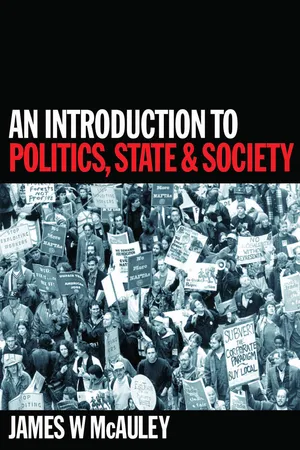
- James W McAuley(Author)
- 2003(Publication Date)
- SAGE Publications Ltd(Publisher)
This attempt to link macro variables with micro ones and to locate theoretical issues with actual events will be explored throughout the book. Politics and the struggle for power manifests and operates at different levels in society. Sociology involves the conceptualization and theorization of how power operates and is distributed in society. It also seeks to identify the key sources of power. This varies depending upon how power is understood but includes the ideological, economic, military and the political, dispersed through structures of class, gender, ethnicity, patriarchy, sexual orientation and so on. The individual and politics In every society individuals become acquainted with a political system in ways that often structure their reaction to political events and their perception of what politics is about. People, in this sense, have, at some level, to ‘learn’ what political issues and politics are. Most people live their lives sticking to their own political ideology, their own set of values, of understandings and beliefs. This is, of course, usually inconsistent over time, made up of a mixture of self-interest, self-evident ‘truths’, inconsistent or partially under-stood ideology, personalized reference points, life history experiences and interactions with other ‘politically’ motivated individuals, organizations and groups. One important starting point is the consideration of just how in any given society individuals learn what is, and what is not, political. Likewise, people must also come to understand what is, and what is not, of political relevance and importance at any particular time. It is possible to illustrate this, if we take the following two examples, separated by distance, but occurring at roughly the same time. The first reflects the experience of David Roediger as a boy growing up in the USA in the 1960s, the second that of John Boyd as a young Protestant living in Northern Ireland in the late 1950s. eBook - PDF
Just and Unjust Interventions in World Politics
Public and Private
- C. Lu(Author)
- 2016(Publication Date)
- Palgrave Macmillan(Publisher)
The discipline of International Relations has typically considered the majority of human beings in the world irrelevant to international life, as they were relegated to the private domestic jurisdiction of states. In the worldview spawned by Westphalia, states and their representatives are the insiders, the rest of humanity the outsiders. The freedom of states thus does not necessarily translate into freedom for individuals and groups within states, just as traditional conceptions of family privacy have not always translated into desirable forms of privacy for individuals, and especially women, within families. The resonance of feminist critiques of privacy in domestic relations with critiques of sovereignty as privacy in interna- tional relations leads us to re-examine the moral basis for states' public and private lives in international society. IV Caveats This discussion so far may allow one to agree with Jeff Weintraub that the public/private construct 'can neither be conveniently simplified nor usefully avoided,' in international as well as domestic political theoryY In the following chapters, I will explore how some prominent ethical perspectives understand the public/private construct at the international level, and the attendant implications for their under- standing of intervention as a moral problem in world politics. Before embarking on this exploration of the ethics of intervention and the public/private construct in world politics, it may be helpful to high- light some caveats. 28 Just and Unjust Interventions in World Politics Distinction and dichotomy To distinguish between 'public' and 'private' is to mark a difference between them. How are we to understand this difference in empirical and normative terms? Most obviously, when we distinguish between public and private agents, spheres, interests, activities or obligations, we are rejecting their conflation or complete identification. eBook - PDF
- Vanessa May, Petra Nordqvist, Vanessa May, Petra Nordqvist(Authors)
- 2019(Publication Date)
- Bloomsbury Academic(Publisher)
The core idea is a distinction between the more social, interacting with others, aspect of an individual and the more internal, reflecting, self. Let us, for the sake of simplicity, state this as a distinction between the person and the self. With this in mind, we can return to the idea of the social construction of personal life as discussed in the previous section. When we talk about the social construction of personal life we are arguing that personal life is differently organised and valued in different societies. In some cases they may even entail denying some individuals the status of ‘person’. This does not mean that individuals in such societies do not possess a sense of ‘self’. Looking at modern Western societies and restating some points made earlier, the following considerations are important: • Ideas of the person and personhood are strongly linked to ideas of human rights and democracy. One consequence of this is that there are constant debates about whether particular categories (children, prisoners, refu-gees, immigrants) should be allowed the status of full personhood. • Ideas of the personal are strongly linked to notions of ownership and choice. To say that ‘this is my personal opinion’, for example, is to state some degree of ownership of that opinion. • There is a heightened awareness of the distinction between the ‘per-son’ and the ‘self’. This is partially a consequence of increasing rates of social and geographical mobility and more complex divisions of labour. Under these circumstances it is possible to argue that the sets of others with whom we interact are too diverse and, often, too weakly connected to each other to provide a stable sense of personal identity. • At the same time there appears to be an increasing value placed upon the ‘real’ and ‘authentic’ self and an increasing desire to discover this by whatever means are available. eBook - ePub
- Vanessa May, Petra Nordqvist, Vanessa May, Petra Nordqvist(Authors)
- 2019(Publication Date)
- Bloomsbury Academic(Publisher)
This is not a complete list but points to some of the ways in which the personal is understood in modern societies. To say that the personal is socially constructed, therefore, is to say that there are social, historical, or cultural causes of these various ways in which the personal is understood and valued. But at all times it should be remembered that these distinctions are not fixed and are frequently subject to challenge and debate.Personal practicesThis chapter has explored some of the meanings associated with the word ‘personal’ and the links between these meanings and the way in which the idea of the person can be seen as being shaped by numerous social and cultural influences. It has also been argued that there are strong arguments in favour of seeing an individual as something more than an assemblage of roles.A possible source of the dissatisfaction with some versions of the social construction of personal life argument is that it is operating at a high level of abstraction. Notions such as democracy, choice, privacy, ownership and so on are ‘big’ words. They are no doubt influential and important but they seem far removed from, say, our example of the Australian suburban house-owner seeking to construct a living family environment. What needs to be done is to move from these public or scholarly discourses about personal life and to explore the actual practices of the personal. We need to see people in terms of all their actual interactions, past, present, and anticipated future, rather than simply in terms of more abstract categories or processes.In talking about ‘practices’, this chapter draws upon a wide range of social thought including symbolic interactionism, ethnomethodology, feminism, postmodern
Index pages curate the most relevant extracts from our library of academic textbooks. They’ve been created using an in-house natural language model (NLM), each adding context and meaning to key research topics.

