Politics & International Relations

The UN Security Council
The UN Security Council is a key international body responsible for maintaining global peace and security. Comprising 15 member states, including five permanent members with veto power, it has the authority to impose sanctions, authorize military action, and establish peacekeeping missions. The Security Council's decisions are binding on all UN member states, making it a central player in international relations.
Written by Perlego with AI-assistance
Related key terms
1 of 5

12 Key excerpts on "The UN Security Council"
 eBook - PDF
Palaces of Hope
The Anthropology of Global Organizations
- Ronald Niezen, Maria Sapignoli(Authors)
- 2017(Publication Date)
- Cambridge University Press(Publisher)
The new UNSC was to have five permanent member states with veto power: the United States, the UK, France, China and the USSR – the victors of World War II. The mandate is formalized in the UN Charter, which defines the responsibilities of the Security Council in relation to the maintenance of international peace and security. The Security Council consists of fifteen member states: the five permanent mem- bers, and the ten remaining seats to be chosen by the UN General Assembly. These ten seats consist of two-year membership with a status as elected member states. Each member has one vote. Resolutions are binding under international law; adoption requires nine votes or more if they include the votes of the five permanent 2 The Council’s rules of procedure are in fact provisional and have never been made permanent. Horseshoe and Catwalk 59 members. 3 The Council shall at the request of the Secretary-General determine whether there exists a threat to peace and security, and recommend solutions. Furthermore, the Security Council has the mandate to request member states of the UN to use military force or economic sanctions and other non-violent methods to stop an aggressor. It may also recommend new members and advise the General Assembly with regard to the election of a new Secretary-General. CONSENSUS-MAKING, PENHOLDERS AND INFORMAL PROCESSES At a meeting in one of the corner offices on the 40th floor of the Manhattan building that houses the Norwegian permanent delegation to the UN, I asked a Norwegian delegate about his views on Norway’s role in the Council. He started to talk about informal processes and channels, outlining the kinds of informal options the Norwegian mission could use in its work with the Security Council. Simply phoning delegates from other Council delegations or the lead country about a certain process was pointed out as an effective way of influencing a process even before it had actually been started. eBook - PDF
International Law, Power, Security and Justice
Essays on International Law and Relations
- Serge Sur(Author)
- 2010(Publication Date)
- Hart Publishing(Publisher)
Let us go beyond this in order to situate the Council in a larger histori-cal, political and institutional context. The Security Council occupies a cen-tral position in the overall UN system; indeed, the United Nations is constructed around the Security Council, which is in turn constructed around its five permanent members (the United States, the United Kingdom, France, Russia, and China)—who construct their own internal relations around their veto rights. Though some might deplore this as an institutional defect in need of repair, in reality the veto right represents one of the founding principles of the UN Charter. This is to say that there is * Previously published as Le Conseil de Sécurité: Blocage, renouveau et aveuir , (2004) 109 Pouvoirs 61–74. not now and never has been one United Nations Organization but rather several of them, or more specifically, several dimensions to the United Nations Organization. We can distinguish at least three UNs, sometimes operating not only apart from but also in opposition to each other: there is the UN of the General Assembly, which is the instrument of the small pow-ers; there is the UN of the Secretariat, directed by the Secretary-General, who alone is able to speak for and act on behalf of the entire UN; and then there is the UN of the Security Council, which is to say, the UN of the great powers. The best word to characterise the quality of relations between these three UNs is one that is used occasionally to describe French domestic politics, namely ‘cohabitation’.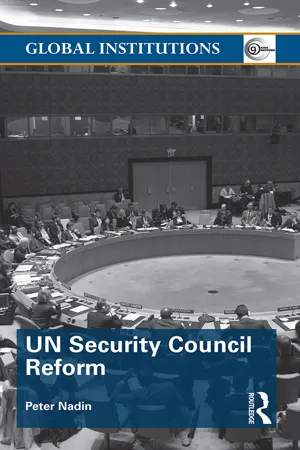 eBook - ePub
- Peter Nadin(Author)
- 2016(Publication Date)
- Routledge(Publisher)
The United Nations and Changing World Politics (Boulder, Colo.: Westview Press, 2010), 35.47 For the first time in forty years (Korean War), The UN Security Council authorized the use of force to repel an aggressor state.48 As well as issues previously considered to lie in the area of domestic jurisdiction. Article 2 (7).49 George Lopez and David Cortright, “Containing Iraq: Sanctions Worked,” Foreign Affairs (July/August 2004).50 In the non-proliferation space, the work of the Security Council exhibits a double standard: non-signatories to the nuclear non-proliferation treaty (NPT) India, Pakistan, and Israel all possess sizable nuclear arsenals, all of which have been developed without warranting the scrutiny of the Security Council.51 Normative and Cross-Cutting: Protection of Civilians in Armed Conflict (res. 1265), Women in Peace and Security (res. 1325), International Terrorism, Peace and Security in Africa (res. 1170), International Peace and Security, Children and Armed Conflict (res. 1261), AIDS and Peacekeeping (res. 1308), Peacekeeping (res. 1327), Strengthening Co-operation with Troop Contributing Countries (res. 1353), The Role of the Security Council in the Prevention of Armed Conflicts (res. 1366), Regional Organization Cooperation (res. 1631), Peacebuilding (res. 1645).52 Ian Johnstone, “Legislation and Adjudication in The UN Security Council: Bringing Down the Deliberative Deficit,” American Journal of International Law 102, no. 2 (2008): 275–308.53 Andrea Bianchi, “Assessing the Effectiveness of The UN Security Council’s Anti-Terrorism Measures: The Quest for Legitimacy and Cohesion,” European Journal of International Law 17, no. 5 (2007): 881–919.54 eBook - PDF
Counter-Terrorism Strategies in a Fragmented International Legal Order
Meeting the Challenges
- Larissa van den Herik, Nico Schrijver(Authors)
- 2013(Publication Date)
- Cambridge University Press(Publisher)
10 The role of The UN Security Council in relation to the use of force against terrorists sir michael wood Terrorism is one of the main contemporary threats to international peace and security. Perpetrators of terrorist acts undermine human rights, funda- mental freedoms and the rule of law, which are the pillars of international stability and of the action of the United Nations. The Organization plays a leading role in the fight against terrorism, which calls for a global response. 1 Given the importance of the UN collective security system and the Security Council’s primary responsibility for the maintenance of inter- national peace and security, and given both legal and political doubts concerning the unilateral use of force by states against terrorists, 2 it is important when states feel driven to take forcible measures against terrorist threats that they bear in mind the Security Council’s powers to take or authorize the use of force. 3 Collective action is almost always better than individual action, legally, politically and in terms of effective- ness. Collective decisions (or even non-decisions) are often wiser than those taken individually. The present contribution deals principally with the potential of the Council in this area, less with actual practice, which is sparse. 4 The aim is I wish to thank Eran Sthoeger for his valuable assistance. 1 Ban Ki-moon, preface, International Instruments related to the Prevention and Suppression of International Terrorism (New York: United Nations, 2008). For a fuller collection, see B. Saul (ed.), Terrorism (Oxford: Hart, 2012) (‘Terrorism Documents’). 2 See Chapters 11–13 in this volume; also L. Moir, Reappraising the Resort to Force: International Law, Jus ad Bellum and the War on Terror (Oxford: Hart, 2010). eBook - PDF
- R. Price, M. Zacher, R. Price, M. Zacher(Authors)
- 2004(Publication Date)
- Palgrave Macmillan(Publisher)
The remaining members of the international community did not formally enter into the deliberations until they were invited to attend the San Francisco conference in June 1945. In 1945 all conference participants recognized that the military great powers had to have major roles in the central UN security institution. If there were one thing that governments took from their analyses of the road to war in the 1930s, it was that the prevention and reversal of aggres- sive wars depended on the military strength and resolve of the great powers. However, there were some important differences among states over the voting rules of the Security Council to be composed of five permanent and six nonpermanent members. The central issue was the scope of the veto of the five permanent members (the P5) in the Council. The conference par- ticipants accepted that the passage of resolutions would require the approval of seven of the eleven members, but many wanted the veto to be limited to issues concerning the use of military force by the United Nations. The five designated permanent members all opposed this, and the Soviet Union stated it would not join the United Nations if there were a diminution in the proposed scope of the veto. The conference participants gave in to the strong stand of the designated five permanent members. 2 Some important provisions concerning the Security Council are the following: ● The 6 nonpermanent members (10 after 1965) are elected for two-year terms (Art. 23). ● Passage of resolutions requires approval of 7 of 11 members (9 of 15 after 1966), including no negative votes of the P5 (Art. 27). ● Decisions on procedural matters (especially the convening of meetings) require 7 of the 11 members (9 of 15 members after 1965). The veto does not apply to votes on procedural issues. However, a decision on what constitutes a procedural issue is subject to the veto (Art. 27).
- Mary Ellen O'Connell(Author)
- 2019(Publication Date)
- Cambridge University Press(Publisher)
In so doing the chapter builds on the previous one. Central to the discussion here, as in Chapter 2, is the prohibition on the use of force. The prohibition is the core substantive principle of the legal 10 See, e.g., E. C. Luck, ‘A Council for All Seasons: The Creation of the Security Council and its Relevance Today’, in V. Lowe et al. (eds.), The United Nations Security Council and War: The Evolution of Thought and Practice Since 1945 (Oxford: Oxford University Press, 2008), 61–85, 83–4; and S. D. Murphy, ‘The Security Council, Legitimacy, and the Concept of Collective Security After the Cold War’, Columbia Journal of Transnational Law, 32 (1994), 201–88, 204–6. 11 See notes 73–5 and accompanying text. 12 See the discussion in Chapter 6 of international legal process. 104 The Art of Law in the International Community regime of peace; The UN Security Council is the most powerful institution for preserving peace. 13 Maintaining the viability and legitimacy of institutions of any kind within the constraints of sub- stantive law is a structural challenge for every legal system. Some of the inherent contradictions of the Security Council make holding the Council to the law all the more difficult. The Charter empowers five UN member states with greater authority than all others in a legal system based on equality of states. The task of the Council is to maintain the peace, yet, its main power is to use military force. The very design of the Council implies that exceptionalism and militarism are acceptable, notions in tension with the prohibition on the use of force as jus cogens. The tension is reflected in the UK legal position on attacking Syria in April 2018. The tensions can be addressed constructively, however, when the rule of law in support of peace is given priority over competing principles. The peace regime does, in fact, need the Security Council, even with its flaws. eBook - ePub
Inside the United Nations
Multilateral Diplomacy Up Close
- Gert Rosenthal(Author)
- 2017(Publication Date)
- Routledge(Publisher)
On the final matter of improved working methods, the author found that decision-making was still heavily weighted in favor of the interests of the P5, but trending in a favorable direction towards more inclusion. For example, by 2012–2013, the P5 had pulled back considerably in their previous efforts to neutralize the working group on procedure and documentation, which was pushing for the advancement of innovations and best practices. Also, the custom of limiting the capacity of initiative to the permanent members, such as reflected in the figure of the “pen holder,” has gradually ceded somewhat to the elected members. During the author’s tenure on the Council, both Togo and Australia were “allowed” to become pen holders (on resolutions referring to Guinea-Bissau and Afghanistan, respectively), as was Guatemala on the Informal Working Group on International Tribunals, which dealt with the tribunals of ex-Yugoslavia and Rwanda. The practice of assigning elected members as “pen holders” was expanded during the period 2014–2015. The evolving content of the Working Methods Handbook is another positive example.Conclusion
There is little doubt that the Security Council is a flawed organ, just as there is little doubt that the United Nations is a flawed organization. Most of the serious challenges the Council faces are a result of decisions incorporated into the Charter, in contrast to other parts of the organization, where many of the challenges can be addressed, and even corrected without amending the Charter. It is also the organ where the tension between the common interests of all members and the national interests of the “major players” is most pronounced. Still, the Security Council continues to play an important role in addressing the ideal of the United Nations itself, which includes “saving succeeding generations from the scourge of war.” In that respect, in the absence of the Security Council a breakdown in the existing world order would become an even greater risk. It is probably due to that reason that member states are still eager to join the Council; in some of the regional groupings, countries have announced their candidatures for the early 2030s. Thus, the wider membership has faced the conundrum of “not throwing out the baby with the bath water” syndrome, in tolerating a flawed organ in order to conserve a noble and admirable ideal. eBook - PDF
China in UN Security Council Decision-Making on Iraq
Conflicting Understandings, Competing Preferences
- Suzanne Xiao Yang(Author)
- 2012(Publication Date)
- Routledge(Publisher)
The nature of Security Council decision-making This line of enquiry needs to be coupled with constant questioning of the viability of the notion of collective security and its utility in the post-Cold War era (and more recently the post-11 September 2001 world). No doubt the UN is important as a proclaimer of international standards providing an exemp- lary basis for the conduct of international relations (Roberts and Kingsbury 1993b: 21). Thus it is necessary to examine the constitutive and regulative roles of norms on individual state behaviour and their impact on policy. Nevertheless, states seldom agree as to when there is a breach of international peace and security that requires adoption of measures of collective security. In practice they tend to differ in deciding to what extent certain measures should be taken, be they economic sanctions, weapons inspections, use of force, humanitarian intervention, or others. Indeed, despite the aspirations to establish a new fra- mework of collective security, ‘unilateral national action, exclusive alliances, and spheres of influence, and balances of power, and all the other expedients’ have never ceased working in the UN. 21 Disparity exists not only between aspirations and reality but also between the norms themselves. There are fundamental tensions between some of the norms, such as between the norm of non-intervention and human rights, ter- ritorial integrity and self-determination. Competing norms and their inter- pretation become a battlefield for exercising power and influence and are often used to justify stark positions and actions. States never tire of using competing norms to attack the validity of a norm in contention, or in some 12 Introduction cases exploring the lack of specificity of a norm to leverage a better negotiating position, all to pursue their own interests and needs. These are most commonly seen in the General Assembly, but also in Security Council diplomacy and decision-making. eBook - PDF
Renegotiating the World Order
Institutional Change in International Relations
- Phillip Y. Lipscy(Author)
- 2017(Publication Date)
- Cambridge University Press(Publisher)
In sum, although voting power indices should be interpreted with some caution, it is abun- dantly clear that the UN dramatically boosted the formal authority of the permanent Council members compared to the League. Having established a structure that tilted the scales in their favor, the P5 also sought to diminish the credibility of outside options as a bargain- ing device in the United Nations. UN planners felt the “possibility of withdrawal would give recalcitrant members the opportunity of securing concessions from the Organization by threatening to leave it.” 88 Hence, procedures for withdrawal were omitted entirely from the Charter in order to reduce the leverage states could obtain through threats of exit. The voting rules of The UN Security Council heavily favor P5 members. At first glance, this suggests that weaker states, which were originally 86 Oneal, Russett, and Berbaum 2003. 87 E.g., Voeten 2008; Stone 2011. 88 Kelsen 1948, 29. 226 The League of Nations and the United Nations Security Council overrepresented in the League, would be deeply dissatisfied. This problem was remedied through the creation of specialized UN agencies that pro- vided economic and technical assistance to developing countries. The aid available from these institutions effectively reversed the burdens of mem- bership that had led underdeveloped League members, such as Costa Rica, to pursue exit. In addition, ambiguities concerning formal withdrawal from the UN have allowed status quo powers in the UN to threaten recalci- trant states with the severance of all benefits associated with UN member- ship, including assistance from agencies like the United Nations Development Programme (UNDP) and the Bretton Woods institutions. Finally, The UN Security Council has also diminished the attractiveness of outside options by establishing itself as the primary source for collect- ive legitimization in international relations. eBook - PDF
Collective Security
Theory, Law and Practice
- Nicholas Tsagourias, Nigel D. White(Authors)
- 2013(Publication Date)
- Cambridge University Press(Publisher)
5 The United Nations Introduction The United Nations is equated with peace and security, though its purposes are wider and include the promotion of human rights, self- determination, and economic and social development. 1 Nevertheless, it is the principal CS institution, with a universal membership and wide- ranging competence in peace and security and matching powers, includ- ing the ability to decide on non-forcible measures and authorise a variety of military actions ranging from consensual peacekeeping to full scale war-fighting. The UN has a strong diplomatic function, often channelled through the UN Secretary-General, 2 building on traditional forms of dispute settlement between states. The question this chapter attempts to address is how peace and security are protected by the UN as a CS institution, given that within the UN there are two types of CS – a ‘major power’ model in the SC, and a ‘representative’ model in the GA. It will be argued that although these visions are often seen as alternatives, the optimum (in terms of both effectiveness and justice) CS system is a combination of both models. Although the SC has ‘primary responsibility for the maintenance of peace and security’, 3 and is granted an impressive array of powers under Chapters VI and VII of the UN Charter, the GA has competence to make recommendations to the SC and to member states on ‘any questions or any matter within the scope of the present Charter’, 4 and thereby has secondary competence in matters of peace and security. As clearly stated by the ICJ in the Certain Expenses opinion, delivered in 1962, the ‘responsibility conferred’ on the Security Council is ‘primary’ and not ‘exclusive’, and the Charter ‘makes it abundantly clear’ that the GA is ‘also to be concerned with international peace and security’. 5 1 Article 1 UN Charter. 2 Reviewed in Chapter 8. 3 Article 24(1) UN Charter. 4 Ibid., Article 10. 5 Certain Expenses (1962), 163. 91 eBook - PDF
- John Merrills, Eric De Brabandere(Authors)
- 2022(Publication Date)
- Cambridge University Press(Publisher)
6; and Gray, Use of Force (n. 24) chs. 7 and 8 and A. Orakhelashvili, Collective Security, Oxford, 2011. 33 See White, The Law of International Organizations (n. 32) pp. 172–4. Also, J. K. Cogan, ‘Stabilization and the expanding scope of the Security Council’s work’ (2015) 109 AJIL 324. 359 Security Council and General Assembly in Action determination under Article 39 requires a political decision, the potential of Chapter VII may be neglected in some situations and exploited in others according to the particular circumstances. Once a determination under Article 39 has been made, it is open to the Security Council to make recommendations, or to decide what measures shall be taken in accordance with Articles 41 and 42 to maintain or restore international peace and security. Article 41 permits the employment of measures ‘not involving the use of armed force’ and is primarily concerned with economic sanctions. Although the intention behind this provision was to enable mandatory sanctions to be imposed on a delinquent state, in practice lack of agreement has often compelled the Security Council to call only for voluntary (i.e. non-obligatory) measures. These, as might be expected, are usually ineffective and demonstrate that, even when a situation is being considered under Chapter VII, political factors govern the ultimate decision. The Security Council’s power to impose military sanctions rests on Article 42 of the Charter, which authorises it to ‘take such action by air, sea or land forces as may be necessary to maintain or restore international peace and security’. Article 43 goes on to provide for member states to conclude agreements with the UN under which their forces will be available for use when needed. This arrangement would, in effect, have provided the UN with a standing army. In the event, however, such agreements were never concluded on account of East–West tensions. eBook - PDF
- Michael E. Brown, Michael Brown(Authors)
- 2018(Publication Date)
- Princeton University Press(Publisher)
The rationale for arms reductions, for control of arms transfers, and for nuclear nonproliferation efforts, all still need to be carefully examined and refined. This is especially impor- tant in view of the common fears that existing arms control arrangements are discriminatory—fears that could be exacerbated if the Security Coun- cil assumes a more central role in nonproliferation matters. CONCLUSION In recent years, the United Nations' role in security affairs has grown enormously, not only in scope, but also in type of activity and in complex- ity. In early 1993, Boutros-Ghali commented that "precedents are created in reality before theories gain consensus"; Goulding said that UN peace- keeping had been through a period of "forced development." 54 Can there be a coherent rationale for all this? The United Nations and International Security «231 For all its limitations, An Agenda for Peace contains a vision of what the United Nations' international security role might be. Although ac- knowledging that the United Nations will coexist with sovereign states for the foreseeable future, it suggests a full agenda for the United Na- tions—one that may well involve it deeply in wars, whether civil or international. In one of its few direct references to warfare, An Agenda for Peace confirms the strong moral sense of the UN's obligation to inter- vene: ". . . armed conflicts today, as they have throughout history, con- tinue to bring fear and horror to humanity, requiring our urgent involve- ment to try to prevent, contain, and bring them to an end." 55 This vision is defective in numerous respects. It makes too little allow- ance for the real differences of perspective among states and for their narrow and often competing interests. It contains little recognition of the sheer difficulty of some conflicts in which the United Nations is invited to intervene, and it fails to acknowledge the reluctance of states to get deeply involved in dangerous situations far from home.
Index pages curate the most relevant extracts from our library of academic textbooks. They’ve been created using an in-house natural language model (NLM), each adding context and meaning to key research topics.

