Psychology

Dorothea Dix
Dorothea Dix was a 19th-century activist who advocated for the humane treatment of individuals with mental illness. She played a significant role in the establishment of mental asylums and lobbied for improved conditions for the mentally ill. Dix's efforts contributed to the reform of mental health care in the United States and raised awareness about the importance of compassionate treatment for individuals with psychological disorders.
Written by Perlego with AI-assistance
Related key terms
1 of 5

3 Key excerpts on "Dorothea Dix"
 No longer available |Learn more
- David Sue, Derald Wing Sue, Stanley Sue, Diane Sue, David Sue, Derald Wing Sue, Diane Sue, Stanley Sue(Authors)
- 2020(Publication Date)
- Cengage Learning EMEA(Publisher)
Editorial review has deemed that any suppressed content does not materially affect the overall learning experience. Cengage Learning reserves the right to remove additional content at any time if subsequent rights restrictions require it. Historical Perspectives on Abnormal Behavior | 19 problems—all in an atmosphere of kindness. This emphasis on moral treatment laid the groundwork for using psychological means to treat mental illness. Indeed, it resulted in much higher rates of “cure” than other treatments of that time (Charland, 2007). In the United States, three individuals—Benjamin Rush, Dorothea Dix, and Clifford Beers—made important contributions to the moral treatment movement. Rush (1745–1813), widely acclaimed as the father of U.S. psychiatry, encouraged humane treatment of those residing in mental hospitals. He insisted that patients be treated with respect and dignity and that they be gainfully employed while hospitalized, an idea still evident in the modern concept of work therapy. Dorothea Dix (1802–1887), a New England schoolteacher, was a leader in 19th century social reform in the United States. At the time, people who were mentally ill were often incarcerated in prisons and poor-houses. While teaching Sunday school to female prisoners, she was appalled to find jailed mental patients living under deplorable conditions. For the next 40 years, Dix worked tirelessly on behalf of those experiencing mental disorders. She campaigned for reform legislation and funds to establish suitable mental hospitals. She raised millions of dollars, established more than 30 mental hospitals, and greatly improved conditions in countless others. But the struggle for reform was far from over. Although the large hospitals that replaced jails and poorhouses had better physical facilities, the humanis-tic focus of the moral treatment movement was lacking. Vincent Van Gogh benefited from the moral treatment movement.
- Tracy Henley(Author)
- 2018(Publication Date)
- Cengage Learning EMEA(Publisher)
Due to electronic rights, some third party content may be suppressed from the eBook and/or eChapter(s). Editorial review has deemed that any suppressed content does not materially affect the overall learning experience. Cengage Learning reserves the right to remove additional content at any time if subsequent rights restrictions require it. E A R LY C O N S I D E R AT I O N S O F M E N TA L I L L N E S S 467 they should never be on display to the public for the purposes of vulgar curiosity and amusement. Despite his many enlightened views, Rush still advocated bloodletting and the use of rotating and tranquilizing chairs. He believed that bloodletting relieved vascular congestion, that rotating relieved the patient’s congested brain, and that strapping a patient’s arms and legs in a so-called tranquilizing chair calmed the patient. Dorothea Lynde Dix Also in the United States, Dorothea Lynde Dix (1802–1887) in 1841 began a campaign to improve the conditions of the mentally ill. Unhappy home circumstances had forced Dix to leave her family before her teen years, and just a few years later she began her own career as a schoolteacher. Later, ill-ness caused her to give up her full-time teaching position and take a job instructing female inmates in a Boston prison. It became clear to Dix that many of the women labeled and confined as criminals actually had mental illnesses, and so Dix began her 40-year campaign to improve the plight of those with mental illness, traveling from state to state and pointing out their inhumane treatment. Within a three-year period, Dix visited 18 states and brought about institutional reforms in most of them. During the Civil War, Dix served as the Union’s superintendent of female nurses; after the war, she toured Europe seeking better treatment of people with mental illness. While in Europe, Dix visited with Queen Victoria and Pope Pius IX, convincing both that these patients were in dire need of better facilities and treatment.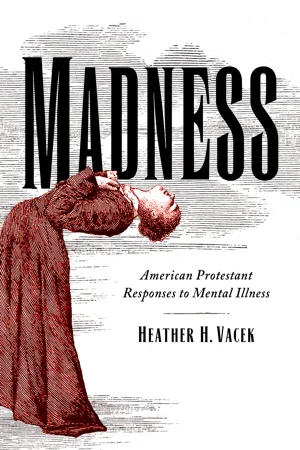 eBook - ePub
Madness
American Protestant Responses to Mental Illness
- Heather H. Vacek, Heather Campain Hartung(Authors)
- 2015(Publication Date)
- Baylor University Press(Publisher)
Whether the legislature was swayed by Dix’s testimony or simply by the numbers—the 1840 census had identified 978 lunatics in the state (229 housed at Worcester, 124 at the Boston Lunatic Hospital, so 625 lived without asylum treatment)—Dix viewed the approval as “a brilliant victory” proving that she was indeed “doing God’s work.” 152 Elated by her success with the legislature, Samuel Howe asserted that he could not “but be impressed with the lesson of courage and hope” that Dix had “taught even to the strongest men.” Horace Mann offered his thanks for her accomplishing “the Christian labor of doing good to those who cannot require you.” 153 Affirmation from men, leaders she respected, emboldened her work. Dix relished success and the recognition of her efforts. Nonetheless, some resisted Dix’s work. A few legislators and local administrators questioned the accuracy of her observations. Some towns published rebuttals to her findings, defending the care they provided. Dix, however, remained steadfast about the truthfulness of her reports. Her social status and prominent acquaintances helped her deflect criticism. Those that tried to discredit her learned that “anyone who thought she could be brushed off as some meddlesome spinster vastly underestimated Dorothea Dix.” 154 That proved true, in part, because she offered not a general, abstracted account, but one that profiled individual lives and particular horrors. Taking her success in Massachusetts as a sign from God that she “was now an instrument of divine mercy,” Dix moved on to make similar assessments and pleas in other states over the next decade. 155 In each location, she followed the same pattern—compiling research, presenting to legislatures, and often writing newspaper articles to garner public support. Citizens and lawmakers in other states met her campaigns with enthusiasm
Index pages curate the most relevant extracts from our library of academic textbooks. They’ve been created using an in-house natural language model (NLM), each adding context and meaning to key research topics.

