Psychology

Social Development in Early Childhood
Social development in early childhood refers to the gradual acquisition of social skills and understanding of social norms and relationships during the first few years of life. This includes the development of empathy, cooperation, and communication abilities. It is a critical period for laying the foundation for future social interactions and relationships.
Written by Perlego with AI-assistance
Related key terms
1 of 5
12 Key excerpts on "Social Development in Early Childhood"
 eBook - PDF
- Olivia Saracho, Bernard Spodek, Olivia N. Saracho, Bernard Spodek(Authors)
- 2007(Publication Date)
- Information Age Publishing(Publisher)
79 Contemporary Perspectives on Socialization and Social Development . . . , pages 79–97 Copyright © 2007 by Information Age Publishing All rights of reproduction in any form reserved. COGNITIVE DEVELOPMENT IN SOCIAL CONTEXT Implications for Early Childhood Education Mary Gauvain Human beings are born with an extraordinary ability to learn. This ability is fundamental to the dramatic changes in children’s understanding of and engagement with the world during infancy and childhood. Research on cognitive development seeks to describe these changes and much of this research has focused on how children think or solve problems on their own. Although this research has provided extensive information about age-related cognitive abilities, it has provided less insight into two other impor-tant and related aspects of cognitive development: how cognitive change occurs and how children think when they are with other people. Children spend much of their time playing and working alongside other people. These experiences provide children with many and varied oppor-tunities for learning that affect the nature and course of cognitive develop-ment. The social world provides children with knowledge about the world along with direction and support in the development of skills that are used to guide intelligent action. In other words, cognitive development is socially constituted, both in terms of what children think about and how children learn to use cognitive abilities to carry out goal-directed actions. CHAPTER 5 80 M. GAUVAIN This chapter discusses cognitive development as an emergent property of social experience. It begins with discussion of the social foundations of human learning from the vantage of evolutionary psychology. The chapter then turns to a theoretical perspective, the sociocultural approach, which considers cognitive development as a social process. eBook - ePub
Children′s Spiritual, Moral, Social and Cultural Development
Primary and Early Years
- Tony Eaude(Author)
- 2008(Publication Date)
- Learning Matters(Publisher)
4 What does social development involve?By the end of this chapter you should:- recognise the link between emotional and social development and how this affects the whole range of children’s learning;
- have considered further the influence of different values and expectations at school, in the home and elsewhere;
- understand why social development is difficult for all children and especially hard for some.
This will help you to meet Standards: Q1, Q2, Q4, Q5, Q7a, Q8, Q18, Q21b, Q31.At first sight, ‘social’ appears the most easily understood of the four elements of SMSC. Many parents, unsure of what spiritual or cultural development involves, would see children learning how to interact with each other and with adults as one main purpose of school. Rightly, teachers of young children concentrate heavily on social and emotional development, seeing it embedded in the whole of school life. However, it merits the same detailed exploration as spiritual, moral and cultural development.Let us start with two descriptions from Ofsted. The first, from the 1999 inspection handbook (1999, p73) sees social development as designed to encourage pupils to take responsibility, show initiative and develop an understanding of living in a community. The 2003 Handbook (Ofsted, 2003, p57) adds thatAs with moral development, these emphasise qualities to be developed. The reference to context highlights the link between social and cultural development.pupils who are socially aware adjust appropriately and sensitively to a range of social contexts. They relate well to others and work successfully as a member of a team. Older pupils share their views and opinions and work towards trying to reach a sensible solution to problems. They show respect for people, living things, property and the environment.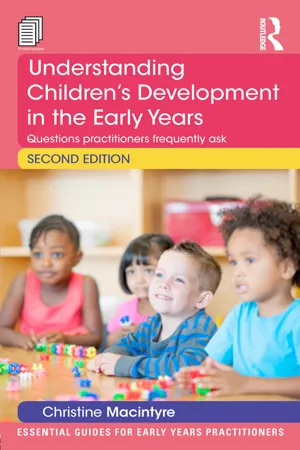 eBook - ePub
Understanding Children’s Development in the Early Years
Questions practitioners frequently ask
- Christine Macintyre(Author)
- 2014(Publication Date)
- Routledge(Publisher)
Chapter 6Understanding social developmentA group of early years practitioners was asked to name ‘the most important things they wished their children could do’ and after a lengthy discussion they compiled the list shown in Table 6.1 . They agreed that social development was critically important and their questions and answers are shared below.Q. Why should social development take priority?Well, social skills are the stepping stones if you like – if you can trust children not to hit each other and share the resources without squabbling and breaking them, then you have time to concentrate on teaching them something, but if you have to stop fights and bickering all the time, then nothing gets done. (Simon)■ TABLE 6.1 Some social skillsRespecting each other and the toys and other resources they have to play with (Simon) Being kind to one another (Sally) Learning to take turns (Amy) Caring and sharing (Megan) Learning to watch out for one another – to be aware of safety issues, especially when playing outside (Carol) Learning to be independent by deciding what they want to do, gathering all the things they need and getting on with it (Jo) Learning to cope when they get bumped or when pieces of work disappoint them (Dave) Listening to each other and following another's lead (Amy) Coping with the routine of the day – knowing what comes next (Omar) Having a friend and being able to share that friend with others (Fran) (The practitioners' names, in brackets, are given to ease referring back to the list). Q. How do you establish this kind of working atmosphere?We try to act as role models, keeping calm and praising those who are behaving well. We hope the others will copy them. If they don’t, then explaining why you are upset or disappointed is always better than being cross. (Sally)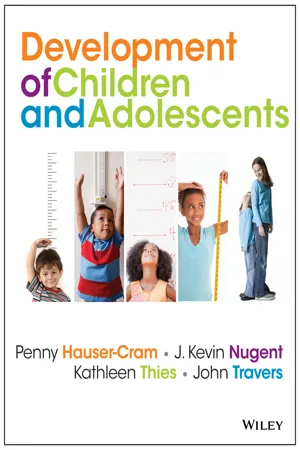 eBook - PDF
The Development of Children and Adolescents
An Applied Perspective
- Penny Hauser-Cram, J. Kevin Nugent, Kathleen Thies, John F. Travers(Authors)
- 2013(Publication Date)
- Wiley(Publisher)
inclusive With respect to a classroom or similar setting, including both children with disabilities and children without disabilities. PsychoSocial Development in Early Childhood 373 Do typically developing children gain anything from their interactions with peers with disabilities? It appears that they do. One group of researchers interviewed young children who attended preschool classes that were either inclusive or in- cluded only typically developing children. They found that children in the inclusive classes had a greater knowledge of the implications of disabilities and a greater acceptance of those with disabilities (Diamond, Hestenes, Carpenter, & Innes, 1997). In a related study, a researcher interviewed 45 typically developing children who attended an inclusive preschool (Dia- mond, 2001). She found that those who had made social con- tact with children with disabilities in the classroom scored higher on measures of social understanding and acceptance of individuals with disabilities than children who had not made such contact. Other researchers have found that typically de- veloping children in inclusive preschools have improved social skills and display less disruptive behavior than their peers enrolled in preschools that do not include children with dis- abilities (Strain & Cordisco, 1994). Children learn a great deal from their interactions with their peers. If their class- rooms include children with disabilities, as many classrooms do, typically developing children gain a greater acceptance and understanding of children with disabilities. This enhanced understanding and acceptance may produce psychosocial skills valued in our society. Prosocial and Antisocial Behaviors Young children display a range of behaviors that affect their relationships with others. Some of these behaviors are prosocial, and others are antisocial. Children engage in prosocial behaviors when they help others without obvious benefits for themselves (Eisenberg & Murphy, 1995). eBook - ePub
Children's Learning in Early Childhood
Learning Theories in Practice 0-7 Years
- Sean MacBlain(Author)
- 2021(Publication Date)
- SAGE Publications(Publisher)
Across the globe all children are experiencing social change resulting from the COVID-19 pandemic, which will already be impacting on their social learning in ways that are yet to be understood. We know of course that social learning in childhood is complex and that it varies across communities, societies, and cultures, and will be made even more complex because of this virus. Early Years practitioners and teachers in primary schools, not to mention parents and other professionals such as Health Visitors and Child Psychologists, are now having to grapple with the complex issue of social distancing and how they might support children’s social learning whilst keeping them safe and healthy; this is new territory and brings with it enormous challenges for Early Years and primary settings!Only a few years ago, and prior to the COVID-19 virus emerging, Mercer (2018) illustrated the complex nature of social development when he explained it as:A series of changes by which children move from egocentric, self-centred, weakly empathic characteristics of early childhood, when they are unfamiliar with many conventions of social behaviour, to more adult-like characteristics that facilitate empathy, social interactions, relationships with adults and other children, and compliance with conventional standards of behaviour. (p. 166)Some years previously, Fontana (1995) had explained egocentrism in childhood as the inability to ‘see the world from anything other than a self-centred, subjective viewpoint’, and importantly referred to the types of activities that teachers can use to develop empathy, such as role play in drama sessions and encouraging children to develop ‘simple imaginative descriptions’ (p. 55). Fontana also emphasised that:Unless prompted by such activities, some children even at the stage of formal operations seem never to have considered what it must be like to be at the butt of class teasing, or to be old and unwanted, or to grow up against a background of family violence. (p. 247) eBook - PDF
Children's Social Behavior
Development, Assessment, and Modification
- Phillip S. Strain, Michael J. Guralnick, Hill M. Walker, Phillip S. Strain, Michael J. Guralnick, Hill M. Walker(Authors)
- 2013(Publication Date)
- Academic Press(Publisher)
In all stages, there is a strong, pervasive bias to form social relations even though the support for this bias differs as a function of the person's developmental stage. Precisely how the individual's so- cial relations are organized within each stage depends on an integration of social network and internal factors. Within this framework, the as- sumption that early experiences are necessarily fundamental to later personality and social dispositions is rejected. Even though there are strong supports for maintaining continuity in patterns of interchange, developmental accommodations can occur at every developmental stage. In this chapter, I do not dwell in depth on the practical implications of this approach for assessment, prediction, and change, although some implications for psychopathology are noted. Further, this revised view of social development suggests that much of the continuity in social behavior, including the prediction of individual differences, arises in the course of living. Hence the attention of the clinician and parent must be given to the conditions in which development is likely to occur, includ- ing the expected trajectory of biological changes, the social network, and 1. A Contemporary Perspective on Social Development 5 the cognitive status of the child. By the same token, if enduring changes are to be produced, they must be concerned not only with early experi- ences but with later ones as well, including those that occur within the individual and within the social system beyond the family. SOME COMMENTS ON HISTORY The new perspective is something of a misnomer; the approach has been in the making since the 1930's, and its roots extend even further back. Over that period, the concerns of social and personality develop- ment extended beyond the boundaries of psychology in sociology, psy- chiatry, evolutionary biology, education, and criminology, among other disciplines. This diversification of interest and talent paid off. eBook - ePub
- Graham C. Davey(Author)
- 2018(Publication Date)
- Wiley(Publisher)
Interestingly, findings have indicated either stability or decreases in prosocial behaviour from around 9–10 years through to early adulthood. For example, Flynn, Ehrenreich, Beron, and Underwood (2014) found that levels of children’s teacher-rated prosocial behaviour (e.g. ‘This child is helpful to peers’) remained stable from 10 to 18 years, while research by Nantel-Vivier et al. (2009) showed that there was either no change or that there were decreases in levels of reported prosocial behaviour from 10 to 15 years, though this depended on who was reporting the behaviour – self-reported prosocial behaviour remained stable whereas teachers’ and mothers’ ratings of prosocial behaviour generally declined. Nantel-Vivier and colleagues (2009) argue that children are learning to focus their prosocial responding in more selective and differentiated ways. For example, they may act more prosocially with some people compared with others (Güroğlu, Van den Bos, & Crone, 2014). Further along the developmental trajectory, there is evidence for a subsequent increase in prosocial behaviour through to the age of 21 years (Luengo Kanacri et al., 2014), with relative stability through the 20s and early 30s (Eisenberg, Hofer, Sulik, & Liew, 2014). Nonetheless, it is important to remember that there are likely to be significant individual differences in these developmental trajectories. As well as the potential role played by the various dimensions of temperament discussed earlier, we will see later in this chapter that the family and the peer group are crucial contexts for understanding individual differences in children’s prosocial behaviours.TEST YOURSELF
- What are the key features of social domain approaches to socio-moral development?
- What factors influence the development of children’s prosocial behaviour?
SECTION SUMMARY
- Research on moral development has focused on cognitive aspects of morality as well as the role played by sociocultural and emotional dimensions.
- Cognitive developmental theories have emphasized stage-like progressions in children’s reasoning about moral rules, with development thought to be based on advances in perspective taking.
- More recent research using a social domain approach suggests that young children can make relatively sophisticated distinctions between different types of social rules, such as knowing the difference between moral violations and social–conventional violations.
- Social and emotional processes appear to play an important role in helping children to learn about these matters.
- The ability to detect and show a preference for prosocial behaviours develops in infancy.
- Prosocial behaviours increase during early childhood and are influenced by social and cognitive processes.
WHO AM I? THE DEVELOPMENT OF SELF AND IDENTITY
LEARNING OBJECTIVE 17.6
Identify the key stages in the development of self and identity, including the awareness of gender, ethnic, and national identity.Just as children develop in their understanding of the social world, there is a significant developmental trajectory in their understanding of self. Our sense of identity or ‘who we are’ is complex and changes across childhood. At the simplest level, having a concept of self may be seen as requiring an ability to distinguish between self and not-self (i.e. what is part of me and what is not) but, as we will see below, explicit beliefs about the self become increasingly sophisticated and multifaceted as children get older. eBook - PDF
On Being a Client
Understanding the Process of Counselling and Psychotherapy
- David Howe, Author(Authors)
- 1993(Publication Date)
- SAGE Publications Ltd(Publisher)
100 On Being a Client and others, say what we say, or do what we do: Ί don't speak in groups because I don't want to make a fool of myself; *She's off sick today because really she doesn't want to meet that difficult client.' In all our dealings with others, we constantly employ a psychological inteφretation of their behaviour. Carey guesses that infants are genetically endowed with brains which are disposed to conduct an intuitive psychology in interactions with others (Carey, 1985: 200). We are biologically oriented towards interacting with other people, and the results of that interaction allow us to develop a consciousness of self and a consciousness of others, an understanding of self and an understanding of others. The child's interest in language is also stimulated, even prompted, by her wish to participate in the social life of those around. Even before speech, the child is busy pointing things out to others. The acquisitions of language, therefore, appears context-sensitive (Bruner, 1990: 71). If the child appreciates the nature and purpose of the context, she will grasp language more quickly. Dunn, in fact, argues that the emotional dimension in human affairs acts as a powerful factor in developing and guiding our psychological skills: Piaget is surely right to emphasize that the important developmental exchanges are not those in which social influence is impressed on children, but those in which they attempt to argue, justify, and negotiate. But my account stresses the significance of the affective dynamics of the relation-ships that motivate the child to engage in discourse about the social world, rather than solely to cognitive conflict of being faced with another person's point of view. It is the motivation to express himself within the relation-ship, to co-operate, to get his way or to share amusement, that, I suggest, in part leads the child to discover the ways of the family world. eBook - PDF
Early Childhood Studies
Principles and Practice
- Jane Johnston, Lindy Nahmad-Williams, Ruby Oates, Val Wood(Authors)
- 2018(Publication Date)
- Routledge(Publisher)
How does this differ from your own definition or the individual definitions? How do you think society affects children’s social development? Reflective Tasks Part 2 Early Years Development 256 Level 2 Ask a group of professionals how they describe society. How do their views differ? How do you think their views have been shaped by their experiences? During the discussions, did they come to a collaborative or shared definition? If so, how did this happen? Ask individual professionals how they think society influences an aspect of devel- opment (physical, emotional, social, cognitive). How are their responses different? Level 3 Within your setting, discuss with your colleagues what they consider society to be. Analyse their responses and identify how the discussion has influenced their ideas. Consider what influence society has on the children in your care. How does society affect the children’s development? How can you help the children’s social development? When a group of early childhood students were asked the question, ‘What is society?’, they responded, ‘It’s about rules and regulations, it’s about our values and our culture, and it’s about people living together and getting along with each other’. You may have come up with something similar to the students and extended their ideas by identifying that society is a group of individual persons, large or small, living, working and socialising together. Did you consider that a family could be viewed as a society? The function of a society is to pro- tect, to provide comfort and emotional stability, and to provide common goals and shared objectives which are mutually beneficial to the people living within the society and for the progress and sustenance of the society. In this way a family can be said to be a society. French philosopher and sociologist Emile Durkheim (1858–1917) identified an important factor of influence as being the ‘ social structure’ of a society.
- Kathleen McCartney, Deborah Phillips, Kathleen McCartney, Deborah Phillips(Authors)
- 2011(Publication Date)
- Wiley-Blackwell(Publisher)
These social influences are important because emotion understanding is a foundation for social competence in early childhood. Individual differences in preschoolers’ emotional competence – defined as capability in emotional expressiveness, emotion regulation, and emotion knowledge – predict teacher and peer measures of social competence both concurrently and in kindergarten (Denham, Blair, DeMulder, Levitas, Sawyer, AuerbachMajor, & Queenan, 2003). The emergence of individual differences in “emotional competence” (Saarni, 1999) or “affective social competence” (Halberstadt, Denham, & Dunsmore, 2001) in the preschool years is important in shaping children’s social skills and dispositions in ways that have implications not only for friendship and peer status but also for academic competence, self-image, and emotional well-being (Thompson & Raikes, in press).Early Emotional VulnerabilityThe importance of the family environment as a laboratory of early emotional development is underscored by the realization that even young children can experience the severity of trauma, depths of sadness and grief, and capacities for uncontrollable anger and aggression that traditionally were viewed as possible only at older ages (Shonkoff & Phillips, 2000). Young children who are witnesses to domestic violence, for example, are more likely to exhibit internalizing symptoms (such as depression and anxiety) and externalizing symptoms (such as aggression) as well as showing signs of post-traumatic stress disorder (Rossman, Bingham, & Emde, 1997; Rossman, Hughes, & Rosenberg, 2000). Comparable symptomatology can be observed in young children who have been maltreated (Cicchetti & Toth, 2000; Macfie, Cicchetti, & Toth, 2001). Young children also exhibit symptomatology of depression (Robinson & Garber, 1995), anxiety disorders (Vasey & Dadds, 2001), conduct and behavioral disorders (Owens & Shaw, 2003; Shaw, Gilliom, Ingoldsby, & Nagin, 2003), and other serious forms of affective psychopathology. The risk of serious psychological problems increases when children are in threatening or traumatizing circumstances like those described above, but psychological symptomatology certainly is not inevitable, and many children in these situations do not develop serious problems, especially when they have available to them social support and other resources for effective coping. eBook - PDF
Childhood and Adolescence
Voyages in Development
- Spencer Rathus(Author)
- 2016(Publication Date)
- Cengage Learning EMEA(Publisher)
How, then, do we explain the connections between violence in the media and aggression? Section Review Personality and Emotional Development In the early childhood years, children’s personalities start becoming more defined. Their sense of self—who they are and how they feel about themselves—continues to develop and becomes more complex. They begin to acquire a sense of their own abilities and their increasing mastery of the environment. As they move out into the world, they also face new experiences that may cause them to feel fearful and anx-ious. Let us explore some of these facets of personality and emotional development. How Does the Self Develop During Early Childhood? The sense of self, or the self-concept, emerges gradually during infancy. Infants and toddlers visually begin to recognize themselves and differentiate themselves from other individuals, such as their parents. In the preschool years, children continue to develop their sense of self. Almost as soon as they begin to speak, they describe themselves in terms of certain categories, such as age groupings (baby, child, adult) and gender (girl, boy). These self-definitions that refer to concrete external traits have been called the categorical self . Children as young as 3 years are able to describe themselves in terms of behav-iors and stable or recurrent emotions (Rosen & Patterson, 2011). For example, in response to the question “How do you feel when you’re scared?” young children frequently respond, “Usually like running away” (Eder, 1989). Or, in answer to the question “How do you usually act around grown-ups?” a typical response might be “I mostly been good with grown-ups.” Thus, even preschoolers seem to understand that they have stable, enduring traits. One aspect of the self-concept is self-esteem, the value or worth that people attach to themselves. Children who have a good opinion of themselves during the Copyright 2017 Cengage Learning.
- Christi Crosby Bergin, David Allen Bergin(Authors)
- 2018(Publication Date)
- Cengage Learning EMEA(Publisher)
Cengage Learning reserves the right to remove additional content at any time if subsequent rights restrictions require it. Chapter 9 Social Development in Early Childhood 267 autism improve in behavior, social interaction, and lan-guage ability. The younger the child when the interven-tion begins, the more successful it is; it should, preferably, begin in toddlerhood. One common approach is behav-ior modification (also called applied behavior analysis, see Chapter 8) to reduce problem behaviors and teach new skills such as how to converse, make eye contact, or read emotional cues in others. This was the approach used with James. A second common approach is to be highly responsive during social interaction, such as imitating the child and scaffolding joint play (Smith & Iadarola, 2015). Sometimes the two approaches are combined. In addition, exercise has helped improve social skills and reduce re-petitive behaviors in children with ASD (Pontifex et al., 2014). You can help children with autism function in your classroom by keeping the physical envi-ronment stable (e.g., don’t move chairs around); providing lecture notes and extra time for writ-ing for older children; and capitalizing on the good rote memory and intense, obsessive in-terests (e.g., dinosaurs, astronomy, maps) of some children with autism (Brownell & Walther-Thomas, 2001). You can also help promote their ToM by talking to them about others’ emotions, thoughts, and desires, which will help your other learn-ers as well (Slaughter, Peterson, & Mackintosh, 2007). You can help them form friendships with particularly warm, kind, and socially mature classmates (Mendelson, Gates, & Lerner, 2016). You will need to collaborate with parents and therapists to provide an optimal classroom environment for each learner. 0 2 4 6.6 2002 2006 2008 2010 2012 9.0 11.3 14.7 14.6 6 8 10 12 14 16 Prevalence of ASD per 1,000 Children The CDC monitors prevalence of autism spectrum disorder across the United States.
Index pages curate the most relevant extracts from our library of academic textbooks. They’ve been created using an in-house natural language model (NLM), each adding context and meaning to key research topics.

