Technology & Engineering

Complex Trigonometric Functions
Complex trigonometric functions involve the use of complex numbers in trigonometric expressions. They extend the concept of trigonometric functions to complex numbers, allowing for the representation of oscillatory phenomena in engineering and technology. These functions are essential in analyzing alternating current circuits, signal processing, and wave propagation, providing a powerful tool for understanding and manipulating periodic phenomena in various engineering applications.
Written by Perlego with AI-assistance
Related key terms
1 of 5
4 Key excerpts on "Complex Trigonometric Functions"
 No longer available |Learn more
- (Author)
- 2014(Publication Date)
- Learning Press(Publisher)
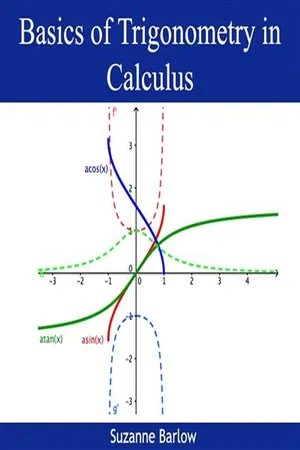
________________________ WORLD TECHNOLOGIES ________________________ Chapter- 3 Trigonometric Functions In mathematics, the trigonometric functions (also called circular functions ) are functions of an angle. They are used to relate the angles of a triangle to the lengths of the sides of a triangle. Trigonometric functions are important in the study of triangles and modeling periodic phenomena, among many other applications. The most familiar trigonometric functions are the sine, cosine, and tangent. In the context of the standard unit circle with radius 1, where a triangle is formed by a ray originating at the origin and making some angle with the x -axis, the sine of the angle gives the length of the y -component (rise) of the triangle, the cosine gives the length of the x -component (run), and the tangent function gives the slope ( y -component divided by the x -component). More pr ecise definitions are detailed below. Trigonometric functions are commonly defined as ratios of two sides of a right triangle containing the angle, and can equivalently be defined as the lengths of various line segments from a unit circle. More modern definitions express them as infinite series or as solutions of certain differential equations, allowing their extension to arbitrary positive and negative values and even to complex numbers. Trigonometric functions have a wide range of uses including computing unknown lengths and angles in triangles (often right triangles). In this use, trigonometric functions are used for instance in navigation, engineering, and physics. A common use in elementary physics is resolving a vector into Cartesian coordinates. The sine and cosine functions are also commonly used to model periodic function phenomena such as sound and light waves, the position and velocity of harmonic oscillators, sunlight intensity and day length, and average temperature variations through the year.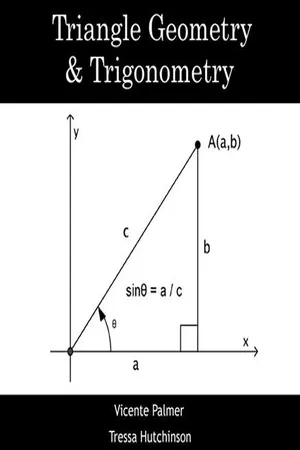 No longer available |Learn more
- (Author)
- 2014(Publication Date)
- Library Press(Publisher)
________________________ WORLD TECHNOLOGIES ________________________ Chapter 10 Trigonometric Functions In mathematics, the trigonometric functions (also called circular functions ) are fun-ctions of an angle. They are used to relate the angles of a triangle to the lengths of the sides of a triangle. Trigonometric functions are important in the study of triangles and modeling periodic phenomena, among many other applications. The most familiar trigonometric functions are the sine, cosine, and tangent. In the context of the standard unit circle with radius 1, where a triangle is formed by a ray originating at the origin and making some angle with the x -axis, the sine of the angle gives the length of the y -component (rise) of the triangle, the cosine gives the length of the x -component (run), and the tangent function gives the slope ( y -component divided by the x -comp-onent). More precise definitions are detailed below. Trigonometric functions are commonly defined as ratios of two sides of a right triangle containing the angle, and can equivalently be defined as the lengths of various line segments from a unit circle. More modern definitions express them as infinite series or as solutions of certain differential equations, allowing their extension to arbitrary positive and negative values and even to complex numbers. Trigonometric functions have a wide range of uses including computing unknown lengths and angles in triangles (often right triangles). In this use, trigonometric functions are used for instance in navigation, engineering, and physics. A common use in elementary physics is resolving a vector into Cartesian coordinates. The sine and cosine functions are also commonly used to model periodic function phenomena such as sound and light waves, the position and velocity of harmonic oscillators, sunlight intensity and day length, and average temperature variations through the year.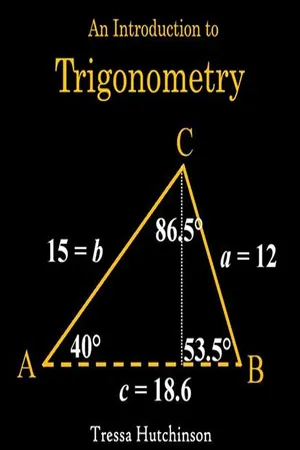 No longer available |Learn more
- (Author)
- 2014(Publication Date)
- Learning Press(Publisher)
________________________ WORLD TECHNOLOGIES ________________________ Chapter 3 Trigonometric Functions In mathematics, the trigonometric functions (also called circular functions ) are func-tions of an angle. They are used to relate the angles of a triangle to the lengths of the sides of a triangle. Trigonometric functions are important in the study of triangles and modeling periodic phenomena, among many other applications. The most familiar trigonometric functions are the sine, cosine, and tangent. In the context of the standard unit circle with radius 1, where a triangle is formed by a ray originating at the origin and making some angle with the x -axis, the sine of the angle gives the length of the y -component (rise) of the triangle, the cosine gives the length of the x -component (run), and the tangent function gives the slope ( y -component divided by the x -component). More precise definitions are detailed below. Trigonometric functions are commonly defined as ratios of two sides of a right triangle containing the angle, and can equivalently be defined as the lengths of various line segments from a unit circle. More modern definitions express them as infinite series or as solutions of certain differential equations, allowing their extension to arbitrary positive and negative values and even to complex numbers. Trigonometric functions have a wide range of uses including computing unknown lengths and angles in triangles (often right triangles). In this use, trigonometric functions are used for instance in navigation, engineering, and physics. A common use in elementary physics is resolving a vector into Cartesian coordinates. The sine and cosine functions are also commonly used to model periodic function phenomena such as sound and light waves, the position and velocity of harmonic oscillators, sunlight intensity and day length, and average temperature variations through the year. eBook - PDF
- Mary Jane Sterling(Author)
- 2023(Publication Date)
- For Dummies(Publisher)
2 Trigonometric Functions IN THIS PART . . . Define the basic trig functions using the lengths of the sides of a right triangle. Determine the relationships between the trig cofunctions and their shared sides. Extend your scope to angles greater than 90 degrees using the unit circle. Investigate the ins and outs of the domains and ranges of the six trig functions. Use reference angles to compute trig functions. Apply trig functions to real-world problems. CHAPTER 6 Describing Trig Functions 91 Chapter 6 Describing Trig Functions B y taking the lengths of the sides of right triangles or the chords of circles and creating ratios with those numbers and variables, our ancestors initi- ated the birth of trigonometric functions. These functions are of infinite value, because they allow you to use the stars to navigate and to build bridges that won’t fall. If you’re not into navigating a boat or engineering, then you can use the trig functions at home to plan that new addition. And they’re a staple for students going into calculus. You may be asking, “What is a function? What does it have to do with trigonom- etry?” In mathematics, a function is a mechanism that takes a value you input into it and churns out an answer, called the output. A function is connected to rules involving mathematical operations or processes. The six trig functions require one thing of you — inputting an angle measure — and then they output a number. These outputs are always real numbers, from infinitely small to infinitely large and everything in between. The results you get depend on which function you use. Although in earlier times, some of the function computations were rather tedious, today’s hand-held calculators, and even phones, make everything much easier. IN THIS CHAPTER » Understanding the three basic trig functions » Building on the basics: The reciprocal functions » Recognizing the angles that give the cleanest trig results » Determining the exact values of functions
Index pages curate the most relevant extracts from our library of academic textbooks. They’ve been created using an in-house natural language model (NLM), each adding context and meaning to key research topics.

