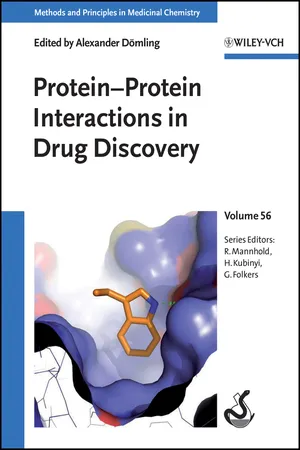
Treating protein-protein interactions as a novel and highly promising class of drug targets, this volume introduces the underlying strategies step by step, from the biology of PPIs to biophysical and computational methods for their investigation.
The main part of the book describes examples of protein targets for which small molecule modulators have been developed, covering such diverse fields as cancer, autoimmune disorders and infectious diseases. Tailor-made for the practicing medicinal chemist, this ready reference includes a wide selection of case studies taken straight from the development pipeline of major pharmaceutical companies to illustrate the power and potential of this approach.
From the contents:
* Prediction of intra- and inter-species protein-protein interactions facilitating systems biology studies
* Modulators of protein-protein interactions: The importance of Three-Dimensionality
* Interactive technologies for leveraging the known chemistry of anchor residues
* SH3 Domains as Drug Targets
* P53 MDM2 Antagonists: Towards Non Genotoxic Anticancer Treatments
* Inhibition of LFA-1/ICAM interaction for treatment of autoimmune diseases
* The PIF-binding pocket of AGC kinases
* Peptidic inhibitors of protein-protein interactions for cell adhesion receptors
* The REPLACE Strategy for generating Non-ATP competitive Inhibitors of Cell-Cycle Protein Kinases
and more
eBook - ePub
Protein-Protein Interactions in Drug Discovery
- English
- ePUB (mobile friendly)
- Available on iOS & Android
eBook - ePub
Protein-Protein Interactions in Drug Discovery
About this book
Information
1
Protein–Protein Interactions: An Overview
1.1 Introduction
Protein–protein interactions (PPIs) are implicated in almost all biological processes for any given protein engaged in complexes with other proteins for the majority of its lifetime. In this regard, proteins function not merely as single, isolated entities, but display their roles by interacting with other cellular components. The different interaction patterns are at least as important as the intrinsic biochemical activity status (e.g., of a protein kinase) of the protein itself. Therefore, to understand the biological role of a protein it is of the utmost importance to know the underlying PPI network. This holds especially true in the case of diseases where, for example, mutations in oncogene or tumor suppressor proteins are recognized as the cause for malignancies. An impressive recent example for the relevance of the PPI interplay is the finding that active-site inhibitors targeting the oncogenic kinase B-Raf can under certain circumstances activate the underlying signal transduction pathway (mitogen-activated protein kinase (MAPK) pathway) instead of inhibiting it [1–3]. This finding is a strong reminder that nature in the majority of cases ultimately relies on regulating protein function by PPIs. In addition to taking into account this important concept for the drug development process, targeting PPIs significantly enlarges the “druggable genome” that was initially estimated to comprise around 1500 single protein targets [4]. While this number is still several times higher than the 266 human protein targets actually addressed by currently approved drugs [5], there are diseases that lack a good “conventional” target like an enzyme, receptor, or ion channel. By adding the number of PPIs occurring in the human body, the so-called protein–protein “interactome,” this situation will definitely be improved. As the size of the interactome has been estimated to lie between 130 000 [6] and 650 000 [7], successfully addressing PPIs will vastly expand our opportunities for pharmacological intervention.
1.2 Role of PPIs in Human Physiology
Direct physical interactions of proteins are intricately implicated in the majority of processes in living organisms (Figure 1.1). For example, reception and propagation of growth signals can start with the binding of a proteinaceous signaling molecule like the epidermal growth factor (EGF) to its cell surface receptor (EGFR). This binding triggers the intracellular assembly and activation of signaling complexes comprised, for example, of adapter proteins like Grb2 and Sos and small G-proteins like Ras that – again by physically interacting – activate protein kinases like Raf. Activated Raf then stimulates a phosphorylation cascade via the kinases MEK (mitogen-activated protein kinase/extracellular signal-related kinase) and ERK (extracellular signal-related kinase) that ultimately leads to gene activation via transcription factors like Sp1 and Elk [8]. As each of these steps necessitates direct binding of the components of this signal transduction chain, small molecules inhibiting these interactions could disrupt this proproliferative signaling. Furthermore, stabilization of the inhibitory binding of regulatory proteins like the Raf kinase inhibitory protein (RKIP) [9] and 14-3-3 to components of the pathway (e.g., Raf) might also produce a therapeutic benefit.
Figure 1.1 Examples of the role of PPIs in human physiology.

Many cellular functions like motility are related to functional changes in the cytoskeleton. For example, dynamic assembly and disassembly of actin filaments are based on the interaction of actin with itself and with protein partners like ADF/cofilin and profilin [10]. Biological (surface) recognition, like in the immune system, is also mediated by PPIs as in the case of binding of lymphocyte function associated antigen (LFA)-1 presented on the surface of immune cells to intracellular adhesion molecule (ICAM)-1 found on the surface of endothelial cells [11]. This interaction enables immune cells to attach to the walls of blood vessels and to migrate into neighboring tissue to initiate inflammation.
The control of subcellular localization is another important aspect of protein regulation performed by PPIs. For example, the transcription factor NFκB is prevented from nuclear import upon complexation with its negative regulator IκB [12]. The 14-3-3 adapter proteins play a similar role in the case of the FoxO transcription factor family [13]. Also, direct regulation of biochemical activity by PPIs is performed many times by PPIs. The phosphatase calcineurin is activated upon complexation with Ca2+-activated calmodulin and repressed upon binding to cabin (calcineurin binding protein) or calcipressin [14]. Another important process involving PPIs is the functional constitution of transcriptional complexes. While transcription factors of the Tcf (T cell factor) LEF (lymphoid enhancer factor) family can directly bind to DNA, transcription starts only when coactivators like β-catenin additionally interact with Tcf/LEF [15]. Many proteins of disease-causing organisms need host proteins as cofactors for their pathogenic activity. For example, exoenzyme S from Pseudomonas aeruginosa, an opportunistic, pneumonia-causing bacterium, has to interact with host 14-3-3 proteins to be able to transfer an ADP-ribose moiety from NAD+ to small G-proteins like Ras [16], thereby inhibiting its target proteins [17].
1.3 Regulation of PPIs
Given the importance and number of PPIs in the living cell it is no surprise that they have to be tightly orchestrated at any moment in time. The occurrence and perseverance of PPIs is governed by the two principal variables local concentration and intrinsic binding energy of the binary interaction [18]. The first is regulated by transcriptional and translational mechanisms, subcellular (co-)localization, degradation rates, and temporary storage. The second can be influenced by covalent modifications like phosphorylation, and by changes in pH, ionic strength, and temperature (Figure 1.2). Furthermore, additional PPIs can modulate binary interactions. They can be inhibitory when, for example, the interaction interface of one partner is masked by binding to the same interface or by simple sterical obstruction. They can also be stabilized, for example, when the third interacting protein binds simultaneously to both protein partners. Such a “bridging” or “assembly platform” function has been described for the A-kinase anchoring proteins (AKAPs) [19] and the kinase suppressor of Ras (KSR) [20]. It is now clear that the local architecture of such signaling complexes is one of the keys to understand regulation and specificity of signaling events.
Figure 1.2 Factors governing the occurrence and perseverance of PPIs. Important control mechanisms for the oligomerization state of interacting proteins. The association–dissociation equilibrium between monomeric and multimeric states is regulated by the partners' local concentration and their mutual binding affinity. Additional cellular or pharmaceutical factors can compete for one partner or stabilize the dimeric complex. (Adapted from Nooren and Thornton [18].)

1.4 Structural Features of PPI Interfaces
PPIs can be established between identical and nonidentical protomers leading to homo- or heterodimeric complexes, respectively. In the following, a number of examples are discussed in more detail. Small-molecule inhibitors have been identified for these PPIs (Table 1.1), strongly validating the general approach to pharmacologically interfere with the interaction of proteins.
Table 1.1 Small-molecule PPI inhibitors from the pharmaceutical industry.

1.4.1 iNOS Homodimer
An example for a homodimeric protein complex is the inducible nitric oxide synthase (iNOS) that produces the signaling molecule NO from l-arginine [36–38]. To perform its catalytic activity NOS depends on the tightly bound cofactors tetrahydopterin (H4B), flavin adenine dinucleotide (FAD), flavin mononucleotide (FMN), and iron protoporphyrin IX (heme). This enzyme is only active as a homodimer, and the crystal structures of the (dimeric) oxygenase domain [38] explained this fact by showing that the dimerization interface shapes the functional binding sites for the cofactors H4B and heme (Figure 1.3). It also displays a large intersubunit cavity of about 750 Å3 that is separated from the surrounding bulk solvent when a zinc ion is coordinated by two cysteines from protomer A and two cysteines from protomer B. With 69% nonpolar and 31% polar amino acids, the interface of the iNOS dimer shows a distribution that is typical for the majority of known homodimers. The contact surface of roughly 2900 Å2 is rather flat. Nonetheless, mainly due to the special situation characterized by interface-bound cofactors, inhibitors of dimer formation could be identified successfully.
Figure 1.3 Structure of the iNOS homodimer. General topology of the iNOS dimer, and expanded, detailed view of the dimer interface with the cysteine-coordinated zinc ion and the cofactors H4B and heme.

1.4.2 β-Catenin/Tcf4 Complex
The Wnt pathway found to be constitutively activated in many colorectal cancers is dependent on the interaction of β-catenin with transcription factors of the Tcf/LEF family. Normally, the transcriptional coactivator β-catenin can be sequestered in the cytoplasm and the Tcf transcription factor is inhibited by complexation with negative regulators of the Groucho family [39]. Upon Wnt activation, β-catenin is translocated into the nucleus and binds to Tcf to constitute the active transcriptional complex [40]. The crystal structure of the human β-catenin/Tcf4 complex [41,42] revealed the mu...
Table of contents
- Cover
- Related Titles
- Title Page
- Copyright
- List of Contributors
- Preface
- A Personal Foreword
- Chapter 1: Protein–Protein Interactions: An Overview
- Chapter 2: Prediction of Intra- and Interspecies Protein–Protein Interactions Facilitating Systems Biology Studies
- Chapter 3: Modulators of Protein–Protein Interactions: Importance of Three-Dimensionality
- Chapter 4: A Leap into the Chemical Space of Protein–Protein Interaction Inhibitors
- Chapter 5: Interactive Technologies for Leveraging the Known Chemistry of Anchor Residues to Disrupt Protein Interactions
- Chapter 6: SH3 Domains as Drug Targets
- Chapter 7: p53/MDM2 Antagonists: Towards Nongenotoxic Anticancer Treatments
- Chapter 8: Inhibition of LFA-1/ICAM Interaction for the Treatment of Autoimmune Diseases
- Chapter 9: The PIF Pocket of AGC Kinases: A Target Site for Allosteric Modulators and Protein–Protein Interaction Inhibitors
- Chapter 10: Retosiban and Epelsiban: Potent and Selective Orally Available Oxytocin Antagonists
- Chapter 11: Peptidic Inhibitors of Protein–Protein Interactions for Cell Adhesion Receptors: RGD Peptides and Beyond
- Chapter 12: REPLACE Strategy for Generating Non-ATP-Competitive Inhibitors of Cell Cycle Protein Kinases
- Index
Trusted by 375,005 students
Access to over 1.5 million titles for a fair monthly price.
Study more efficiently using our study tools.
Frequently asked questions
Yes, you can cancel anytime from the Subscription tab in your account settings on the Perlego website. Your subscription will stay active until the end of your current billing period. Learn how to cancel your subscription
No, books cannot be downloaded as external files, such as PDFs, for use outside of Perlego. However, you can download books within the Perlego app for offline reading on mobile or tablet. Learn how to download books offline
Perlego offers two plans: Essential and Complete
- Essential is ideal for learners and professionals who enjoy exploring a wide range of subjects. Access the Essential Library with 800,000+ trusted titles and best-sellers across business, personal growth, and the humanities. Includes unlimited reading time and Standard Read Aloud voice.
- Complete: Perfect for advanced learners and researchers needing full, unrestricted access. Unlock 1.5M+ books across hundreds of subjects, including academic and specialized titles. The Complete Plan also includes advanced features like Premium Read Aloud and Research Assistant.
We are an online textbook subscription service, where you can get access to an entire online library for less than the price of a single book per month. With over 1.5 million books across 990+ topics, we’ve got you covered! Learn about our mission
Look out for the read-aloud symbol on your next book to see if you can listen to it. The read-aloud tool reads text aloud for you, highlighting the text as it is being read. You can pause it, speed it up and slow it down. Learn more about Read Aloud
Yes! You can use the Perlego app on both iOS and Android devices to read anytime, anywhere — even offline. Perfect for commutes or when you’re on the go.
Please note we cannot support devices running on iOS 13 and Android 7 or earlier. Learn more about using the app
Please note we cannot support devices running on iOS 13 and Android 7 or earlier. Learn more about using the app
Yes, you can access Protein-Protein Interactions in Drug Discovery by Alexander Dömling, Raimund Mannhold,Hugo Kubinyi,Gerd Folkers in PDF and/or ePUB format, as well as other popular books in Medicine & Pharmacology. We have over 1.5 million books available in our catalogue for you to explore.