Students and professionals alike will benefit from this latest addition to the IFT Press book series. In Food Carbohydrate Chemistry, upper undergraduate and graduate students will find a clear explanation of how basic principles of carbohydrate chemistry can account for and predict functional properties such as sweetness, browning potential, and solubility properties. Professionals working in product development and technical sales will value Food Carbohydrate Chemistry as a needed resource to help them understand the functionality of carbohydrate ingredients. And persons in research and quality assurance will rely upon Food Carbohydrate Chemistry for understanding the principles of carbohydrate analytical methods and the physical and chemical properties of sugars and polysaccharides.
- English
- ePUB (mobile friendly)
- Available on iOS & Android
eBook - ePub
Food Carbohydrate Chemistry
About this book
Not since "Sugar Chemistry" by Shallenberger and Birch (1975) has a text clearly presented and applied basic carbohydrate chemistry to the quality attributes and functional properties of foods. Now in Food Carbohydrate Chemistry, author Wrolstad emphasizes the application of carbohydrate chemistry to understanding the chemistry, physical and functional properties of food carbohydrates. Structure and nomenclature of sugars and sugar derivatives are covered, focusing on those derivatives that exist naturally in foods or are used as food additives. Chemical reactions emphasize those that have an impact on food quality and occur under processing and storage conditions. Coverage includes: how chemical and physical properties of sugars and polysaccharides affect the functional properties of foods; taste properties and non-enzymic browning reactions; the nutritional roles of carbohydrates from a food chemist's perspective; basic principles, advantages, and limitations of selected carbohydrate analytical methods. An appendix includes descriptions of proven laboratory exercises and demonstrations. Applications are emphasized, and anecdotal examples and case studies are presented. Laboratory units, homework exercises, and lecture demonstrations are included in the appendix. In addition to a complete list of cited references, a listing of key references is included with brief annotations describing their important features.
Information
1
Classifying, Identifying, Naming, and Drawing Sugars and Sugar Derivatives
Structure and Nomenclature of Monosaccharides
Aldoses and Ketoses
Configurations of Aldose Sugars
D- vs. L-Sugars
Different Ways of Depicting Sugar Structures
Fischer, Haworth, Mills, and Conformational Structures
Classifying Sugars by Compound Class—Hemiacetals, Hemiketals, Acetals, and Ketals
Structure and Nomenclature of Disacchaarides
Structure and Optical Activity
A Systematic Procedure for Determining Conformation (C-1 or 1-C), Chiral Family (D or L), and Anomeric Form (α or β) of Sugar Pyranoid Ring Structures
Structure and Nomenclature of Sugar Derivatives with Relevance to Food Chemistry
Glycols (Alditols)
Glyconic, Glycuronic, and Glycaric Acids
Deoxy Sugars
Amino Sugars and Glycosyl Amines
Glycosides
Sugar Ethers and Sugar Esters
Vocabulary
References
Structure and Nomenclature of Monosaccharides
Sugars are polyhydroxycarbonyls that occur in single or multiple units as monosaccharides, disaccharides, trisaccharides, tetrasaccharides, or oligosacharides (typically three to ten sugar units). Monosaccharides (also known as simple sugars) exist as aldoses or ketoses, with glucose and fructose being the most common examples. Glycose is a generic term for sugars. Sugars are also classified according to the number of carbon atoms in the molecule (e.g., trioses, tetroses, pentoses, hexoses, heptoses, etc.).
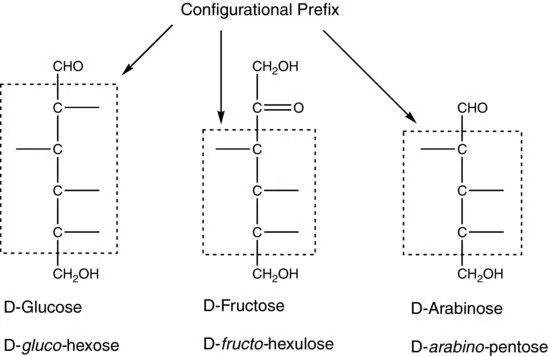
Figure 1.1 Structure and nomenclature of glucose, fructose, and arabinose.
Aldoses and Ketoses
Aldoses contain an aldehyde functional group at carbon-1 (C-1), whereas ketoses contain a carbonyl group that is almost always located at carbon-2 (C-2). C-1 for aldoses and C-2 for ketoses are the reactive centers for these molecules and are known as the anomeric carbon atoms. Figure 1.1 shows the structure for D-glucose, D-fructose, and, in addition, D-arabinose. Sugars have common or trivial names with historical origins from chemistry, medicine, and industry. There is also a systematic procedure for naming sugars (some examples are shown in Table 1.1). Glucose is also commonly known as dextrose. In systematic nomenclature, its suffix is hexose, indicating a 6-carbon aldose sugar, and the prefix is gluco-, which shows the orientation of the hydroxyl groups around carbons 2–5. The symbol D refers to the orientation of the hydroxyl group on C-5, the highest numbered asymmetric carbon atom, also known as the reference carbon atom. Since fructose (also known as levulose) has just three asymmetric carbon atoms, its configurational prefix is the same as that for the pentose sugar arabinose. Thus, the systematic name for glucose is D-gluco-hexose and fructose is D-arabino-hexulose.
Table 1.1 Trivial and Systematic Names of Selected Sugars
| Trivial (or Common) | Systematica |
| D-Erythrose | D-erythro-tetrose |
| D-Threose | D-threo-tetrose |
| D-Arabinose | D-arabino-pentose |
| D-Lyxose | D-lyxo-pentose |
| D-Ribose | D-ribo-pentose |
| D-Xylose | D-xylo-pentose |
| D-Allose | D-allo-hexose |
| D-Altrose | D-altro-hexose |
| D-Galactose | D-galacto-hexose |
| D-Glucose | D-gluco-hexose |
| D-Gulose | D-gulo-hexose |
| D-Idose | D-ido-hexose |
| D-Mannose | D-manno-hexose |
| D-Talose | D-talo-hexose |
| aIn the systematic name, the configurational prefix is italicized, and the stem name indicates the number of carbon atoms in the molecule. | |
Configurations of Aldose Sugars
Figure 1.2 shows all possible configurations around the asymmetric carbon atoms for the triose, tetrose, pentose, and hexose D-aldose sugars. Diastereoisomers are molecular isomers that differ in configuration about one or more asymmetric carbon atoms; there are eight hexose diastereoisomers. Epimer is yet another term in sugar chemistry that refers to diastereoisomers that differ in configuration about only one asymmetric carbon atom (e.g., D-galactose is the 4-epimer of D-glucose). The term has historical significance because the melting point of dinitrophenylhydrazone derivatives was a classical procedure used in identifying sugars. The 2-epimers (e.g., glucose and mannose, allose and altrose, etc.) gave identical dinitrophenylhydrazone derivatives.
Figure 1.2 Structures of the D-aldoses containing from 3 to 6 carbon atoms as depicted by the Rosanoff shorthand convention.
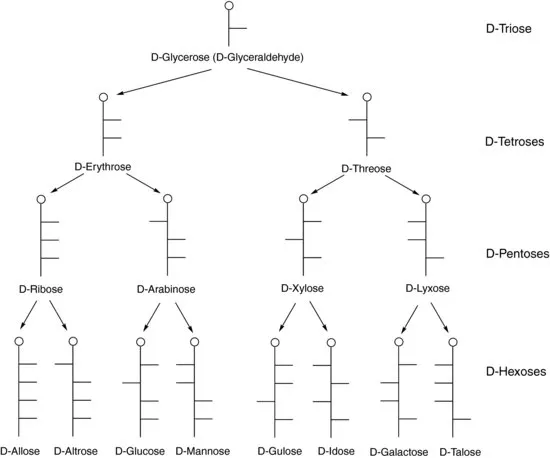
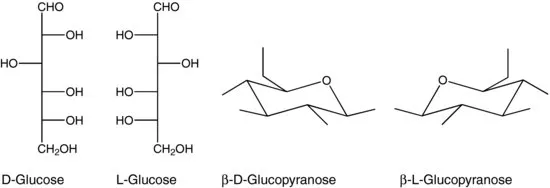
Figure 1.3 D- and L-glucose as depicted in the Fischer and conformational projections.
D- vs. L-Sugars
L-sugars are the mirror images of D-sugars. Figure 1.3 depicts the structures of D- and L-glucose in the Fischer and conformational projections. (Note: When drawing an L-sugar, the orientation of the hydroxyl groups on every asymmetric carbon atom need to be reversed; a frequent error is to only change the orientation on the reference carbon atom.) D- and L-glucose are enantiomers, nonsuperimposable stereoisosmeric molecules that are mirror images. L-sugars occur rarely in nature. A pair of enantiomers are identical in chemical reactivity, and they have the same taste properties. They are handled differently in biological systems, however. Although humans absorb L-sugars, L-sugars are not metabolized and thus have no caloric value.
Figure 1.4 Furanose and pyranose structures of β-D-glucose and β-D-fructose.
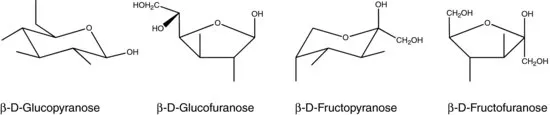
Figure 1.5 β-D-glucopyranose as depicted by the Haworth, Mills, and conformational conventions.
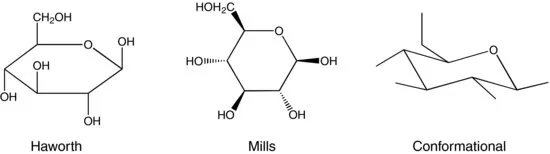
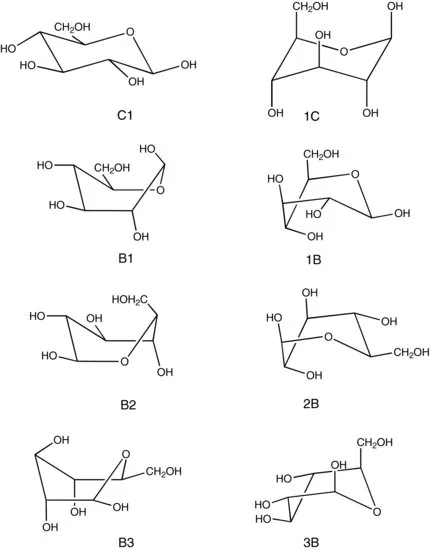
Figure 1.6 Basic chair and boat conformations for β-D-glucopyranose.
Different Ways of Depicting Sugar Structures
Fischer, Haworth, Mills, and Conformational Structures
It is important to realize that pentose and hexose sugars exist as ring forms, and only a small amount will occur in the acyclic form. Thus, the Fischer projections shown in Figure 1.2 are in no way representative...
Table of contents
- Cover
- Series One
- Title Page
- Copyright
- Series Two
- Dedication
- Contributors
- Acknowledgments
- Introduction
- Chapter 1: Classifying, Identifying, Naming, and Drawing Sugars and Sugar Derivatives
- Chapter 2: Sugar Composition of Foods
- Chapter 3: Reactions of Sugars
- Chapter 4: Browning Reactions
- Chapter 5: Functional Properties of Sugars
- Chapter 6: Analytical Methods
- Chapter 7: Starch in Foods
- Chapter 8: Plant Cell Wall Polysaccharides
- Chapter 9: Nutritional Roles of Carbohydrates
- Appendices
- Index
- Food Science and Technology
Trusted by 375,005 students
Access to over 1.5 million titles for a fair monthly price.
Study more efficiently using our study tools.
Frequently asked questions
Yes, you can cancel anytime from the Subscription tab in your account settings on the Perlego website. Your subscription will stay active until the end of your current billing period. Learn how to cancel your subscription
No, books cannot be downloaded as external files, such as PDFs, for use outside of Perlego. However, you can download books within the Perlego app for offline reading on mobile or tablet. Learn how to download books offline
Perlego offers two plans: Essential and Complete
- Essential is ideal for learners and professionals who enjoy exploring a wide range of subjects. Access the Essential Library with 800,000+ trusted titles and best-sellers across business, personal growth, and the humanities. Includes unlimited reading time and Standard Read Aloud voice.
- Complete: Perfect for advanced learners and researchers needing full, unrestricted access. Unlock 1.5M+ books across hundreds of subjects, including academic and specialized titles. The Complete Plan also includes advanced features like Premium Read Aloud and Research Assistant.
We are an online textbook subscription service, where you can get access to an entire online library for less than the price of a single book per month. With over 1.5 million books across 990+ topics, we’ve got you covered! Learn about our mission
Look out for the read-aloud symbol on your next book to see if you can listen to it. The read-aloud tool reads text aloud for you, highlighting the text as it is being read. You can pause it, speed it up and slow it down. Learn more about Read Aloud
Yes! You can use the Perlego app on both iOS and Android devices to read anytime, anywhere — even offline. Perfect for commutes or when you’re on the go.
Please note we cannot support devices running on iOS 13 and Android 7 or earlier. Learn more about using the app
Please note we cannot support devices running on iOS 13 and Android 7 or earlier. Learn more about using the app
Yes, you can access Food Carbohydrate Chemistry by Ronald E. Wrolstad in PDF and/or ePUB format, as well as other popular books in Technology & Engineering & Food Science. We have over 1.5 million books available in our catalogue for you to explore.