Catalytic Air Pollution Control: Commercial Technology is the primary source for commercial catalytic air pollution control technology, offering engineers a comprehensive account of all modern catalytic technology. This Third Edition covers all the new advances in technology in automotive catalyst control technology, diesel engine catalyst control technology, small engine catalyst control technology, and alternate sustainable fuels for auto and diesel.
Chemical reactions occur by breaking chemical bonds of reactants and by forming new bonds and new compounds. Breaking stable bonds requires the absorption of energy, whereas making new bonds results in the liberation of energy. The combination of these energies results in either an exothermic reaction in which the conversion of reactants to products liberates energy or an endothermic process in which the conversion process requires energy. In the former case, the energy of the product is lower than that of the reactants, with the difference being the heat liberated. In the latter case, the product energy is greater by the amount that must be added to conserve the total energy of the system. Under the same reaction conditions, the heat of reaction (ΔH) being a thermodynamic function does not depend on the path or the rate by which reactants are converted to products. Similarly, the free energy of reaction (ΔG) of the reaction is not dependent on the reaction path because it too is a thermodynamic state function. This will be emphasized once we discuss catalytic reactions. The rate of reaction is determined by the slowest step in a conversion process independent of the energy content of the reactants or products.
1.2 CATALYZED VERSUS NONCATALYZED REACTIONS
A few decades ago, chlorofluorocarbons (i.e., CF2Cl2), emitted primarily from refrigerants, were found to catalyze the destruction of the ozone (O3) layer in the stratosphere necessary to protect us from harmful ultraviolet (UV) radiation and its skin cancer consequences. Fortunately alternative chemicals are now used, and this problem is no longer of great concern. It does, however, serve as an excellent example of a homogeneous gas phase catalytic reaction. First let us consider the very slow noncatalytic reaction between gaseous O3 and O atoms produced by dissociation of O2 by solar radiation in the upper atmosphere:
(1.1)
Chlorine atoms, produced by solar radiation of chlorofluorohydrocarbons, catalyze the decomposition of ozone by reacting with it to form ClO and O2(1.2). The ClO then reacts with the O atoms regenerating Cl and producing more O2(1.3).
(1.2)
(1.3)
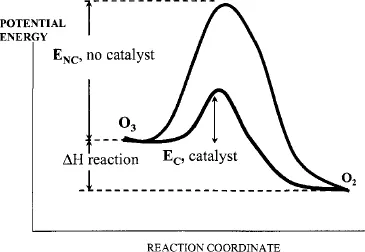
Adding both reactions results in Eq. (1.1) and completes the catalytic cycle since the Cl and ClO are both consumed and regenerated in the two reactions. Thus, Cl is a homogeneous catalyst for the destruction of O3. The uncatalyzed reaction is very slow, and its reaction profile can be described kinetically by the Arrhenius profile in which reactants convert to products by surmounting the noncatalytic activation energy barrier (ENC) as shown in Figure 1.1. The rate constant k of the reaction is inversely related to the exponential of the activation energy, where T is the absolute temperature, R is the universal gas constant, and ko is the preexponential constant. The Arrhenius equation (1.4) indicates that the rate constant k decreases the higher the activation energy (E).
FIGURE 1.1. Catalyzed and uncatalyzed reaction energy paths for O3 decomposition to O2. Activation energy for catalyzed reaction EC is lower, and the reaction is faster than the noncatalyzed ENC.
(1.4)
Since the catalyzed reaction has a lower activation energy (EC), its reaction rate is greater. The barrier was lowered by the Cl catalyst providing a chemical shortcut to products. Although the rate is greater for the catalyzed reaction, the enthalpy (ΔH) and free energy (ΔG) are not changed. Similarly the equilibrium constant for both catalyzed and noncatalyzed reactions is not changed since both operate under the same reaction conditions in the stratosphere. The catalyst can only influence the rate of which reactants are converted to products in accordance to the equilibrium constant and cannot make thermodynamically unfavorable reactions occur. In industrial practice, reactions conditions, such as temperature and pressure, are varied to bring the free energy to a desirable value to permit the reaction to occur.
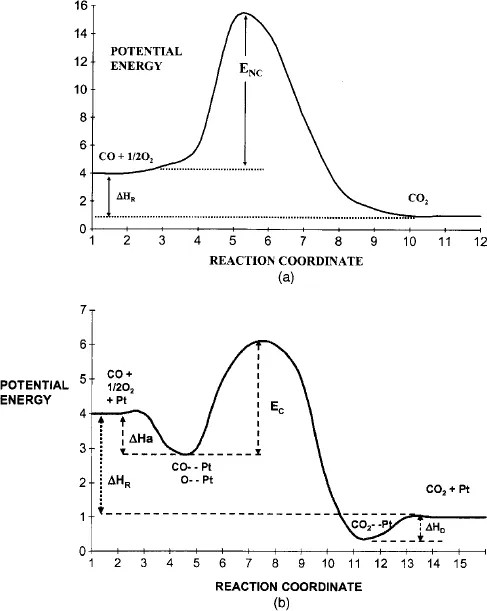
Now we will consider the conversion of carbon monoxide (CO), a known human poison, to CO2, a reaction of great importance to the quality of air we breathe daily. The overall rate of the noncatalytic reaction is controlled by the dissociation of the O2 molecule to O atoms (rate-limiting step), which rapidly react with CO forming CO2. The temperature required to initiate the dissociation of O2 is greater than 700°C, and once provided, the reaction rapidly goes to completion with a net liberation of energy (the heat of reaction is exothermic). The requirement to bring about the O2 dissociation and ultimately the conversion of CO to CO2 has an activation energy (ENC). Reaction occurs when a sufficient number of molecules (O2) possess the energy necessary (as determined by the Boltzmann distribution) to surmount the activation energy barrier (ENC) shown in Figure 1.2a). The rate of reaction is expressed in accordance with the Arrhenius equation (1.4). Typically the activation energy for the noncatalytic or thermal conversion of CO to CO2 is about 40 Kcal/mole.
FIGURE 1.2. Activation energy diagram for a) thermal reaction of CO and O2 and b) the same reaction in the presence of Pt. Activation energy for the noncatalyzed reaction is ENC. The Pt catalyzed reaction activation energy is designated Ec. Note that the heat of reaction ΔHR is the same for both reactions. ΔHa = heat of adsorption; ΔHD = heat of desorption.
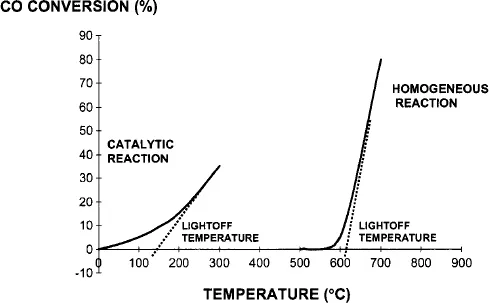
Let us now discuss the effect of passing the same gaseous reactants, CO and O2, through a reactor containing a solid catalyst. Since the process is now carried out in two separate phases, the term heterogeneous catalytic reaction is used. In the presence of a catalyst such as Pt, the O2 and CO molecules adsorb on separate sites in a process called chemisorption in which a chemical partial bond is formed between reactants and the catalyst surface. Dissociation of chemisorbed O2 molecules to chemisorbed O atoms is rapid, occurring essentially at room temperature. Highly reactive adsorbed O atoms react with chemisorbed CO on adjacent Pt sites producing CO2, which desorbs from the Pt site, completing the reaction and freeing the catalytic site for another cycle. Thus, the activation energy for the Pt catalyzed reaction (Ec), shown in Figure 1.2b), is considerably smaller than that for the noncatalyzed reaction, enhancing the conversion kinetics. Typically the activation energy for Pt catalyzed CO to CO2 is less than about 20 Kcal/mole. Figure 1.3 shows the initial lightoff of a conversion versus temperature plot for the catalyzed reaction occurring around 100°C. The noncatalyzed reaction has a considerably higher lightoff temperature (around 700°C) because of its higher activation energy. More input energy is necessary to provide the molecules the necessary energy to surmount the activation barrier so lightoff occurs at higher temperatures. It should be noted, however, that the noncatalyzed reaction has a greater sensitivity to temperature, (slope of plot). Thus, the reaction with the higher the activation energy has the greater sensitivity to temperature, making it increase to a greater extent with temperature than that with a lower activation energy. This is a serious problem for highly exothermic reactions, such as CO and hydrocarbon oxidation, where noncatalytic free radical reactions, with large activation energies, can lead to undesirable products. Thus, the temperature must be carefully controlled within the reactor.
FIGURE 1.3. Conversion of CO versus temperature for a noncatalyzed (homogeneous) and a catalyzed reaction.
Equations relating reaction rates to activation energies will be discussed in considerable detail in Chapter 4, but for now, it is sufficient to understand that an inverse relationship exists between the activation energy and the reaction rate.
The environmental significance of catalyzed reactions is now apparent; a r...
Table of contents
Cover
Half Title page
Title page
Copyright page
Dedication
Preface
Acknowledgments
Acknowledgments, First Edition
Acknowledgments, Second Edition
Part I: Fundamentals
Part II: Mobile Sources
Part III: Stationary Sources
Part IV: New and Emerging Technologies
Index
Trusted by 375,005 students
Access to over 1.5 million titles for a fair monthly price.
Study more efficiently using our study tools.
Frequently asked questions
Yes, you can cancel anytime from the Subscription tab in your account settings on the Perlego website. Your subscription will stay active until the end of your current billing period. Learn how to cancel your subscription
No, books cannot be downloaded as external files, such as PDFs, for use outside of Perlego. However, you can download books within the Perlego app for offline reading on mobile or tablet. Learn how to download books offline
Perlego offers two plans: Essential and Complete
Essential is ideal for learners and professionals who enjoy exploring a wide range of subjects. Access the Essential Library with 800,000+ trusted titles and best-sellers across business, personal growth, and the humanities. Includes unlimited reading time and Standard Read Aloud voice.
Complete: Perfect for advanced learners and researchers needing full, unrestricted access. Unlock 1.5M+ books across hundreds of subjects, including academic and specialized titles. The Complete Plan also includes advanced features like Premium Read Aloud and Research Assistant.
Both plans are available with monthly, semester, or annual billing cycles.
We are an online textbook subscription service, where you can get access to an entire online library for less than the price of a single book per month. With over 1.5 million books across 990+ topics, we’ve got you covered! Learn about our mission
Look out for the read-aloud symbol on your next book to see if you can listen to it. The read-aloud tool reads text aloud for you, highlighting the text as it is being read. You can pause it, speed it up and slow it down. Learn more about Read Aloud
Yes! You can use the Perlego app on both iOS and Android devices to read anytime, anywhere — even offline. Perfect for commutes or when you’re on the go. Please note we cannot support devices running on iOS 13 and Android 7 or earlier. Learn more about using the app
Yes, you can access Catalytic Air Pollution Control by Ronald M. Heck,Robert J. Farrauto,Suresh T. Gulati in PDF and/or ePUB format, as well as other popular books in Sciences physiques & Chimie organique. We have over 1.5 million books available in our catalogue for you to explore.