- 152 pages
- English
- ePUB (mobile friendly)
- Available on iOS & Android
About this book
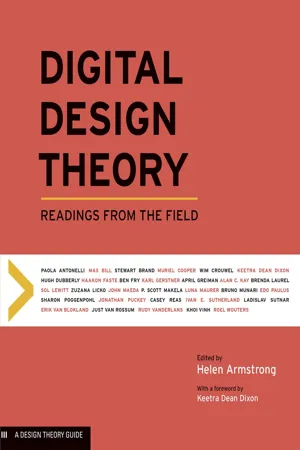
Digital Design Theory bridges the gap between the discourse of print design and interactive experience by examining the impact of computation on the field of design. As graphic design moves from the creation of closed, static objects to the development of open, interactive frameworks, designers seek to understand their own rapidly shifting profession. Helen Armstrong's carefully curated introduction to groundbreaking primary texts, from the 1960s to the present, provides the background necessary for an understanding of digital design vocabulary and thought.Accessible essays from designers and programmers are by influential figures such as Ladislav Sutnar, Bruno Munari, Wim Crouwel, Sol LeWitt, Muriel Cooper, Zuzana Licko, Rudy VanderLans, John Maeda, Paola Antonelli, Luna Maurer, and Keetra Dean Dixon. Their topics range from graphic design's fascination with programmatic design, to early strivings for an authentic digital aesthetic, to the move from object-based design and to experience-based design. Accompanying commentary assesses the relevance of each excerpt to the working and intellectual life of designers.
Frequently asked questions
- Essential is ideal for learners and professionals who enjoy exploring a wide range of subjects. Access the Essential Library with 800,000+ trusted titles and best-sellers across business, personal growth, and the humanities. Includes unlimited reading time and Standard Read Aloud voice.
- Complete: Perfect for advanced learners and researchers needing full, unrestricted access. Unlock 1.4M+ books across hundreds of subjects, including academic and specialized titles. The Complete Plan also includes advanced features like Premium Read Aloud and Research Assistant.
Please note we cannot support devices running on iOS 13 and Android 7 or earlier. Learn more about using the app.
Information
Table of contents
- Cover
- Title
- Contents
- Building Towards a Point of Always Building: A Visual Foreword
- Acknowledgments
- Introduction: Giving Form to the Future
- Timeline
- Section One: Structuring the Digital
- Theory at Work: 1960s–1970s
- Section Two: Resisting Central Processing
- Theory at Work: 1980–2000
- Section Three: Encoding the Future
- Theory at Work: 2000–Present
- Glossary
- Text Sources
- Bibliography
- Credits
- Index
- Colophon
- About the Author