How are "grey market" imports changing media industries? What is the role of piracy in developing new markets for movies and TV shows? How do jailbroken iPhones drive innovation?
The Informal Media Economy provides a vivid, original, and genuinely transnational account of contemporary media, by showing how the interactions between formal and informal media systems are a feature of all nations – rich and poor, large and small.
Shifting the focus away from the formal businesses and public enterprises that have long occupied media researchers, this book charts a parallel world of cultural intermediaries driving global media production and circulation. It shows how unlicensed, untaxed, or unregulated networks, which operate across the boundaries of established media markets, have been a driving force of media industry transformation. The book opens up new insights on a range of topical issues in media studies, from the creative disruptions of digitisation to amateur production, piracy and cybercrime.
- English
- ePUB (mobile friendly)
- Available on iOS & Android
eBook - ePub
The Informal Media Economy
About this book
Trusted by 375,005 students
Access to over 1.5 million titles for a fair monthly price.
Study more efficiently using our study tools.
Information
1
Formal and Informal Media
Television is a strongly regulated and centralized medium that has long been crucial to modernizing projects. From the early state control of television broadcasting before the Second World War, to technological developments drawing on wartime research and development, and the medium's mass appeal in postwar consumer economies, television was born in a period of remarkable formality. Today, many of these formal features are still in play. Broadcasting is a clearly defined global business with high barriers to entry and a limited pool of competitors. It attracts considerable scrutiny from state regulators, civil society groups, unions, business competitors and consumers. In most nations, broadcasters adhere to strict conditions regarding content and advertising and pay licence fees to the government. States control their radio spectrum and, in many cases, fund, or otherwise expect public broadcasters to fulfil, cultural policy objectives. Commercial television is the province of large, consolidated and diversified companies like Comcast and BSkyB (controlled by News Corp). These are among the most profitable, stable and regulated media companies in the world.
But this is not the end of the story. Throughout the television sector there is a wide variety of informal actors, from unlicensed broadcasters to pay-per-view pirates and grey hardware vendors. Anyone who has ever downloaded Breaking Bad, purchased a smart card from a stranger or leeched off a neighbour's cable connection has, wittingly or not, encountered the informal TV economy. Sometimes this informal economy dwarfs its legal counterpart, effectively becoming the norm. India is famous for its intricate system of off-the-books cable connections, run by local entrepreneurs – cable wallahs – who provide cheap, customized programming to their neighbourhoods. Pirate DVDs provide a bounty of content, and homes are connected using intricate networks of DIY wiring. Revenues – if declared at all – are underreported, and retransmitted content is probably unlicensed. Nonetheless, this system is massive and ubiquitous. More Indians get their TV from a local cable wallah than directly from any corporation. Nobody really knows how many viewers the informal cable economy serves in India; nor do we know how many programmers, card vendors, installers and repairers it employs. But the numbers are likely to be higher than the equivalent numbers for the legal cable business. Ravi Sundaram describes this economy as a form of ‘pirate modernity’: ‘private enterprise without classic capitalists, or classic workers, or legal industrial estates, without brands or legal monetary rents to the state’ (2009: 104).
It is perhaps tempting to think of these two worlds – the formal economy of corporate broadcasting and the informal, off-the-books TV economy – as existing in parallel, like train tracks that never cross, but this is not the case. Formal and informal economies are connected by exchanges of personnel, ideas, content and capital (we call these interactions). If we look back at the history of television we see that many formal companies started out as signal pirates before transforming themselves into legitimate operators, some even changing the rules of the game to suit themselves. Other formal companies rely on informal agents for market intelligence, technological innovation or free labour. Conversely, pirates depend on formal businesses for most of their content. Many also aspire to a career in the legitimate media sector, and frequently collaborate with established players when it is mutually beneficial to do so.
Understanding informality and formality in this way – as connected and co-dependent – invites us to view media in a new light. Too often, media industry change is presented as a singular trajectory: according to one reading, a one-way process of consolidation, corporatization and rationalization; according to another, ongoing fragmentation and disintermediation. In what follows, we offer a different kind of story about media industry history, which emphasizes the way formal and informal actors, from the largest corporations to the fly-by-night sole traders, are intertwined and interacting. This chapter introduces some analytic tools that can usefully interpret these interactions. Beginning with a simple binary (formal/informal) we build up to a dynamic model. Most examples are from one particular area of the media landscape, television – a relatively formal industry with enduring informal dimensions. Through these examples we tell a more general story about how formal and informal activities interact as a medium emerges, establishes and adapts.
From Binary to Spectrum
Analysing interactions between formal and informal media worlds requires us to think holistically about the media environment. A useful starting point is to ensure that our horizon is as inclusive as is possible, that it includes both the multinational broadcasters and the pirates. Most models for media industry analysis restrict their focus to the formal players, and if the informals are represented at all, they are merely noise around the regular system. We prefer to think about the informal economy as already integrated into the wider landscape, and to view media industries as encompassing both formal and informal sectors from the outset.
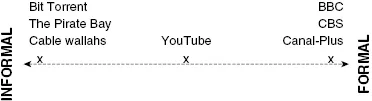
To represent this diversity, imagine a simple one-dimensional spectrum with formal systems located at one end and informal systems at the other (see Figure 1.1). Rather than a binary division, this schematic views informality/formality as a continuous line. Differences between the systems are variances of degree rather than fundamental oppositions. The line that connects the cable pirates and the CEOs is continuous, and – as we will see later – circuitous. From this starting point, we can begin to see systems, entities, actors and economies that combine formal and informal elements. Our ‘mid-spectrum’ example, YouTube, has both elements. The platform functions as a promotional vehicle for professional producers and a distribution system for unauthorized uploads and amateur content. The middle ground has not been easy territory: in fact, YouTube's position in this media landscape has been hotly contested. Broadcasters, producers and distributors have all sued YouTube at various points, challenging the legal status of this open, video sharing platform. YouTube survives because it has won most of these battles, but many other internet-based media services have failed. The attributes that distinguish the formal and the informal are often the result of such conflicts. When we look closely at the establishment of boundaries, through legal change, regulatory realignment, corporate fiat or other forms of official power, we find that the boundary between formal and informal actors – between pirates and legitimate broadcasters, for example – often turns out to be movable and permeable.
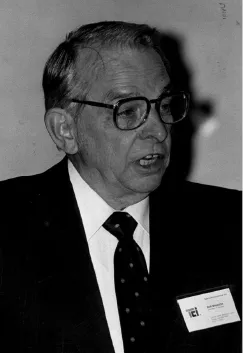
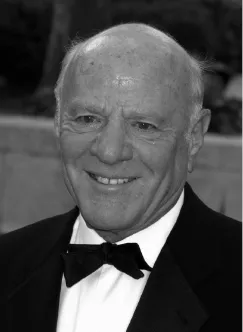
The history of cable television in the United States provides a clear example of the contingency of these boundaries. Early cable companies like Bob Magness's Tele-Communications Incorporated (TCI) were essentially free-riders: they rebroadcast the free-to-air signals of the national TV networks (Robichaux 2003). Entrepreneurs prospered by picking out neighbourhoods where over-the-air signals were poor, then installed basic cabling and energetically signed up TV-deprived residents for low monthly payments. They did not have permission from broadcasters to use their signals in this way. From the point of view of the major networks, this was piracy or ‘signal theft’. Carriage disputes of this kind remain endemic in multi-platform television systems. Since 1992, US law has required ‘transmission consent’, formalizing a system of payments back to the networks. A similar conflict – with a different outcome – has marked the emergence of internet streaming services. Former Paramount and Fox executive Barry Diller backed a company called Aereo, a ‘loophole start-up’ that began by allowing its subscribers to watch live broadcast TV over the internet. Aereo's service was useful for cable ‘cord-cutters’ and for people who live in areas with poor reception or have no free-to-air antenna, but the legality of Aereo's business model was always uncertain. Aereo did not pay networks for their signals; it presented itself as a personal video recording service, using ‘farms’ of thousands of tiny antennas (one per subscriber), capturing broadcast signals that were then streamed to the devices of individual customers. Predictably, the networks sued Aereo for copyright violation. Aereo won the first round, but a Supreme Court ruling in 2014 disagreed and spelt the end of Aereo's operations.

This story of regulatory uncertainty and mobile legal boundaries is common to many parts of the world. Throughout Mediterranean Europe, broadcasting was an extra-legal activity for decades. Greece had a tightly state-controlled TV environment until 1987 when it underwent a rapid and messy process of deregulation. The result was a proliferation of local operations run by aspiring moguls. Unlicensed stations sprang up overnight. These operated as legitimate businesses, screening advertisements for clients and creating their own programming, but were technically illegal because they had no official authorization to broadcast. Around 50 per cent of the movies they screened may also have been pirated (USTR 2001). Italy is another interesting case. Since the 1970s, Italy's loose system of television licensing meant the distinction between legal and illegal media business was uncertain. Alongside the state-owned national broadcaster RAI, private broadcasters were permitted to broadcast their signals locally. This right to broadcast was allocated on a first-come, first-served basis, resulting in a flood of entrants into the market; by 1985 Italy had more than 1300 TV stations – the highest number per capita in the world (Noam 1987; Balbi and Prario 2010). Silvio Berlusconi built a huge media empire in the cracks between Italy's chaotic broadcast laws. Shuttling videotapes around the country, he stitched together a national advertising system and openly flouted the ban on country-wide broadcasting. His company Mediaset would become one of Europe's most powerful conglomerates, with operations in every corner of Italy and throughout Eastern and Western Europe. RAI's monopoly was effectively broken. In 1990 Italy's media laws were completely rewritten to favour Mediaset, meaning that a RAI/Mediaset duopoly was effectively authorized by the state. Built outside the law, Berlusconi's media business was given the imprimatur of the Italian parliament, and an informal empire was formalized. As Noam notes, Italy's ‘transformation from state-run to privately owned TV is not the result of government policy, but was caused by the entrepreneurial initiatives of broadcast “pirates” w...
Table of contents
- Cover
- Title page
- Copyright page
- Preface
- Introduction
- 1: Formal and Informal Media
- 2: Entrepreneurs
- 3: Work
- 4: Geographies
- 5: Regulation
- 6: Brands
- 7: Metrics
- Conclusion
- References
- Index
- End User License Agreement
Frequently asked questions
Yes, you can cancel anytime from the Subscription tab in your account settings on the Perlego website. Your subscription will stay active until the end of your current billing period. Learn how to cancel your subscription
No, books cannot be downloaded as external files, such as PDFs, for use outside of Perlego. However, you can download books within the Perlego app for offline reading on mobile or tablet. Learn how to download books offline
Perlego offers two plans: Essential and Complete
- Essential is ideal for learners and professionals who enjoy exploring a wide range of subjects. Access the Essential Library with 800,000+ trusted titles and best-sellers across business, personal growth, and the humanities. Includes unlimited reading time and Standard Read Aloud voice.
- Complete: Perfect for advanced learners and researchers needing full, unrestricted access. Unlock 1.5M+ books across hundreds of subjects, including academic and specialized titles. The Complete Plan also includes advanced features like Premium Read Aloud and Research Assistant.
We are an online textbook subscription service, where you can get access to an entire online library for less than the price of a single book per month. With over 1.5 million books across 990+ topics, we’ve got you covered! Learn about our mission
Look out for the read-aloud symbol on your next book to see if you can listen to it. The read-aloud tool reads text aloud for you, highlighting the text as it is being read. You can pause it, speed it up and slow it down. Learn more about Read Aloud
Yes! You can use the Perlego app on both iOS and Android devices to read anytime, anywhere — even offline. Perfect for commutes or when you’re on the go.
Please note we cannot support devices running on iOS 13 and Android 7 or earlier. Learn more about using the app
Please note we cannot support devices running on iOS 13 and Android 7 or earlier. Learn more about using the app
Yes, you can access The Informal Media Economy by Ramon Lobato,Julian Thomas in PDF and/or ePUB format, as well as other popular books in Social Sciences & Media Studies. We have over 1.5 million books available in our catalogue for you to explore.