eBook - ePub
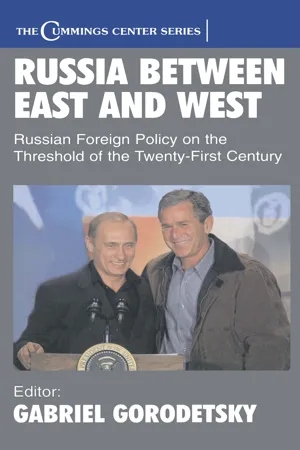
Russia Between East and West
Russian Foreign Policy on the Threshhold of the Twenty-First Century
- 206 pages
- English
- ePUB (mobile friendly)
- Available on iOS & Android
eBook - ePub
Russia Between East and West
Russian Foreign Policy on the Threshhold of the Twenty-First Century
About this book
Gabriel Gorodetsky unravels President Putin's efforts to re-establish Russia's position as a major power, attempting to reconcile Russia's traditional national interests with the newly emerging social and political entity taking shape at home.
Information
Part I:
A Great Power in Transition Faces Globalization
1
The New Russia and the New World Order
In the aftermath of the Cold War the structure of international relations is in a state of transformation, and the nature of the New World Order remains an open question. The international community can and must determine the path it intends to take. One can only hope that its choice will correspond to the changes taking place in international relations.
Russian policy envisages a multipolar path for the evolution of international relations. This idea is reflected in a range of documents, such as the new version of the National Security Doctrine (approved by the President of the Russian Federation on 10 January 2000). The principle of multipolarity has, consequently, been adopted as the official doctrine of Russian foreign policy. This particular orientation took shape gradually. Although the idea of ‘polycentrism in international policy’ was expressed as early as 1993, in the foreign policy doctrine developed under Foreign Minister Andrei Kozyrev, practical conclusions were never drawn.
It should be noted that Russian political scientists do not share a uniform view of multipolarity. Arguments can be heard that multipolarity is not only incorrect but even harmful to Russia’s national interests; that it corresponds to the realities of world development even less than the idea of US leadership; that it does not provide a complete picture of the contemporary world; that it establishes false guidelines, and so forth. These divergent opinions and assessments can be explained mostly by the fact that the problems of the evolution of international relations since the end of the Cold War have been insufficiently studied. But, on the whole, analysis of the various points of view on this topic shows that the opponents of multipolarity are unable to raise serious objections to a multipolar world system. By and large the matter comes down to disagreements over Russia’s foreign policy orientation: some propose a tilt towards the West, others towards Asia, and yet others, towards the USA.
Meanwhile, a multipolar world system is already a reality. In fact, it also existed during the period of bipolarity, but at that time the entire diversity of world development was reduced to the formula of ‘class’ relations between the two military–political blocs and their leaders. As soon as bipolarity vanished from the stage of world politics, the role of national interests acquired a remarkable new significance. Many states belonging to structures whose existence had been dictated by the logic of confrontation between the two blocs found themselves in an awkward position. The shadows of the past gradually disappeared leading to an erosion of the former single-bloc orientation. It is no longer possible to realize national interests within the framework of one bloc alone. This is especially true for large states, of which Russia is one.
Multipolarity is created, first and foremost, by economic, military and political factors rather than by global cultural diversity, which is linked more with civilizational than with ‘polar’ traits. Secondly, it takes into account, de facto, both the established centres of gravity and influence that have formed in international relations and the newly emerging ‘poles’ at the regional and sub-regional levels. Thirdly, multipolarity not only ‘continues’ history but also responds to globalization and its consequences for international relations. Fourthly, it opens up prospects for democratization and the humanization of international relations.
Multipolarity can therefore be seen not just as another ideological scheme but also as an objective condition of international relations, which gradually ripened even at the height of the Cold War but which became clearly manifested only after its end. Therefore, multipolarity represents an entirely realistic perspective for the further evolution of the contemporary world.
Contemporary international relations in the epoch of globalization could develop along a variety of potential paths. This is also true of the possible configurations of multipolarity. One determining factor is globalization, which is changing the economic, social, cultural and informational environment of human life. On the one hand, it leads to increasing interdependency among countries with regard to practically all aspects of their national interests. On the other hand, the vulnerability of countries to external factors in their quest to ensure stable and progressive development is becoming ever more apparent. Therefore, the state of the international arena has become, as never before, a major challenge to nation-states.
It should be noted that the collapse of the bipolar structure of international relations and the concurrent process of globalization has created a qualitatively new situation in international relations and generated numerous problems that require either new analysis or modification of previous interpretations. In particular, the question of the subjects of international relations requires a new analysis. There seem to exist other players in world affairs besides the state. Non-governmental organizations and multinational corporations are playing an increasingly prominent role. Their very existence serves to democratize international life. The number of regional organizations of various types is growing, as is their influence on events on the regional level and beyond. Therefore there is a need for non-traditional approaches to the formation of political doctrines for a modern world system that address the conditions of the twenty-first century.
Moreover, we should bear in mind that globalization and the further evolution of international relations are mutually intertwined, but nonetheless independent, processes. Each has its own roots and its own internal driving forces of development. At the root of international relations lie the national interests of states. Globalization exerts an influence on national interests, transforms their content, particularly in the economic and financial spheres, but in no way eliminates or replaces them. It does not eliminate the disparity between national interests, but rather seeks their compatibility and consolidation in pursuit of security and stability. It would be a serious mistake to ignore the autonomy of these two processes. This remark is necessary, since there are attempts to dissolve international relations in the wake of globalization, on the assumption that the latter is the totally dominant trend.
One of the positive consequences of globalization is the growing range of possibilities that states have for pursuing their national interests as members of the world community. Previous limitations on choice are disappearing and there is an increasing diversification of political and economic ties. This is apparent even among members of military–political alliances. The emerging multipolarity provides broad opportunities for national–political autonomy beyond the determining force of economic factors. Hence, when speaking of multipolarity, it should be remembered that states have new possibilities for realizing their national interests. And yet, it should be borne in mind that globalization can also lead to the manipulation and distortion of the transformation that is taking place in the world community.
The process of globalization is developing unevenly, and this is most apparent in the formation of integrated economic ‘poles’ characterized by a fairly high level of density of economic connections and complex interdependency. It is precisely these poles that occupy the leading position in the world economy today. Their existence and interaction provide the basis for economic multipolarity in international relations. Therefore, when the USA is characterized as the sole superpower in the world, it should not be forgotten that, for all its significance, its share of gross world production is just over 20 per cent.
At the present time, several dozen integrated economic coalitions exist, with varying degrees of maturity. The most advanced is the framework of the European Union (EU), which has set itself the goal of forming a fully fledged political entity and pole of international relations with a single currency and economic, foreign and military policy. This will represent the consolidated interests and functions of the member states of the EU. To a certain extent, we are witnesses to a unique historical experiment – the birth in Europe of something like a new species of cooperative superpower.
The tendency towards integration on the regional and sub-regional levels is a general feature of the development of international relations, particularly since the 1970s. Such integration qualitatively changes the structure and orientation of international collaboration. Moreover, it is compounded by the development of connections on the inter-coalition and inter-regional levels, as evidenced by the collaboration now gaining momentum between the EU and Latin American integrated groups, between the regional organizations of Europe and Asia, Asia-Pacific and Latin America. World economic expansion will gradually take shape as a result of the interaction among integrated unions.
The advantages of globalization are realized precisely on the level of regions and integrated unions. At the same time, the integration of state economies makes it possible to mitigate the negative aspects of globalization, since it is on this level that opportunities appear to create cooperative mechanisms for managing these processes and reducing the costs of globalization for nation-states. Consequently, integrated unions fulfil a clearly defensive function. On a global level, mechanisms have not yet emerged for the management of these processes, as demonstrated by the scale of the recent Asian economic crisis which dealt such a painful blow to Russia’s weak market economy. In other words, it is easier to implement management strategies successfully on the level of integrated unions than on either the national or the global level. Inter-regional ties can also be viewed in relation to the establishment of methods to regulate globalization processes. It is clear that economic integration demands increasingly intensive coordination between the actions of states in the political sphere as well.
In summing up this brief analysis of these phenomena, I would like to emphasize above all the regional scale of multipolarity, the integrated alliances that form its framework and their growing influence on the behaviour of states. Their integrative and defensive functions should be examined when considering the further evolution of contemporary international relations.
Of course, not all existing economic groups can become world-class poles, but their significance on the regional and sub-regional levels cannot be ignored. Multipolarity in contemporary international relations means today a limited number of poles, without any one pole possessing absolute power. Let us look into the economic sphere of international relations which has changed fundamentally since the 1970s. Today in the economic sphere, the USA and the EU account for approximately 21 per cent each of gross world production, while the share of Japan, China and ASEAN (Asssociation of South East Asian Nations) amounts to more than 20 per cent. Prognoses suggest that, by 2015, the share of both the USA and the EU will have diminished relatively, while the share of China and Japan will increase along with that of the entire Asian group, whose share will amount to practically one-quarter of the gross world product.
In this arena, Russia is an insignificant force with slightly over 1.5 per cent of gross world production. But this is a country with enormous, though as yet unrealized, potential, possessing 15–20 per cent of the world’s estimated oil reserves, 42 per cent of its natural gas and 43 per cent of its coal. In terms of its GNP, Russia falls between the tenth and twentieth place among the most developed nations. However, the country’s intellectual property is assessed at US$400 billion and it has significant potential in the area of high technology.
To economic can be added monetary multipolarity, which is already a salient tendency. Until recently, the world monetary system has been tied to the American currency – more than half of world trading accounts are settled in dollars, which has placed the USA in a significantly advantageous position. However, the introduction by the EU of a single currency has removed this asymmetry, undermining the strategic position of the USA and narrowing the dollar’s living space’. The consolidation of Asian countries in the financial sphere could have far-reaching consequences for the American dollar. This is precisely what was demonstrated by the initiative of the finance ministers of the ASEAN countries, the Republic of Korea, Japan and China, at their meeting in Chiang Mai (Thailand), which has resulted in the establishment of an Asian monetary fund. As we see, even in this sphere of international financial and economic relations, monetary unipolarity is being eroded.
The USA has unequivocal hegemony in the military sphere and in the field of high technology. At the same time, the EU’s determination to establish its autonomous military potential is clearly aimed at overcoming just this situation. The EU has also announced its intention to ‘catch up’ with the USA in the sphere of high technology.
Naturally, there are other states apart from the USA that can be counted as relatively independent ‘poles’. States such as China, India, Russia and a number of Latin American countries possess sufficient resources to ensure their own development (putting aside, for now, an assessment of the quality of this development, which is a separate topic), but even they do not shun various forms of integration with other states.
Of course, multipolarity in international relations does not mean the quest for some kind of ideal recipe or panacea for all the abundant threats and misfortunes afflicting the human race. Nonetheless, only a multipolar world system in all its diversity can provide a genuine framework for ensuring the balance of interests among the participants in global processes. The main point is not the number of poles but the very nature of international relations, which cannot but reflect multipolarity. Specifically, multipolarity is incompatible with hegemony in international relations. It is increasingly evident that the urge of a single state or group of countries to dominate global politics and economics contradicts the fundamental principles of contemporary international relations. In this sense, multipolarity is the obvious alternative in so far as it is based on consideration of the national interests and sovereignty of states.
Therefore, when the Russian delegation proposed to the countries of the G8 its doctrine for peace in the twenty-first century, it proceeded from the assumption that the democratization of international relations should be an inextricable element of peace in the coming century. The affirmation and observation of democratic norms and principles in internal state policy, the establishment of a civil society, will undoubtedly have a beneficial influence on international relations, but only on condition that democratic states apply to international affairs the values that prevail in their own domestic affairs. The use of military force and interference in the internal affairs of sovereign states can hardly be included among these democratic values.
A theoretical analysis of multipolarity in international relations is significant in and of itself, but it also has practical value: it should enable the Russian government to determine the most appropriate parameters and gu...
Table of contents
- Cover
- Halftitle
- Title
- Copyright
- Contents
- List of Abbreviations
- Introduction
- Part I: A Great Power in Transition Faces Globalization
- Part II: Russia’s Road into Europe
- Part III: A Northern Passage
- Part IV: The Southern Tier and the Middle East
- Part V: Rethinking the Far East
- Notes on Contributors
- Index
Trusted by 375,005 students
Access to over 1.5 million titles for a fair monthly price.
Study more efficiently using our study tools.
Frequently asked questions
Yes, you can cancel anytime from the Subscription tab in your account settings on the Perlego website. Your subscription will stay active until the end of your current billing period. Learn how to cancel your subscription
No, books cannot be downloaded as external files, such as PDFs, for use outside of Perlego. However, you can download books within the Perlego app for offline reading on mobile or tablet. Learn how to download books offline
Perlego offers two plans: Essential and Complete
- Essential is ideal for learners and professionals who enjoy exploring a wide range of subjects. Access the Essential Library with 800,000+ trusted titles and best-sellers across business, personal growth, and the humanities. Includes unlimited reading time and Standard Read Aloud voice.
- Complete: Perfect for advanced learners and researchers needing full, unrestricted access. Unlock 1.5M+ books across hundreds of subjects, including academic and specialized titles. The Complete Plan also includes advanced features like Premium Read Aloud and Research Assistant.
We are an online textbook subscription service, where you can get access to an entire online library for less than the price of a single book per month. With over 1.5 million books across 990+ topics, we’ve got you covered! Learn about our mission
Look out for the read-aloud symbol on your next book to see if you can listen to it. The read-aloud tool reads text aloud for you, highlighting the text as it is being read. You can pause it, speed it up and slow it down. Learn more about Read Aloud
Yes! You can use the Perlego app on both iOS and Android devices to read anytime, anywhere — even offline. Perfect for commutes or when you’re on the go.
Please note we cannot support devices running on iOS 13 and Android 7 or earlier. Learn more about using the app
Please note we cannot support devices running on iOS 13 and Android 7 or earlier. Learn more about using the app
Yes, you can access Russia Between East and West by Gabriel Gorodetsky in PDF and/or ePUB format, as well as other popular books in Política y relaciones internacionales & Historia militar y marítima. We have over 1.5 million books available in our catalogue for you to explore.