Culinary Taste: Consumer Behaviour in the International Restaurant Sector looks at the factors that influence our culinary tastes and dining behaviour, illustrating how they can translate into successful business in industry.
With a foreword from Prue Leith, restaurateur, author, teacher, and prolific cookery writer and novelist, and a list of well-known and respected international contributors from the UK, France, Australia and Hong Kong, this text discusses the issues involved from a multitude of angles.
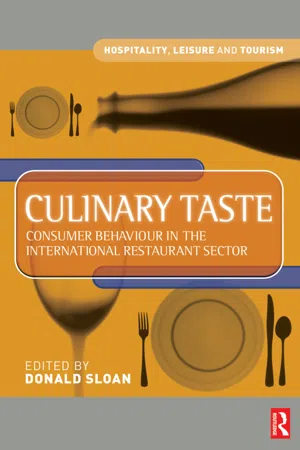
- 208 pages
- English
- ePUB (mobile friendly)
- Available on iOS & Android
eBook - ePub
Culinary Taste
About this book

The social construction of taste
This chapter examines the argument that taste is socially constructed and that the food tastes we have and the choices we make about what to eat are determined by social factors. For example, although man is omnivorous, the cultural rules governing what is defined as good to eat, the way it is prepared, cooked or not cooked, served and eaten vary between cultures in often quite dramatic ways (Scholliers, 2001), and these definitions change through time (Elias, 1978). Thus it is possible to conceive of the construction of taste as occurring within a framework of rules at different levels; the level of culture generally, including cultural rules expressed in food ways or cuisine, filtered through other layers such as region, religion, class, caste, gender, family and so on. This explains how individual tastes can be different within a family; choices are indeed different but they are made within a relatively narrow framework of possibilities provided by position in the social structure. There are in addition the influences of medical advice, the state and of food suppliers. However, this chapter focuses on the arguments concerning the influence of social class in particular.
Bourdieu and the Social Construction of Taste
Any discussion of the social construction of taste must begin with the seminal work of the French sociologist, Pierre Bourdieu. Bourdieu was not just interested in cultural tastes but also in the way in which taste arises out of and is employed in struggles for social recognition and status. In 1979 he published ‘Distinction: a social critique of the judgement of taste’, a work which drew together his thinking across a range of disciplines and which explores the lifestyles of France’s class structure (Bourdieu, 1984). Supported by an analysis of statistical data already in the public domain, he argued that our taste, and indeed all our consumption behaviour, is an expression of social class. Different social classes can be identified by the way in which they express their tastes in music, art, clothes, home decoration and of course the food they eat. However, his analysis of class does not depend on simple economic or materialist criteria. Nor does he argue that the construction of taste is a simple outcome of the deterministic processes of occupation or income: this is what makes his ideas on the social construction of taste so interesting and powerful.
Habitus
The concept of habitus is the link between the objective and the subjective components of class, that is, class as determined by largely economic factors, and class as a set of practices, dispositions and feelings. Habitus refers to the everyday, the situations, actions, practices and choices which tend to go with a particular walk of life and an individual’s position in the social world (this includes, e.g. gender and race as well as class). Habitus therefore, can be seen as including a set of dispositions, tendencies to do some things rather than others and to do them in particular ways rather than in other ways. Habitus does not, therefore determine our practices, but it does make it more likely that we will adopt certain practices rather than others. The link with objective class position comes through a consideration of how habitus is acquired. To suggest that it is learned implies a self-consciousness that is absent in Bourdieu’s conception. Here we need to draw on the concept of socialization to capture the way in which, although habitus is learned, this learning is acquired in an unselfconscious way simply by being immersed in a particular social milieu. The dispositions acquired through habitus are the ways of doing things that those sharing a particular social position think of as natural and obvious, common sense, and taken for granted. These dispositions do not prevent us from behaving in other ways, that is, they do not proscribe what we can or cannot do through a set of rules, but the patterns of behaviours common to a particular habitus become inculcated in our sense of who and what we are. So habitus disposes individuals to make certain choices. While we do not choose practices as free individuals, neither are we forced or impelled into them; rather we behave in ways which seem obvious and reasonable given our social milieu. Thus habitus could be overridden by other considerations in certain circumstances; for example, rational calculation where an individual realizes that the way he or she is disposed to behave in a particular context is not the best response to that context (Bourdieu, 1979, p. 122). However, since habitus is embedded in class position, choices and tastes are a matter of class rather than of individual personality, or in other words our tastes are socially rather than individually constructed. Habitus and lifestyle on the one hand, and class position on the other, set limits on one another which, while not excluding the caviar eating road digger, make such a choice less likely. The tendency is that individuals sharing a particular habitus (and therefore class position) will react in similar ways, make similar choices and share similar judgements of tastes.
Habitus and Social Class
This brings us to a consideration of the class-based source of habitus. For Bourdieu, class position is not based crudely on the possession or non-possession of the means of production as in Marxist materialistic conceptions of class. He draws on the work of Weber, which allows him to identify different classes and fractions of classes in a hierarchical schema rather than to see class in terms of two classes in opposition to one another, although he retains the notion of struggle between the classes (to be considered further later). Bourdieu sees class as determined by the possession of differing amounts of different forms of capital. In simple economic terms, capital is what results from production, and in turn it goes towards feeding more production. For example, a restaurant is a form of economic capital. Once built, it is used to make other things (meals). The raw materials used and the money to buy them with are also forms of capital. Capital thus comes from production and in turn feeds more production; capital reproduces production. However, Bourdieu, in contrast to Marx, who only considered economic capital, extends the idea of capital to other aspects of the social, which he argues are themselves social products which are circulated and which can be used to produce further capital. Of these, cultural capital and symbolic capital are the most significant for our purposes, and are discussed further below.1
Non-Economic Forms of Capital
So, then, economic capital is to do with products of the economy (goods and money). Cultural capital is to do with the circulation of cultural products and the reproduction of cultural relations. Cultural capital comes from possessing the kind of knowledge and familiarity with cultural products which enable a person to know how they work, what to say about them and how to appreciate and evaluate them. In essence, how to consume them. Cultural capital is acquired through immersion in habitus; it can be accumulated during a lifetime and passed on from generation to generation in just the same way as economic capital. Cultural capital may come from the actual possession of certain culturally valued artefacts such as paintings. It may derive from activities such as going to the opera or from appreciating fine wine, or from knowledge about cultural products.
Bourdieu distinguishes between legitimate, middlebrow and working class culture and identifies the tastes associated with each of these categories, and for class fractions within them. While it is possible to acquire legitimate cultural capital (i.e. the definitions and judgements of taste possessed by the dominant classes) through individual effort or education, such expressions of learned tastes do not have the same status and social standing as tastes which appear to be natural or innate.
The myth of an innate taste … is just one of the expressions of the recurrent illusion of a cultivated nature predating any education. (Bourdieu et al., 1991, p. 109)
Thus to be cultivated, to be a master in the judgement of taste, an appreciation of high culture must appear to be innate:
Culture is only achieved by denying itself as such, namely as artificial and artificially acquired. (Bourdieu et al., 1991, p. 110)
Cultivated individuals experience their own distinction as taken for granted and natural, as a mark of their social value. It follows then that the working classes must lack the necessary nature for a proper enjoyment of cultural products, and that this explains their infrequent attendance at museums and galleries, their consumption of heavy food and so on. To grow up in a habitus which inculcates cultural capital is clearly an advantage in other spheres. For example, Bourdieu argued that the cultural capital possessed by the dominant classes enabled them to acquire educational capital much more easily than the lower classes. The disposition to succeed in the educational system and the familiarity with the codes and symbols of education, all part of the habitus of the dominant classes, (Wilkes, 1990) leads to the perpetuation of privilege, as educational capital can then be converted into economic capital in the form of well paid jobs.
Symbolic capital is a form of cultural capital which refers to the sphere of signs. All aspects of social behaviour carry the potential to operate as a sign, or symbol, of an individual’s position. For example, the type of car an individual drives, where he or she shops, what they wear, all these things carry messages. However, the way in which the messages or signs are interpreted may vary depending on the relative positions of the bearer and the observer:
Each lifestyle can only really be construed in relation to the other, which is its subjective and objective negation, so that the meaning of behaviour is totally reversed depending on which point of view is adopted. (Bourdieu, 1984, p. 193)
Thus, what is valuable symbolic capital in one group is not necessarily worth much in another once these practices are removed from the particular habitus which gives them value. In this way, articles, behaviours and bodily gestures which signify membership of a particular class or class fraction may earn disapproval from members of a different habitus. Various forms of cultural capital compete to assert their own value, and the status of those who hold them. In this struggle, it is the cultural forms and symbols belonging to the most powerful social groups which are able to assert their definition as legitimate culture. So the signs and symbols used by the dominant classes to act as markers for their superior position acquire cultural legitimacy because of this very association with a superior habitus. Further, they present themselves not as arbitrary judgements of taste but as natural, and it is the culture of these dominant groups which define all others in their own terms, seeing the culture of subordinate groups as tasteless.
Different forms of capital can be exchanged for other forms of capital. Economic capital can be invested in cultural or symbolic capital and cultural capital can be converted into economic capital. The possession of varying amounts of different forms of capital produces and maintains class distinctions and fractions within classes. For example although in contemporary societies economic capital is the dominant form of capital which supports the broad class categories of upper class, middle class and working class, within these broad categories there are fractions distinguished by their possession or non-possession of cultural and symbolic capital. Bourdieu distinguishes, for example, within the upper classes, the dominant fraction of the dominant class (a fraction which possess high amounts of economic capital but relatively lower amounts of cultural capital) and the dominated fraction of the dominant class (a fraction which possesses high amounts of cultural capital but relatively less economic capital). These class fractions produce different habituses, and distinguish themselves by their different tastes. The appropriation of cultural practices by the dominant classes enables them to have a sense of distinction deriving from their habitus of legitimately established domination and the power to define and establish the boundaries of taste. The middle classes are characterized by what Bourdieu calls ‘cultural good-will’ (Bourdieu, 1979, p. 370); middle class habitus assumes the tone of conformity with the tastes of the dominant class to whose position they aspire, and which enables them to distinguish themselves from the working class. The expression of taste for this class will therefore ape (as far as economic and cultural capital will allow) the taste of the class above and will be characterized by a respect for culture, over-conventionality and over-conformity. However, the bourgeois sense of ease and belonging is absent for the middle classes whose acquisition of cultural practices is only acquired through effort and application. In terms of eating out for example, upwardly mobile middle class groups seeking to copy the restaurant choices or restaurant behaviours of the upper classes might not feel altogether at ease, might feel out of their depth or might struggle to enjoy the food. In addition, of course, their relative lack of economic capital would mean that the cost of this sort of meal could only be justified for a special occasion, adding to the sense of unease. For the working classes taste is the choice of the necessary; a working class habitus is established out of the necessity for the material conditions of existence which values and makes a virtue of the plain, the unpretentious, the useful, ...
Table of contents
- Cover
- Title Page
- Copyright
- Contents
- Acknowledgements
- Contributors
- Foreword (Prue Leith)
- Introduction (Donald Sloan)
- 1. The social construction of taste (Diane Seymour)
- 2. The postmodern palate: dining out in the individualized era (Donald Sloan)
- 3. Taste and space: eating out in the city today (David Bell)
- 4. Chic cuisine: the impact of fashion on food (Joanne Finkelstein)
- 5. The shock of the new: a sociology of nouvelle cuisine (Roy C. Wood)
- 6. Contemporary lifestyles: the case of wine (Marion Demossier)
- 7. Shaping culinary taste: the influence of commercial operators (We are what we eat, or what we are persuaded to eat?) (Maureen Brookes)
- 8. Gender and culinary taste (Roy C. Wood)
- 9. Developing a taste for health (David Fouillé)
- 10. My most memorable meal ever! Hospitality as an emotional experience (Conrad Lashley, Alison Morrison and Sandie Randall)
- Index
Trusted by 375,005 students
Access to over 1.5 million titles for a fair monthly price.
Study more efficiently using our study tools.
Frequently asked questions
Yes, you can cancel anytime from the Subscription tab in your account settings on the Perlego website. Your subscription will stay active until the end of your current billing period. Learn how to cancel your subscription
No, books cannot be downloaded as external files, such as PDFs, for use outside of Perlego. However, you can download books within the Perlego app for offline reading on mobile or tablet. Learn how to download books offline
We are an online textbook subscription service, where you can get access to an entire online library for less than the price of a single book per month. With over 1.5 million books across 990+ topics, we’ve got you covered! Learn about our mission
Look out for the read-aloud symbol on your next book to see if you can listen to it. The read-aloud tool reads text aloud for you, highlighting the text as it is being read. You can pause it, speed it up and slow it down. Learn more about Read Aloud
Yes! You can use the Perlego app on both iOS and Android devices to read anytime, anywhere — even offline. Perfect for commutes or when you’re on the go.
Please note we cannot support devices running on iOS 13 and Android 7 or earlier. Learn more about using the app
Please note we cannot support devices running on iOS 13 and Android 7 or earlier. Learn more about using the app
Yes, you can access Culinary Taste by Donald Sloan,Prue Leith in PDF and/or ePUB format, as well as other popular books in Business & Consumer Behaviour. We have over 1.5 million books available in our catalogue for you to explore.