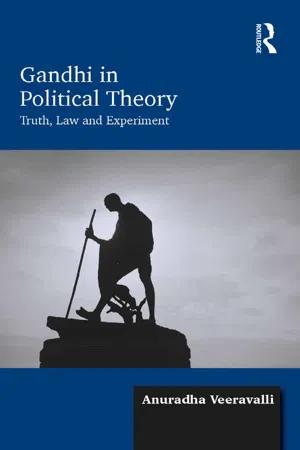
- 166 pages
- English
- ePUB (mobile friendly)
- Available on iOS & Android
eBook - ePub
About this book
Can Gandhi be considered a systematic thinker? While the significance of Gandhi's thought and life to our times is undeniable it is widely assumed that he did not serve any discipline and cannot be considered a systematic thinker. Despite an overwhelming body of scholarship and literature on his life and thought the presuppositions of Gandhi's experiments, the systematic nature of his intervention in modern political theory and his method have not previously received sustained attention. Addressing this lacuna, the book contends that Gandhi's critique of modern civilization, the presuppositions of post-Enlightenment political theory and their epistemological and metaphysical foundations is both comprehensive and systematic. Gandhi's experiments with truth in the political arena during the Indian Independence movement are studied from the point of view of his conscious engagement with method and theory rather than merely as a personal creed, spiritual position or moral commitment. The author shows how Gandhi's experiments are illustrative of his theoretical position, and how they form the basis of his opposition to the foundations of modern western political theory and the presuppositions of the modern nation state besides envisioning the foundations of an alternative modernity for India, and by its example, for the world.
Information
Chapter 1
Introduction: Truth, Law and Experiment in Political Theory
I believe in absolute oneness of God and, therefore, also of humanity. What though we have many bodies? We have but one soul. The rays of the sun are many through refraction. But they have the same source, I cannot therefore detach myself from the wickedest soul (nor may I be denied identity with the most virtuous). Whether, therefore, I will or not, I must involve in my experiment, the whole of my kind. Nor can I do without experiment. Life is but an endless series of experiments.
Gandhi, Young India, 25–9–19241
I THINK that the word “saint” should be ruled out of present life. It is too sacred a word to be lightly applied to anybody, much less to one like myself who claims only to be a humble searcher after Truth, knows his limitations, makes mistakes, never hesitates to admit them when he makes them, and frankly confesses that he, like a scientist, is making experiments about some “of the eternal verities” of life, but cannot even claim to be a scientist because he can show no tangible proof of scientific accuracy in his methods or such tangible results of his experiments as modern science demands.
Gandhi, Young India, 12–5–19202
There is a growing awareness of the significance and need for a Gandhian approach to crises that confront societies, political economies, and nation states the world over. It could be said that there was a sense of that even in Gandhi’s time. Witness to two World Wars, young men and women from the world over joined him in his Ashram, where the pilot tests of his experiments with Truth and non-violence were held. He had reinvented the traditional hermitage, with etymological precision and incisiveness, to mean ‘place of labour’ and to serve, like its etymological analogue ‘labor-atory’, in the cause of his experiments with Truth; he captured, on the one hand, the essence of the vernacular that viewed labour as a form of self-sacrifice. On the other hand, the Ashram contested the premise and methods of modern science and the modern laboratory. Gandhi’s unique experiment lay in his proposal of non-violence as a means to truth:
In this age of wonders, no one will say that a thing or an idea is worthless because it is new. To say it is impossible because it is difficult, is again not in consonance with the spirit of the age. Things undreamt of are daily being seen, the impossible is ever becoming possible. We are constantly being astonished at the amazing discoveries in the field of violence. But I maintain that far more undreamt of and seemingly impossible discoveries will be made in the field of non-violence. (Harijan, 25–8–1940, p. 260 from Gandhi 1969. p. 163)
What is it that constitutes Gandhi’s approach? His experiment was no ordinary phenomenon and cannot be explained away in terms of being uniquely Indian in theory, practice, or relevance. Nor can it, and must it, be explained away as being a moral or spiritual intervention with no epistemological or cognitive import. This is not to deny that he was influenced by Indian thought and traditions, neither is it to deny that his intervention was moral and influential. It is merely to point out that the crux of the matter lay in his precise and incisive understanding not only of modern civilization, but of its most fundamental presuppositions, epistemological, metaphysical and political. His experiments with Truth and non-violence not only present a critique of the presuppositions of modern civilization but bear testimony to the possibility of an alternative modernity.
His analysis of the presuppositions of modern civilization and its inherently violent and self-destructive methods has gained prophetic overtones. Yet, surprisingly, few admit that Gandhi was a systematic thinker. Academia continues to be ambivalent about Gandhi and about attributing any systematic theory to him. Despite overwhelming scholarship and an ever-increasing body of work on his thought, his non-violent movements and his life, not much attention has been paid to the method and structure of his thought and the systematic nature of his intervention within a discipline. In fact, the overriding assumption has been that Gandhi did not possess or present a theory or a system; nor did he belong to a discipline, and therefore to look for any systematic intervention by Gandhi in any discipline would be misplaced.3
Without an appraisal of Gandhi’s systematic contribution to political theory, main stream theory will continue to treat him as falling outside its realm – a messiah, an exemplar, a ‘Mahatma’ maybe, but not a challenge to mainstream political theory. However, we argue that Gandhi’s intervention challenges the foundational principles of modern political theory, and, in fact, proposes an alternative theory and method. Thus the Gandhian alternative must be considered a serious contender with mainstream political theory and with the institutions and principles that constitute the modern nation state. Since the foundational question underlying all theory, and especially so of political theory, is the question of the relation between man and the world, its presuppositions will involve, or imply, both epistemological and metaphysical questions.
Indeed, Gandhi himself was wary of propounding a theory as such or a philosophy. That was not, at any rate, his immediate intention or purpose. However, he clearly had a theory as well as a systematic method of inquiry and experiment to test its truth. Gandhi was as wary of empty theory as he was of being carried away by theory-less activism which reduced action to a question of ethics or spirituality and ethics, in its turn, to dogma or a matter of prescription:
The theory is there; our practice will have to approach it as much as possible. Living in the midst of the rush, we may not be able to shake ourselves free from all taint. Every time I get into a railway car or use a motor bus, I know I am doing violence to my sense of what is right. I do not fear the logical result of that basis. The visiting of England is bad, and my communication between South Africa and India by means of ocean greyhounds is also bad and so on. You and I can and may outgrow these things in our present bodies, but the chief thing is to put our theory right. (Gandhi 1957. p. 5)
The deceptive simplicity of Gandhi’s writings has the advantage, as he himself claimed, that they can be placed in the hands of a child and be understood. The disadvantage is that the simplicity hides the precision and depth of his analysis and the theoretical foundations of his attack against the fundamental epistemological presuppositions of modernity and the modern nation state. The contention of this book is that his critique of modern civilization and its presuppositions was comprehensive, and systematic. Therefore in every field that he cared to conduct experiments, even if they appeared preliminary, his intervention not only critiqued but also indicated a systematic alternative method, both institutional and technical, to counter the existing regime of modernity within the discipline: ‘I have been practicing with scientific precision non-violence and its possibilities for an unbroken period of over fifty years. I have applied it in every walk of life, domestic, institutional, economic and political’ (Harijan, 6–7–1940, pp. 185–6 from Gandhi 1969, p. 163).
Thus his entire attempt is to consider the presuppositions of peace in political theory and to establish institutions and methods of dissent following the method of non-violence in the context of the modern nation state. It is the logic of this method and the need to demonstrate its possibilities that made him assert himself and his point of view in the face of political opposition from fellow freedom fighters in the Congress. He is often accused of having been high-handed and arrogant in his dealings with other leaders such as Ambedkar and Subhas Chandra Bose and resolutely stubborn with his demands on the Congress. The presumption that Gandhi’s views have no theoretical foundation leads commentators to provide local and psychological explanations such as these. These allegations represent only the other half of those who focus on Gandhi’s ethical or saintly achievements. Both ignore the question of theory and method. Both assume there is none in Gandhi and that his disagreements, therefore, are personal rather than theoretical.
Review: Theory and Practice in Gandhi
As we have said, despite significant attempts at establishing Gandhi’s credentials within political theory, there is an overriding emphasis on the ethical impetus that he lent to political discourse rather than any fundamental challenge he posed to its structural, institutional or theoretical foundations. Literature on Gandhi’s political thought falls into two broad categories – one that discusses his political philosophy, and the other, that focuses on his non-violent action and modes of dissent and the influence they have had on other non-violent movements. Finally, there are biographical sketches that throw light on his political life, that discuss the propriety or impropriety of his personal life and his political decisions and relations, his treatment of family and others, and his experiments. Thus theory and practice/idealism and pragmatism, and his personal and political experiments are separated. This dualism is, in a sense, predictable given the modern post-Enlightenment method of analysis which separates the private and the public spheres and political philosophy from political practice.4 Gandhi’s effort, however, lay in combining dissent with reform and in the establishment of institutions that could carry these experiments forward. Except for a few Gandhian followers, any intellectual interest or curiosity in the study of these institutions and carrying forward their experiments has been neglected.
Political philosophers see Gandhi as intervening in the debate between East and West or tradition and modernity, and do not succeed in locating the pulse, the principle of motion, or method that allows Gandhi to forge an independent path that emerges from the dialectic, or one may call it ‘opposition’, of East and West, tradition and modernity, rather than following the one and rejecting the other. They then attempt to formulate Gandhi’s position, as presenting a non-Western or alternative perspective to modern Western political theory, in different ways. Parekh (1989) has argued that Gandhi addresses the universalistic paradigms of Western political theory from a unique perspective embedded in Indian experience and tradition. Terchek (2000) emphasizes the importance of the autonomy of the individual, a very liberal theme which nevertheless is formulated quite differently in Gandhi’s political theory. He points out that the individual, in Gandhi, is constituted in a relation of interdependence with community and cosmos and therefore is fundamentally different from the one of liberal theories of individualism. He holds, however, that Gandhi is no esoteric thinker and can be seen as engaging in a kind of comparative political theory, sharing the concerns of key thinkers such as Rousseau, Weber, Nietzche and Tocqueville in the West. Sorabjee (2012) traces the points of similarity and difference between the Stoics and Gandhi. Others have shown how Gandhi’s theory of swaraj, as sovereignty of the people, as opposed to that of the state, addresses, in crucial ways, the inherent contradictions between the goals of freedom of the individual and the power of the state, and the separation of private and public spheres in liberal theory (Nandy 2000, Pantham 1983).
Then again, the need to place Gandhi within a framework of thought has led to various attempts to trace the lineage of certain concepts in Gandhi, or to locate him within the structure and influence of a specific tradition. Shah (1996) and Parel (2006) locate him in a non-sectarian, non-theological Hindu theory of Purusharthas. Shah (1996) argues that this not only helps one understand the unity of Gandhi’s thought but also establishes a criterion with which one may critically assess his thought and action. Chatterjee (1993) characterizes it as an intervention in nationalist discourse, Parekh (1989) as presenting an indigenous political theory born out of the Indian experience and with its own unique political vocabulary, as Hindu reformist discourse, or in terms of the discourse of tradition and modernity, and East and West (Parekh 1999). Others have attributed the centrality of ahimsa in his thought to the influence of Jainism (Hay 1970), his understanding of vicarious suffering as a mode of dissent, reform and self-transformation, to Christianity. Dalton (1999) argues that Gandhi makes a conscious attempt to establish continuity with the Indian tradition referring us to his use of terms such as Ram Raj, swaraj, swadeshi, satya, ahimsa, and satyagraha which have distinct resonances within the Indian tradition. More recently, Devji (2012), locates, compares and contrasts the inspiration for Gandhi’s movement in the 1857 sepoy mutiny/war of independence.
The sheer force of his attack, the success and failure of his experiments at the altar of India’s swaraj, and the threat that they posed to the modern world, cannot be explained in terms merely of local and temporal factors, his Vaishnav and Jain background, the Gita, or his reading of Ruskin and Tolstoy. While there is no denying the influences, it would be evident to anyone who studies him that Gandhi transfigured everything about tradition, imbued terms with new meaning, potency and use, and critiqued tradition and its practices relentlessly, with the touchstones of reform, non-violence and experiments with Truth rather than with the principles of authority and authenticity imposed by orthodoxy and tradition. Therefore, while on the one hand he was wary of the principles on which modern civilization was built, on the other hand, he was equally wary of tradition and fundamentally differed from it.
The key here lies in Gandhi’s acknowledgement, when he was looking for a new word to re-name ‘Passive resistance’, that it heralded the birth of a new idea: ‘I only knew that some new principle had come into being.’ And the newborn had to be given a new name: Satyagraha was chosen. Gandhi modified, his nephew, Maganlal’s suggestion of Sadagaraha, or good force to Satyagraha – truth force: Truth put to new use, brought out of its cloistered spiritual/metaphysical existence to forge a non-violent movement against British Imperialism, and the civilization it represented. In the process, a new word had been coined, and new meaning forged, not without purpose, since it fielded the non-dualism of truth and reality, in opposition to their dualism and the resulting definition of truth as correspondence with reality that forms the epistemological and metaphysical basis of modern civilization. Yet it had its resonance in the language of the people and provided them with the means to participate on equal ground in their fight against the state and their British rulers.
To try to situate Gandhi in a tradition is to side-step the issue of method, and the systematic structure of his thought. Indeed, many have felt that Gandhi did not have any such systematic theory, and to attempt to fit him into one would be to confine him to the dogmatic. While others have simply emphasized the importance of his non-violent practice, suspicious perhaps that the quest for theory is ultimately an excuse for inaction. Even amongst those who have the deepest regard for his faith in non-violent dissent, there is, however, an element of scepticism about whether his non-violence would work elsewhere, with nations and races other than the British. Dalton (1999) asks, for instance, whether the principle of non-violence would work with totalitarian and unscrupulous opponents such as the Nazis. Cortright (2008) asks whether non-violence can have a role to play in this age of conflict, violence and economic crises. He traces Gandhi’s influence on non-violent activist movements through a study of Martin Luther King Jr., and others.
Others have criticized Gandhi’s critique of modern civilization as being a sweeping generalization, misguided, primitive, and as being, anti-science, anti-technology and anti-West. Earlier, Tagore the poet and littérateur of Bengal, reprimanded him for his advocacy of what appeared to be narrow parochialism, a closing of the mind vis-à-vis other cultures, and hatred of the West. Terchek (2000) is of the view that Gandhi’s rejection of modernity significantly erodes the autonomy of the person as constituted by liberalism with its emphasis on reason, productivity, progress and technology. Some argue that it represents an extreme form of idealism, impractical and sometimes inconsistent with Gandhi’s own use and appreciation of some of the amenities that modern technology had made possible such as the printing press and the railways (Hardiman 2003). Hardiman further argues that Gandhi’s critique of modernity was selective; he was fascinated by science as a subject of study but critical of the methods it adopted such as vivisection. He argues that Gandhi’s ‘overstated’ critique in Hind Swaraj served the purpose of warning us nevertheless of an uncritical acceptance of all invention and innovation as a sign of the progress of civilization. This is seen by some as a romanticization of the rural or as presenting an Arcadian perspective (Hardiman 2003), or presenting a just, economic, and ecologically viable alternative, based on a difference of scale in modes of production (Schumacher 1973).
Gandhi, however, speaks of ‘rural mindedness’, indicating that the crux of the issue, for him, was a difference in world view and life world based on principles of non-violence, rather than any specific opinion about the rural, or the small-scale per se. His concern was with the very modes of production that represented and created the divide between the village and the city, the one representi...
Table of contents
- Cover Page
- Title Page
- Copyright Page
- Contents
- Dedication
- Preface
- Glossary
- 1 Introduction: Truth, Law and Experiment in Political Theory
- 2 Presuppositions of War and Peace: The Mind, the World and the Law of Non-violence
- 3 Sovereignty: Individual, Civil Society and the State
- 4 Territory: Nationalism, Identity and Frontiers
- 5 The Science of Peace: Industrialization and the Political Economy
- 6 Presuppositions of Pluralism: Experiments in Unity, Equality, and Difference
- Index
Trusted by 375,005 students
Access to over 1.5 million titles for a fair monthly price.
Study more efficiently using our study tools.
Frequently asked questions
Yes, you can cancel anytime from the Subscription tab in your account settings on the Perlego website. Your subscription will stay active until the end of your current billing period. Learn how to cancel your subscription
No, books cannot be downloaded as external files, such as PDFs, for use outside of Perlego. However, you can download books within the Perlego app for offline reading on mobile or tablet. Learn how to download books offline
Perlego offers two plans: Essential and Complete
- Essential is ideal for learners and professionals who enjoy exploring a wide range of subjects. Access the Essential Library with 800,000+ trusted titles and best-sellers across business, personal growth, and the humanities. Includes unlimited reading time and Standard Read Aloud voice.
- Complete: Perfect for advanced learners and researchers needing full, unrestricted access. Unlock 1.5M+ books across hundreds of subjects, including academic and specialized titles. The Complete Plan also includes advanced features like Premium Read Aloud and Research Assistant.
We are an online textbook subscription service, where you can get access to an entire online library for less than the price of a single book per month. With over 1.5 million books across 990+ topics, we’ve got you covered! Learn about our mission
Look out for the read-aloud symbol on your next book to see if you can listen to it. The read-aloud tool reads text aloud for you, highlighting the text as it is being read. You can pause it, speed it up and slow it down. Learn more about Read Aloud
Yes! You can use the Perlego app on both iOS and Android devices to read anytime, anywhere — even offline. Perfect for commutes or when you’re on the go.
Please note we cannot support devices running on iOS 13 and Android 7 or earlier. Learn more about using the app
Please note we cannot support devices running on iOS 13 and Android 7 or earlier. Learn more about using the app
Yes, you can access Gandhi in Political Theory by Anuradha Veeravalli in PDF and/or ePUB format, as well as other popular books in Philosophy & Political Philosophy. We have over 1.5 million books available in our catalogue for you to explore.