A leader in the social movement that achieved Trinidad and Tobago's independence from Britain in 1962, Eric Williams (1911–1981) served as its first prime minister. Although much has been written about Williams as a historian and a politician, Maurice St. Pierre is the first to offer a full-length treatment of him as an intellectual. St. Pierre focuses on Williams's role not only in challenging the colonial exploitation of Trinbagonians but also in seeking to educate and mobilize them in an effort to generate a collective identity in the struggle for independence. Drawing on extensive archival research and using a conflated theoretical framework, the author offers a portrait of Williams that shows how his experiences in Trinidad, England, and America radicalized him and how his relationships with other Caribbean intellectuals—along with Aimé Césaire in Martinique, Juan Bosch in the Dominican Republic, George Lamming of Barbados, and Frantz Fanon from Martinique—enabled him to seize opportunities for social change and make a significant contribution to Caribbean epistemology.
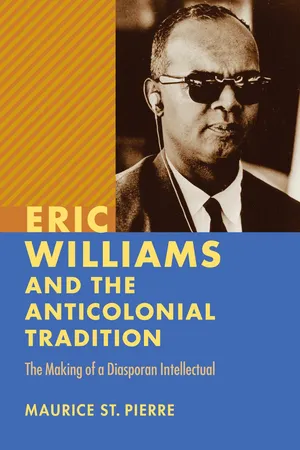
eBook - ePub
Eric Williams and the Anticolonial Tradition
The Making of a Diasporan Intellectual
- 272 pages
- English
- ePUB (mobile friendly)
- Available on iOS & Android
eBook - ePub
Eric Williams and the Anticolonial Tradition
The Making of a Diasporan Intellectual
About this book
Information
1Colonialism in Early Twentieth-Century Trinidad and Tobago
The Construction of a Socially Dishonored Status
TRINIDAD AND Tobago’s early history, like that of other Caribbean territories, such as Guyana and Jamaica, reflects a struggle for contested space by various European powers. In Trinidad, for instance, the Spanish introduced a cedula of population in the form of a decree issued from Madrid on 24 November 1783; it was designed to increase the amount of labor on the island by way of a free grant of land to every settler who came to Trinidad with his slaves. Since a requirement of the cedula was that the immigrant had to be a Roman Catholic and the subject of a nation friendly to Spain, the settlers tended to be almost exclusively French, as only the French planters could meet the requirement.1 Later, following clashes between French privateers and British ships and because the British feared that a Spanish-French alliance would imperil its war strategy and be a threat to several of its most valuable islands, a British striking force under the command of Sir Ralph Abercromby engaged a Spanish squadron in February 1797 in Trinidad. However, the Spanish position was weak, and after token resistance the governor, Don José Maria Chacon, surrendered on 17 February 1797.2 In this manner, these European powers were able to overcome the Arawaks and the Caribs (from whose name the word Caribbean derives), who had previously inhabited the island.
In this chapter, therefore, I focus on Williams’s lived experiences while growing up in Trinidad, with the lifeworld, or the everyday trials and tribulations, of the dominated and its connection with the system, the bureaucratic nature of institutional control that characterized domination. In other words, I focus on the social process by which legal norms, the views especially of members of the elite, and established practices were used in the social construction of difference to privilege the dominant and disadvantage the dominated. These bodies of knowledge, however, became institutionalized in the sense that they were disseminated throughout the society in newspapers and, important for our purposes, the household and the educational institutions in such a manner as to rise to the level of “truth.”
ERIC WILLIAMS’S early years in Trinidad have been variously described by Williams himself,3 as well as by others.4 However, my main concern is to isolate various aspects of Williams’s biography that ultimately will help us understand the type of person he was and how this undergirded his intellectual activities. Contextually, it is worth noting that Williams’s published autobiography was not originally conceived as a biographical statement but, as he put it some fifteen years earlier, in 1954, as “a political manifesto,” a statement of his education and his fight with his then employer, the Caribbean Commission. Additionally, Williams noted in the unpublished version that the autobiography was very much a response to the racism he had experienced at Oxford University and to British attacks against him following the publication of his book Capitalism and Slavery. Since the autobiography was to be an account of his education in a broad sense, the title was originally intended to be Caribbean Museum, the Education of a British Colonial Subject.5 Consequently, he notes that his aim in the biography and then the anthology, with the history of the Caribbean to come, was to “cash in, with something new, on the present BWI [British West Indian] popularity, and to see if I can get a bestseller which will allow me to retire and devote my time solely to writing and to West Indian education through that medium.”6 It is evident from the above that, lacking an independent profession like law or medicine at this stage, Williams was intent on converting the cultural and symbolic capital emanating from his specialized knowledge into monetary benefits, or economic capital.
In looking at the question of race, Erving Goffman’s views with respect to stigma are useful. Goffman notes, for example, that originally the term stigma referred to “bodily signs designed to expose something unusual and bad about the moral status of the signifier.”7 The stigmatized individual was seen as a blemished person, ritually polluted and to be avoided, particularly in public places. Goffman further distinguishes three different types of stigma—the tribal stigmata of race, nation, and religion—which can be transmitted through lineage and thereby contaminate all the members of the family.8 Since the question of stigma may be viewed in terms of social relationships, this suggests that the experiences of the stigmatized person are important facets of his or her biography, while those who view and treat the attribute—for example, race—as being blemished are a part of a coterie of biographical others. I will therefore refer to the manner in which the stigmata of race conferred on the non-White Trinbagonian was a socially blemished status and show how the process of this conferral became part of the knowledge base of the society.
IN ADDRESSING Williams’s experiences in the family and in education in Trinidad and Tobago, it is helpful to view the organizational expressions of these institutions—the household and the school, respectively—as social spaces. Space, as Georg Simmel contends, in and of itself is a form without effect. Space becomes a social space insofar as it is filled with what Simmel refers to as “social and psychological energies.” Indeed, what, for example, makes a city or a society is less its geographical location than it is the presence and interaction among human beings who populate that space, thereby embedding it with social meanings. Spatial forms, therefore—such as households, schools, and universities, which are also physically demarcated existential entities in the sense that they have boundaries—thus become social spaces to the extent that social interactions and relationships are woven into the fabric of a physical space. As Simmel notes, spaces are not spatial facts “with sociological consequences” but rather “sociological facts that are formed spatially.”9 As we will see, especially in chapter 7, relationships within a physical space like the foreign-controlled U.S. base in Trinidad, which might be converted into a locale for domination, can be perceived as disadvantaging the locals and privileging the Americans.
To contextualize further, as John Urry observes, the “house” is not to be seen as a purely physical object but as a space within which one’s imagination and daydreaming can take place and be given full rein. Since the household may contain various objects, such as books, it also becomes an externalization of the self and the site of memorized events, “imbued with memory traces.” Furthermore, since the duration of time spent in the household is itself dependent upon spatial specificity, a space such as a household “transforms time in such a way that memory is made possible [and] plays a particularly significant role in the forming and sustaining of memory.”10 It is in this context that the household as a physical space assumes special significance with regard to biography and relationships with biographical others, especially in terms of memorized events—space and time—and ultimately knowledge production.
It is also in the household that identities are formed that will later influence political action and intellectualism.11 Finally, since, as Paul Gilroy observes, race differences displayed in the culture are reproduced in educational institutions and, above all, in family life, families “are not only the nation in microcosm, but they also act as the means to turn social processes into natural instinctive ones.”12 As will be seen in the chapters that follow, an understanding of Williams’s experiences and the knowledge he acquired in physical spaces such as his father’s house and the educational institutions he attended, some of which were transformative, is vital for comprehending his subsequent “cursing” of colonialism, especially the racial component.
Eric Eustace Williams was born on 25 September 1911, the first of the twelve children, one of whom died early, of Henry and Eliza Williams. One of his most important experiences as a child, regarding the social construction of difference on the basis of color, class, and access to education in early twentieth-century Trinbago, occurred in the household. Williams notes, for example, that since his father was “dark brown,” he was automatically beyond the pale of social acceptance. This disability was aggravated, according to Williams, by the fact that his father’s father, “a full blooded Negro,” had eloped with and married one of the daughters in a well-to-do local White family that employed him in a menial capacity. Since this was the least pardonable transgression of the language, or habitus, of race relations in the eyes of the White ruling class—“a coloured man might marry an English, Scotch or European girl, never a local White”—his paternal grandmother was disowned by her family.
The application of this negative sanction exemplifies, further, the argument that oppression, especially with regard to economic capital—and such facets of social capital as access to important social networks, for example, a good job, and of cultural capital as a good education—is passed on from one generation to another within the context of familial relationships. Since, as is clear from Williams’s recollections, his family did not possess significant social, economic, or cultural capital to transmit to him and his siblings, they were doomed to experience social disadvantages not confronted by White families. This explains why, having violated the norm with respect to the transmission of these forms of capital to the next generation, Williams’s grandmother could not confer on her family the capital that exemplified White privilege.
The response to this normative violation on the part of Williams’s grandmother is also of interest in view of the fact that White males who fathered children with Black women out of wedlock were not necessarily deprived of economic capital. Indeed, as Faith Smith has shown, the products of these relationships peopled a privileged stratum of mulattoes who consequently were in a position to enjoy certain “compensating privileges.” These included a good education and concomitant symbolic and economic capital, which aided them and others with whom they were in “constant intercourse” in their intellectual activities.13
One wonders, therefore, how things would have been had it been Williams’s paternal grandfather who was White: in that case, would his father have been the recipient of symbolic and economic capital that would have positively impacted his life chances, and what implications would that have had for Williams’s career overall and for the course of history in Trinidad and Tobago? Moreover, as Joe Feagin observes, in the context of racist oppression in the United States, “The social inheritance mechanisms are disguised to make the intertemporal inheritance of resources, power and privilege appear to be fair, when in fact the White resources, power, and privilege typically represent the long-term transmission of unjust enrichment across numerous generations of oppressors and oppressed.”14 This helps explain the protracted nature of oppression and the difficulty experienced in railing against colonialism as a form of oppression.
In any event, the prevailing norms with respect to physical characteristics—color in this case—seeped into the Williams household. Williams’s only paternal aunt, who kept a small private nursery school and who was most important in his early life, was “a strict disciplinarian, ascetic in countenance as my father, dark brown in colour, with long black hair,” or what was referred to in Trinidad as “good grass.” This was the ideal of colored Trinidadians, who were mortally afraid of “bad hair,” especially of the kinky variety, which was maliciously compared to goat dung. Such was the importance of the color and hair criteria as a basis for social differentiation that light-complexioned children of mixed marriages with “bad light hair”—more often than dark children with “good black hair”—were ridiculed with the appellation shabeen and contemptuously referred to by young boys as “wire-heads.”15
Williams’s mother, on the other hand, who was ten years younger than his father, came from a prominent French Creole family, the de Boissières, was light-complexioned, and had four sisters and two brothers. According to Michael Pocock, who was related to the de Boissières, Williams’s mother was related to Henry Boissière, a wealthy landed proprietor who lived on the Champs Elysées estate in Maraval. However, although Williams’s maternal grandfather, Jules Arnold Boissière, and his maternal great-grandfather, John Nicolas Boissière, were both born out of wedlock, in sharp contrast with Williams’s paternal grandmother, their fathers provided for them financially, and John Nicolas’s father even arranged for him to be born in Europe to avoid the possibility of scandal. This enabled the family to pass on social and economic capital to successive generations.
This less than socially pristine pedigree notwithstanding, Eliza Williams “was considered, and considered herself of bourgeois French creole heritage.” Additionally, she “had the French style and she thought that she was an aristocrat.”16 Ken Boodhoo suggests, however, that because “his [Williams’s] mother was the more assertive of the parents, how the family perceived itself, and its perception of others, must have been largely influenced by how she viewed her status in the society.” And although the family was highly regimented and both parents were strict disciplinarians, one of Williams’s sisters opined that the mother “was the boss. She was the ruler. She gave the orders,” while the father was generally regarded as a “peaceful, if firm, individual.”17
Although he retained few memories of his maternal aunts, who were also light-skinned, Williams maintained that their station in life afforded additional insight into the nature of colonial society at the time. Unlike in the case of some Trinidadian families, especially in the upper socioeconomic echelons, there was no discrimination either inside or outside the Williams family against the darker-skinned children. This was partly because even the lighter-skinned children “were obviously coloured”18 and partly because Williams, who was one of the darker ones, had achieved an intellectual status despite the odds.
When it came to marriage, however, skin color was regarded entirely differently, and Williams’s parents were adamant. One of his aunts married a Negro tram driver and was generally regarded as “having lost caste.” According to the tenor of the times, the light-skinned woman who had reached the drawing room might go back to the kitchen after marrying “dark” but was not expected to descend lower than the “professions.” Another aunt, who was generally considered to be a “play girl,” also married a Negro and was heard to say in the context of domestic violence that “she would use the ice pick on her husband.” A third aunt, who worked in one of the big stores in the capital “for a few dollars a week,” had a Negro boyfriend whom Williams described as “not undistinguished looking [and] always dressed in a waistcoat,” at the time considered to be a “symbol of the professional class . . . taking salt in his coff...
Table of contents
- Cover Page
- Title Page
- Copyright
- Dedication
- Contents
- Acknowledgments
- Introduction
- 1 Colonialism in Early Twentieth-Century Trinidad and Tobago: The Construction of a Socially Dishonored Status
- 2 Life Abroad: The Academic Intellectual and the Struggle for Credentialism
- 3 The Native Son Returns: The Public Intellectual and the Quest for Credibility
- 4 In Search of Relevance: The “University of Woodford Square” and the Political Party Paper
- 5 Exploiting the Political-Opportunity Structure: The Emergence of the People’s National Movement Party
- 6 From Pedantic Visionary to Elected Politician
- 7 The Bachacs Confront the “Hydra-Head” of Colonialism: The American Presence in Trinidad and Tobago
- 8 Caliban and the Anticolonial Tradition
- Afterword: The Head That Wears the Crown Lies Uneasy
- Notes
- Selected Bibliography
- Index
Trusted by 375,005 students
Access to over 1.5 million titles for a fair monthly price.
Study more efficiently using our study tools.
Frequently asked questions
Yes, you can cancel anytime from the Subscription tab in your account settings on the Perlego website. Your subscription will stay active until the end of your current billing period. Learn how to cancel your subscription
No, books cannot be downloaded as external files, such as PDFs, for use outside of Perlego. However, you can download books within the Perlego app for offline reading on mobile or tablet. Learn how to download books offline
Perlego offers two plans: Essential and Complete
- Essential is ideal for learners and professionals who enjoy exploring a wide range of subjects. Access the Essential Library with 800,000+ trusted titles and best-sellers across business, personal growth, and the humanities. Includes unlimited reading time and Standard Read Aloud voice.
- Complete: Perfect for advanced learners and researchers needing full, unrestricted access. Unlock 1.5M+ books across hundreds of subjects, including academic and specialized titles. The Complete Plan also includes advanced features like Premium Read Aloud and Research Assistant.
We are an online textbook subscription service, where you can get access to an entire online library for less than the price of a single book per month. With over 1.5 million books across 990+ topics, we’ve got you covered! Learn about our mission
Look out for the read-aloud symbol on your next book to see if you can listen to it. The read-aloud tool reads text aloud for you, highlighting the text as it is being read. You can pause it, speed it up and slow it down. Learn more about Read Aloud
Yes! You can use the Perlego app on both iOS and Android devices to read anytime, anywhere — even offline. Perfect for commutes or when you’re on the go.
Please note we cannot support devices running on iOS 13 and Android 7 or earlier. Learn more about using the app
Please note we cannot support devices running on iOS 13 and Android 7 or earlier. Learn more about using the app
Yes, you can access Eric Williams and the Anticolonial Tradition by Maurice St. Pierre in PDF and/or ePUB format, as well as other popular books in Literature & Latin American & Caribbean Literary Criticism. We have over 1.5 million books available in our catalogue for you to explore.