A Good American Family
eBook - ePub

A Good American Family

The Red Scare and My Father

  1. 432 pages
  2. English
  3. ePUB (mobile friendly)
  4. Available on iOS & Android
eBook - ePub

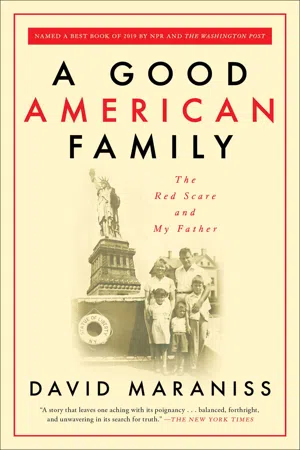
A Good American Family

The Red Scare and My Father

About this book

Named a Best Book of 2019 by NPR and The Washington Post.

In a riveting book with powerful resonance today, Pulitzer Prize–winning author David Maraniss captures the pervasive fear and paranoia that gripped America during the Red Scare of the 1950s through the chilling yet affirming story of his family’s ordeal, from blacklisting to vindication.

Elliott Maraniss, David’s father, a WWII veteran who had commanded an all-black company in the Pacific, was spied on by the FBI, named as a communist by an informant, called before the House Un-American Activities Committee in 1952, fired from his newspaper job, and blacklisted for five years. Yet he never lost faith in America and emerged on the other side with his family and optimism intact.

In a sweeping drama that moves from the Depression and Spanish Civil War to the HUAC hearings and end of the McCarthy era, Maraniss weaves his father’s story through the lives of his inquisitors and defenders as they struggle with the vital twentieth-century issues of race, fascism, communism, and first amendment freedoms. A Good American Family powerfully evokes the political dysfunctions of the 1950s while underscoring what it really means to be an American. It is an unsparing yet moving tribute from a brilliant writer to his father and the family he protected in dangerous times.
Frequently asked questions

Yes, you can cancel anytime from the Subscription tab in your account settings on the Perlego website. Your subscription will stay active until the end of your current billing period. Learn how to cancel your subscription.
No, books cannot be downloaded as external files, such as PDFs, for use outside of Perlego. However, you can download books within the Perlego app for offline reading on mobile or tablet. Learn more here.
Perlego offers two plans: Essential and Complete
  • Essential is ideal for learners and professionals who enjoy exploring a wide range of subjects. Access the Essential Library with 800,000+ trusted titles and best-sellers across business, personal growth, and the humanities. Includes unlimited reading time and Standard Read Aloud voice.
  • Complete: Perfect for advanced learners and researchers needing full, unrestricted access. Unlock 1.4M+ books across hundreds of subjects, including academic and specialized titles. The Complete Plan also includes advanced features like Premium Read Aloud and Research Assistant.
Both plans are available with monthly, semester, or annual billing cycles.
We are an online textbook subscription service, where you can get access to an entire online library for less than the price of a single book per month. With over 1 million books across 1000+ topics, we’ve got you covered! Learn more here.
Look out for the read-aloud symbol on your next book to see if you can listen to it. The read-aloud tool reads text aloud for you, highlighting the text as it is being read. You can pause it, speed it up and slow it down. Learn more here.
Yes! You can use the Perlego app on both iOS or Android devices to read anytime, anywhere — even offline. Perfect for commutes or when you’re on the go.
Please note we cannot support devices running on iOS 13 and Android 7 or earlier. Learn more about using the app.
Yes, you can access A Good American Family by David Maraniss in PDF and/or ePUB format, as well as other popular books in History & Social Science Biographies. We have over one million books available in our catalogue for you to explore.

Information

— PART ONE —

Watching One Another

1


The Imperfect S

I WAS NOT yet three years old and have no memory of anything that happened that day. It was March 12, 1952. My father, Elliott Maraniss, sat at the witness table in Room 740 of the Federal Building in Detroit, where he had been subpoenaed to testify before the House Committee on Un-American Activities. As the questioning neared the end, he asked whether he could read a statement. There were several points he wanted to make about his freedoms as an American citizen, as an army veteran who had commanded an all-black company during World War II, and as a newspaperman. John Stephens Wood of Georgia, chairman of the committee, rejected this request. ā€œWe don’t permit statements,ā€ Wood said. ā€œIf you have one written there, we shall be glad to have it filed with the clerk.ā€
The chairman’s denial was arbitrary. If a witness was compliant, named names, repented, and humbly sought absolution, then a statement might be allowed. But my father was not compliant. He challenged the committee’s definition of what it meant to be American and invoked the Fifth Amendment in refusing to answer questions about his political activities, so his statement was submitted—unread—to the committee clerk, and from there essentially buried and forgotten. No mention was made of it in newspaper accounts the next day, nor was it included as an addendum to the hearing transcript published by the U.S. Government Printing Office months later. It was just one more document entombed in history, eventually stored in the vast collections of the National Archives in downtown Washington, the same vaulted building that holds original copies of the Declaration of Independence, the U.S. Constitution, and the Bill of Rights—the foundation trinity of the American idea.
By the time I looked at the committee’s old files, sixty-three years had passed since the hearing. My father was dead, as were Chairman Wood and all the other players in that long-ago drama. But the moment came alive to me as soon as I opened a folder in Series 3, Box 32, of the HUAC files and found the statement. Three pages. Typed and dated. When I began reading the first page, it was not the writing that struck me but the physical aspect of the words on the page, starting with the first letter of the first word of the first line:
Statement of Elliott Maraniss.
That was the line, though in the original, the capital S of ā€œStatementā€ jumped up a half-space, as capital letters on manual typewriters sometimes did. And in typing his first name, it looked as though my father twice hit the neighboring r key instead of the t, and rather than x-ing it out or starting over again he had just gone back and typed two t’s over the r’s.
The pages that followed were resonant with meaning. My father was trying to explain who he was, what he believed in, and the predicament in which he found himself. But it was the composition of that prosaic first line that hit me hardest, the imperfect S.
This seems to be how life often works; the smallest gestures and details can assume the most significance. Now I could place myself in 1952, sitting there in Detroit as my father composed his statement only days after being fired from his newspaper job in the wake of a subpoena and the testimony of an FBI informant who had identified him as a member, or former member, of the local Communist Party. I could see my dad at the typewriter, a place where I had watched him so often in later years. He was a hunt-and-peck typist, jabbing away at an old dusk-gray upright with his index fingers, a Pall Mall (and later Viceroy) burning beside him in a heavy glass ashtray strewn with half-smoked and twice-smoked cigarette butts. There was a certain violence and velocity, thrilling but harmless, to his typing. He was messy and noisy, accompanying his work with a low, vibrating hum, thinking wordlessly aloud. He punched so hard and fast that ribbons frayed and keys stuck. He slapped the carriage return with the confidence of an old-school newspaperman. He was always making typos and correcting them by x-ing them out or typing over them, like those r’s and t’s.
It is invariably thrilling to discover an illuminating document during the research process of writing a book, but in this case that sensation was overtaken by pangs of a son’s regret. Looking at the typed statement, I started to absorb, finally, what I had never fully allowed myself to feel before: the pain and disorientation of what my father had endured. For decades I had desensitized myself to what it must have been like for him. I had always considered him in the moment, rarely if ever relating present circumstances to the context of his past. As much as I loved him, I had never tried to put myself in his place during those years when he was in the crucible, living through what must have been the most trying and transformative experience of his life. Until I saw the imperfect S.

THE RESEARCH VISITS to the National Archives came at the beginning of my long-overdue attempt to understand what had happened to my father and our family and the country during what has come to be known as the McCarthy era, named for the demagogic senator who emblemized the anticommunist Red Scare fury of the early 1950s. Joseph McCarthy himself enters this story only as a shadowy presence in the background. As far as I can tell, my father never encountered him, and McCarthy never uttered his name. Their connection was more poetic than literal. McCarthy came from Wisconsin and died in 1957. That is the same year my father emerged from five years of being blacklisted and our family’s fortunes changed for the better when he was hired by the Capital Times in Wisconsin, a progressive Madison newspaper that made its name fighting McCarthy.
But even while McCarthy grabbed sensational headlines, the House Un-American Activities Committee, as it was commonly called (hence the acronym HUAC), was closer to the center of it all. Committee members and staff positioned themselves as arbiters, investigators, inquisitors, judges, juries, crusaders, patriots. In Washington and at hearings on the road like the one in Detroit, their intent was to root out and publicly shame people who had been affiliated with the Communist Party. Are you now or have you ever been . . . ? The assumption was that a party member was indisputably unpatriotically un-American.
Un-American—a bland word construction with explosive intent, and peculiarly American at that. To accuse a citizen of France of being un-French or a Brit of being un-British or a Swiss of being un-Swiss would mean—exactly what? The first impulse might be to conjure up some innocuous stereotype of each country: the un-French not liking food, the un-British disdaining flowers, the un-Swiss afraid of heights. But the un-American label came to connote something more sinister. To be labeled un-American by the committee meant that you were considered subversive, scary, alien, spineless, spiteful, and disdainful of wholesome American traditions. You probably hated apple pie and baseball, but also had no use for democracy and were intent on the violent overthrow of the government.
I knew my father as none of those things. By the time I reached political consciousness, he had survived, adjusted, and moved on, rarely looking back. That earlier period, as my older brother, Jim, once explained to me, ā€œwas like another life, one that didn’t belong to him anymore at all, just a folly, and it was a dead letter to him, and should stay dead.ā€
My father was born in Boston in 1918 and spent most of his childhood years in Brooklyn, but once he left the East Coast to attend college in Michigan he turned into a booster of the people, places, and sensibility of Middle America—of Big Ten universities and glacier lakes with swimming beaches and dairy farmers and black earth and corn on the cob and Tigers or Cubs or White Sox or Braves games on the radio. When we moved to Madison, he brought with him only a few exotic remnants from his past, including an appetite for bagels and onions and liverwurst and the delight he took in teaching us silly tunes from his New York childhood. The Bowery, the Bowery, they say such things and they do strange things on the Bowery, the Bowery. I’ll never go there anymore. And another that ended Go easy on the monkey wrench, your father was a nut. But his tastes beyond that were decidedly Middle American. He would sit in front of the television set in his big chair in the living room and watch Red Skelton play the country bumpkin Clem Kadiddlehopper and laugh so hard that he’d start coughing. Every time we drove around the curve of Lake Michigan, traveling between Madison and Ann Arbor, he’d have us recite the same ditty: Chicken in a car and the car can’t go. That’s how you spell Chi-ca-go.
In politics and journalism, he taught me to be skeptical but not cynical, to root for underdogs, think for myself, be wary of rigid ideologies, and search for the messy truth wherever it took me. So many better-known figures of the Old Left had taken other paths, either toward neoconservatism and staunch anticommunism or toward bitterness and despair, but he had done neither. He emerged as a liberal but undogmatic optimist. There was no sourness or orthodoxy in him. His favorite essayist was George Orwell, whose leftist politics were accompanied by a clear-eyed assessment of the totalitarian horrors of the left as well as the right. He was a newspaperman first and foremost, with a keen appreciation for human foibles and failings. He was generous with money, affection, encouragement, and the benefit of the doubt. He seemed tolerant of almost everything but intolerance. Hate the action, not the person, he would say; racism, not the racist. ā€œIt could be worseā€ was his mantra, a phrase that represented his response to daily vicissitudes but carried a meaning deeper than I realized—as did most of his teachings. It is hard for me to overstate how much of a force for good he was not only in my life and those of my siblings, but also in the lives of scores of newspaper people, professional acquaintances, and friends of the family who were heartened and encouraged by his intuitive intelligence and positive nature over many decades.
But there was a time when Elliott Maraniss was a communist. I say this without hesitation, without shame or pride. There are aspects of his thinking during that period that I can’t reconcile, and will never reconcile, as hard as I try to figure them out and as much of a trail as he left for me through his writings. I can appreciate his motivations, but I am confounded by his reasoning and his choices. He wanted the reality of American life to live up to the words of the Declaration of Independence and the belief that all men are created equal. He was driven by a quest for racial and economic equality, for the betterment of humankind, and believed that capitalism had benefited the rich at the expense of working people, of that I am certain. But among other indefensible positions, how could he buy the Soviet line after the 1939 Nonaggression Pact between the Soviet Union and Nazi Germany? It was a head-spinning turnabout; suddenly the world’s most ardent antifascists were talking about the need for peace in Europe and denouncing capitalist warmongers almost as loudly as they denounced Hitler. In retrospect, it seems obvious that for an extended period of his young life he was naĆÆvely in service to rigid ideology, to the God that failed, as the title of a powerful book of essays by former communists put it. Perhaps he was even blinded by love, though I find it inadequate to attribute his involvement with communism to an attempt to please my mother, Mary Cummins Maraniss, who with her older siblings was a young communist long before meeting him.
So he was not falsely accused of being a communist because, for a time, he was one. But didn’t being a citizen of this country give him the freedom to affiliate with the politics of his choosing and to write and speak his mind, as long as he didn’t betray his country as a foreign agent? Wasn’t there an essential radical tradition in America that was propelled by a desire not to destroy but to realize something better and fairer? Was he un-American? What does that even mean? By whose standard? Un-American compared to whom and to what?

IN MY SEARCH for answers, it seemed important to study my father’s experience within the larger context of the combustible mix of other isms that shaped the middle decades of the twentieth century, including capitalism, racism, and anti-Semitism, but especially fascism and communism, the diametrically opposite political reactions to problems of the modern world that both gave rise to totalitarian systems and murderous rulers. Fascists mythologized the past, demonized outliers, and glorified military strength and will over reason; communists idealized the notion of an inevitable egalitarian future while mutating into a controlling and paranoid elite. Although my father would be the central figure in this story, my intent was not to deal with him alone, but to situate him and our family’s struggle within a larger, diverse group of people who encountered one another in Room 740 of the Federal Building in Detroit during the late winter of 1952. Witnesses, lawyers, informants, politicians. What brought each of them into that hearing room? How might their actions help me understand my father? What did their stories say not just about that frightful era but about what it means to be American or un-American? The answers were to be found outside the hearing room, along winding paths through the twentieth-century world.
The cast of Americans includes Chairman John Stephens Wood, a southern Democrat who in his youth had briefly belonged to the Ku Klux Klan, had another dark secret in his past, and during his tenure in Congress supported the poll tax and opposed all attempts to desegregate private and public institutions, including the military. Another member of the committee, Republican Charles E. Potter of Michigan, had lost both legs and one testicle to a German land mine during World War II; he returned from the war as an outspoken anticommunist but later regretted the excesses of the McCarthy era, which he called ā€œdays of shame.ā€ The committee counsel, Frank S. Tavenner Jr., was a lawyer from the Shenandoah Valley of Virginia who did most of the interrogating at the hearings; before joining HUAC he had been the acting chief U.S. counsel at the Tokyo War Crimes Tribunal.
Along with my father another of the witnesses at the Detroit hearings was my uncle, my mother’s older brother, Robert Cummins, who after graduating from the University of Michigan in 1937 boarded a ship to France, climbed over the Pyrenees and down into Spain, where he and other Americans joined forces with Spanish Loyalists fighting Generalissimo Francisco Franco and the fascists in the Spanish Civil War. Instead of being thanked for their service, these men were hounded by the U.S. government for years, scorned for their leftist politics and dismissed as ā€œpremature anti-fascists.ā€ Another witness was Coleman Young, a civil rights and labor activist whose unrepentant testimony at those hearings propelled him into a political life that eventually took him into the Detroit mayor’s office.
My father’s defense lawyer, George W. Crockett Jr., an African American, was a civil liberties advocate who was a partner in one of the first integrated law firms in the country, and earlier had represented defendants in the Foley Square trial, the seminal legal battle concerning the rights of Communist Party leaders in the United States. These men were charged, tried, convicted, and imprisoned for nothing more than being leaders of the party. Crockett and the other defense lawyers were also eventually jailed for contempt of court.
The informant who named hundreds of names at the Detroit hearing, Bereniece Baldwin, was a grandmother who had been recruited by the FBI to infiltrate the Michigan Communist Party, a secret life she carried out for nine years.

IN HIS UNREAD statement, my father refuted the committee with his own definition of being American. In what followed that imperfect S, he said that he had been a loyal citizen of the United States all of his thirty-four years, through war and peace; that he had enlisted in the army one week after Pearl Harbor and served for more than four years, ending with the Okinawa campaign, after which he was discharged as a captain; that he was a homeowner and taxpayer, husband and father of two boys and a girl; that he was taught in school to defend the principles of the Constitution and to try to secure for all Americans the blessings of peace, freedom, and economic well-being; and that for doing no more than that and exercising his right of free speech he had been fired from his job and blacklisted.
Now, he wrote, ā€œI must sell my home, uproot my family and upset the tranquility and security of my three small children in the happy, formative years of their childhood. But I would rather have my children miss a meal or two now than have them grow up in the gruesome, fear-ridden future for America projected by the members of the House Committee on Un-American Activities. I don’t like to talk about these personal things. But my Americanism has been questioned and to properly measure a man’s Americanism you must know the whole pattern of his life.ā€
As a biographer and chronicler of social history, I’ve spent...

Table of contents

  1. Cover
  2. Dedication
  3. Epigraph
  4. Author’s Note
  5. Part One: Watching One Another
  6. Part Two: In a Time of War
  7. Part Three: Trials and Tribulations
  8. Part Four: Five Years
  9. Epilogue: Second Acts
  10. Photographs
  11. Acknowledgments
  12. About the Author
  13. Notes
  14. Selected Bibliography
  15. Illustration Credits
  16. Index
  17. Copyright