As tourists increasingly moved across the United States in the late nineteenth and early twentieth centuries, a surprising number of communities looked to capitalize on the histories of Native American people to create tourist attractions. From the Happy Canyon Indian Pageant and Wild West Show in Pendleton, Oregon, to outdoor dramas like Tecumseh! in Chillicothe, Ohio, and Unto These Hills in Cherokee, North Carolina, locals staged performances that claimed to honor an Indigenous past while depicting that past on white settlers' terms. Linking the origins of these performances to their present-day incarnations, this incisive book reveals how they constituted what Katrina Phillips calls “salvage tourism”—a set of practices paralleling so-called salvage ethnography, which documented the histories, languages, and cultures of Indigenous people while reinforcing a belief that Native American societies were inevitably disappearing.
Across time, Phillips argues, tourism, nostalgia, and authenticity converge in the creation of salvage tourism, which blends tourism and history, contestations over citizenship, identity, belonging, and the continued use of Indians and Indianness as a means of escape, entertainment, and economic development.
eBook - ePub
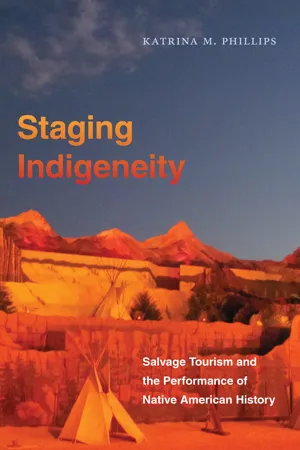
Staging Indigeneity
Salvage Tourism and the Performance of Native American History
- 288 pages
- English
- ePUB (mobile friendly)
- Available on iOS & Android
eBook - ePub
About this book
Information
CHAPTER ONE
Days of Old West Are Lived Again
The Happy Canyon Indian Pageant and Wild West Show
It is all a chapter taken out of the history of the old West—a chapter which every American with red blood in his veins should read in the real before it passes by and, like the old West, forever disappears on the horizon of time. But to understand, one must look with one’s own eyes on these things. Then you will feel the stir and the thrill of life of these golden lands of hopes and achievements, where man extends a generous and hospitable welcome to those who cross his trails; it is a spectacle which makes you go away with a bigger, finer feeling toward life, and a genuine respect and appreciation for [those] who have “taken chances,” have risked limb and even life at times in their sports of daring and skill, that you may see how their fathers once struggled in earnest against unequal odds in order to attain the Winning of the West.
—Charles Wellington Furlong, “The Epic Drama of the West,” 1916
Happy Canyon is the result of the overworked condition of the Roundup directors. The Roundup could entertain the people in the afternoon, but there was nothing for them to do in the evening.
“Put on a night show,” everyone advised.
“Put on a nightcap,” the directors answered. “We don’t even have the time to do that. If we attempted it we’d be putting on a night show in the asylum down here.”
—Sunday Oregonian, September 12, 1915
According to local legend, a handful of men, including a businessman from Pendleton, Oregon, along with a former Indian superintendent, rode out to a council on the nearby home of the Confederated Tribes of the Umatilla Indian Reservation (CTUIR) in the summer of 1910. The Treaty of 1855 had forcibly removed the Cayuse, Umatilla, and Walla Walla Indians to the reservation, which had only exacerbated long-simmering tensions between the Indians and the white residents of Pendleton. But in 1910, boosters and businessmen in Pendleton were planning a round-up—akin to what we would now consider a rodeo—for that September, and they wanted to invite the Indians to town for the events. They promoted the round-up as a time for the Indians to gather at one of their former salmon camps, trade with the whites, participate in parades, and dance for the crowds in the arena. After the council, the delegates, unsure of the Indians’ willingness to participate, turned for home and went back to Pendleton. As legend has it, they saw a cloud of dust rising on the horizon as they stood on the loading docks of the Pendleton Woolen Mills on the first morning of the round-up. The tribe had accepted the invitation, and they set up their round-up camp where they had set up their salmon camps so many decades earlier. And so the Pendleton Round-Up was born, a celebration of Western life and livelihoods that has become an iconic pilgrimage for generations of locals and tourists.1
It’s a great story. But, like all great stories, there’s more to it than that. The push to revive the woolen mills and, in turn, Pendleton’s economy meant finding ways to put Pendleton on the map. Its railroad connections certainly helped. But Pendleton wasn’t Portland, and it wasn’t Seattle. It didn’t have the luxury of a diversified economy or easy port access. Some scholars and Pendleton organizers argue that a visit from Buffalo Bill Cody and his Wild West show pushed Pendletonians to put on their own show. Others who examine the events focus on the Bishop brothers, the men who resurrected the struggling Pendleton Woolen Mills, and their friendship with Lee Moorhouse, a local photographer and former Indian agent at a nearby reservation. There are those who claim that the switch from a cattle-driven economy to a sheep-focused economy was the catalyst for the Round-Up. Still more recall the region’s long history of commemorative and civic celebrations, such as the Portland Rose Festival or Pendleton’s 1909 Fourth of July celebration.2
Organizers and promoters of the Round-Up and Happy Canyon have long championed these events as real and raw, the epitome of the Western experience and the most authentic portrayal of Western history. The first Round-Up, hastily cobbled together in 1910, not only established Pendleton’s claim to authenticity but validated it through the ease with which the production came together. As Charles Wellington Furlong, who counted writing for Harper’s Monthly Magazine among his many endeavors, noted, a visitor to Pendleton in September would “rub elbows with many an old Indian fighter.” Thanks to Happy Canyon, “you are in a little frontier world of fifty years ago,” a place where “many of these players are in reality the characters they portray.… Not even a rehearsal is held. The ‘boys’ are simply told what is expected of them and when they are to do it.… You see bad men and vigilantes come riding through town; the bar-room has its shooting scrape, and cowboy and cowgirl gracefully reel through their dances on horseback and take part in ranch and town games of various kinds.”3 For Furlong and the thousands who flocked to Pendleton, the frontier world of yore was more than just the stuff of books and magazines. Like Lerner and Loewe’s musical Brigadoon, the charming, anachronistic ideal of a sleepy small town came to life for those who truly believed.4 Unlike the slick, polished Wild West shows that required extensive rehearsals before appearing before their audiences, the Round-Up and Happy Canyon seemingly sprang up overnight. A local newspaper described the scene in 1914: “The town of ‘Happy Canyon’ has grown from nothing to a thriving frontier metropolis and, commencing Wednesday evening, will be a scene of commercial activity and hilarious festivity.”5

Pendleton, Oregon, and the Confederated Tribes of the Umatilla Indian Reservation. Map by Josiah Donat.
As a production and a re-created frontier town, Happy Canyon intended to capitalize on the proven draw of the West. From the first Round-Up in 1910 and the first night show in 1913 to the 1914 development of a Wild West–type of vaudeville entertainment and the 1916 addition of an Indian pageant, unraveling the history of these events reveals the multilayered appeal and function of Pendleton’s claim to Wild Western history. The Round-Up founders created a commodity structured around its insistent portrayal of itself and its residents, both Native and white, as the personification of the West, and they designed a celebration to appeal to its own residents as well as outsiders.
Pendleton employed a rhetoric of disappearance through the development of the Round-Up and Happy Canyon. Salvage tourism functioned as a catalyst for tourists who believed that the taming of the West made Pendleton itself a vanishing commodity. Promotional materials centered on the Round-Up and Happy Canyon as a means of salvaging the wildness of the West in the wake of the seemingly inevitable march of progress. The tourists (and locals) who flooded Pendleton demonstrate that, even in this Western state in the early twentieth century, the cowboys-and-Indians motif of the West was a powerful draw. In one trip, tourists could witness a multitude of Western-themed events within the rodeo arena and throughout Pendleton.
The addition of Happy Canyon offered the chance to fully experience life in the Wild West. The first few years of the Happy Canyon pavilion included banks, saloons, stores and shops, a hotel, a post office, gambling houses, and “other institutions such as flourished in the ‘days of ’49.’ ”6 Additionally, each institution was “in actual operation” with play money currency called “ten-buck bills,” where one buck equaled one penny, and they were the only accepted currency within the pavilion. Before allowing for general merriment, organizers planned for an hour-long program whose features would “be remindful of the early pioneer days.”7 By re-creating a Western town within an already decidedly Western town, Happy Canyon served as a kind of time machine for tourists. The cultivation of Happy Canyon as an immersive experience, coupled with the growing popularity of the Round-Up and the demonstrated appeal of Western-themed entertainment, developed from a flourishing focus on the disappearing Western ideal as propagated through history and period popular culture.
The West, as they say, is history.
“A Long and Colorful History”: Oregon’s Indians and the Round-Up
Major Lee Moorhouse, whose vast photograph collection includes thousands of images of life on the Umatilla Indian Reservation, took a few photos of a Cayuse man named Paul Showaway in the early 1900s. Showaway, the East Oregonian proclaimed in 1904, was “perhaps the most widely advertised American Indian alive, not even excepting Chief Joseph, of the Nez Perce.”8 Moorhouse’s photos of Showaway, who was clad in “one of the gaudiest Indian robes” produced by the Pendleton Woolen Mills, were part of the company’s advertising campaign. Not “a single civilized country under the sun,” the newspaper boasted, had escaped the onslaught of postcards sent from Pendleton’s post office.9
Like many men of his era, Moorhouse wore many hats throughout his career. In 1878, he served as the governor’s field secretary during the Bannock-Paiute War.10 Elected mayor of Pendleton in 1885, he became the Indian agent on the Umatilla Indian Reservation in 1889.11 The Treaty of 1855 had created the reservation through the cession of 6.4 million acres of land a mere fifty-five years before the first Round-Up, and the federal policy of allotment opened up 140,000 acres of the Umatilla Indian Reservation for settlement. The Pendleton Notch Act authorized the sale of tribal lands to the city, and part of the city was built on the reservation.12 In 1891, Moorhouse oversaw the reservation’s allotment and the subsequent auction of “surplus” lands to non-Native ranchers, farmers, and land speculators.13 Twenty years before the first Round-Up, Indians still needed permission from Indian agents like Moorhouse in order to leave the reservation, and only after revealing “the destination, duration, and purpose” of the trip.14
The creation of the reservation had not fully alleviated the tensions between Natives and non-Natives. Indeed, many point to these hostilities—and the need to salvage the relationship between townsfolk and the CTUIR—as the reason why Round-Up organizers invited Indians to participate.15 When Roy Bishop and his brothers, whose retail merchant father had married the daughter of a prominent Oregon textile mill owner, bought the then-defunct Pendleton Woolen Mills in 1909, they began manufacturing blankets based on the color and design preferences of both local and Southwest Indians.16 As plans for the Round-Up began to fall into place the following summer, Bishop, thanks to his “personal acquaintance with the Indians” through the Woolen Mills, and Moorhouse rode out to the reservation to invite them.17 Moorhouse and the Bishop brothers were not planning to use Native participants in the same way Buffalo Bill Cody and other Wild West show proprietors did. Natives who worked in Wild West shows, while still marketed as authentically Indian, usually participated in historical reenactments centered on stagecoach attacks and military skirmishes ...
Table of contents
- Cover
- Title Page
- Copyright
- Dedication
- Contents
- List of Illustrations, Maps, and Table
- Acknowledgments
- Introduction: Discovering and Defining Salvage Tourism
- Chapter One: Days of Old West Are Lived Again: The Happy Canyon Indian Pageant and Wild West Show
- Chapter Two: It’s a Part of Us: The Continued Allure of Pendleton
- Chapter Three: Out of the Darkness of Tragedy: The Creation of Unto These Hills
- Chapter Four: We Are Telling Our Story: Salvaging Unto These Hills
- Chapter Five: No Longer a Wooden Indian from the History Books: Tourism, Tecumseh, and American Nationalism
- Chapter Six: The Great Pretenders: Playing Indian in Tecumseh!
- Conclusion: Should You Ask Me, Whence These Stories?: The Power of Salvage Tourism
- Notes
- Bibliography
- Index
Trusted by 375,005 students
Access to over 1.5 million titles for a fair monthly price.
Study more efficiently using our study tools.
Frequently asked questions
Yes, you can cancel anytime from the Subscription tab in your account settings on the Perlego website. Your subscription will stay active until the end of your current billing period. Learn how to cancel your subscription
No, books cannot be downloaded as external files, such as PDFs, for use outside of Perlego. However, you can download books within the Perlego app for offline reading on mobile or tablet. Learn how to download books offline
Perlego offers two plans: Essential and Complete
- Essential is ideal for learners and professionals who enjoy exploring a wide range of subjects. Access the Essential Library with 800,000+ trusted titles and best-sellers across business, personal growth, and the humanities. Includes unlimited reading time and Standard Read Aloud voice.
- Complete: Perfect for advanced learners and researchers needing full, unrestricted access. Unlock 1.5M+ books across hundreds of subjects, including academic and specialized titles. The Complete Plan also includes advanced features like Premium Read Aloud and Research Assistant.
We are an online textbook subscription service, where you can get access to an entire online library for less than the price of a single book per month. With over 1.5 million books across 990+ topics, we’ve got you covered! Learn about our mission
Look out for the read-aloud symbol on your next book to see if you can listen to it. The read-aloud tool reads text aloud for you, highlighting the text as it is being read. You can pause it, speed it up and slow it down. Learn more about Read Aloud
Yes! You can use the Perlego app on both iOS and Android devices to read anytime, anywhere — even offline. Perfect for commutes or when you’re on the go.
Please note we cannot support devices running on iOS 13 and Android 7 or earlier. Learn more about using the app
Please note we cannot support devices running on iOS 13 and Android 7 or earlier. Learn more about using the app
Yes, you can access Staging Indigeneity by Katrina Phillips in PDF and/or ePUB format, as well as other popular books in Social Sciences & North American History. We have over 1.5 million books available in our catalogue for you to explore.