eBook - ePub
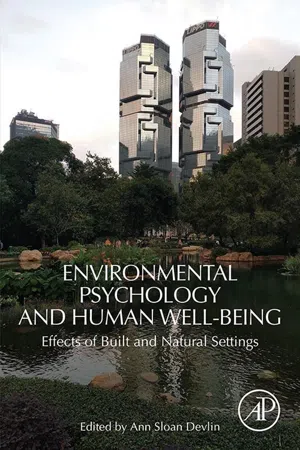
Environmental Psychology and Human Well-Being
Effects of Built and Natural Settings
- 482 pages
- English
- ePUB (mobile friendly)
- Available on iOS & Android
eBook - ePub
About this book
Environmental Psychology and Human Well-Being: Effects of Built and Natural Settings provides a better understanding of the way in which mental and physical well-being is affected by physical environments, along with insights into how the design of these environments might be improved to support better health outcomes. The book reviews the history of the field, discusses theoretical constructs in guiding research and design, and provides an up-to-date survey of research findings. Core psychological constructs, such as personal space, territoriality, privacy, resilience, stress, and more are integrated into each environment covered.
- Provides research-based insight into how an environment can impact mental and physical health and well-being
- Integrates core psychological constructs, such as coping, place attachment, social support, and perceived control into each environment discussed
- Includes discussion of Kaplan's Attention Restoration Theory and Ulrich's Stress Reduction Theory
- Covers educational settings, workplace settings, environments for active living, housing for the elderly, natural settings, correctional facilities, and more
Information
Subtopic
Applied PsychologyIndex
Psychology1
Concepts, Theories, and Research Approaches
Ann Sloan Devlin, Department of Psychology, Connecticut College, New London, CT, United States
Abstract
The chapter introduces the reader to major concepts and theories used to frame research about built and natural environments, and to do so with some historical perspective. Two broad categories are highlighted, those that deal with spatial behavior broadly defined and those that deal with the role of the natural environment in human well-being (Kaplan’s Attention Restoration Theory; Ulrich’s Stress Reduction Theory). A variety of spatial and place-related concepts are considered including territoriality, personal space, privacy, defensible space, space syntax, new urbanism, place attachment, and place identity. These concepts are delineated both because of their significance in the history of environmental psychology and because these theories and concepts are used by a number of authors in this volume. In addition, the chapter considers the range of research strategies that characterize work in environment–behavior studies, from true experiments, field experiments, and field studies to qualitative work.
Keywords
Attention Restoration Theory; Stress Reduction Theory privacy; territoriality; defensible space; place attachment; research design
Chapter overview
The purpose of this chapter is to provide some sense of the major theories and concepts that are used to frame research about built and natural environments, and to do so giving a sense of the history of the discipline. In a relatively short chapter, not every theory and concept can be included. The approach here places emphasis on spatial theories and concepts related to the built environment and on two of the primary theoretical approaches to examining the impact of nature on well-being: Attention Restoration Theory and Stress Reduction Theory. In addition, the chapter includes a brief examination of the kinds of research designs and strategies that characterize environmental psychology and environment–behavior studies more generally.
Introduction
The label “environmental psychology” suggests a single disciplinary lens, but since its inception in the late 1960s, environmental psychology (and environment–behavior studies more generally) has been characterized by a cross-disciplinary approach that includes anthropology, sociology, animal behavior, urban planning, education, architecture, natural resources, as well as psychology. Today we might add to those the disciplines of medicine, public health, and transport engineering, given the interest in addressing public health problems like obesity through attention to the physical environment (e.g., active living).
From its beginnings, there has been a recognition that environmental psychology has an applied emphasis or at least would benefit from collaboration with practitioners. For example, Proshansky argued that the field would need to “work closely with practitioners who design, use, and determine the operation of physical settings” (Proshansky, 1974, p. 554) for useful concepts and ideas to emerge. Similarly, in his, 1970 paper “The emerging discipline of environmental psychology,” Wohlwill, one of the early leaders in the field, also saw the importance of interdisciplinary activity and viewed the field as one that would necessarily need to be positioned between basic and applied research. Wohlwill also recognized a problem that continues to this day: the difficulty of getting out of disciplinary silos to foster interdisciplinary thinking. For that reason, journals like Environment and Behavior and Journal of Environmental Psychology that publish papers on human–environment interactions from a variety of disciplines are important, as are organizations such as the Environmental Design Research Association (EDRA) that promote interdisciplinary communication.
In addition to the applied emphasis, it is also the case that early work in the discipline focused more on the built than the natural environment, although that imbalance has certainly been redressed over the ensuing decades. In a paper articulating the need and challenge of developing theory in environmental psychology, Proshansky argued the emphasis on the built environment was fairly self-evident, and covered the range of human behaviors: “We are referring to when, how, and where people read, talk, eat, work, act as a family, make love, fight, and get bored” (Proshansky, 1974, p. 542). In terms of the processes that would occupy the attention of the environmental psychologist in understanding interactions between people and their environments, he listed cognitive functions (e.g., perception, thinking) as well as motivation and emotion.
Given the number of disciplines involved, the field is characterized by a wide range of constructs and theories. In fact, some might argue that the field has far more of the former than the latter. Constructs can be defined as psychological entities that have no basis in physical reality but are a product of thinking (Corsini, 2002). For example, place attachment and restorativeness are constructs. The difficult job of researchers is to measure constructs, which tend to be abstract and represent ideals, with scales or other kinds of assessments that are “real.” These measures are the actual tools researchers have to assess elusive constructs (Muchinsky, 2012). Theories typically involve an interrelationship of principles and seek to predict or describe outcomes that have been verified to a considerable extent by data (Corsini, 2002).
This chapter will focus on the concepts and theories that have utility in explaining behavior across different scales and venues, across both built and natural environments, specifically, behaviors that enhance our well-being and goal achievement. This is what Stokols (1977, p. 25) calls “human-environment optimization,” earlier called behavior–environment fit. Speaking about optimization processes, Stokols (1977, p. 30) asks whether we should measure their effectiveness in terms of “physical health, mental well-being, expressed satisfaction with the environment, or some combination of these dimensions.” This is a question we are still attempting to answer. The authors of the chapters in this book will provide some assessment of the ways in which the question has been approached in their own areas of study and expertise.
Why theory is difficult
The founding researchers in our field, particularly Proshansky (1974), seem to have understood that while there was a need for organizing principles that could help explain how built (and natural) settings affect us, this would be difficult to achieve and that the approach would probably be more descriptive than theoretical. In a word, environmental psychology is “messy.” Proshansky recognized that we might not ever develop a comprehensive systematic theory:
The emphasis on theory here is not a call for elaborate rational systems in which an interlocking network of assumptions, propositions, and concepts leads to testable empirical generalizations. On the contrary, systematic theory at this level not only is not possible at present but may never be for environmental psychology.
(Proshansky, 1974, p. 544)
Similarly, Veitch and Arkkelin (1995) claim the field has no grand theory because of the highly variable relationships researchers examine. They point to the wide range of methodologies, the differences in measurement approaches across settings, and the lack of sufficient data to confirm a unifying theory. The same point was made by Proshansky, Ittelson, and Rivlin (1970) in their early book of readings in environmental psychology; there appears to be a lack of integration because of the difficulties in communicating in terms of language and disciplinary emphases that erect boundaries (what others have called the silo problem); the differences in conceptual tools and methodologies; and the varying focus and scale of analysis (from cities to individuals).
Given these challenges, Proshansky (1974) argued for a more limited goal, that is, that the systematic use would be at the level of concepts and ideas that could be used to shape research questions. With the range of dependent measures used to assess constructs of interest (e.g., stress, restorativeness, territoriality), it makes comparing outcomes across studies difficult. Further complicating this challenge is that studies involving the same concept often differ in scale; one can investigate territoriality with respect to a room, a house, a neighborhood, or on a larger geographical region. Where are we with regard to Proshansky’s more limited goal? One of the contributions of this volume will be an answer to that question.
Theories and constructs: an overview
This chapter highlights two broad categories of theories and constructs, those that deal with spatial behavior broadly defined and those that deal with the role of the natural environment in human well-being. This choice is not surprising given the emphasis in this book on built and natural environments. A second reason for emphasizing these categories is their applicability across a range of different kinds of environments. In the case of spatial constructs, we can consider environments that range in scale from large (e.g., cities) to small (e.g., rooms). In the case of natural environments, the range spans from environments that are pristine (i.e., wilderness) to those that are heavily manicured (e.g., lawns).
As a caveat to the theoretical selections, it is important to note that there are some widely used theories in environmental psychology such as the Theory of Planned Behavior (TPB; Ajzen, 1991), an extension of the Theory of Reasoned Action (Ajzen & Fishbein, 1980; Fishbein & Ajzen, 1975) that are not emphasized here. In TPB, the focus on attitudes, norms, and perceived behavior control emphasizes the individual as the starting point; the environment is secondary. TPB has been applied to topics such as health behaviors and recycling, predicting the circumstances under which people are likely to perform prohealth and proenvironmental behaviors, respectively. Certainly, the theory is relevant to the idea that environments differ in the degree to which they provide behavioral constraint, but thus far people who are interested in built and natural environments as the “vessels” in which behavior takes place have not routinely relied on TPB.
Spatial constructs and theories
Perhaps tied to its beginnings as a discipline that emphasized the built environment, there are a number of recognized theories or at the very least interrelated concepts that focus on spatial behavior. Among these we could list Barker, Wright, and Gump’s work on behavior setting theory in the context of ecological psychology (Barker, 1968; Barker & Gump, 1964; Barker & Wright, 1955), Hall’s (1966) theory of proxemics, Lynch’s (1960) five components that structure city form, Newman’s (1972) theory of defensible space, and the tenets of New Urbanism (e.g., Duany, Plater-Zyberk, & Speck, 2000; Katz, 1994; see also the Congress for the New Urbanism:http:/www.cnu.org). Kaplan’s early work (Kaplan, 1973) on the cognitive map as a representational system (allowing humans to recognize, predict, evaluate, and take action) might fit in here as well.
Underlying a number of these spatial theories (e.g., Newman’s theory of defensible space) are a variety of spatial and place-related concepts (territoriality, personal space, personal distance, proxemics, privacy, crowding, place attachment). A number of these concepts and their interrelationships were laid out in Altman’s 1975 book The Environment and Social Behavior: Privacy, Personal Space, Territory, Crowding. In the literature, different lynchpins have been used to connect these spatial concepts. Altman viewed privacy as the central concept uniting these aspects of spatial behavior. Proshansky (1974) and colleagues used freedom of choice to connect the concepts of privacy, territoriality, and crowding. In his compendium, Environment and Behavior: An Introduction, Bechtel (1997) lists five pioneers of environment–behavior work: Barker, Hall, Lynch, Sommer, and Alexander. There is a heavy spatial emphasis in this group, reflecting the direction of the early work in the field.
Space syntax
One of the spatial theories that is used in envi...
Table of contents
- Cover image
- Title page
- Table of Contents
- Copyright
- Dedication
- List of Contributors
- Introduction: Rationale, Chapter Overviews, and Author Biographies
- 1. Concepts, Theories, and Research Approaches
- 2. A Typology of Suburban Experiences in the United States
- 3. Residential Environments and Active Living
- 4. Housing for Older Adults
- 5. City Life and Well-Being
- 6. The Role of the Physical Environment in Education
- 7. Workplace Settings
- 8. The Environment and Consumer Behavior
- 9. Everyday and Nearby Natural Environments
- 10. Behavioral Impact of Naturalistic and Wilderness Settings
- 11. Can Correctional Environments Be Humane? A Case for Evidence and Value-Based Design
- 12. Healthcare Settings
- 13. Designing Mental and Behavioral Health Facilities: Psychological, Social, and Cultural Issues
- 14. Memory Care and Alzheimer’s Units
- 15. Therapeutic Landscapes
- Concluding Remarks
- Index
Trusted by 375,005 students
Access to over 1.5 million titles for a fair monthly price.
Study more efficiently using our study tools.
Frequently asked questions
Yes, you can cancel anytime from the Subscription tab in your account settings on the Perlego website. Your subscription will stay active until the end of your current billing period. Learn how to cancel your subscription
No, books cannot be downloaded as external files, such as PDFs, for use outside of Perlego. However, you can download books within the Perlego app for offline reading on mobile or tablet. Learn how to download books offline
Perlego offers two plans: Essential and Complete
- Essential is ideal for learners and professionals who enjoy exploring a wide range of subjects. Access the Essential Library with 800,000+ trusted titles and best-sellers across business, personal growth, and the humanities. Includes unlimited reading time and Standard Read Aloud voice.
- Complete: Perfect for advanced learners and researchers needing full, unrestricted access. Unlock 1.5M+ books across hundreds of subjects, including academic and specialized titles. The Complete Plan also includes advanced features like Premium Read Aloud and Research Assistant.
We are an online textbook subscription service, where you can get access to an entire online library for less than the price of a single book per month. With over 1.5 million books across 990+ topics, we’ve got you covered! Learn about our mission
Look out for the read-aloud symbol on your next book to see if you can listen to it. The read-aloud tool reads text aloud for you, highlighting the text as it is being read. You can pause it, speed it up and slow it down. Learn more about Read Aloud
Yes! You can use the Perlego app on both iOS and Android devices to read anytime, anywhere — even offline. Perfect for commutes or when you’re on the go.
Please note we cannot support devices running on iOS 13 and Android 7 or earlier. Learn more about using the app
Please note we cannot support devices running on iOS 13 and Android 7 or earlier. Learn more about using the app
Yes, you can access Environmental Psychology and Human Well-Being by Ann Sloan Devlin in PDF and/or ePUB format, as well as other popular books in Psychology & Applied Psychology. We have over 1.5 million books available in our catalogue for you to explore.