Remarkable progress has been achieved within recent years in developing flexible, wearable, and stretchable (FWS) electronics. These electronics will play an increasingly significant role in the future of electronics and will open new product paradigms that conventional semiconductors are not capable of. This is because flexible electronics will allow us to build flexible circuits and devices on a substrate that can be bent, stretched, or folded without losing functionality. This revolutionary change will impact how we interact with the world around us. Future electronic devices will use flexible electronics as part of ambient intelligence and ubiquitous computing for many different applications such as consumer electronics, medical, healthcare, and security devices. Thus, these devices have the potential to create a huge market all over the world.
Flexible, Wearable, and Stretchable Electronics, provide a comprehensive technological review of the state-of-the-art developments in FWS electronics. This book offers the reader a taste of what is possible with FWS electronics and describes how these electronics can provide unique solutions for a wide variety of applications. Furthermore, the book introduces and explains new applications of flexible technology that has opened up the future of FWS electronics.
KEYWORDS:Wearable electronics, Flexible and stretchable electronics, Soft materials, Nanomaterials, Health monitoring, and Human-machine interfaces.
Contents
1.1Introduction
1.2Functional Electronic Components and Devices
1.3Thin Film Transistors (TFTs)
1.3.1Carbon Nanotube-Based TFTs
1.3.2Organic TFTs
1.4Displays
1.5Sensors
1.5.1Gases and Light Signals
1.5.2Miscellaneous Signals
1.6Batteries
1.7Bio-Integrated Electronics
1.7.1Healthcare-Monitoring Devices
1.7.2Human-Machine Interfaces
1.8Conclusions and Future Outlook
Acknowledgments
References
1.1Introduction
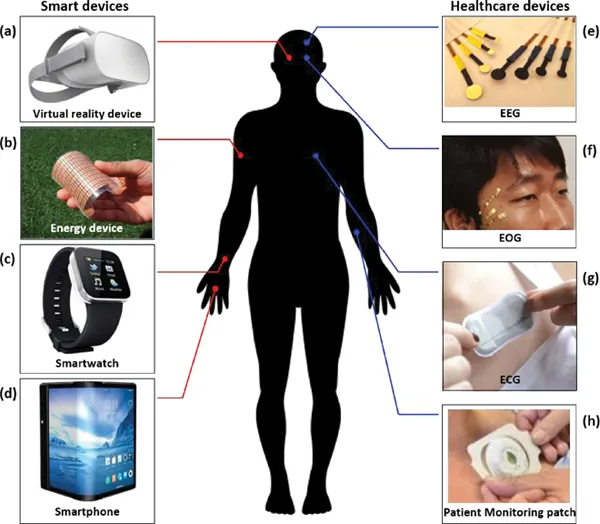
Over the last few decades, there has been an increased interest in flexible electronic devices due to their potential applications for smartphone, mobile display, and wearable healthcare system. Smart electronics, widely used today, have thin, lightweight, and wireless characteristics, which allow the employment on the human body and clothes. More recently, innovative features in curved, foldable smart devices enable enhanced mobility, user convenience, and conformal interfaces. Remarkable advances in wearable, wireless electronics have opened a new paradigm of portable, home health monitoring and therapeutics. The use of noninvasive, wearable systems for tracking biological signals provides real-time, continuous health monitoring, without the use of wired, bulky hardware in the conventional medical systems. Such biopotential signals, including electroencephalogram (EEG), electrooculogram (EOG), electrocardiogram (ECG), electromyogram (EMG), and bodily secretions, can investigate the clinical changes in brain activity, eye movement, cardiac systole-diastole cycle, and so on. Figure 1.1 illustrates some of recently developed wearable smart electronic devices and healthcare systems (Kim, Lee et al. 2016, Leleux et al. 2014, Ameri et al. 2018, Hong et al. 2019, Pickham et al. 2018).
FIGURE 1.1Wearable, flexible, and stretchable electronics for smart and healthcare devices. (a) Virtual reality device, (b) Flexible thin battery, (c) Wearable smart watch, and (d) Flexible smartphone. (e) EEG, (f) EOG, (g) ECG, and (h) Patient monitoring patch for human healthcare. ((b) Reproduced with permission from Kim, Lee et al. (2016), copyright 2016, ACS Publications; (e) Reproduced with permission from Leleux et al. (2014), copyright 2013, Wiley-VCH; (f) Reproduced with permission from Ameri et al. 2018), copyright 2008, Nature Publishing Group; (g) Reproduced with permission from (Hong et al. 2019), copyright 2019, Wiley-VCH; (h) Reproduced with permission from (Pickham et al. 2018), copyright 2018, Elsevier.)
Although significant progress in the field of flexible and stretchable electronics successfully achieves the commercialization in smart and healthcare applications, the currently available devices, based on rigid materials, have limited applications in biocompatibility, long-term wearability, portability, and direct integration with the skin and/or clothes. To achieve soft, stretchable electronics, capable of conforming to the dynamic surface and retaining their performance, novel approaches in advanced materials, mechanics design, and system integration are required. Once bulky and rigid materials are oriented into the downscaling of material dimensions, they easily accomplish the flexibility (Leleux et al. 2014, Lu, Suo, and Vlassak 2010). The design engineering, such as open-mesh and serpentine interconnection, is also a promising approach to endure the strain/stress, resulting in achievement of stretchability (Park et al. 2009). These concepts allow exhibiting unique electronic, optoelectronic, and bioelectronics properties that their bulk counterparts do not possess. These will be further discussed in Section 1.2.
Collectively, this chapter provides a summary of recently developed wearable, flexible, and stretchable hybrid electronics, emphasizing the advancement in materials, designs, and integration technologies. We introduce key wearable applications of flexible and stretchable electronics in thin film transistors (TFTs), displays, sensors, batteries, and bio-integrated electronics. Lastly, we conclude by discussing an overview of remaining challenges and future perspectives in wearable electronics.
1.2Functional Electronic Components and Devices
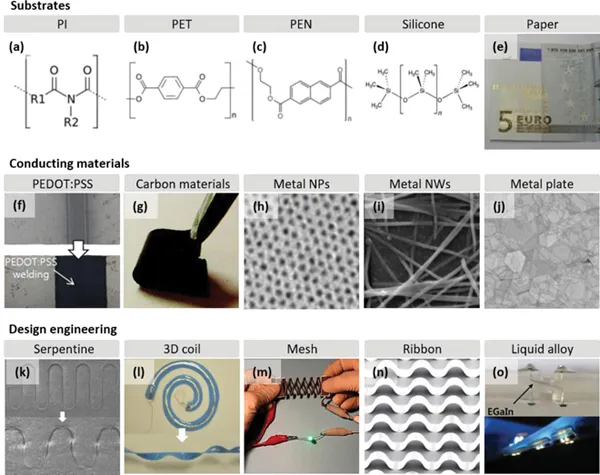
The strategies to integrate flexible, wearable, and stretchable devices exploit specialized materials and designs, and are classified into three main categories: supporting substrates, conducting materials, and pattern engineering (Figure 1.2). Compared to the rigid substrates, polymer-based substrate materials play a huge role in flexible and wearable technologies due to their inherent low mechanical stiffness, thermal stability, and chemical resistance. Among polymer substrates, polyimide (PI), polyethylene terephthalate (PET), and polyethylene naphthalate (PEN) exhibit great flexibility and electrical insulation (Figure 1.2a–c) (Webb et al. 2013, Wang et al. 2012, Nomura et al. 2004, Cao et al. 2016, Kaltenbrunner et al. 2013, Wang, Liu, and Zhang 2017). However, these polymer substrates with low adhesive force and high elastic modulus have been limited in the direct application to wearable and stretchable electronics (Liu, Pharr, and Salvatore 2017). Soft silicone materials, including polydimethylsiloxane (PDMS), Ecoflex, and Solaris, have the elastic modulus similar to that of skin, enabling conformal contact and stretchability without an adhesion failure (Figure 1.2d) (Kim, Lu et al. 2011, Liu, Pan, and Liou 2017). In addition, the most used paper in everyday life has also been considered as the supporting substrates for low-cost flexible electronics (Figure 1.2e) (Tobjörk and Ö sterbacka 2011, Zschieschang et al. 2011).
FIGURE 1.2Substrates, conducting materials, and designs for flexible and stretchable electronics. Representative polymers for the electrical insulated substrates: (a) PI, (b) PET, (c) PEN, (d) Silicone elastomer, and (e) Paper. ((a-d) Reproduced with permission from Wang, Liu, and Zhang (2017), copyright 2017, Wiley-VCH. (e) Reproduced with permission from Zschieschang et al. (2011), copyright 2011, Wiley-VCH.) Representative forms of conducting nanomaterials: (f) PEDOT:PSS. (Reproduced with permission from Oh et al. (2016), copyright 2016, Wiley-VCH.) (g) Carbon materials such as CNT and graphene. (Reproduced with permission from Xu et al. (2008), copyright 2008, ACS Publications.) (h) Metal nanoparticles (NPs). (Reproduced with permission from Zhao et al. (2015), copyright 2015, ACS Publications). (i) Metal nanowires (NWs). (Reproduced with permission from Kwon et al. (2017), copyright 2017, ACS Publications.) (j) Metal plate. (Reproduced with permission from Lin et al. (2014), copyright 2014, ACS Publications.) Geometry structure designs enhance the system-level deformability: (k) Serpentine. (Reproduced with permission from Pan et al. (2017), copyright 2017, Wiley-VCH.). (l) 3D coil. (Reproduced with permission from Mohammed and Kramer (2017), copyright 2017, Wiley-VCH.). (m) Mesh. (Reproduced with permission from Guo et al. (2016), copyright 2016, ACS Publications.). (n) Ribbon. (Reproduced with permission from Wu et al. (2016), copyright 2016, Wiley-VCH.) (o) Liquid alloy. (Reproduced with permission from (Yoon et al. 2014), copyright 2014, Wiley-VCH.)
To successfully maintain the high electrical and mechanical performances on diverse electronics, the functional nanomaterials is applied as the conductive electrodes though either top-down or bottom-up approaches (Yu et al. 2017). The top-down approach manufacturing with e-beam evaporation and/or sputtering tools is critical to implement thin layers because the flexural rigidity is proportional to the thickness, which is called as Euler-Bernoulli beam theory (Son et al. 2014, Lemaitre and Chaboche 1994). Figure 1.2f-i summarizes representative conductive materials synthesized via bottom-up approach. One of conductive polymer, poly(3,4- ethylenedioxythiophene):polystyrene sulfonate (PEDOT:PSS), with low modulus organics, can be structured with minimal degradation of electrical property under extreme deformations (Figure 1.2f) (Lipomi et al. 2012, Oh et al. 2016). Since carbon-based nanomaterials, such as carbon nanotube (CNT) and graphene, exhibit exceptionally high fracture strength and electrical performance, they enhance the mechanical robustness of electronics (Figure 1.2g) (Geim and Novoselov 2010, Kabiri Ameri et al. 2017, Sekitani et al. 2008, Xu et al. 2008). Downscaling of the metal materials (Au, Ag, and Cu) is also the most promising approach for decreasing flexural rigidity. These metal nanoparticles (NPs), nanowires (NWs), and nanoplates endure a larger amount of stress/strain strength than the bulk counterparts during extreme deformations (Figure 1.2h–j) (Kwon et al. 2018, Choi, Han et al. 2018, Lee et al. 2013, Zhao et al. 2015, Kwon et al. 2017, Lin et al. 2014).
In addition to the thinned supporting substrates and nanomaterials, the geometric layout engineering has been used to enhance the device deformation, as shown in Figure 1.2k-o.
Mechanically optimized serpentine structure design displays high sys...
Table of contents
Cover
Half Title
Series Page
Title Page
Copyright Page
Contents
Preface
About the Series Editor
About the Editor
Contributors
1. Flexible, Wearable, and Stretchable Electronics
2. Stretchable Conductor
3. Components and Devices
4. Printing Techniques
5. Carbon Nanotube-Based Flexible Electronics
6. Flexible Sensor Sheets for Healthcare Applications
7. Controlled Spalling Technology
8. Flexible and Stretchable Liquid Metal Electronics
9. Advanced Flexible Hybrid Electronics (FHE)
10. Metal-Laminated Fabric Substrates and Flexible Textile Interconnection
11. Flexible and Stretchable Systems for Healthcare and Mobility
12. Fabrication of Transparent Antennas on Flexible Glass
13. Testing and Reliability Characterization Methods for Flexible Hybrid Electronics
Index
Trusted by 375,005 students
Access to over 1.5 million titles for a fair monthly price.
Study more efficiently using our study tools.
Frequently asked questions
Yes, you can cancel anytime from the Subscription tab in your account settings on the Perlego website. Your subscription will stay active until the end of your current billing period. Learn how to cancel your subscription
No, books cannot be downloaded as external files, such as PDFs, for use outside of Perlego. However, you can download books within the Perlego app for offline reading on mobile or tablet. Learn how to download books offline
Perlego offers two plans: Essential and Complete
Essential is ideal for learners and professionals who enjoy exploring a wide range of subjects. Access the Essential Library with 800,000+ trusted titles and best-sellers across business, personal growth, and the humanities. Includes unlimited reading time and Standard Read Aloud voice.
Complete: Perfect for advanced learners and researchers needing full, unrestricted access. Unlock 1.5M+ books across hundreds of subjects, including academic and specialized titles. The Complete Plan also includes advanced features like Premium Read Aloud and Research Assistant.
Both plans are available with monthly, semester, or annual billing cycles.
We are an online textbook subscription service, where you can get access to an entire online library for less than the price of a single book per month. With over 1.5 million books across 990+ topics, we’ve got you covered! Learn about our mission
Look out for the read-aloud symbol on your next book to see if you can listen to it. The read-aloud tool reads text aloud for you, highlighting the text as it is being read. You can pause it, speed it up and slow it down. Learn more about Read Aloud
Yes! You can use the Perlego app on both iOS and Android devices to read anytime, anywhere — even offline. Perfect for commutes or when you’re on the go. Please note we cannot support devices running on iOS 13 and Android 7 or earlier. Learn more about using the app
Yes, you can access Flexible, Wearable, and Stretchable Electronics by Katsuyuki Sakuma in PDF and/or ePUB format, as well as other popular books in Technology & Engineering & Computer Engineering. We have over 1.5 million books available in our catalogue for you to explore.