Seamanship Techniques
eBook - ePub

Seamanship Techniques

Shipboard and Marine Operations

  1. 888 pages
  2. English
  3. ePUB (mobile friendly)
  4. Available on iOS & Android
eBook - ePub

Seamanship Techniques

Shipboard and Marine Operations

About this book

Ideal for Merchant Navy Officers from Cadet rank to Master Mariner, the fifth edition of this highly respected book is in full colour, and has been updated to include more information on topics as diverse as electronic navigation and AIS technology whilst still including essential information on subjects such as safety at sea, rescue operations, watchkeeping duties and pollution control. It covers international standards and works well on courses throughout the world.

Seamanship Techniques is written for serving mariners and nautical students from cadet to master level, studying for professional marine qualifications under the International Maritime Organization as per STCW requirements. Used by training establishments around the world, this best seller is the only reference to both shipboard practice and ship operations that seafarers will need.

Frequently asked questions

Yes, you can cancel anytime from the Subscription tab in your account settings on the Perlego website. Your subscription will stay active until the end of your current billing period. Learn how to cancel your subscription.
At the moment all of our mobile-responsive ePub books are available to download via the app. Most of our PDFs are also available to download and we're working on making the final remaining ones downloadable now. Learn more here.
Perlego offers two plans: Essential and Complete
  • Essential is ideal for learners and professionals who enjoy exploring a wide range of subjects. Access the Essential Library with 800,000+ trusted titles and best-sellers across business, personal growth, and the humanities. Includes unlimited reading time and Standard Read Aloud voice.
  • Complete: Perfect for advanced learners and researchers needing full, unrestricted access. Unlock 1.4M+ books across hundreds of subjects, including academic and specialized titles. The Complete Plan also includes advanced features like Premium Read Aloud and Research Assistant.
Both plans are available with monthly, semester, or annual billing cycles.
We are an online textbook subscription service, where you can get access to an entire online library for less than the price of a single book per month. With over 1 million books across 1000+ topics, we’ve got you covered! Learn more here.
Look out for the read-aloud symbol on your next book to see if you can listen to it. The read-aloud tool reads text aloud for you, highlighting the text as it is being read. You can pause it, speed it up and slow it down. Learn more here.
Yes! You can use the Perlego app on both iOS or Android devices to read anytime, anywhere — even offline. Perfect for commutes or when you’re on the go.
Please note we cannot support devices running on iOS 13 and Android 7 or earlier. Learn more about using the app.
Yes, you can access Seamanship Techniques by D.J. House in PDF and/or ePUB format, as well as other popular books in Technology & Engineering & Geography. We have over one million books available in our catalogue for you to explore.

Information

Publisher
Routledge
Year
2018
eBook ISBN
9781317197706
Edition
5

1
The Ship

Introduction

The art and science of seamanship has developed from the experience of maritime nations over many centuries. Sea transport has moved through the changing years of propulsion by oars, the discovery days of sail, through the advances of steam and the benefits of oil to finally emerge into atomic power. The marine industry has historically seen the excitement of discovering new worlds and the conquering of offshore boundaries, to become settled with the advance of trade in all directions of the compass.
The ship, once stored and provisioned, becomes the ideal in self-sufficiency, capable of the transport of cargo, livestock, troops, passengers, gas, fluids, minerals, etc. The fact that the vessel provides a source of power which can cope with varying degrees of emergency and still be able to sustain itself, says a lot for the developed marine industry.
The ship is equipped with such ancillary equipment as required to be able to load and discharge, in a safe condition, all cargoes and passengers as the vessel is designed to accommodate. Bearing in mind the function of the ship, it is not difficult for seafarers to realize how their characters have been influenced by the independent nature of their employment. Seamanship and the ships themselves have created the spirit of adventure that turned such men as Magellan, Drake and Nelson into more than legends.
Even in today’s ships, be they of the mercantile marine or ‘men of war’, it is hoped that the same spirit prevails alongside past practice and the increased levels of technology.

Terms and Definitions

Abeam

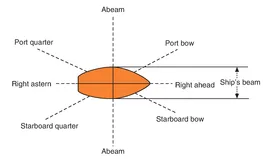
A bearing projected at right angles from the fore and aft line, outwards from the widest part of the ship (Figure 1.1).
Figure 1.1 The ship in relation to its surroundings.

Ahead

‘Right ahead’ is the line that the fore and aft line, if projected, would extend in front of the vessel (Figure 1.1). Opposite to the term ‘astern’ when used in relation to relative bearings. It may also be used as an engine-room order to cause the engines to turn in order to move the ship ahead.

Amidships

The middle of the vessel in both transverse and longitudinal directions. More commonly used as a helm order, where it is usually shortened to ‘midships’ (see Table 10.1).

Athwartships

Defined as ‘in a direction’ from one side of the ship to the other, at a right angle to the fore and aft line.

Breadth

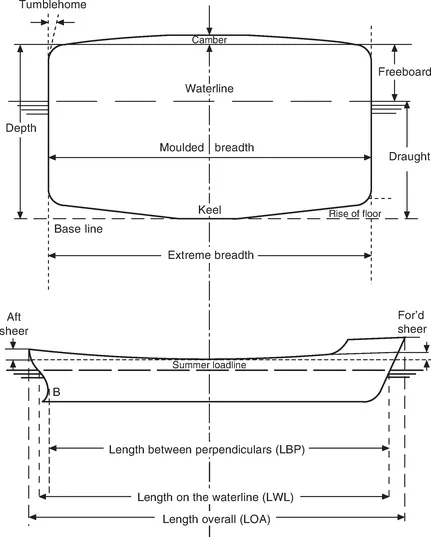
The maximum beam of the vessel measured from the outside edge of the shell plating on either side of the vessel is the extreme breadth (Figure 1.2).
The beam of the vessel measured amidships, between the inside edge of the shell plating on either side of the vessel, is the moulded breadth (Figure 1.2).

Camber (or round of beam)

The curvature of the deck in the athwartships direction. The measurement is made by comparing the height of the deck at the centre of the vessel to the height of the deck at the side of the vessel (Figure 1.2).

Depth

The extreme depth of the vessel is measured from the bottom side of the keel to the top of the deck beams, the measurement being taken at the side of the vessel.
Figure 1.2 Ship’s principal dimensions.
The moulded depth is measured from the top side of the keel to the top of the deck beams, at the side of the vessel.

Flare

The outward curvature of the shell plating in the foremost part of the vessel, providing more width to the forecastle head and at the same time helping to prevent water coming aboard.

Fore and Aft Line

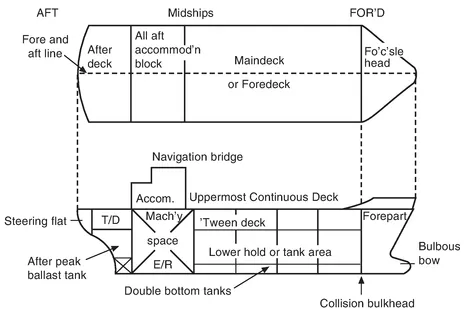
An imaginary line passing from the stem to the stern through the centre of the vessel (Figure 1.3).
Figure 1.3 The ship in section and plan.
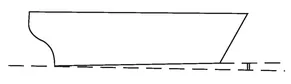
Figure 1.4 Keel rake.

Freeboard

This is the vertical distance, measured at the ship’s side, from the waterline to the top of the freeboard deck edge. The freeboard measurement is taken at the amidships point. The deck edge is marked by a painted line 25 mm × 300 mm, above the Plimsoll line (Figure 1.2 and Figure 1.36).

Keel Rake

The angle of inclination of the line of the keel to the horizontal (Figure 1.4).

Length between Perpendiculars (LBP)

The distance between the forward and aft perpendicu...
Table of contents

  1. Cover Page
  2. Half Title page
  3. Series page
  4. Title Page
  5. Copyright Page
  6. Contents
  7. Preface to the First Edition
  8. Preface to the Fifth Edition
  9. Acknowledgements
  10. About the Author
  11. Abbreviations
  12. 1 The Ship
  13. 2 Anchor Work (Fundamentals)
  14. 3 Ropework
  15. 4 Wirework and Rigging
  16. 5 Lifting Gear
  17. 6 Cargo and Hatchwork
  18. 7 Boatwork and Life-Saving Appliances
  19. 8 Survival Craft and Practice
  20. 9 Communications
  21. 10 Watchkeeping Duties
  22. 11 Marine Instruments Monitoring and Measurement
  23. 12 Meteorology
  24. 13 Preventing Collisions at Sea
  25. 14 Emergencies
  26. 15 Fire-Fighting
  27. 16 Search and Rescue Operations
  28. 17 Ship Handling: Equipment
  29. 18 Ship Handling: Manoeuvring and Mooring Operations
  30. 19 Tanker Operations
  31. 20 The Application of MARPOL and Prevention of Pollution to the Marine Environment
  32. 21 Appendix I: Mariner's Self Examiner (for the Training of Deck Officers, MN)
  33. 22 Appendix II: Officer of the Watch: Certificate of Competency
  34. 23 Appendix III: Chief Officer (First Mate): Certificate of Competency
  35. 24 Appendix IV: Ship's Master: Certificate of Competency
  36. 25 Appendix V: Rule of the Road: Reference to the ColRegs and the IALA Buoyage System
  37. Index