- 142 pages
- English
- PDF
- Available on iOS & Android
eBook - PDF
About this book
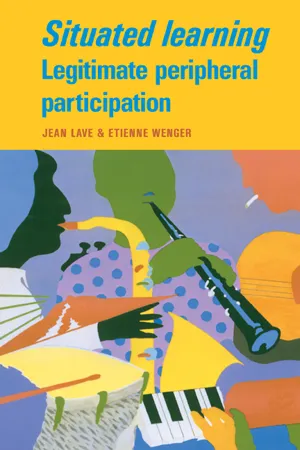
In this important theoretical treatist, Jean Lave, anthropologist, and Etienne Wenger, computer scientist, push forward the notion of situated learning - that learning is fundamentally a social process. The authors maintain that learning viewed as situated activity has as its central defining characteristic a process they call legitimate peripheral participation (LPP). Learners participate in communities of practitioners, moving toward full participation in the sociocultural practices of a community. LPP provides a way to speak about crucial relations between newcomers and old-timers and about their activities, identities, artefacts, knowledge and practice. The communities discussed in the book are midwives, tailors, quartermasters, butchers, and recovering alcoholics, however, the process by which participants in those communities learn can be generalised to other social groups.
Information
Table of contents
- Cover
- Half-title
- Title
- Copyright
- Dedication
- Contents
- Series Foreword
- Foreword by William F. Hanks
- Acknowledgments
- 1 Legitimate Peripheral Participation
- 2 Practice, Person, Social World
- 3 Midwives, Tailors, Quartermasters, Butchers, Nondrinking Alcoholics
- 4 Legitimate Peripheral Participation in Communities of Practice
- 5 Conclusion
- References
- Index
Trusted by 375,005 students
Access to over 1.5 million titles for a fair monthly price.
Study more efficiently using our study tools.
Frequently asked questions
Yes, you can cancel anytime from the Subscription tab in your account settings on the Perlego website. Your subscription will stay active until the end of your current billing period. Learn how to cancel your subscription
No, books cannot be downloaded as external files, such as PDFs, for use outside of Perlego. However, you can download books within the Perlego app for offline reading on mobile or tablet. Learn how to download books offline
We are an online textbook subscription service, where you can get access to an entire online library for less than the price of a single book per month. With over 1.5 million books across 990+ topics, we’ve got you covered! Learn about our mission
Look out for the read-aloud symbol on your next book to see if you can listen to it. The read-aloud tool reads text aloud for you, highlighting the text as it is being read. You can pause it, speed it up and slow it down. Learn more about Read Aloud
Yes! You can use the Perlego app on both iOS and Android devices to read anytime, anywhere — even offline. Perfect for commutes or when you’re on the go.
Please note we cannot support devices running on iOS 13 and Android 7 or earlier. Learn more about using the app
Please note we cannot support devices running on iOS 13 and Android 7 or earlier. Learn more about using the app
Yes, you can access Situated Learning by Jean Lave,Etienne Wenger in PDF and/or ePUB format, as well as other popular books in Psychology & Developmental Psychology. We have over 1.5 million books available in our catalogue for you to explore.