A practical guide to carrying out ethical research with children and young people, this practical handbook examines the ethical questions that arise at each stage of research, from first plans to dissemination and impact. Illustrated with case studies from international and inter-disciplinary research, it offers advice for addressing each ethical question, issue or uncertainty. Including:
• A showcase of the best practice on a range of topics including data protection
• Practical guidance for responding to recent global changes in policy and practice in ethics and law
• Discussion of the challenges and opportunities of digital research with children
The updated second edition continues to provide an excellent resource for those exploring the old, current and new consensuses on the ethics of researching with children.
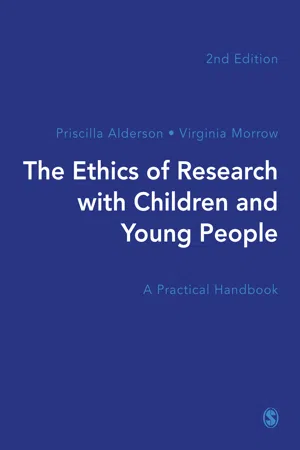
eBook - ePub
The Ethics of Research with Children and Young People
A Practical Handbook
- 240 pages
- English
- ePUB (mobile friendly)
- Available on iOS & Android
eBook - ePub
The Ethics of Research with Children and Young People
A Practical Handbook
About this book
Information
Part 1 The planning stages
One Planning the research: purpose and methods
Two basic questions
There are two basic ethical questions at the outset of any study, whether it is research, evaluation, audit or other consultation:
- Is it worth doing?
- Can the investigators explain the research clearly enough so that anyone they ask to take part can give informed consent or refusal?
These two questions lead to many sub-questions, and this chapter begins by reviewing the sub-questions raised by a range of research purposes and methods. We then summarise three stages of growing awareness about research ethics. These are linked to three main ethical frameworks for assessing research studies based on ideas about duties, rights and harms or benefits. The chapter ends by returning to the importance of starting from uncertainty.
Questions about purpose and methods
- Are the research questions worth asking and why?
- Have they already been answered – has previous research on this question been checked for in a thorough literature search?
- In whose interests are the questions being asked?
- How well do the methods fit the aims in order to conduct research effectively?
- Do the chosen methods offer the best, or at least the most reasonably efficient, means of answering the questions?
- What are the strengths and limitations of the chosen methods?
Is the research worth doing?
Research, consultations and evaluations can be unethical in the sense that they ask the wrong questions, or the methods do not fit the questions. The studies may waste time and money, at best come up with useless answers, and at worst produce misleading ones that support future misguided and even harmful policies.
Do theories matter?
Research is often seen as either theoretical or practical. Yet it is not as simple as that. First, all research studies and questions are grounded in theory, as Box 1.1 illustrates. We cannot avoid holding beliefs or theories, for example, about what children are and ought to be like. For most of the 20th century, developmental psychology dominated the study of childhood and it tends to construct children as ‘human becomings’ rather than fully ‘human beings’ (James and Prout, 1997; Mayall, 2002; Qvorturp, 2005; Alderson, 2008).
It was not until theories about children’s incompetence began to be questioned that research began to be funded and conducted which took more account of children’s views of their experiences and capacities. When researchers accept theories of children as people and human beings, this can lead to mutually respectful ethical relationships in research.
Box 1.1 Defining terms, thinking about theories: ‘young carers’ of a disabled family member
How many hours of care have to be given in an average week for a child to count as a ‘young carer’? And how does that time differ from the housework and childcare and loving support that children give in so many families that do not have a disabled member? The way theories see children (and also disabled people) as victims or problem-solvers, as helpless dependents or else interdependent contributors interacting with other family members, will alter the research questions and conclusions.
Do viewpoints matter?
There are differing ways of seeing and understanding children, which alter how children’s accounts of themselves are elicited and interpreted. Each member of a family has a different viewpoint and, for example, children who ‘play truant’ from school or ‘abscond’ might have convincing reasons for doing so. Researchers therefore need to think about the ‘standpoint’ from which they are studying children, and the ethical implications of that standpoint: whether they try to stand in and understand the child’s position, or the adults’ viewpoints, such as parent, teacher, social worker, politician or tax payer. Are they respecting children’s standpoints and competencies, and grounding research methods in this respect? (Mayall, 2002). A second ethical and useful way to examine theories, instead of taking standpoints for granted, is to be more aware of them and of the context, power differences and whose interests are likely to be served by the research (Box 1.2).
Box 1.2 Evaluating a school-based behaviour programme
A hypothetical example
A school invited a team to evaluate its behaviour programme, run by a specialist company, in which the 12 ‘most difficult’ children in the school and their mothers took part in play and education sessions one morning a week. The team was asked to use a questionnaire to collect the views of the teachers, the parents and the company running the programme. The team decided to look at a range of views, including children’s. They asked all the children in the school what they thought about the effects of the programme, whether they thought there might be better ways to tackle behaviour problems, and how they might spend the budget for the programme. The children were much less likely than the adults to think that the programme worked well. They thought the play sessions and budget should be shared more fairly through the school, and they had positive ideas on how all the children and staff could work together to tackle the behaviour problems, instead of calling on outside help. The answers from different groups highlighted how people tend to speak from their own standpoint and interests. The 12 mothers were afraid to criticise the programme in case they seemed to endorse the view that they and their children were troublesome. The company praised the programme and so did the teachers who liked having one morning a week without their most difficult children. The 200 children in the school wanted to have more play programmes during their lessons.
Do methods matter?
Chapter 3 will review how each data-collecting method raises ethical questions on respecting the ‘worth and dignity… of all members of the human family’ (UN, 1989). Mixed methods, for example, can help to include young children actively and respectfully (Box 1.3).
Box 1.3 The participatory Mosaic approach
Children aged 3–4 years took photographs, went on tours and made maps and drawings while talking with adults (child conferencing), to build up a picture of children’s perspectives on their early childhood settings and services. The researchers state that the ‘framework for listening’ is:
- multi-method in recognising the different ‘voices’ or language of children;
- participatory in treating children as experts and agents in their own lives;
- reflexive by including children, practitioners and parents in reflecting on meanings and interpretations of the data;
- adaptable because it can be applied in a variety of early childhood settings;
- focused on children’s own experiences and views.
Information is gathered and then pieced together for dialogue, reflection and interpretation. The approach can be used for many purposes, including looking at lives lived rather than knowledge gained or care received. It can be embedded in practice and used as an evaluative tool in individual reviews, internal audits, childcare audits, changes to the environment, promoting an ongoing dialogue, increasing confidence, developing skills and encouraging children to become more active participants. There is concern to listen carefully, to respect children’s privacy and to avoid intruding into their free time (Clark and Moss, 2011).
Three phases in the growing awareness of research ethics
This section outlines three phases of growing awareness about ethics in the longer history of healthcare research (Beauchamp and Childress, 1979/2013), as a background to social research ethics.
Phase 1 – doing ‘good’ and feeling good: beneficence and duty
Early medical ethics guidelines were about etiquette, relations with colleagues and promoting public respect for the profession. Some of these standards benefited patients, but they also benefited the medical profession and its authority and power. In the Hippocratic tradition, from the 5th century bce, doctors assumed they knew best what was ‘good’ for patients (Box 1.4).
Box 1.4 Phase 1 – beneficence and duty: the main assumptions
- All true professionals fulfil their duty to benefit service users.
- Standards are ensured by training and expert knowledge.
- To be a professional means to be the best judge of what is good for your service users.
Phase 2 – concern about harm: respect and rights
Confidence in these beliefs was shaken by scandals about harmful research, such as the Nazi experiments that led lawyers to write the first international guidelines on ethical research, the Nuremberg Code (1947), which begins:
The voluntary consent of the human subject is absolutely essential [the ability] to exercise free power of choice, without the intervention of any element of force, fraud, deceit, duress, over-reaching or other ulterior forms of constraint or coercion.
Based on Anglo-American law, the Code respects personal integrity. Only people who are competent to consent should be asked to take part in research. Children were excluded as being too vulnerable and pre-competent to be research subjects, unless the research was testing some treatment or service that was intended to benefit them. Potential research subjects should be given enough information about the risks and hoped-for benefits to enable them to ‘make an understanding and enlightened decision’ about whether they wish to take part in research (Box 1.5).
Phase 3 – confidence yet caution: balancing harm and benefit
The Declaration of Helsinki (World Medical Association [WMA], 1964/2013) was the first international code on research ethics to be written by doctors, in response to public concern about dangerously under-researched medical treatments. Helsinki seeks to reassure by beginning with doctors’ expertise and their mission to ‘help suffering humanity’. There is only brief mention of ‘informed consent’, and instead the emphasis is on doctors’ assessments of harms and benefits, of whether research is worthwhile and of how to safeguard subjects’ interests.
Box 1.5 Phase 2 – concern about harm: the main assumptions
Research and services can harm as well as benefit:
- Professionals do not always act benignly or skilfully or with sufficient knowledge.
- Professional expertise and self-regulation are valuable but not sufficient safeguards.
- Ordinary people can understand expert information if it is clearly explained.
- Only the potential research subject can make an ‘enlightened’ decision about whether to consent to research, believing that the risks are worth taking for the sake of the hoped-for benefits the research might bring.
- Human rights must be respected.
Medical research involving human subjects must be conducted only by those individuals with the appropriate scie...
Table of contents
- Cover
- Half Title
- Acknowledgements
- Title Page
- Copyright Page
- Contents
- Acknowledgements
- About the authors
- Introduction: why ethics matters
- Part 1 The planning stages
- One Planning the research: purpose and methods
- Two Assessing harms and benefits
- Three Respect for rights: privacy and confidentiality
- Four Designing research: selection and participation
- Five Money matters: contracts, funding research and paying participants
- Six Reviewing aims and methods: ethics guidance and committees
- Part 2 The data-collecting stage
- Seven Information
- Eight Consent
- Part 3 The writing, reporting and follow-up stages
- Nine Disseminating and implementing the findings
- Ten The impact on children and young people
- Appendix: Ten topics in ethical research
- References
- Index
Trusted by 375,005 students
Access to over 1.5 million titles for a fair monthly price.
Study more efficiently using our study tools.
Frequently asked questions
Yes, you can cancel anytime from the Subscription tab in your account settings on the Perlego website. Your subscription will stay active until the end of your current billing period. Learn how to cancel your subscription
No, books cannot be downloaded as external files, such as PDFs, for use outside of Perlego. However, you can download books within the Perlego app for offline reading on mobile or tablet. Learn how to download books offline
Perlego offers two plans: Essential and Complete
- Essential is ideal for learners and professionals who enjoy exploring a wide range of subjects. Access the Essential Library with 800,000+ trusted titles and best-sellers across business, personal growth, and the humanities. Includes unlimited reading time and Standard Read Aloud voice.
- Complete: Perfect for advanced learners and researchers needing full, unrestricted access. Unlock 1.5M+ books across hundreds of subjects, including academic and specialized titles. The Complete Plan also includes advanced features like Premium Read Aloud and Research Assistant.
We are an online textbook subscription service, where you can get access to an entire online library for less than the price of a single book per month. With over 1.5 million books across 990+ topics, we’ve got you covered! Learn about our mission
Look out for the read-aloud symbol on your next book to see if you can listen to it. The read-aloud tool reads text aloud for you, highlighting the text as it is being read. You can pause it, speed it up and slow it down. Learn more about Read Aloud
Yes! You can use the Perlego app on both iOS and Android devices to read anytime, anywhere — even offline. Perfect for commutes or when you’re on the go.
Please note we cannot support devices running on iOS 13 and Android 7 or earlier. Learn more about using the app
Please note we cannot support devices running on iOS 13 and Android 7 or earlier. Learn more about using the app
Yes, you can access The Ethics of Research with Children and Young People by Priscilla Alderson,Virginia Morrow in PDF and/or ePUB format, as well as other popular books in Education & Research in Education. We have over 1.5 million books available in our catalogue for you to explore.