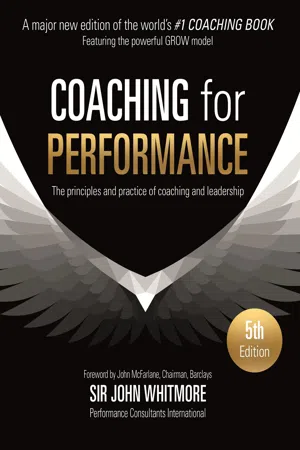
"Coaching for Performance is the proven resource for all coaches and pioneers of the future of coaching." Magdalena N. Mook, CEO, International Coach Federation (ICF) "Shines a light on what it takes to create high performance." John McFarlane, Chairman, Barclays, Chairman, TheCityUK C oaching for Performance is the definitive book for coaches, leaders, talent managers and professionals around the world. An international bestseller, featuring the influential GROW model, this book is the founding text of the coaching profession. It explains why enabling people to bring the best out of themselves is the key to driving productivity, growth, and engagement. A meaningful coaching culture has the potential to transform the relationship between organizations and employees and to put both on the path to long-term success. Written by Sir John Whitmore, the pioneer of coaching, and Performance Consultants, the global market leaders in performance coaching, this extensively revised and extended edition will revolutionize the traditional approach to organizational culture. Brand new practical exercises, corporate examples, coaching dialogues, and a glossary, strengthen the learning process, whilst a critical new chapter demonstrates how to measure the benefits of coaching as a return on investment, ensuring this landmark new edition will remain at the forefront of professional coaching and leadership development.
eBook - ePub
Coaching for Performance
The Principles and Practice of Coaching and Leadership FULLY REVISED 25TH ANNIVERSARY EDITION
- 240 pages
- English
- ePUB (mobile friendly)
- Available on iOS & Android
eBook - ePub
Coaching for Performance
The Principles and Practice of Coaching and Leadership FULLY REVISED 25TH ANNIVERSARY EDITION
About this book
Information
PART I
Coaching Is Bigger Than Coaching
1 What Is Coaching?
Coaching focuses on future possibilities, not past mistakes
Despite the existence of the International Coach Federation (ICF) with members in 138 countries, if you look up “coach” or “coaching” on the Oxford Dictionaries website, you’ll be none the wiser as to what all these people are up to. It offers two definitions. The first mentions a bus used for longer journeys, a railway carriage, and traveling. The second includes sports instruction or training, private tuition, and extra teaching. It might surprise you to learn that the first is more relevant. Coaching is all about a journey and nothing about instruction or teaching. It is as much if not more about the way things are done as about what is done. Coaching delivers results in large measure because of the powerful working relationship created, and the means and style of communication used. The coachee does acquire facts and develops new skills and behaviors, not by being told or taught but by discovering from within, stimulated by coaching. Of course, the objective of improving performance is paramount, and how that is best achieved and sustained is what this book reveals.
The Inner Game
Let us take a look at the birth of modern-day coaching. Timothy Gallwey was perhaps the first to demonstrate a simple but comprehensive method of coaching over four decades ago. A Harvard educationalist and tennis expert, he threw down the gauntlet in 1974 with a book entitled The Inner Game of Tennis, which was quickly followed by Inner Skiing and The Inner Game of Golf.
The word “inner” was used to indicate the player’s internal state or, to use Gallwey’s words, that “the opponent within one’s own head is more formidable than the one the other side of the net.” Anyone who has had one of those days on the court when you can’t do anything right will recognize what he is referring to. Gallwey went on to claim that if a coach can help a player to remove or reduce the internal obstacles to performance, an unexpected natural ability to learn and to perform will occur without the need for much technical input from the coach.
The Inner Game Equation
To illustrate this, Gallwey created a simple Inner Game Equation which, with the benefit of hindsight, we can see very effectively summarizes the objective of modern coaching:
Performance = potential – interference
P = p – i
P = p – i
Both the Inner Game and coaching focus on improving performance (P) by growing potential (p) and by decreasing interference (i).
Internal obstacles are often more daunting than external ones.
At the time Gallwey’s books first appeared, few coaches, instructors, or professional sportspeople could believe his ideas, let alone embrace them, although players devoured them eagerly in bestseller-list quantities. The professionals’ ground of being was under threat. They thought that Gallwey was trying to turn the teaching of sport on its head and that he was undermining their egos, their authority, and the principles in which they had invested so much. In a way he was, but their fear exaggerated their fantasies about his intentions. He was not threatening them with redundancy, merely proposing that they would be more effective if they changed their approach.
The essence of coaching
We can see from all this that Gallwey had put his finger on the essence of coaching. Indeed, my definition of coaching describes the link to the Inner Game and all it stands for: Coaching is unlocking people’s potential to maximize their own performance. It is helping them to learn rather than teaching them. After all, how did you learn to walk? Did your mother or father instruct you? We all have a built-in, natural learning capability that is actually disrupted by instruction.
This idea was not new: Socrates had voiced the same concept some 2,000 years earlier, but somehow his philosophy got lost in the rush to materialistic reductionism of the last two centuries. The pendulum has swung back and coaching, if not Socrates, is here to stay for a century or three yet! Gallwey’s books coincided with the emergence of a more optimistic psychological model of humankind than the old behaviorist view that we are little more than empty vessels into which everything has to be poured. The new model suggested we are more like acorns, each of which contains within it all the potential to be a magnificent oak tree. We need nourishment, encouragement, and the light to reach toward, but the oaktreeness is already within us.
If we accept this model – and few people now contest it – the way we learn, and more importantly the way we teach and instruct, must be called into question. Unfortunately, habits die hard and old methods persist, even though most of us know their limitations. It may be harder to give up instructing than it is to learn to coach.
Let me extend the acorn analogy a step further. Oak saplings, growing from acorns in the wild, quickly develop a single, hair-thin tap root to seek out water. This may extend downward as far as a meter while the sapling is still only 30cm tall. When grown commercially in a nursery, the tap root tends to coil in the bottom of the pot and is broken off when the sapling is transplanted, setting back its development severely while a replacement grows. Insufficient time is taken to preserve the tap root and most growers do not even know of its existence or purpose.
When transplanting a sapling, the wise gardener will uncoil the tender tap root, weight its tip, and carefully thread it down a long, vertical hole driven deep into the earth with a metal bar. The small amount of time invested in this process so early in the tree’s life ensures its survival, and allows it to develop faster and become stronger than its commercially grown siblings. Wise business leaders use coaching to emulate the good gardener.
In the past, the universal proof of the success of new coaching methods was hard to demonstrate because few people had understood and used them fully. This is now changing and I hope that the additional models I have included in this book will support this further. However, many coaches have been unwilling to set aside old, proven ways for long enough to reap the rewards of new ones. Recently, as much through necessity as progress, employee engagement has been proven to be linked to performance, and so all the behaviors that underpin engagement – which are all coaching behaviors, such as collaborating, meaningful goal setting, delegating, and accountability – have found their way into business language and, more importantly, into behavior too.
Mentoring
Since I am defining coaching, I should perhaps mention mentoring, another word that is now common in business parlance. The word originates from Greek mythology, in which it is reported that Odysseus, when setting out for Troy, entrusted his house and the education of his son Telemachus to his friend, Mentor. “Tell him all you know,” Odysseus said, and thus unwittingly set some limits to mentoring.
Some people use the term mentoring interchangeably with coaching. However, mentoring is very different to coaching, because coaching is not dependent on a more experienced person passing down their knowledge – in fact, this undermines the building of self-belief which creates sustained performance, as we shall discover. Instead, coaching requires expertise in coaching, not in the subject at hand. That is one of its great strengths. And something that coaching leaders grapple with most – but is key – is to learn when to share their knowledge and experience and when not to.
Mike Sprecklen was the coach and mentor to the famous all-conquering British rowing pair Andy Holmes and Steve Redgrave. “I was stuck, I had taught them all I knew technically,” Sprecklen said on completion of a Coaching for Performance workshop many years ago, “but this opens up the possibility of going further, for they can feel things that I can’t even see.” He had discovered a new way forward with them, working from their experience and perceptions rather than from his own. Good coaching and leading, and good mentoring for that matter, can and should take a coachee beyond the limitations of the coach, leader, or mentor’s own knowledge.
Inner Business
Many years ago I sought out Tim Gallwey, was trained by him, and founded the Inner Game in Britain. We soon formed a small team of Inner Game coaches. At first all were trained by Gallwey, but later we trained our own. We ran Inner Tennis courses and Inner Skiing holidays, and many golfers freed up their swings with Inner Golf. It was not long before our sporting clients began to ask us if we could apply the same methods to prevailing issues in their companies; IBM was the first. On the ski slopes of the Alps, leaders discovered a revolutionary way of learning to ski using the Inner Game and wanted us to help them bring this approach to their work. What is of note here is that the simple methods could be readily applied to almost any situation. Of course, the rest is history – we pioneered this new approach in business, which we called “performance coaching.” All the leading exponents of business coaching today graduated from this and have been profoundly influenced by the Gallwey school of coaching.
Since 1982, Performance Consultants has built and elaborated on those first methods and adapted them to the practical issues and conditions of today’s business environment. Indeed, our team has partnered with clients to apply coaching to such diverse topics as employee engagement, Lean methodology, and safety. We have specialized in teaching leaders to coach and transform organizations and also in providing expert coaching for executives and for business teams. Although coaches have to compete with one another in the market, they tend to be friends and not infrequently work together. This in itself speaks highly of the method, for it was Gallwey who suggested that your opponent in tennis is really your friend if they make you stretch and run. Opponents are not friends if they just pat the ball back to you, as that will not help you to improve your game, and isn’t that what we are all trying to do in our different fields?
Although Gallwey, my more senior colleagues in Performance Consultants, and many others who now practice coaching in the business arena cut our teeth in sport, coaching in sport itself has changed little overall. It remains significantly behind the methodology of coaching that is virtually universal in business today. That is because when we introduced coaching into business four decades ago, the word was new in that context and did not bring with it the baggage of a long history of past practice. We were able to introduce new concepts without having to fight old prejudices and practitioners of old coaching.
That is not to say that we met no resistance to coaching in business; we still do at times from people who have remained strangely insulated from or blind to change. Coaching as a practice in business is here to stay, although the word itself might disappear as its associated values, beliefs, attitudes, and behaviors become the norm for everyone, as I explore in this book. My hope is that this Fifth Edition will lay the foundation for this to occur.
Mindset and Maslow
Gallwey was building on the work of others. In the 1940s, American psychologist Abraham Maslow broke away from the tradition of delving into pathology to try to understand human nature. He studied mature, complete, successful, and fulfilled people, and concluded that we could all be that way. In fact, he asserted that this was the natural human state. All we had to do, in his opinion, was to overcome our inner blocks to development and maturity. Maslow, along with Carl Rogers and others, was the father of the more optimistic wave of psychological thinking that is still in the process of displacing carrot-and-stick behaviorism as the best way of leading and motivating people. Psychological optimism is essential if we are to fully embrace coaching as the leadership style of the future.
Maslow is best known in business circles for his Hierarchy of Needs. This model suggests that our most basic need is for food and water, and that we will care for little else (except possibly a mobile phone!) until that physiological need is met. Once we have secured a supply of food and water, we begin to concern ourselves with items such as shelter, clothing, and safety. And once we have met, at least in part, these physical needs, we begin to focus on our social needs, including the need to belong to a grouping. These needs are met in part by our family, but later we also meet them in pubs, clubs, and teams.
FIGURE 1: Maslow’s Hierarchy of Needs

Next we seek to satisfy our desire for respect and admiration – the need for esteem from others – by display and by competing for power, victory, or recognition. These emotional needs are eventually displaced by a subtle shift to the need for self-esteem, or as I prefer to call it, self-belief (the bedrock of coaching and the prerequisite for high performance). Here we demand higher standards of ourselves and look to our own criteria by which we measure ourselves, rather than to how others see us. In terms of mindset, we have become independent.
Maslow’s highest state was the self-actualizing person, who emerges when both the esteem needs (respect from others and belief in self) are satisfied and individuals are no longer driven by the need to prove themselves, either to themselves or to anyone else. These latter two needs are personal and are free of any external dependency. Maslow called the final stage self-actualizing rather than self-actualized, because he saw it as a never-ending journey. The primary need associated with self-actualizers is the need for meaning and purpose in their lives. They want their work, their activities, and their existence to have some value, to be a contribution to others. They are interdependent. I will discuss this vital performance leap from independence to interdependence in the next chapter.
MOTIVATION AT WORK
People will seek to engage in those activities that help them to meet their needs. They are likely to be only partially conscious of this process. Work has naturally developed in ways that do help meet those needs, and now it has to develop to the next level. At the basic level, work does meet people’s primary needs by giving them an income with which they can feed, water, clothe, and house their families. Furthermore, work offers promotion, prestige, pay ...
Table of contents
- Cover
- Praise
- Title Page
- Copyright
- Contents
- Foreword by John McFarlane, Chairman, Barclays Bank
- Preface by Tiffany Gaskell, Director, Performance Consultants International
- Introduction
- A Note to the Reader
- Part I: Coaching Is Bigger Than Coaching
- Part II: The Principles of Coaching
- Part III: The Practice of Coaching
- Part IV: Specific Applications of Coaching
- Part V: Realizing the Potential of Coaching
- Appendix 1: Glossary of Coaching Terms
- Appendix 2: Coaching Question Toolkit
- Appendix 3: Some Solutions to the Nine Dot Exercise
- Bibliography
- Acknowledgments
- About the Authors
Trusted by 375,005 students
Access to over 1.5 million titles for a fair monthly price.
Study more efficiently using our study tools.
Frequently asked questions
Yes, you can cancel anytime from the Subscription tab in your account settings on the Perlego website. Your subscription will stay active until the end of your current billing period. Learn how to cancel your subscription
No, books cannot be downloaded as external files, such as PDFs, for use outside of Perlego. However, you can download books within the Perlego app for offline reading on mobile or tablet. Learn how to download books offline
Perlego offers two plans: Essential and Complete
- Essential is ideal for learners and professionals who enjoy exploring a wide range of subjects. Access the Essential Library with 800,000+ trusted titles and best-sellers across business, personal growth, and the humanities. Includes unlimited reading time and Standard Read Aloud voice.
- Complete: Perfect for advanced learners and researchers needing full, unrestricted access. Unlock 1.5M+ books across hundreds of subjects, including academic and specialized titles. The Complete Plan also includes advanced features like Premium Read Aloud and Research Assistant.
We are an online textbook subscription service, where you can get access to an entire online library for less than the price of a single book per month. With over 1.5 million books across 990+ topics, we’ve got you covered! Learn about our mission
Look out for the read-aloud symbol on your next book to see if you can listen to it. The read-aloud tool reads text aloud for you, highlighting the text as it is being read. You can pause it, speed it up and slow it down. Learn more about Read Aloud
Yes! You can use the Perlego app on both iOS and Android devices to read anytime, anywhere — even offline. Perfect for commutes or when you’re on the go.
Please note we cannot support devices running on iOS 13 and Android 7 or earlier. Learn more about using the app
Please note we cannot support devices running on iOS 13 and Android 7 or earlier. Learn more about using the app
Yes, you can access Coaching for Performance by John Whitmore in PDF and/or ePUB format, as well as other popular books in Business & Human Resource Management. We have over 1.5 million books available in our catalogue for you to explore.