This is a new and updated edition of this acclaimed first business book on the powerful, simple yet subtle approach to positive change in people, teams and organisations. Used around the world by a wide range of people, professions and organisations, the first edition has now sold nearly 10, 000 copies and been translated into 7 languages. Including new chapters reflecting the increasing importance of coaching and the solutions focus movement in the business environment, this wide-ranging book is filled with all the most important ideas, case examples and practical tips for managers, facilitators and consultants. Proven in many fields and with a distinguished intellectual heritage, " The Solutions Focus" provides a simple and direct route to progress in your organisation. It focuses on: solutions - not problems; in between: the action is in the interaction; make use of what's there; possibilities - past, present and future; and language. Every case is different. The trouble with traditional approaches to people problems is that they assume a straightforward relationship between cause and effect, between a problem and its solution. A solutions-focused approach sidesteps the search for the causes of a problem and heads straight for the solution, showing you how to envisage your preferred future and quickly takes steps forward. The authors present a set of practical techniques, including specific forms of questioning that lead to immediate action and results. They show how to identify what is working in your organisation and amplify it to make useful changes; to focus on what is possible rather than what is intractable and how to be solution focused, not solution forced.
- 288 pages
- English
- ePUB (mobile friendly)
- Available on iOS & Android
eBook - ePub
About this book
Information
1
Small Changes—and a Big Idea
There are three simple, elegant and radical ideas at the heart of any solutions-focused change:

So, if you are the sort of person who likes to be clear about where you are heading, you will find tools in here to help you clarify your vision and those of the people around you.
If you prefer change in your workplace to be as simple and straightforward as possible, and you see the sense in capitalizing on what’s already going well, then this book invites you to join a growing worldwide community who are enjoying great results from these pragmatic notions.
And if you are keen to do more with less and make the best use of your resources, this book will start you moving toward a fundamental reshaping of the way you think about and deal with people.
Be warned: This book can change your thinking. At first sight, the ideas may seem obvious. Who would rather be problem focused than solutions focused, given the choice? Yet many people are, without even recognizing it.
Others mistake the principles for simplistic positive thinking. The Solutions Focus involves much more than thinking, such as new skills for questioning or acting in adversity, and a rigorous process for choosing precisely what to do, in often mind-bogglingly tricky circumstances.
It takes skill and practice. But if you are willing to master it, then the Solutions Focus allows you to devise steps that involve you and your colleagues or clients in changing your setup as little as necessary. It means being absolutely clear about what you want, discovering what is already working well, then encouraging the processes that strengthen these positive forces. This approach is now being used by many companies and organizations around the world, in the US and Canada, in the UK and across the rest of Europe and in Japan, Singapore and Australasia, as the basis for change and progress in challenging situations.
When asked which force he thought had the greatest power to shape history, Theodore White said, “The idea.” You will engage here with ideas capable of delivering an immense amount of progress—fast. From proven roots in psychiatry and health through to developments in education and organizations, these ideas are transforming ways of working with people and their problems.
In contrast to the “big ideas” of the 1990s such as business process reengineering and downsizing—with their attendant negative effects and disruption—the Solutions Focus is a big idea about small steps.
Problem focus or solutions focus?
What are the most important differences between a problem focus and a solutions focus?
PROBLEM FOCUS | SOLUTIONS FOCUS |
What’s wrong | What’s wanted |
What needs fixing | What’s working |
Blame | Progress |
Control | Influence |
Causes in the past | “Counters” in the past |
The expert knows best | Collaboration |
Deficits and weaknesses | Resources and strengths |
Complications | Simplicity |
Definitions | Actions |
The Solutions Focus model
In the diagram below, time is represented along the horizontal axis. The dot in the middle stands for the current situation. The P on the left is the problem—with its causes in the past and its continuation toward the “dreaded future.” By contrast, the fluffy cloud on the right is the future perfect—an ideal state in which current problems have vanished.
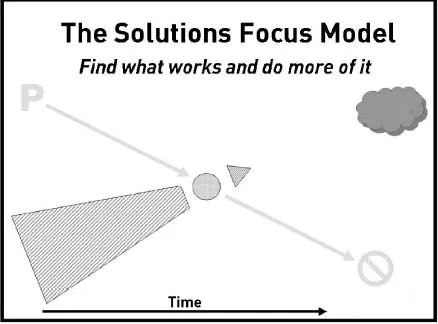
Conventionally, we assume that learning about the problem will help with working toward a solution. But here, we can see that the problem axis and solution axis are different and independent. Finding out about the problem makes us experts on the problem, which is best overlooked.
The idea of knowing where we want to be is familiar to any strategist, who takes an interest in where we are now and where we want to go. But while the conventional strategist’s next step is to devise a plan to get us from here to there, the Solutions Focus practitioner takes a different route, knowing that any long-term plan is likely to be out of date before it has left the publisher, a prime candidate for derailment by unexpected events.
Instead, we look back in time to find what has been happening in our organization that is already taking us in the direction we want to go. This rich body of skills, resources and examples provides the fuel, the encouragement, the motivation and the sense of possibility to choose what small step to take next: a step in the direction of the future perfect.
Once we do more of what we already know works, we can notice its impact and choose to do more of it if it proves useful.
The following real-life example illustrates how a challenging workplace problem was handled by some smart solutions-focused questioning.
The Solutions Focus in action: “An Inspector Calls”
The chemical site had a problem and it was looming larger—a threat of closure from a new safety inspector. The plant had seen plenty of change over the years, with old machinery decommissioned and new processes brought on stream. Safety, which had always been a key issue, was now managed by a plant safety team in conjunction with the safety regulator’s site inspector.
The inspector had a great deal of power: He could go wherever he wanted on site, enforce improvement notices (potentially at great expense), and ultimately stop operations and close down the plant. In the past, working relations with successive inspectors had been reasonable. But now the new inspector was proving uncooperative when presented with the plant team’s latest plans to improve the site’s safety culture.
The team members had been expecting support from the regulator and were surprised by his officious attitude: He wanted to see every piece of paper and was reluctant to engage in the customary informal exchanges with managers.
The team tried all the regular good tactics for getting along, but to no avail. As stories spread—“You can’t get a straight answer out of him”; “He’s not interested in anything except the paperwork”; “He’s out of his depth, you know”; “He won’t stop till he’s found something wrong”—a sense of despondency gripped the site.
The safety team knew the essence of the problem: The inspector was stopping them from making progress with their safety culture plans and a worsening impasse would threaten the very future of the site, with appalling knock-on effects for their parent company.
Traditional problem-focused ways of approaching the situation might include:
The safety team brought us in to help, perhaps suspecting that we would begin by setting up mediation between them and the inspector.
Instead, we took a solutions focus, asking them to rate their encounters with him on a scale of 0–10. One manager quickly snorted, “Zero!” We paused and waited. “Apart from once, when it was a 3 for 20 seconds…”
Suddenly there was a glimmer of hope. The crux of the solution, we figured, would be in those few seconds; not in any of the traditional approaches, and not even requiring conscious action from the inspector. The solution was not going to center on him as an individual, with all his “flaws, failings and difficulties,” but on the interactions between him and the safety team. We needed to know more.
When we asked the manager what he had done to ...
Table of contents
- Cover Page
- Title Page
- Copyright Page
- Contents
- Preface to the Second Edition
- 1 Small Changes—and a Big Idea
- 2 Staying Simple
- 3 Solutions not Problems
- 4 Inbetween—The Action Is in the Interaction
- 5 Make Use of What’s There
- 6 Possibilities—Past, Present and Future
- 7 Language—Simply Said
- 8 Every Case Is Different
- 9 The Complete Toolkit
- 10 Coaching Solutions
- 11 Managers Coach Their People to Solutions
- 12 Team Coaching
- 13 Organizational Solutions
- 14 The Solutions Artist and Scientist
- 15 How We Reached Here
- Acknowledgments
- References
- Bibliography
- Index
- About the Authors
Trusted by 375,005 students
Access to over 1.5 million titles for a fair monthly price.
Study more efficiently using our study tools.
Frequently asked questions
Yes, you can cancel anytime from the Subscription tab in your account settings on the Perlego website. Your subscription will stay active until the end of your current billing period. Learn how to cancel your subscription
No, books cannot be downloaded as external files, such as PDFs, for use outside of Perlego. However, you can download books within the Perlego app for offline reading on mobile or tablet. Learn how to download books offline
Perlego offers two plans: Essential and Complete
- Essential is ideal for learners and professionals who enjoy exploring a wide range of subjects. Access the Essential Library with 800,000+ trusted titles and best-sellers across business, personal growth, and the humanities. Includes unlimited reading time and Standard Read Aloud voice.
- Complete: Perfect for advanced learners and researchers needing full, unrestricted access. Unlock 1.5M+ books across hundreds of subjects, including academic and specialized titles. The Complete Plan also includes advanced features like Premium Read Aloud and Research Assistant.
We are an online textbook subscription service, where you can get access to an entire online library for less than the price of a single book per month. With over 1.5 million books across 990+ topics, we’ve got you covered! Learn about our mission
Look out for the read-aloud symbol on your next book to see if you can listen to it. The read-aloud tool reads text aloud for you, highlighting the text as it is being read. You can pause it, speed it up and slow it down. Learn more about Read Aloud
Yes! You can use the Perlego app on both iOS and Android devices to read anytime, anywhere — even offline. Perfect for commutes or when you’re on the go.
Please note we cannot support devices running on iOS 13 and Android 7 or earlier. Learn more about using the app
Please note we cannot support devices running on iOS 13 and Android 7 or earlier. Learn more about using the app
Yes, you can access The Solutions Focus by Mark McKergow,Paul Z. Jackson in PDF and/or ePUB format, as well as other popular books in Business & Mentoring & Coaching. We have over 1.5 million books available in our catalogue for you to explore.