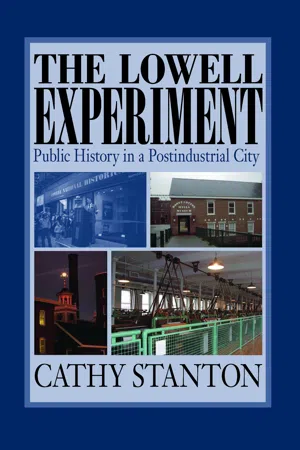
In the early nineteenth century, Lowell, Massachusetts, was widely studied and emulated as a model for capitalist industrial development. One of the first cities in the United States to experience the ravages of deindustrialization, it was also among the first places in the world to turn to its own industrial and ethnic history as a tool for reinventing itself in the emerging postindustrial economy. The Lowell Experiment explores how history and culture have been used to remake Lowell and how historians have played a crucial yet ambiguous role in that process.
The book focuses on Lowell National Historical Park, the flagship project of Lowell's new cultural economy. When it was created in 1978, the park broke new ground with its sweeping reinterpretations of labor, immigrant, and women's history. It served as a test site for the ideas of practitioners in the new field of public history—a field that links the work of professionally trained historians with many different kinds of projects in the public realm.
The Lowell Experiment takes an anthropological approach to public history in Lowell, showing it as a complex cultural performance shaped by local memory, the imperatives of economic redevelopment, and tourist rituals—all serving to locate the park's audiences and workers more securely within a changing and uncertain new economy characterized by growing inequalities and new exclusions.
The paradoxical dual role of Lowell's public historians as both interpreters of and contributors to that new economy raises important questions about the challenges and limitations facing academically trained scholars in contemporary American culture. As a long-standing and well-known example of "culture-led re-development," Lowell offers an outstanding site for exploring questions of concern to those in the fields of public and urban history, urban planning, and tourism studies.
- English
- ePUB (mobile friendly)
- Available on iOS & Android
eBook - ePub
About this book
Information
PART I
HISTORY, PERFORMANCE, ETHNOGRAPHY
CHAPTER 1
Lowell and the Public History Movement
The flagship project of Lowell’s culture-led redevelopment is Lowell National Historical Park (NHP), created in 1978. Unlike traditional national parks, it is not a neatly bounded piece of real estate owned outright by the National Park Service, but a series of buildings and open spaces within the downtown area and along the canal system that once powered the textile mills (see map, pp. 42–43). This kind of decentralized park and its successor, the “heritage area,” have now become more common in the Park Service, but when Lowell NHP was being developed, it was an entirely new concept. Visitors—and even local residents—are often still confused about where the park actually is. And so most park rangers begin their guided tours by addressing that point. After posing the question “Why Lowell?”—that is, “Why is there a national park here?”—they talk about the steep drop in the Merrimack River that provided the initial waterpower for the mills, and the planned industrial city that was quickly built once the waterpower was harnessed. Then they try to convey to visitors that what is being interpreted at the national park is not just isolated mills or canals or corporation boardinghouses, but an entire city, whose life today is in many senses an outgrowth of its industrial past—in the words of the park’s first historian, “an artifact of the industrialization process” (Weible 1991:xi). To get this idea across, the rangers sometimes use a phrase that was heard often during the park’s early years: “The park is the city and the city is the park.”
Similarly, I want to begin by setting out the reasons I focused on Lowell, and specifically on the public historians at Lowell NHP. Lowell offers an exceptional opportunity to investigate the processes of redevelopment and representation currently occurring in many places around the globe and to consider the role of historians and other public intellectuals within those processes. The city has always been on the leading edge of the cycle of capitalist production, beginning with its creation as a planned industrial community in the 1820s. The “Lowell experiment,” as some called it, was an attempt to create a manufacturing center that would combine efficiency in production with democratic moral values and social structures—to nurture what seemed best about industrial capitalism while avoiding its worst dangers and excesses. As such, the Lowell model was widely studied and emulated in America and abroad. One of the earliest American places to become industrialized, Lowell was also among the first to experience the shock of deindustrialization. By the 1960s, it had gained a reputation as one of the most down-and-out of New England’s depressed mill towns. When it turned to a culture-based revitalization approach in the 1970s, it was riding the edge of another wave. Faced with the need to restructure their economies as manufacturing activity moved elsewhere in the second half of the twentieth century, towns, cities, and regions throughout the industrialized world increasingly began turning to culture—in the form of heritage trails, museums, arts districts and public art projects, sports facilities, waterfront recreation areas, outdoor festivals and other performing-arts events—in an attempt to repair some of the social and infrastructural damage done by the loss of industries, and to draw new kinds of people and businesses into decayed and abandoned downtowns and industrial areas. This repertoire of strategies and the perception of cultural vibrancy they promote have become a familiar characteristic of contemporary cities worldwide (for useful discussions of this, see Dicks 2003: 67–92, and Ward 1998: 188–208).
Lowell was not the first city to adopt this culture-based approach to revitalization, any more than it was the single birthplace of the Industrial Revolution. But the city has been an exceptionally important nodal point for both industrial and cultural production, giving this small city a symbolic weight out of proportion to its size. In both endeavors, people associated with Lowell took existing ideas and innovations and combined them in new, more rationalized and purposeful forms. Lowell’s nineteenth-century creators gained a competitive edge because they were able to remove many of the variables of everyday life from the manufacturing process and to control every aspect of textile production from generating power to housing and feeding their workers. A century and a half later, the originators of Lowell’s postindustrial experiment took a similarly integrative approach to reinventing the city. They intentionally began to blur the lines between museums, classrooms, tourism, art, festivals and other local celebrations, recreation, economic development, and the cityscape itself, and found new ways to yoke public and private investment together in aid of turning the city’s fortunes around. At the time, this was largely uncharted territory. In subsequent decades, this paradigm—the new “Lowell experiment” that gives this book its title—has been adopted and adapted not only in deindustrialized places throughout the world, but in many kinds of communities seeking to strengthen their economies and make themselves more visible and “visitable.”1 New terminology has developed to describe the cluster of strategies pioneered in places like Lowell thirty years ago. More and more towns, cities, and regions worldwide are seeking to promote their “creative economies” or “cultural industries,” broadly defined as the whole range of commercial and nonprofit cultural and artistic activities from museums and farmers’ markets to sports, advertising, and new expressive technologies like digital media.2 A term now widely used in Britain, “culture-led regeneration,” perhaps comes closest to capturing the essence of this overall approach, particularly the notion that cultural activities may be useful in establishing a kind of beachhead from which other kinds of economic and social growth can take hold. So ubiquitous is this tactic, particularly in former industrial communities, that one pair of observers has written recently about “the rise and rise of culture-led urban regeneration” (Miles and Paddison 2005).
Within such efforts, the specific histories and landscapes of particular places are seen as invaluable assets that can be mobilized to help “brand” (or in depressed areas, to re-brand) places so that they are immediately associated in people’s minds with memorable images, stories, and impressions. As in Lowell, many of these projects emphasize obsolete industries or ways of life, endowing them, in Barbara Kirshenblatt-Gimblett’s words, with a “second life” as heritage (1997:7). Heritage areas, historic canal corridors, cultural routes, regional parks, and similar developments are proliferating in the United States and internationally. Along with countless nonfederal projects, there are currently twenty-three federally designated heritage areas in the United States, with more waiting in the wings. Like Lowell, many of these places seek to capture the prize of supralocal designations of significance—that is, official declaration that their unique local characteristics are somehow significant on a national or even global level. The United States National Park Service has generally taken a subsidiary role in these projects (in Lowell, for example, it is a central but by no means the dominant player in the city’s preservation and interpretation efforts), but its presence has been tremendously important in legitimating the overall enterprise. In Asia, where tourism is one of many rapidly expanding economic sectors, many development projects are linked with designation by UNESCO as World Heritage sites. Many of these ventures are, like Lowell’s, essentially local efforts, but increasingly they also occur on much larger scales, echoing the way Lowell’s industrial experiment was not only copied but expanded in other places. The Tennessee Civil War National Heritage Area, authorized in 1996, encompasses the entire state, while some heritage areas span state and even international borders. The National Park Service’s National Underground Railroad Network to Freedom initiative seeks to make thematic connections among sites in many parts of the United States, and a number of projects at U.S. borders with Canada and Mexico promote “two-nation vacations” and use cultural partnerships and conceptual connections to further trade or security agendas. Some of the Asian heritage-area projects, such as China’s Tea Route and Southern Silk Road, have adopted a regional partnership structure explicitly modeled after heritage areas in the United States.3 The future of heritage- and culture-based development projects, then, appears to be the Lowell model writ large.
Because it adopted this repertoire of culture-led development strategies earlier than most places, Lowell is an obvious place to ask how those strategies are playing out a generation after they first came into use. None of these strategies is unproblematic, and many questions have been raised about whether their benefits are distributed evenly and whether they will be any more durable and accountable to a wide range of local needs—more “sustainable,” in the current rhetoric—than older economic patterns proved to be. In Lowell, as in many urban communities, these questions are sharpened by changing demographic realities that have brought large influxes of new immigrants from Asia, South and Central America, and elsewhere in recent decades. As the city busily woos new residents and visitors at the high end of the new economy, it also continues to draw many at the lower end of the socioeconomic scale, who are seeking refuge from hardship elsewhere or a toehold in the American economy. Many of these newcomers struggle in Lowell’s new economy, often working in the remaining manufacturing jobs in the area or in the least lucrative parts of the growing service sector. Not only does Lowell’s changing population mirror general demographic trends in early-twenty-first-century Western places, but it reveals the widening split between rich and poor that is characteristic of postindustrial economies. The presence of these newer migrant groups both plays into Lowell’s celebration of history and ethnicity and unsettles it.
The city thus offers a site to explore many of the questions raised by the adoption of strategies of cultural display as a vehicle to benefit any community. How can places be made attractive as tourist sites without trivializing or erasing difficult and complex histories? Can prosperity generated with the help of these strategies be spread far enough to benefit poorer neighborhoods and residents? And what of the longer-term prospects for the “new economy”? Just as imitation and competition within the early textile industry decreased profitability for all, will the cultural market eventually become saturated with ethnic festivals, sports stadiums, and history museums, undermining the ability of all but the most iconic places to stand out among the crowd? There are already signs of a “race to the bottom” in various new-economy sectors. The delivery of many kinds of information and services, seen as cutting-edge products in the United States only a decade ago, are already being “outsourced” to places with cheaper labor (Madhavan 2005). Successful competition means being able to deliver ever more complex and innovative combinations of knowledge and experience, and the exponents of such concepts as the “creative class,” “creative city,” “experience economy,” “placemaking,” and “branding”—the contemporary heirs of Lowell’s nineteenth-century innovators—are greatly in demand by places and organizations seeking a foothold in this intensely competitive global marketplace.4 Meanwhile, cycles of boom and bust are shorter and shorter throughout the global economy, to the extent that deindustrialization—the loss of manufacturing jobs due to the de-skilling of workers and the mechanization of production—is now occurring even in countries still in the process of industrializing. How can places and workers in the United States and abroad contend with the volatility and mobility of these new kinds of production? What happens when the cultural institutions that might be positioned best to raise critical questions about these processes—for example, universities and museums—are intimately involved in efforts to promote economic redevelopment in places like Lowell? What are the social costs, in terms of our ability to understand and respond to the changing economic circumstances of our lives, of linking the production of knowledge so closely with the quest for economic growth?
There is an additional reason Lowell is such a useful site for posing these questions. The mix of voices speaking about history and heritage in Lowell has included a concentration of professional public historians—workers in a field that has been emerging over the same period of time in which the city has been reinventing itself. The presence of these people—trained to think critically and analytically about the causes and consequences of historical change—means that there have been voices raising precisely these kinds of questions throughout Lowell’s ongoing redevelopment efforts. This adds an element to Lowell’s focus on its industrial past that makes it much more useful for investigating not only a wide range of history-making processes but also the role of critical scholars in the contemporary American public sphere.
The Public History Movement in the United States
“Public history” is not the same as “history in public.” Many kinds of people and institutions—schools, museums, tour companies, historical societies, government agencies, filmmakers, and individual researchers and enthusiasts—are involved in history-related activities in public, and many of these activities have longer lineages than the historical profession that developed in the late nineteenth century. But within the larger arenas of public history-making and professional history, a specific movement emerged in the United States in the 1970s whose adherents termed themselves “public historians.” In essence, the movement represents an attempt by academically trained historians to re-establish a place for themselves in the public history making sphere after almost a century of retreat from it, and to assert within it that their methods and insights are of value to the society outside academy walls. Because the work of public historians in Lowell is the primary focus of this book, it will be useful at the outset to look at the development of the field.
History as a scholarly discipline emerged in European universities in the late nineteenth century and took root in the United States via young American scholars pursuing graduate study in Germany. The professionalizing of the American field—the establishment of credentials, standards, and review processes—is often considered to have begun in 1884 with the creation of the American Historical Association (see Novick 1988 for a detailed account of these processes). The AHA was one of many Gilded Age and Progressive Era organizations that reflected a broad interest in the past, an interest often linked with a parallel concern about the sweeping changes of the industrialism, immigration, and rapid social and technological shifts of the present.5 Although the AHA originally encompassed many amateur historians and subgroups, a gradual parting of the ways between professionals and amateurs occurred during the first half of the twentieth century. Eventually, the AHA and the professional field as a whole came to be dominated by academic historians, most of whom talked only to one another. Between 1890 and 1910, only one-quarter of the AHA’s members were college teachers, and local historical societies and self-trained historians and writers were well represented; after 1927, almost all of the presidents of the organization held a Ph.D. (Novick 1988:49). Over the first half of the twentieth century, many of the amateur affiliates slipped away as they found the AHA less and less congenial to their interests. The Conference of Archivists left the AHA after twenty seven years to become the Society of American Archivists in 1936, and the Conference of State and Local Historical Societies became the independent American Association of State and Local History in 1940, after a thirty six-year affiliation (Conard 2002:148). As Peter Novick points out, many historians in the new profession expected that they would dominate the production of historical knowledge at all levels of public history-making, including collegiate and precollegiate education and popular publishing. Over time, however, they managed to retain full control only of college teaching. The scholarly emphasis on scientific method and personal objectivity very often produced works that did not appeal to general audiences, while various levels of government and the professionalizing field of pre-collegiate education took the lead in determining what kind of history was taught in public schools (Novick 1988:185).
Although the overall arc of the historical profession moved away from the public realm over the course of the twentieth century, there were some small crossovers and areas of overlap between academically trained historians and the practice of history in public. Rebecca Conard has traced some of these overlapping areas, showing that many elements of the public history field were in place long before the field began to try to define itself in the 1970s (Conard 2002:148–164). Two World Wars and the Great Depression turned the attention of many in the federal government to history as a tool for documenting and promoting their own war and recovery efforts and for stimulating community and national identity—and employment—during the 1930s. Federally sponsored history projects in this period include the well-known oral history collections and local guidebooks produced under the auspices of the Works Progress Administration (WPA) and the development of new historic sites and professional positions for historians within the National Park Service (NPS), which had been created in 1916.6 At the same time, private corporations discovered the public relations value of establishing their own museums and collections, a development that led to the creation of many corporate archives and archivist positions. More indirect corporate-sponsored history could be found in the creation of sites such as John D. Rockefeller’s Colonial Williamsburg and Henry Ford’s Greenfield Village, both projects of the 1920s and 1930s. Yet historians working in all of these areas remained largely isolated from one another and from academic historians, whose professional dialogue usually remained within the college gates.
There was no collective attempt to bridge the public–academic gap until the 1970s, when two developments converged to produce a new field that its exponents dubbed “public history.” First, young historians leaving American graduate schools were encountering a rapidly shrinking academic job market. Almost fifty new doctoral programs in history had been created shortly after World War II (Novick 1988:406); by the 1970s the field was glutted, and few new Ph D.’s could look forward to a secure collegiate teaching position. In response, some academic historians who already had experience as planning and policy consultants or expert court witnesses began to consider what other kinds of gainful employment their graduate students might pursue. A handful of programs focusing on historical archives, management, or preservation already existed in the United States; the first academic training program for public historians per se was started at the University of California at Santa Barbara in 1976, with the ambitious goal of helping to bring about a gradual change in American public life “so that the historical method of analysis becomes an integral element in all decision-making” (quoted in Conard 2002:164–65). By the end of the decade, there were almost fifty degree programs that fit the definition of public history, although not all claimed the title. This was a period of increased public investment in educational and cultural ventures, and many graduates of public history programs found jobs directly or indirectly funded by institutions that had benefited from this expansionist moment—for example, the state historic preservation offices created by the National Historic Preservation Act of 1966, new national parks and heritage areas, and countless Bicentennial-era heritage projects.
Not everyone saw this as a positive development for the historical discipline. Some historians, for example Peter Novick, lamented the intrusion of “particularist” agendas into a scholarly mode of inquiry built on the ideal of looking impartially at the past (1988:510–21). For Novick, the whole notion of a “public history” challenged the foundations that the profession was built on. He argued that much of what passed for public history was actually private history, assembled to order for corporate clients or government agencies, while historians who worked in museums and similar settings were involved in popular history that was answerable to its audiences’ interests but not necessarily to the norms of solid historical research as upheld in the academy. For many historians who went to work in the public sector, though, these realities were not distractions from their work, but welcome opportunities for a radical rethinking of how and why historians did what they did. In other words, there were philosophical as well as practical reasons to work outside the academy. Much of this philosophy was linked with the impact of various leftist causes—feminism, civil rights movements, environmentalism, anticolonial struggles—of the 1960s and 1970s. This fluorescence of radicalism was felt throughout the academy, prompting the development of new disciplines and directions in some places and a defensive circling of the wagons in others. Within the historical field, this social climate was influential in sparking a “new social history” focused on “ordinary” and often nonprivileged subjects—workers, women, immigrants, ethnic and racial minorities—rather than on the traditional “great men” and momentous events.7 But the changes went beyond the content of historical writing, shaking up what had been in many ways a conservative discipline and prompting many historians to join in the general scholarly soul-searching about what their own social role should be in the world ...
Table of contents
- Cover
- Title Page
- Copyright
- Dedication
- CONTENTS
- ILLUSTRATIONS
- PROLOGUE: The Map in the Museum
- PART I HISTORY, PERFORMANCE, ETHNOGRAPHY
- PART II THREE TOURS OF LOWELL
- PART III PUBLIC HISTORY IN LOWELL
- EPILOGUE
- APPENDIX
- NOTES
- WORKS CITED
- INDEX
- About the Author
- Back Cover
Trusted by 375,005 students
Access to over 1.5 million titles for a fair monthly price.
Study more efficiently using our study tools.
Frequently asked questions
Yes, you can cancel anytime from the Subscription tab in your account settings on the Perlego website. Your subscription will stay active until the end of your current billing period. Learn how to cancel your subscription
No, books cannot be downloaded as external files, such as PDFs, for use outside of Perlego. However, you can download books within the Perlego app for offline reading on mobile or tablet. Learn how to download books offline
Perlego offers two plans: Essential and Complete
- Essential is ideal for learners and professionals who enjoy exploring a wide range of subjects. Access the Essential Library with 800,000+ trusted titles and best-sellers across business, personal growth, and the humanities. Includes unlimited reading time and Standard Read Aloud voice.
- Complete: Perfect for advanced learners and researchers needing full, unrestricted access. Unlock 1.5M+ books across hundreds of subjects, including academic and specialized titles. The Complete Plan also includes advanced features like Premium Read Aloud and Research Assistant.
We are an online textbook subscription service, where you can get access to an entire online library for less than the price of a single book per month. With over 1.5 million books across 990+ topics, we’ve got you covered! Learn about our mission
Look out for the read-aloud symbol on your next book to see if you can listen to it. The read-aloud tool reads text aloud for you, highlighting the text as it is being read. You can pause it, speed it up and slow it down. Learn more about Read Aloud
Yes! You can use the Perlego app on both iOS and Android devices to read anytime, anywhere — even offline. Perfect for commutes or when you’re on the go.
Please note we cannot support devices running on iOS 13 and Android 7 or earlier. Learn more about using the app
Please note we cannot support devices running on iOS 13 and Android 7 or earlier. Learn more about using the app
Yes, you can access The Lowell Experiment by Cathy Stanton in PDF and/or ePUB format, as well as other popular books in History & Historic Preservation in Architecture. We have over 1.5 million books available in our catalogue for you to explore.