- English
- ePUB (mobile friendly)
- Available on iOS & Android
eBook - ePub
About this book
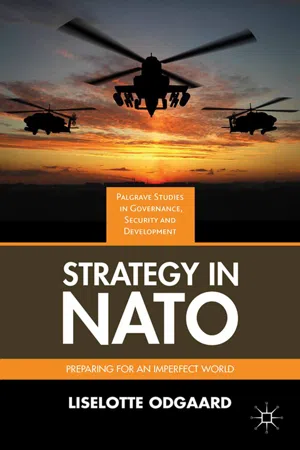
This edited volume addresses the challenges and opportunities facing NATO post-2014, applying an original approach to strategy that will produce fresh insights into this hot topic within the international security community.
Information
1
Introduction
Villiam Krüger-Klausen and Liselotte Odgaard
What are the consequences of using a plethora of nonmilitary objectives and instruments in modern conflicts for strategy’s role as a link between policy and implementation in operational theaters? Does the military end up leading from the center due to its well-tested and detailed planning procedures while being only one actor out of many in terms of the objectives and instruments devised in the campaign plans for theaters such as Iraq and Afghanistan?1 Politicians working in a reality of bargaining and policies determined by the lowest common denominator are increasingly micromanaging the tactical battles, in practice often becoming co-leaders at this level. Military leaders working in an environment characterized by methodical evaluation within closed military circles that follow strict military logic tend to influence overall political visions.2 In modern conflicts, involving both civil and military challenges and solutions, both politicians and military leaders venture far into the sphere of the other party.3 Strategy must allow the politicians sufficient control of the direction of the conflict and coordinate the efforts while leaving the military and civilian agencies sufficient space for action.4
The International Security Assistance Force (ISAF) in Afghanistan exemplifies this problem. It is engaged in nation-building processes involving numerous actors. The involvement of many stakeholders has resulted in the establishment of numerous overlapping institutions and the emergence of countless divergent interests that have decoupled regional governance processes at theater level from the objectives devised by specialists at the security strategy level.5 This tendency crowds out the theater-level actors and their insights into on-the-ground sentiments, resources, and constraints.6 As pointed out by Henry Kissinger, strategy should be reinstated as a link between policy and tactics.7 This link must be based on sound methodical analysis encompassing insights from politicians, civilian agencies, as well as the military leadership.8
In the North Atlantic Treaty Organization (NATO), commanders are not merely key figures at the theater strategic level, but also end up defining the ways and means used to pursue core national interests at the grand strategy level. A contributing factor to the key role of the commander in NATO operations is the relative ineffectiveness of the comprehensive approach. This approach has introduced an overabundance of actors at the theater level, which has added to the complexity and detracted from the efficiency in the implementation of strategies as per grand strategic guidance. The comparative effectiveness of military commanders in planning processes has allowed successive commanders in NATO operations in Afghanistan to dominate strategy formulation from bottom to top.9
Another problem faced by NATO is the difficulty in meeting the objectives derived from the alliance’s strategic concept of a comprehensive approach to conflict management. The civilian-led combining of security, governance, and development is treated with something approaching reverence by many, but it has been a severe disappointment on the ground, largely through a combination of incapacity and unwillingness on the part of civilian actors. The fact that military power is necessary but not sufficient remains true, but governments need to look afresh at the comprehensive approach and how they can ensure that the institutions and agencies they largely fund cooperate appropriately.10
These problems bespeak of a NATO alliance beset by problems of coordination, adjustment, and efficiency, which pervade strategic planning across functional and geographical issue areas. In particular, it would appear that the complexity of actors and institutions involved in implementing strategies at security and theater strategic levels detracts from the ability of the grand strategy level to translate core national interests into central ends, ways, and means that guide strategic planning at the two other levels.
The Concept of Strategy
Strategy can be defined as a process that translates political visions into attainable objectives, applying the available instruments by feasible methods. This chapter offers a set of definitions and a set of strategic variables that address the disconnection between policy and tactics by devising a concept of strategy that is derived from the essential functions and challenges of the modern security sector.11 The concept of strategy suggests how to translate political visions into plans for implementation by civilian and military organizations.12 These concepts, listed here, are derived from the insights of military personnel informed by military planning processes. They allow us to adopt a systematic and manageable approach to strategy formulation that informs us of the processes at work in complex environments of strategic thinking.
We identify three levels of strategy: grand, security, and theater strategy, each describing different types of tasks, skills, and purpose when contributing to strategic planning:
1.Grand strategy represents the most general level of strategy and lies at the intersection of policy making and bureaucracy, focusing on the core interests, values, and long-term objectives pursued by the state. Grand strategy is defined as a state’s vision concerning its future relative position on the basis of national interests and values.
2.Security strategy encompasses sector-specific programs for implementing visions that rely on specialists from the economic, military, and diplomatic sectors. Security strategy can be defined as the development, application, and allocation of methods and instruments to achieve national security objectives. It is functionally specific in the sense that states can have strategies of economic development, foreign policy, defense, energy, and foreign aid.
3.Theater strategy involves the coordinated and synchronized application of methods and instruments within a geographically defined area of implementation, such as Afghanistan and Iraq, where available objectives and instruments are tailored to on-the-ground realities, often by a commander and his staff. It has a geographical focus and is located below the instrumental level.
Within each of the strategic levels, we identify five strategic key variables: time, position, legitimacy, implementation structure, and capabilities, each essential in determining the design of the strategy:
1.Time can be short, medium, or long. It reflects the speed at which a conflict manifests itself and how fast strategic planners address a conflict. The variable time is used to describe the time available to realize objectives.
2.Position concerns the interests and values of a particular state. The variable position is used to describe the interests and values that define the substance of strategic planning seen from the perspective of the state engaged in strategy making.
3.Legitimacy concerns the compatibility between the interests and values of the state and its allies, partners, and enemies. The variable legitimacy is used to describe the acceptability of the objectives from the point of view of the surroundings.
4.Implementation structure refer to the channels used to communicate a strategy. The variable implementation structure is used to describe the domestic and international apparatus available as a channel of implementation.
5.Capabilities refer to a combination of military, economic, financial, and knowledge resources available to realize political visions. The variable capabilities describe the capabilities available to realize objectives, whether these are of a military, economic, political, or diplomatic nature.
Formulating strategies that ensure coherence between political and operational objectives is a challenging undertaking. The challenge stems from the fact that traditionally, strategic planning in the security sector is often carried out by defense agencies as a separate, compartmentalized effort. Instead, it must now be conducted in cooperation with civilian agencies such as foreign ministries, embassies, and ministries of finance. The proliferation of actors and issues involved in conflict management in the security sector is reflected in the definition of strategy, which has been taken beyond its original meaning to become a catchphrase for almost all processes describing means-ends relations in organizations. Concepts such as environmental strategy, educational strategy, and labor market strategy indicate this development.
We do not wish to reclaim strategy as exclusively belonging to the realm of military activities.13 However, we do propose that strategy as a concept is revisited with a view to combining the simple conceptual models of civilian agencies with the systematic approach to dealing with numerous actors and issues employed in military contexts to carve out a space between policy and tactics. The academic complementary to civilian policy makers is the international relations literature, where strategy is usually described by means of dynamics such as balancing, coercive diplomacy, regimes, et cetera, but without an eye for the different organizational settings involved in strategic planning or the processes involved.14 The academic complementary to military tactics is the strategic studies debate among defense academies. This debate identifies and systematizes the complexity of actors and issues involved in strategic planning. However, the debate is also marked by detail, describing the agenda of strategic planning without deducing the key elements and variables crucial to address political visions.15 We revisit the concept of strategy with the purpose of combining the insights of policy makers and civilian agencies informed by international relations thinking and the insights of tacticians and military staff informed by military planning processes to a strategic concept suitable for modern security conflict management.
This edited volume aims at assessing the qualities and the problematic aspects of contemporary processes of strategy formulation and implementation in NATO. To this end, the individual chapters focus on the interplay between political, civilian, and military agencies in strategic planning processes at grand strategy, security strategy, and theater strategy levels. In addition, this edited volume looks at how developments at the operational level impact on strategic planning at higher levels. The substance in processes of strategy formulation is captured by focusing on the five variables: time, position, legitimacy, implementation structure, and capabilities, which are arguably essential to any planning process.
In this book, these variables are used to characterize NATOs strategic planning process, irrespective of the strategic level at which it takes place. The basis for strategic thinking at all three strategic levels are national and international considerations on, first, the time available to realize objectives, second, the position of the state in terms of interests and values that define the substance of strategic planning, third, the legitimacy of objectives, fourth, implementation structures such as the US alliance system, the UN system, or a party apparatus available as a channel of implementation at the national or international level, and fifth, the capabilities available to realize these objectives.
Strategy in NATO
The strategy concept is revisited in chapter two “Preparing for the Imperfect World: Strategy in a Conflict Management Environment,” which describes the three strategic levels and the five variables in greater detail. The remaining chapters apply the strategy concept to NATO by addressing the following three questions:
1.What defines the nature of the strategic planning process and the instruments and rules of the game at grand, security, and/or theater strategic level?
2.On the basis of an analysis of time, p...
Table of contents
- Cover
- Title
- 1 Introduction
- 2 Preparing for an Imperfect World: Strategy in Conflict Management Environments
- 3 NATO’s Future Strategy: Ready for the Threats of the Future or Refighting the Battles of the Past?
- 4 US National Security Strategy and NATO
- 5 The Indispensable Enabler: NATO’s Strategic Value in High-Intensity Operations Is Far Greater Than You Think
- 6 NATO and EU: A “Strategic Partnership” or a Practice of “Muddling Through”?
- 7 NATO and Libya: The Dawn of European Security Management, a Warning, or Business as Usual?
- 8 International Law and the Role of Legitimacy
- 9 When Strategy Ends
- 10 Time and the Question of Unintended Influences on Military Strategy
- 11 Strategizing NATO’s Narratives
- 12 Effect-Based Thinking in NATO, Utilizing All Instruments of Power while Planning for and Conducting Operations
- Bibliography
- List of Contributors
- Index
Trusted by 375,005 students
Access to over 1.5 million titles for a fair monthly price.
Study more efficiently using our study tools.
Frequently asked questions
Yes, you can cancel anytime from the Subscription tab in your account settings on the Perlego website. Your subscription will stay active until the end of your current billing period. Learn how to cancel your subscription
No, books cannot be downloaded as external files, such as PDFs, for use outside of Perlego. However, you can download books within the Perlego app for offline reading on mobile or tablet. Learn how to download books offline
Perlego offers two plans: Essential and Complete
- Essential is ideal for learners and professionals who enjoy exploring a wide range of subjects. Access the Essential Library with 800,000+ trusted titles and best-sellers across business, personal growth, and the humanities. Includes unlimited reading time and Standard Read Aloud voice.
- Complete: Perfect for advanced learners and researchers needing full, unrestricted access. Unlock 1.5M+ books across hundreds of subjects, including academic and specialized titles. The Complete Plan also includes advanced features like Premium Read Aloud and Research Assistant.
We are an online textbook subscription service, where you can get access to an entire online library for less than the price of a single book per month. With over 1.5 million books across 990+ topics, we’ve got you covered! Learn about our mission
Look out for the read-aloud symbol on your next book to see if you can listen to it. The read-aloud tool reads text aloud for you, highlighting the text as it is being read. You can pause it, speed it up and slow it down. Learn more about Read Aloud
Yes! You can use the Perlego app on both iOS and Android devices to read anytime, anywhere — even offline. Perfect for commutes or when you’re on the go.
Please note we cannot support devices running on iOS 13 and Android 7 or earlier. Learn more about using the app
Please note we cannot support devices running on iOS 13 and Android 7 or earlier. Learn more about using the app
Yes, you can access Strategy in NATO by Liselotte Odgaard in PDF and/or ePUB format, as well as other popular books in Politics & International Relations & Political Philosophy. We have over 1.5 million books available in our catalogue for you to explore.