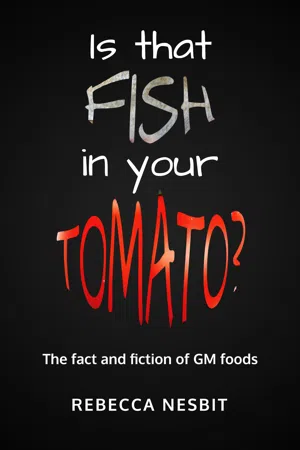
What is genetic modification? What does it truly mean for us and the world around us? What are the risks and benefits? And, what's more, how does it even work? The facts about GM are few and far between, but opinions from both sides of the debate are vocal and overpowering. Is that Fish in your Tomato? is a beacon through the noise, explaining the origins and science behind GM, the environmental uncertainties and the public health concerns which have opponents worried. No stone is left unturned in Nesbit's quest to explore the fact and fiction of genetic modification. In the process, she has created the quintessential, scientifically-informed guide to understanding the subject.
- English
- ePUB (mobile friendly)
- Available on iOS & Android
eBook - ePub
About this book
Information
Topic
PhilosophySubtopic
Philosophy & Ethics in ScienceChapter 1
Introduction
Two decades after the first GM foods went on sale, many news reports go something like this:
Reporter: Environmentalists have today released a report which shows the devastating effects of GM crops on farmland wildlife.
Camera zooms in on activist on the couch.
Activist: Yes, this is further proof of the dangers of genetically-modified organisms. The only people who benefit are the companies who developed this Frankenfood, and the rest of us pay the price.
Reporter: And how has the company responsible for this technology responded?
Cut to industry representative in a different studio.
Industry representative: I’m afraid the conclusions of the report are simply incorrect. It completely misrepresents the reality, which is that GM crops pose no more risk to health or the environment than conventional crops. In fact, they bring major benefits.
Cut back to the couch.
Activist: I’m sorry but that’s wrong. You are ignoring studies which link GMOs to cancer and to terrible environmental damage. We are gambling with our future by releasing untested and dangerous new technologies into the environment.
Industry representative: Any GM crop on the market has gone through years of rigorous testing. Major scientific societies around the world have agreed that GM crops are safe. And more than that, we are going to need to use genetic engineering to feed a population of 9 billion people.
Cut back to the news reporter who is thinking ‘job done, we’ve presented both sides of the argument’. You reach for the remote feeling none the wiser.
Life would be easier if we could firmly hold an extreme position on GM crops – it would be reassuring to have a conviction either that GM crops should be stopped at all costs or that they will solve world hunger. At risk of a spoiler alert, the evidence doesn’t conveniently support either of those world views. In the following 19 chapters I will look at the complexity surrounding the possibilities, the risks and the limitations of genetically modified organisms. We will cover everything from organ-donor pigs to purple tomatoes, and consider challenges which range from ‘superweeds’ to patents.
This book stems from my dissatisfaction with the ‘facts’ I was presented with by people on both sides of the debate. GMOs had always captured my attention, and I began to explore the science whilst working at Rothamsted Research, the world’s oldest agricultural research station. I was an ecologist studying butterfly migration, but was exposed to some of the complexities of creating a sustainable food supply. The stakes are high – few things are more important than our health and the environment. The concerns were too great to ignore, though I needed to throw out some long-held convictions.
Previously, the very negative view from environmental campaigners had rung true for me. Around the turn of the millennium, I was doing everything that an environmentally conscious teenager should do: I challenged the school’s recycling policy, attended Friends of the Earth meetings and argued vehemently against GM crops. As I learnt more, my opinions became increasingly sophisticated. During my time as a biology undergraduate, I wrote a very convincing essay arguing for a low-risk strategy when dealing with the environment. GM crops, I reasoned, aren’t a gamble we should be taking.
However, as the years went on an extreme position became increasingly hard to justify. As I learnt of the risks we’re taking with our current food production, I realised that we can’t afford to be idealistic about solutions. At the same time, our understanding of the effects of GM crops was increasing. Some people argue that we released the first GM crops without enough evidence that they were safe. Whether or not this is true, the information we gained from doing so has made it increasingly clear that GMOs aren’t inherently dangerous. As more evidence has built up, the American Association for the Advancement of Science and many other scientific societies from around the world have concluded that genetically modified crops present very similar risks to those developed through conventional breeding. Both GM and conventional crops do, however, raise some questions about the environmental and social impacts of food production.
Answering these questions requires knowledge about both science and society, and interpreting the evidence around GM foods is a pretty complex task. For a start, how do you collect all the information you need? Smallholders growing GM cotton don’t exactly submit information about wildlife on their land to a central database. And even if we have information about what happened when we introduced GM crops, it’s impossible to know what would have happened if we hadn’t. Crop yields could be increasing due to improved farm management, for example, rather than due to the GM crop. The same is true when you compare current yields of GM and non-GM crops: are farmers who grow GM crops acting differently to those who don’t? Still, there are ways to collect some of this information, and estimates have been made about the overall benefit.
Annual GMO reports from the agricultural consultancy PG Economics provide interesting reading. They present estimated economic benefits of US$18.8 billion in 2012 alone. Their calculations for environmental indicators estimate that insect-resistant crops have reduced pesticide spraying by 503 million kilos, which is a global reduction of 8.8%.
Such estimates are extremely interesting but, even if we could completely trust the accuracy of these global figures, they mask a huge variation in the impacts of GM crops. Different crops have different effects, both positive and negative, and the same is true for different environments and management practices. Economic benefits are also unevenly distributed, both between countries and within countries.
Take insect-resistant cotton, which has brought the greatest benefit where pests are at their worst, as we will see in Chapter 5. Before the introduction of insect-resistant crops, the pest problem either meant yields were drastically reduced or that farmers used large quantities of pesticides. The impact of insect-resistant cotton has often been positive, both for farmers and for insect diversity. There are situations, however, where it hasn’t been a success.
In the Andhra Pradesh region of India the initial introduction of insect-resistant crops caused yield losses. Insect resistance had only been put into cotton varieties suitable for irrigated land, yet these varieties were still introduced into areas prone to drought. Predictably, this wasn’t a recipe for success. These particular failures were nothing to do with genetic modification itself, yet show a major problem for local farmers which global statistics don’t reveal. Just because a crop brings benefits in theory, it doesn’t mean it always will in practice.
Even within one success story, new innovations often come with winners and losers. Take Syngenta’s product of the year 2014, Enogen corn, developed for ease of bioethanol creation. The company heralded it as a win-win-win solution, benefitting ethanol-production factories, farmers and rural communities (it didn’t add the fourth, presumably sizeable, win for itself), and no doubt the crop brought some benefits. Still, even if the alternative is fossil fuels, many would argue that a major loser in the story of biofuels from food crops is the environment. Again, this environmental risk isn’t caused by genetic modification itself, but is still a problem associated with the crop.
In parts of the world, growers and seed developers have deemed that planting GM crops will be a win for them, sometimes with incentives from governments. The area of farmland planted with GM crops has been steadily increasing for the last two decades. In 1996, 1.7 million hectares were planted with GM crops, and this had risen to 180 million by 2015. In 2015, GM crops were planted in 28 countries on six continents, and roughly three quarters of this was in just three countries: the USA, Brazil and Argentina. About 12% of the world’s cropland was planted with GM crops, and the vast majority of this was commodity crops.
In total, 18 million farmers grow GM crops. Eleven countries in South and Central America planted GM crops in 2014, mostly maize, cotton and soybean. Of the six Asian countries which grow GM crops commercially, cotton is the most common crop, with food crops being approved in just three Asian countries: China, Bangladesh and the Philippines. These include maize, eggplant, papaya and tomatoes.
The situation is very different in the EU, where a small amount of insect-resistant maize is grown, almost exclusively in Spain. However, Europe has approved more GM crops for import, and most of these imports end up in animal feed. In particular, the EU relies on imports for the majority of its soybean needs. With 83% of the land in soybean production planted with GM, it’s relatively hard to find a GM free option for this important component of animal feed.
Likewise, few African countries have GM crops approved for planting. Crops which have gained approval in South Africa include varieties of maize, cotton and rice, and GM cotton is grown in Burkina Faso and Sudan. Egypt has approved a variety of GM maize, although in 2015 none was actually grown. A further seven countries are conducting field trials. In 2015, 3.5 million hectares of GM crops were grown commercially in Africa.
The difference between continents is the result of both social factors and technology. So far, commercial crops for industrial agriculture have been the focus of development, with the crops which are important to subsistence farmers attracting much less attention. Currently, almost all the GM crops grown worldwide are resistant to herbicides or to pests, or to both. As we will see, there is a much greater diversity of crops in the pipeline, many of them explicitly created for the developing world.
These techniques are blurring the distinction between GM and ‘conventional’ breeding. Is it time to question exactly what we class as GM, and consider whether extra regulations for these crops are warranted? Certainly anyone who disagrees with GM because it is ‘unnatural’ might like to take a look at current plant breeding practices (as we do in Chapter 4). Although the ‘natural is best’ outlook is prevalent in the GMO debate, it is worth questioning its logic.
‘All natural’ has become great marketing, but it isn’t a way to guarantee benefits either from a health or environmental point of view. Fake fur is undeniably a more environmentally sound choice than catching an arctic fox. Likewise, modern pharmaceuticals are a more environmentally friendly (and effective) treatment for fevers and convulsions than rhino horns. From a health perspective too, natural isn’t always best. Even familiar foods such as potato can be harmful in their natural raw state. And unless you’ve invited your enemies for dinner, you no doubt cut off the rhubarb leaves before making a crumble.
Without ‘natural vs man-made’ as a simple way to judge risks and benefits, we instead have to rely on the evidence. Specifically, we need to look at the evidence for each crop on a case-by-case basis. There’s a wide variety of GM crops under development, so we can’t conclude that all GMOs are good or all GMOs are bad. The differences between GM crops aren’t simply scientific; they are also social and economic. Who owns the technology, for example, and is it being used in a responsible way?
Many of the issues we have to consider aren’t unique to GM, even though they are often presented that way. The GM debate, so often fuelled by misinformation, can distract us from the real issues of sustainable food production. These issues are vitally important. Agriculture is by far the leading cause of deforestation, is responsible for 70% of freshwater extraction, and causes about a third of greenhouse gas emissions. Faced with a growing population and a changing climate, we have some very serious challenges to meet. Meanwhile, the current GM stalemate is draining resources both from people developing GMOs and from their opponents.
We have come a long way in the two decades since the first GM crop was commercialised, and thankfully the more dramatic early predictions certainly haven’t played out...
Table of contents
- Chapter 1
- Chapter 2
- Chapter 3
- Chapter 4
- Chapter 5
- Chapter 6
- Chapter 7
- Chapter 8
- Chapter 9
- Chapter 10
- Chapter 11
- Chapter 12
- Chapter 13
- Chapter 14
- Chapter 15
- Chapter 16
- Chapter 17
- Chapter 18
- Chapter 19
- Chapter 20
- Index
Trusted by 375,005 students
Access to over 1.5 million titles for a fair monthly price.
Study more efficiently using our study tools.
Frequently asked questions
Yes, you can cancel anytime from the Subscription tab in your account settings on the Perlego website. Your subscription will stay active until the end of your current billing period. Learn how to cancel your subscription
No, books cannot be downloaded as external files, such as PDFs, for use outside of Perlego. However, you can download books within the Perlego app for offline reading on mobile or tablet. Learn how to download books offline
Perlego offers two plans: Essential and Complete
- Essential is ideal for learners and professionals who enjoy exploring a wide range of subjects. Access the Essential Library with 800,000+ trusted titles and best-sellers across business, personal growth, and the humanities. Includes unlimited reading time and Standard Read Aloud voice.
- Complete: Perfect for advanced learners and researchers needing full, unrestricted access. Unlock 1.5M+ books across hundreds of subjects, including academic and specialized titles. The Complete Plan also includes advanced features like Premium Read Aloud and Research Assistant.
We are an online textbook subscription service, where you can get access to an entire online library for less than the price of a single book per month. With over 1.5 million books across 990+ topics, we’ve got you covered! Learn about our mission
Look out for the read-aloud symbol on your next book to see if you can listen to it. The read-aloud tool reads text aloud for you, highlighting the text as it is being read. You can pause it, speed it up and slow it down. Learn more about Read Aloud
Yes! You can use the Perlego app on both iOS and Android devices to read anytime, anywhere — even offline. Perfect for commutes or when you’re on the go.
Please note we cannot support devices running on iOS 13 and Android 7 or earlier. Learn more about using the app
Please note we cannot support devices running on iOS 13 and Android 7 or earlier. Learn more about using the app
Yes, you can access Is that Fish in your Tomato? by Rebecca Nesbit in PDF and/or ePUB format, as well as other popular books in Philosophy & Philosophy & Ethics in Science. We have over 1.5 million books available in our catalogue for you to explore.