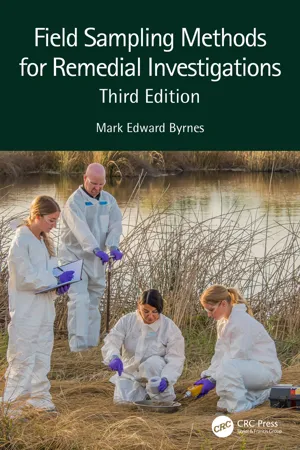
Originally published in 1994, the first edition of Field Sampling Methods for Remedial Investigations soon became a premier resource in this field. The "Princeton Groundwater" course designated it as one of the top books on the market that addresses strategies for groundwater characterization, groundwater well installation, well completion, and groundwater sampling. This long awaited third edition provides most current and most cost-effective environmental media characterization methods and approaches supporting all aspects of remediation activities. This book integrates recommendations from over one hundred of the most current US EPA, State EPA, US Geological Survey, US Army Corps of Engineers, and National Laboratory environmental guidance and/or technical documents.
This book provides guidance, examples, and/or case studies for the following subjects:
- Implementing the EPA's latest Data Quality Objectives process
- Developing cost effective statistical & non-statistical sampling designs supporting all aspects of environmental remediation activities, and available statistical sample design software
- Aerial photography, surface geophysics, airborne/surface/downhole/building radiological surveys, soil gas surveying, environmental media sampling, DNAPL screening, portable X-ray fluorescence measurements
- Direct push groundwater sampling, well installation, well development, well purging, no-purge/low-flow/standard groundwater sampling, depth-discrete ground sampling, groundwater modeling
- Tracer testing, slug testing, waste container and building material sampling, pipe surveying, defining background conditions
- Documentation, quality control sampling, data verification/validation, data quality assessment, decontamination, health & safety, management of investigation waste
A recognized expert on this subject, author Mark Byrnes provides standard operating procedures and guidance on the proper implementation of these methods, focusing on proven technologies that are acknowledged by EPA and State regulatory agencies as reputable techniques.