“FITNESS BEGINS IN THE HIGH CHAIR”
EXERCISE IN THE COLD WAR
1
Much like the slow-burning detonation cord in old cartoons, the news that American children were unfit traveled slowly through the halls of Washington before it exploded in political crisis. In 1953, physician Hans Kraus and exercise enthusiast Ruth P. Hirschland traveled to Austria and Italy, where they administered a battery of fitness tests designed by Kraus and his colleague, Dr. Sonja Weber, to children aged six to nineteen to investigate the causes of backaches in adults. The Kraus-Weber tests were composed of a number of exercises to measure what the researchers had deemed “minimum fitness levels”: toe touching to measure hamstring flexibility, sit-ups and leg lifts to measure abdominal strength, and prone leg and torso lifts to measure back strength. Kraus and Hirschland had previously examined several groups of American children, and their European tests were conducted only for purposes of comparison. Expecting to find similar results between the two groups, they were astonished to find major differences: while 56 percent of the American children had failed the tests, only 8 percent of the European children had.1
Kraus and Hirschland attributed the high rate of failure among the American children to the fact that “European children do not have the benefit of a highly mechanized society; they do not use cars, school buses, elevators or any other labor-saving devices. They must walk everywhere. Their recreation is largely based on the active use of their own bodies.” Their three-page report argued for expanded physical fitness programs and testing for children, especially younger ones, and warned that “insufficient exercise may cause the dropping of muscle efficiency levels below that necessary for daily living.”2
Unlike most academic articles, Kraus and Hirschland’s work did not go unnoticed. In fact, within a few months, word of the study had reached the ears of the president, and newspapers and magazines across the United States were reporting that American children were unfit, sparking a national conversation about fitness. Cosmopolitan asked, “Are We and Our Children Getting Too Soft?” Ladies’ Home Journal wondered, “How Fit Are Our Children?” and Newsweek explained in a lengthy article “Why the President Is Worried about Our Fitness.”3 Set against profound anxieties about postwar abundance, baby boom child rearing, and the Cold War, the Kraus-Hirschland study seemed to offer concrete proof that there was a problem with America’s children and suggested that if their bodies could be reformed, so could they.
President Eisenhower reacted swiftly to news of the study’s results by establishing the President’s Council on Youth Fitness (PCYF). During its five-year existence, the now largely forgotten council conducted an intensive public information campaign to raise awareness of fitness. From 1956 to 1960, the PCYF maintained a constant media presence that reminded parents and youth alike that it was their civic duty to get their bodies—and their minds—in shape. Although most Americans and many scholars cite the Kennedy administration’s President’s Council on Physical Fitness as the first national fitness campaign, it was in fact the PCYF that brought the concept of personal fitness to national attention.4 In so doing, the council helped broaden consumer interest in exercise and paved the way for a dramatic expansion of the commercial fitness industry in the 1960s. As a governmental agency created at the height of the Cold War, however, the council embedded its physical fitness message within a more complex rhetoric of reform that envisioned children as future parents, citizens, and soldiers whose moral, mental, and physical capabilities were key to maintaining the superiority of the nation both at home and abroad.
Although a study on physical fitness had precipitated the PCYF’s establishment, those involved in setting it up quickly expanded its mission to include the well-being of American children in all areas. Council organizers interpreted fitness—a word that, in the 1950s, did not automatically connote physical condition—as fitness in all possible senses. The first youth fitness conference, held at the U.S. Naval Academy in Annapolis in 1956, defined fitness as an idea that “encompasses the total person—spiritual, mental, emotional, social, cultural as well as the physical.”5 The mission of “total fitness” allowed the PCYF to address numerous postwar anxieties with its campaign: exercise would be one part of a total plan designed to resolve the juvenile delinquency crisis; improve both physical and mental aptitude for military service; counteract the perceived detrimental effects of a new, higher standard of living; and help educate young Americans about the duties of citizenship in a democracy.
President Eisenhower had first been alerted to the Kraus-Hirschland study by Pennsylvania senator James H. Duff. Duff had originally been contacted by constituent John B. Kelly, a prominent Philadelphian, a sculling champion, and the father of Princess Grace, who had organized the short-lived World War II fitness drive called Hale America. Highlighting a theme that would recur during discussions about national fitness, Duff expressed concern that the muscular strength that had made westward expansion possible was now in jeopardy. “Here we are only a few generations removed from the frontier and one of the most serious problems facing us now is the physical deterioration of our youth,” he wrote to Eisenhower.6 As Duff and Kelly saw the situation, forceful, mighty bodies were an integral part of the nation’s heritage, and their potential loss could mean the end of the American empire.
The Kraus-Weber tests crystallized a number of fears regarding American bodies. The prosperous years of the postwar economic boom had created a rapidly growing middle class that avidly purchased suburban homes, automobiles, and “push-button gadgets.”7 But as welcome as these goods were, they also sparked worries that luxury was corrosive, leading to physical laziness and mental sloth. Many of the lifestyle changes cited in Kraus and Hirschland’s article were true: suburban children now rode buses to school rather than walked, television occupied a large portion of Americans’ leisure hours, and the increased automation of factories and the expansion of the service industry called for less physical movement at work. Simply put, physical abilities were less important in this new landscape. These changes conflicted with closely held ideas about a shared national past and the physical characteristics necessary for productive citizenship, however. The American body was a fit body, poised to take action and able to endure hardship, a visible symbol of physical power. It had been instrumental in conquering the West, winning two world wars, and establishing a strong economy on the backs of able workers. New Deal–era artwork of the 1930s, for example, portrayed sculpted, muscular bodies in the service of national memory. Depression-era murals from the Federal Art Project relied heavily on agricultural and labor themes, featuring muscular workers toiling for the nation.8 Americans imagined that their forebears used these strong bodies to forge a nation, and they relied on such depictions in artwork to find strength in the midst of the Depression. Christina Jarvis’s analysis of World War II–era images—Uncle Sam and Rosie the Riveter, folk heroes Paul Bunyan and John Henry, combat-themed advertising, and superhero imagery—similarly illustrates how physical hardiness was an integral part of the national identity, providing reassurance during trying times.9 The idea that Americans were a muscular people and, by extension, fit and strong was buttressed by the belief that Americans had access to the best health care system in the world and enjoyed a superior diet that only a land of plenty could provide.10 The notion, then, that Americans were becoming unfit, soft, weak, or flabby—adjectives the news media employed in the wake of the fitness report—represented nothing less than the destruction of a national myth.
More specifically, news of the fitness report was troubling because it portended a weak military force. The results of the Kraus-Weber tests were viewed as both an explanation of past problems in military staffing and evidence that such issues would continue. Because physical abilities were seen as instrumental to winning the Cold War, it was imperative that a solution be found to the fitness problem. Figures from World War I, World War II, and the Korean War indicated that American draftees were failing their induction physicals at dramatic rates. Widespread media coverage suggested that soon there wouldn’t be enough fit men to maintain an adequate military. Moreover, soldiers already in the armed forces were seen as increasingly ill equipped to serve. Anecdotal reports abounded that men were not as tough as they used to be. John Kelly attributed the nation’s military softness to a higher standard of living during the formative years: “I’ve often heard combat veterans say that, man for man, the Japanese infantryman of World War II was a much tougher soldier than his American counterpart. Because of his rugged childhood, he could march farther and endure more privations.”11 Just as the launching of Sputnik jump-started a host of science and math initiatives in schools, the Kraus-Hirschland report began a national conversation about fitness and the American way of life that began in 1953 and continued in the media, the political sphere, and the home throughout the decade, raising important questions about human bodies and how to maintain them in the context of postwar abundance.
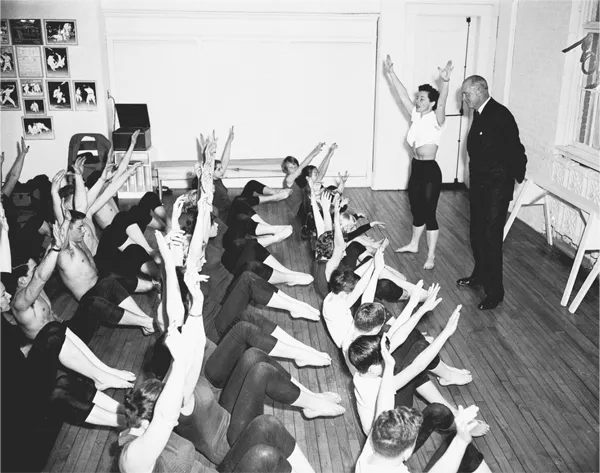
Former Olympian John B. Kelly observes Bonnie Prudden (formerly Ruth Hirschland) conducting a class at her school, the Institute for Physical Fitness, in White Plains, New York. Kelly was responsible for bringing Prudden and Hans Kraus’s study of children’s fitness to national attention. (© Bettman/Corbis)
ESTABLISHING THE COUNCIL
It’s not surprising that national fitness efforts were first directed toward children. Between 1946 and 1964, 78 million Americans were born, leading to an unprecedented population boom. During the decade of the 1950s, births hovered at around 4 million a year—a U.S. record.12 As this group transitioned into adolescence, a distinct teen culture emerged with its own music, fashion, dance, and language. At the same time, these increasingly independent adolescents, who often had their own cars and pocket money, were targeted by a plethora of new teen-directed magazines, films, comic books, television programs, and advertising. The sheer number of young adults, combined with decreasing parental influence and reports of delinquent behavior, created the perception of “a storm of criminality [that] was rumbling across the nation.”13 Child development experts, parents, politicians, and law enforcement officials seemed to agree that adolescents had become more prone to commit crimes. As one sociologist commented, “Rowdiness in and out of school, abuse of driving privileges, joy-riding, thefts, excessive drinking, vandalism and sexual misconduct are among the principal forms of disapproved acts seemingly becoming more frequent among teenagers from ‘better’ backgrounds.”14
The belief that a generation of young Americans was out of control led Congress to take action. The Senate Judiciary Subcommittee on Juvenile Delinquency, chaired by Estes Kefauver, blamed comics, television, and the cinema for the increase in crimes, keeping the topic in the news as it held hearings in a number of American cities through the 1950s.15 While purportedly investigating the causes of poor behavior among teens, these hearings—and the coverage of them—added to the perception that teenagers across the country were running wild. These were the first televised governmental hearings of any kind, and according to one estimate, 86 percent of American television sets were tuned in when they aired.16 In addition, Hollywood took advantage of the salacious topic to turn out a spate of delinquency films—with titles such as Rebel without a Cause, Blackboard Jungle, Teen-Age Crime Wave, Crime in the Streets, and The Delinquents—perpetuating the notion of teens gone wild.17
Although juvenile delinquency had been a newsworthy topic since the 1940s, it reached a peak between 1953 and 1956—the same time fitness was identified as a problem.18 Early planning documents and media reports about the PCYF indicate that organizers considered improving physical fitness a desirable goal because it could also help curtail delinquent behavior. Physical fitness programs could occupy leisure hours, channel excess energy, and “improve” the character of youth through fitness activities, especially organized competitive sports. Eisenhower explained in a letter: “At the suggestion of one of my friends, I am trying to bring together a number of outstanding sports figures. The aim of the meeting is to see what we can do about combatting juvenile delinquency and substituting an increasing interest in sports among young p...