eBook - ePub
Available until 23 Dec |Learn more
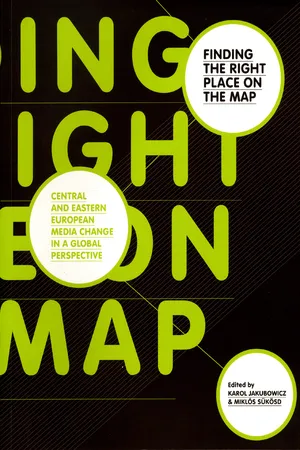
Finding the Right Place on the Map
Central and Eastern European Media Change in a Global Perspective
This book is available to read until 23rd December, 2025
- 304 pages
- English
- ePUB (mobile friendly)
- Available on iOS & Android
eBook - ePub
Available until 23 Dec |Learn more
Finding the Right Place on the Map
Central and Eastern European Media Change in a Global Perspective
About this book
Finding the Right Place on the Map is an international comparison of the media systems and democratic performance of the media in post-communist countries. From a comparative east-west perspective, this groundbreaking volume analyzes issues of commercial media, social exclusion, and consumer capitalism. With topics ranging from the civil society approach, public service broadcasting, fandom, and the representation of poverty, each chapter considers a different aspect of the trends and problems surrounding the international media. This volume is an up-to-date overview of what media transformation has meant for post-communist countries in the past two decades.
Frequently asked questions
Yes, you can cancel anytime from the Subscription tab in your account settings on the Perlego website. Your subscription will stay active until the end of your current billing period. Learn how to cancel your subscription.
At the moment all of our mobile-responsive ePub books are available to download via the app. Most of our PDFs are also available to download and we're working on making the final remaining ones downloadable now. Learn more here.
Perlego offers two plans: Essential and Complete
- Essential is ideal for learners and professionals who enjoy exploring a wide range of subjects. Access the Essential Library with 800,000+ trusted titles and best-sellers across business, personal growth, and the humanities. Includes unlimited reading time and Standard Read Aloud voice.
- Complete: Perfect for advanced learners and researchers needing full, unrestricted access. Unlock 1.4M+ books across hundreds of subjects, including academic and specialized titles. The Complete Plan also includes advanced features like Premium Read Aloud and Research Assistant.
We are an online textbook subscription service, where you can get access to an entire online library for less than the price of a single book per month. With over 1 million books across 1000+ topics, we’ve got you covered! Learn more here.
Look out for the read-aloud symbol on your next book to see if you can listen to it. The read-aloud tool reads text aloud for you, highlighting the text as it is being read. You can pause it, speed it up and slow it down. Learn more here.
Yes! You can use the Perlego app on both iOS or Android devices to read anytime, anywhere — even offline. Perfect for commutes or when you’re on the go.
Please note we cannot support devices running on iOS 13 and Android 7 or earlier. Learn more about using the app.
Please note we cannot support devices running on iOS 13 and Android 7 or earlier. Learn more about using the app.
Yes, you can access Finding the Right Place on the Map by Karol Jakubowicz, Miklós Sükösd, Karol Jakubowicz,Miklós Sükösd in PDF and/or ePUB format, as well as other popular books in Languages & Linguistics & Eastern European History. We have over one million books available in our catalogue for you to explore.
Information
AFTER TRANSITION: THE MEDIA IN POLAND, RUSSIA AND CHINA
Introduction
It is now nearly twenty years since the great crisis of Communism that led to the struggles, revolts and revolutions of 1989–92. The outcomes of those events have differed widely from place to place. Probably only North Korea survives today as a museum of a fully functioning Stalinist state. Elsewhere, even where the Communist parties continue to hold monopolies of political power, for example, in China, there have been changes, more or less extensive, to the nature of social and economic life. At the other extreme, eight of the European former Communist countries have changed sufficiently as to join the European Union, and two others are preparing for accession. Between the extremes, there are different types of political and economic systems established with a greater or lesser degree of stability.
The variety of different patterns of social organization is mirrored by the different patterns of media system. The rankings of ‘Global Press Freedom’ produced annually by Freedom House score Estonia and Latvia as “Free” at 17 points (equal 24th with the USA and Canada and one point better than the UK). Poland is “Free” at 20 points (equal 37th with France and two points ahead of Spain). Russia is “Not Free” at 68 points (equal 145th with Afghanistan, Egypt and Ethiopia and one point ahead of Malaysia). China is “Not Free” with 82 points (equal 177th with Vietnam, one point better than Syria and two points better than the Israeli-Occupied Territories/Palestinian Authority). Right down the bottom, number 194 in rank order, definitely “Not Free” and scoring 97 points is North Korea, one point below Burma, Cuba and Turkmenistan (Freedom House 2005). Whatever one makes of the value of the methodology employed to construct these rankings, and it strikes the current author as crude and frankly ideological, there is no doubt that the overall order does illuminate important differences. Other, equally limited, surveys, for example, that produced by Reporters Without Frontiers, differ in detail but produce similar rank orders, although everyone seems to agree that the Nordic countries are tops (Reporters Without Frontiers 2005).
Given that there were some strong similarities in the political and economic systems of all of these states at the start of the process of change, explaining the different outcomes, for the media no less than for the societies as a whole, is a major theoretical and empirical challenge. This paper suggests that the dominant political science tradition of understanding post-communist social change, which is usually, and inelegantly, called ‘transitology,’ is mistaken in its fundamental approach. Since most studies of the mass media rest, either implicitly or explicitly, upon the same assumptions, it is also the case that much of the writing about media in post-Communist societies has proved unable to theorise the very interesting empirical material it has generated. An alternative approach, that of ‘elite continuity,’ developed to account for changes on the western fringe of the former Warsaw Pact, is presented as an alternative to explain media change in three major cases: Poland, Russia and China. It is argued that this way of theorizing the processes at stake provides a more satisfactory account of the evidence, and also provides a possible basis for extension to other instances of transition.
The crisis of ‘transitology’
The collapse of European communism in 1989–1991 was widely seen as part of the ‘third wave’ of democratization whose most famous proponent was the US political scientist Samuel Huntington (1991). Scholarly thinking about the events has largely been conducted within the intellectual current often known as ‘transitology.’ This had been developed a decade or so previously, and had focused most of its attention on the end of European fascism and the military dictatorships that dominated South American politics up to the mid 1980s. The concepts and methods developed to address those processes were extended to try to analyse the new wave of changes. The aim of transitology is to explain explicitly political change from dictatorial to democratic regimes and for them; ‘What we refer to as the “transition” is the interval between one political regime and another’ (O’Donnnell and Schmitter 1986, 2). With this intellectual background, it is hardly surprising that there has been an underlying assumption that post-Communist change was a process of which led from totalitarian communism to democratization. The bulk of this writing can fairly be termed ‘teleological’ since it assumes that there was a definite end, democracy as practiced in the ‘originator’ countries of north-west Europe and North America, towards which countries in transition are inevitably tending. The processes of change can therefore be understood, and judged, by measuring how far along the trajectory towards democracy the countries in question were. Despite the fierce theoretical debates that the term ‘democracy’ continues to provoke, the consensus amongst authors working in this tradition, however much they disagree about other things, is to follow Schumpeter and to stress a ‘minimalist’ conception of democracy (O’Donnell 2000, 6–11). As one author put it: ‘a transition to democracy is complete when: (I) there is a real possibility of partisan alternation in office, (2) reversible policy changes can result from alternation in office, and (3) effective civilian control has been established over the military.’ (Przeworski 1992, 105). In the purer forms of transitology, issues of social structure are an obstacle to a proper understanding of political transition: as one writer proudly proclaimed, transitology ‘deliberately excludes from [the] basic denotation of democratic government, as a tactic of inquiry, any references to social structures and socioeconomic relations, believing that their inclusion is likely to obscure rather than facilitate the scientific comparative probing of political regimes’ (Shain 1995, 47). Even rather more critical writers, who do acknowledge that democratization has the potential of profound social implications, distinguish these issues from the consideration of democratization per se (O’Donnell and Schmitter 1986, 11–14).
This bold intellectual project immediately confronted an obvious and distinctive feature of post-Communist transition, which is that alongside the political changes consequent on the collapse of the Communist Party’s monopoly of power, there were also thorough-going economic changes. The political changes were characterized as democratization and the economic changes as marketization. It was, thus, necessary to modify the absolute insistence on isolating the political level from any other kinds of factors, and to argue that these two processes are interdependent. With some honourable exceptions, the project of democratization was, in most cases, held to be theoretically impossible without the concurrent introduction of a market economy (Przeworksi 1991; Linz and Stepan 1996, 11). The bulk of writing may be fairly characterized as “teleological” in this second aspect, too, in that it assumes that end of the process is already set and determined as a market economy and that these societies can be studied from the point of view how far they have progressed upon the path leading towards the economic relations that exist in the ‘originator’ countries, or more specifically the United States of America. The pure teleology of the original formulation of transitology was modified into a ‘twin teleology’ of democratization and marketization. Social change in post-Communist countries has thus been scrutinized for evidence of the fact that the societies in question are both becoming more democratic and more market-oriented, with the two processes dependent, one upon the other.
Discussions of the mass media play a surprisingly small part in political science accounts of transition or, indeed, of democracy. Logically, a theory derived from the view of democracy advanced by Schumpeter fits well with Lippmann’s view of public opinion. But this connection is seldom or never explicitly drawn, although, of course, however unpalatable in theory and objectionable on normative grounds, in practice it provides a good working account of the situation in the originator countries. In general, it is stated that a free and independent media is a necessary condition for democracy, but the discussion remains innocent of any of the issues concerning such a statement that have been raised by research into media and communication. There are one or two honourable exceptions (Pei 1994; O’Neil 1998) but: ‘Students of democratization often assert that a free press is one of the key ‘pillars of democracy’, but this idea is rarely developed any further’ (O’Neil 1996, 3).
Communication scholars have naturally been more attentive to the problems of the media in transition, although it is fair to say that in the West the topic has received far less attention than other media phenomena, like the avatars of Big Brother, which are perhaps of lesser world-historical importance. They have, however, generally been more or less directly influenced by the twin teleologies of democracy and marketization developed by the transitologists. Again, there are important exceptions (Splichal 1994; Downing 1996; Zhao 1998; Reading 2003; Koltsova 2006) but the mainstream, while differing substantially over the pace of progress, more or less wrote the history of transition in terms of the struggles for media freedom and market economics (Lee 1994; Mickiewicz 1999; Gross 2002; Jakubowicz 2003a).
Nearly two decades later, this account of the trajectory of both society and the media no longer seems at all convincing. As one of the key critics of the ‘transition paradigm’ pointed out, only some of the societies that had begun a process of political change in 1989 had, by 2002, established what political scientists recognize as stable democracies (Carothers 2002). If the foundation of the paradigm had placed a very strong emphasis upon elections as the defining feature of a democracy, later scholars had wished to qualify that by adducing other factors. The end state was redefined as a ‘liberal democracy’, which was differentiated from a variety of other states, variously classified by different authors as ‘electoral democracy’, ‘feckless pluralism’, ‘dominant power politics’, ‘sultanism’ and so on. The seemingly endless proliferation of different intermediate stages between democracy and dictatorship not only reduces the elegance of the paradigm but also calls into question its explanatory power. In place of the belief in a straightforward and more or less linear transition to democracy as the ideal type of transition, with all instances of imperfection being regarded as anomalies, Carothers argued that theory and practice should: ‘start by assuming that what is often thought of as an uneasy, precarious, middle ground between full-fledged democracy and outright dictatorship is actually the most common political condition today of countries in the developing world and the post-communist world’ (2002, 17–18).
There are some signs that a similar conclusion is being drawn within studies of media in transitional societies even by some of those writers earlier associated with the transition school. Thus, Jakubowicz writes after a detailed account of the failure to establish public service broadcasting in the region that: ‘It could be said, as with post-Communist transformation in general, that from one point view, media system change will be achieved once what is happening in Central and Eastern European media no longer has anything to do with overcoming the legacy of the Communist system — and that is quite some time away’ (2004, 68). Similarly, recent studies of the press in China have tended to stress the extent to which the supposed contradictions between journalists and state have been resolved in the construction of ‘Chinese Party Publicity Inc.’ (Zhou 2000; Lee, Zhou and Huang 2006). In the case of Russia, of course, the consolidation of the Putin presidency is seen as establishing a new form of authoritarian control over the media (Belin 2002).
The evident failure of the ‘transition paradigm’ to provide a satisfactory account of political and economic development, either at the general level of political science or in the narrow but central field of the media, necessitates a reconsideration of our theoretical orientation. One option is to attempt to modify the paradigm, à la Tycho Brahe, in order to account for the observational anomalies. An alternative is to re-examine the problem and seek to discover whether there might be a better paradigm to explain it. It is the latter course that is adopted here.
The theory of elite continuity
As an alternative explanation of the dynamics of post-Communist media systems we may consider the theory of elite continuity. When studying the complex and protracted evolution of the media in Poland, Hungary, the Czech Republic and Slovakia in the first years after the fall of Communism, it quickly became apparent that the course of events was not following the programmes outlined either by the former dissidents who were now in power nor by the legion of consultants from Western Europe and the USA who were offering them advice as to how to restructure broadcasting and the press. The very worthy aim shared by almost everyone involved in the early years of transition might be summarized not too inaccurately as an attempt to create newspapers like the New York Times and broadcasters like the BBC (Sparks 2001). In fact, what emerged were newspapers that were highly partisan in their orientation and broadcasters that remained closely aligned with the state rather than the public (Sparks 1998).
In an attempt to offer a theoretical explanation for these realities, seven major components were identified:

Table of contents
- Cover
- Title page
- Copyright
- Contents
- Twelve Concepts Regarding Media System Evolution and Democratization in Post-Communist Societies
- Part One: Dimensions of Change
- Part Two: Normative and Policy Approaches to Media and Democracy
- Part Three: Objectivity vs Partisanship and Fandom
- The Disadvantaged in Infotainment Television: From Representation to Policy
- Authors Biographies