Equipping you with action plans, implementation steps and more than 100 marketing weapons, Jay Conrad Levinson, The Father of Guerrilla Marketing, and social media expert Shane Gibson teach you how to combine the timeless principles of guerrilla marketing with the latest social media applications and networks. Discarding overwhelming statistics, buzzwords and acronyms, Levinson and Gibson provide a step-by-step social media attack plan. Following their take-no-prisoners guerilla approach, you’ll learn how to identify unconventional social media opportunities, engage customers, motivate action, and capture profits away from your competitors. Includes: • 19 secrets every guerrilla social media marketer needs to know • The Guerrilla Social Media Toolkit • The Seven-Sentence Social Media Attack Plan • 22-point social site and blog checklist • 20 types of ROI • Free guerrilla intelligence tools • Future social media weapons that are worth knowing about • And more! This is THE social media guerrilla’s go-to guide—learn how to employ a social media plan that earns attention—and profits!
eBook - ePub
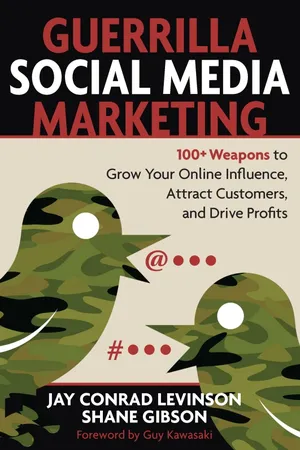
Guerrilla Social Media Marketing
100+ Weapons to Grow Your Online Influence, Attract Customers, and Drive Profits
- 250 pages
- English
- ePUB (mobile friendly)
- Available on iOS & Android
eBook - ePub
Guerrilla Social Media Marketing
100+ Weapons to Grow Your Online Influence, Attract Customers, and Drive Profits
About this book
Information
CHAPTER 1
THE GUERRILLA SOCIAL MEDIA MARKETER’S PATH
Guerrilla marketing is about achieving conventional goals using unconventional means. Instead of spending large sums of money on traditional mainstream broadcast media, guerrillas use cost-efficient, creative, and innovative strategies to rise above their competition. Today, more than any other time in history, we have an almost limitless arsenal of free or nearly free marketing tools at our fingertips. These tools are the new media marketing tools of this millennium, and they’re called “social media.”
dp n="17" folio="2" ?Social media is a set of tools and websites that are free or nearly free and allow marketers and the community to create content and meaningful conversations online. They include blogs, photo-sharing sites, video-sharing sites, social networks, audio podcasts, and internet radio shows as well as a wide selection of mobile social sharing and communications tools. The conversations and content created by communities and those marketers that engage them are having a huge impact on brands, communities, and the consumer.
Much hyped, promoted, misunderstood, and maligned, social media marketing is a complex multidimensional set of tools, networks, and media. There are many paths to take in the realm of social media marketing. PR people will argue that social media marketing is best left to them. The VP of marketing, the customer service department, and especially your legal department will also argue that they are, in fact, the ones that should be in charge of social media marketing for any company.
What most executives, marketing professionals, and ad agencies fail to realize is that marketing now belongs to everyone, and everyone must be equipped and engaged in the social media space. Your customer with two Tweets, a video blog, and a Facebook status update can do more good or harm to your brand than one of your well-planned marketing campaigns.
DAVE CARROLL GUERRILLA SOCIAL MEDIA MARKETING PIONEER
UNITED BREAKS GUITARS
Nova Scotian Dave Carroll and his band Sons of Maxwell produced a series of videos with the theme “United Breaks Guitars.” They produced the first video after nine frustrating months of trying to get United Airlines to pay for damage done by their baggage handlers to Dave’s Taylor guitar. It wasn’t a question of fault; several witnesses in the plane saw handlers recklessly throwing the guitars about the baggage loading area.
Of course, the words “policy,” “protocol,” and many other things that mean “we’re not paying you for the damage that was done” were uttered. After exhausting the United customer service bureaucracy labyrinth, Dave decided not to quit. Instead he put his guerrilla hat on and got creative and innovative. He recruited the help of some friends in video production and produced a very catchy and humorous music video telling of his plight. Within the first 24 hours of the video being on YouTube, it had several hundred thousand views. As of this writing, it had gotten almost ten million views and was growing daily.
Some experts even speculated that the drop in United’s share value the next day was partially due to so many views of the negative video. Dave was soon on every major television network and in every major newspaper. This one customer, with a video camera, a catchy tune, and a free YouTube account had rebranded the company that “flies the friendly skies” to one that “breaks guitars.”
This is the power of social media. Your customers, your competitors, and everyone in between can be a Dave Carroll and so can you.
Eventually United conceded, but the guitar was already fixed and the damage to its good name was already done. The reality is that, according to United, it has a 99.5 percent success rate for handling bags. The problem is, people will believe their friendly musician friend Dave, not a stat pushed out by a big company.
There are many trails to be blazed in social media. Some will build communities that raise money for charity, others like Barack Obama’s online campaign will turn the tide of opinion. The guerrilla social media marketing path is one that is blazed with a keen focus on community, innovation, engagement, and—most importantly—profit. The guerrilla path has a beginning but unless you sell your business or retire, it has no ending. It is a way of doing business and engaging the marketplace that drives real long-term business results. This is not a book on clever marketing campaigns or short-term Facebook contests. The guerrilla path in social media marketing is not easy; in fact it encompasses a set of principles, traits, and attitudes that take work to understand, master, and implement. Still, if you master and implement what you learn in this book, it will be almost impossible for you to fail.
Anyone can become a successful guerrilla social media marketer, but they must want to be one. They must also commit to the personal transformation and work that is necessary to get there. Beyond attitudes, marketing weapons, and plans, we must have the right personality traits to become successful.
THE TEN PERSONALITY TRAITS OF A GUERRILLA SOCIAL MEDIA MARKETER
In the following pages you will learn the personality traits of a guerrilla social media marketer. It will be up to you whether or not these traits describe who you are or who you want to become; you will have to make a decision as to whether or not this doctrine of marketing is for you. It’s not an easy path, but the rewards are huge.
1. Immune to Hype
There is a lot of hype around social media. The guerrilla searches for truth, verifies information, and executes with dependable tools and strategies. With so many people blasting Twitter updates, sharing Facebook messages, and posting blog entries, it’s easy to get caught up in the excitement of a new product, tool, or market and dive in headfirst. Here’s why guerrillas don’t fall into this trap:
• Any new social media marketing tool or community takes time, energy, and resources to test and evaluate effectively.
• Great technology alone doesn’t mean a marketing tool is worth investing in. The tool must be backed by a great company and have the potential for longevity.
• While you chase every trend and new tool, you neglect communities and marketing tools that need focus and commitment to get a long-term return on investment.
• Hype is a sign that something is broadly used. Guerrillas look for opportunities to have the first-mover advantage rather than following the herd.
You can protect yourself from the hype by
• watching other guerrillas and innovators that cater to your target market. What is their feedback in relation to the new technology or tool?
• looking for hard data on the tool, product, or technology. Get your data from multiple sources to confirm their accuracy. Forrester Research, MarketingProfs.com, or your local chapter of the Social Media Club are great places to find accurate information.
• checking the credibility of those who claim to be having success with the technology. Are they profitable? Is what they are doing sustainable and scalable?
• remembering that a good marketing attack takes months or even years to be fully effective. Be careful about jumping from idea to idea without allowing ideas time to mature. The latest thing may not be the most effective thing for your business.
2. Curiosity
Sir Alexander Fleming of Scotland discovered penicillin serendipitously. He was observing staphylococcus and looking for a way to battle this bacteria without harming people’s immune system. A not-so-organized Fleming had petri dishes unwashed and stacked in the sink. He went away on a brief trip. During this time several mold cultures grew in and around some of the petri dishes. Somehow the mold and the staphylococcus were mixed by accident, and Fleming discovered that this fungus was able to kill the bacteria. This serendipitous event lead to the discovery of penicillin and has now saved what is likely millions of lives. Mr. Fleming was constantly trying new things and asking “why?” and “what if?”
Guerrillas aren’t afraid to experiment, make mistakes, or try new things to gain a competitive advantage. Not unlike Alexander Fleming, guerrillas need to be willing to combine different elements of marketing and strategy in a creative fashion. They then need to be curious when new and exciting or even unexpected results arise. They also investigate, measure, and document the results so they can replicate the results on a grand scale.
Some “what if?” and “I wonder” questions that a curious guerrilla could ask are:
• What if I started giving more reports away for free online?
• What if I blogged five times a week and decreased my length of entry to no more than 200 words?
• I wonder what would happen if I asked Guy Kawasaki to do a guest blog on our site?
• I wonder if I had my podcasts transcribed and posted in my blog if it would increase reader retention?
• What if I asked my readers to contribute content to our blog and rewarded them for doing so?
• I wonder why fewer people blog on the weekends? Is there an opportunity in this?
Chris Anderson, author of Free: The Future of a Radical Price (Hyperion, 2009), asked “What if I gave 144,000 copies of my book away for free online?” The answer for him was a rapid and sustained New York Times and Amazon.com bestseller status.
3. The Ability to Sprint
There will be small windows of opportunity, and the guerrilla is always ready to exploit them with energy, passion, and resources. The world and the internet move very fast. Sometimes marketing and business opportunities come quickly. Being at the right place and the right time is only one part of the formula. Being prepared and ready to take advantage of these opportunities is the magic ingredient in the formula for success.
Some things to help you be ready to sprint are:
• Having a plan in place and a team ready in the event that one of your marketing attacks goes viral; make sure your business is scalable for increased demand.
• Being prepared to pull a 24-hour shift or a 14-day work shift when a huge opportunity hits. Once you have momentum, capitalize on it. Things will eventually slow down, and you can rest then.
• Being ready if things go bad in your social media. Sometimes sprinting is about quickly and aggressively dealing with an onslaught of negative feedback or news. Taking 24 hours, or even two hours, to respond to customer complaints or competitive slander is too long. You need to be ready to respond immediately and stomp out those brandburning fires.
4. The Ability to Run Marathons
Many battles are battles of attrition. Guerrillas know how to wear their competition down and build a presence through consistency. One of the biggest costs in marketing is not running bad campaigns or promotions, it’s quitting on good campaigns and marketing attacks too soon. The ability to run marathons has many aspects. Guerrillas must
• have a long-term plan that goes beyond a monthly or quarterly focus.
• have a marketing calendar that they follow daily.
• be focused on business goals, not distracted or enamored by the latest technology.
• understand that a customer may need to be exposed...
Table of contents
- Title Page
- Acknowledgements
- Foreword
- Preface
- CHAPTER 1 - THE GUERRILLA SOCIAL MEDIA MARKETER’S PATH
- CHAPTER 2 - BUILDING THE GUERRILLA’S PERSONAL BRAND
- CHAPTER 3 - THE TOP TEN ATTRIBUTES OF A GUERRILLA SOCIAL MEDIA MARKETER
- CHAPTER 4 - THE GUERRILLA SOCIAL MEDIA ARSENAL
- CHAPTER 5 - GUERRILLA ROI
- CHAPTER 6 - GUERRILLA FOCUS
- CHAPTER 7 - GUERRILLA SOCIAL MEDIA MARKETING DEFINED
- CHAPTER 8 - BUILDING AND PROTECTING YOUR GUERRILLA HQ
- CHAPTER 9 - RECRUITING AND PARTNERING WITH GUERRILLAS
- CHAPTER 10 - YOUR GUERRILLA SOCIAL MEDIA ATTACK PLAN
- 107 SOCIAL MEDIA TWEETS
- GUERRILLA SOCIAL MEDIA MARKETING GLOSSARY
- INDEX
- Subscribe to Entrepreneur Magazine
- Copyright Page
Trusted by 375,005 students
Access to over 1.5 million titles for a fair monthly price.
Study more efficiently using our study tools.
Frequently asked questions
Yes, you can cancel anytime from the Subscription tab in your account settings on the Perlego website. Your subscription will stay active until the end of your current billing period. Learn how to cancel your subscription
No, books cannot be downloaded as external files, such as PDFs, for use outside of Perlego. However, you can download books within the Perlego app for offline reading on mobile or tablet. Learn how to download books offline
Perlego offers two plans: Essential and Complete
- Essential is ideal for learners and professionals who enjoy exploring a wide range of subjects. Access the Essential Library with 800,000+ trusted titles and best-sellers across business, personal growth, and the humanities. Includes unlimited reading time and Standard Read Aloud voice.
- Complete: Perfect for advanced learners and researchers needing full, unrestricted access. Unlock 1.5M+ books across hundreds of subjects, including academic and specialized titles. The Complete Plan also includes advanced features like Premium Read Aloud and Research Assistant.
We are an online textbook subscription service, where you can get access to an entire online library for less than the price of a single book per month. With over 1.5 million books across 990+ topics, we’ve got you covered! Learn about our mission
Look out for the read-aloud symbol on your next book to see if you can listen to it. The read-aloud tool reads text aloud for you, highlighting the text as it is being read. You can pause it, speed it up and slow it down. Learn more about Read Aloud
Yes! You can use the Perlego app on both iOS and Android devices to read anytime, anywhere — even offline. Perfect for commutes or when you’re on the go.
Please note we cannot support devices running on iOS 13 and Android 7 or earlier. Learn more about using the app
Please note we cannot support devices running on iOS 13 and Android 7 or earlier. Learn more about using the app
Yes, you can access Guerrilla Social Media Marketing by Jay Levinson in PDF and/or ePUB format, as well as other popular books in Commerce & Marketing. We have over 1.5 million books available in our catalogue for you to explore.