The Father of Guerrilla Marketing, Jay Conrad Levinson delivers the first book to adapt the profit-producing principles of Guerrilla Marketing to the world of nonprofits. The nonprofit sector has increased by 65%--a flood of new organizations are vying for donations, competing for volunteers, and carving out their share of the marketplace. Joined by co-authors Frank Adkins and Chris Forbes, Levinson shows nonprofit marketers how to gain the competitive edge they need by replacing their lack of money with the power of time, energy, imagination, and information—allowing them to maximize their impact and raise more money! Armed with time-tested principles, 200 proven weapons of Guerrilla Marketing, and relevant tactics and tools, nonprofit marketers learn how to boost public awareness, increase effectiveness in recruiting volunteers, mobilize advocates, and raise more money—no matter the state of their finances. • Introduces the "seven golden rules” for fundraising success and recruiting volunteers • 200 proven weapons of Guerrilla Marketing customized for nonprofits • Covers publicity and social media tactics specific to the nonprofit community • Concepts are illustrated through real-world examples and comparison tables
eBook - ePub
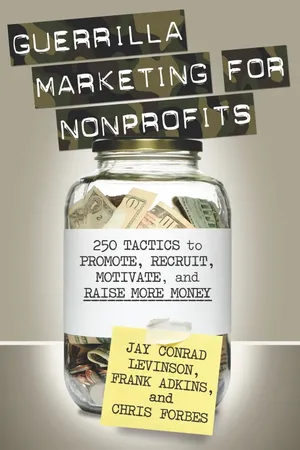
Guerrilla Marketing for Nonprofits
250 Tactics to Promote, Motivate, and Raise More Money
- 336 pages
- English
- ePUB (mobile friendly)
- Available on iOS & Android
eBook - ePub
Guerrilla Marketing for Nonprofits
250 Tactics to Promote, Motivate, and Raise More Money
About this book
Information
It has never been more strategic than it is now in the nonprofit sector to learn to think and act like a guerrilla.
CHAPTER 1
What Nonprofits Need Is Better Marketing
SO YOU WANT TO REVOLUTIONIZE THE WORLD and make it a better place? We have some good news that will help you turn your great ideas into the powerful results you are dreaming about. You are at the starting point of a journey in which we hope to change your thinking in ways that will help you take your organization to the next level. We want to take you on a guided tour of what guerrilla marketing can do for your nonprofit. Right now you are at the beginning of your quest. Soon you will take charge yourself bringing your marketing plans to life. As your momentum builds, your voyage will get easier, but your marketing trek never ends until you completely accomplish your organization’s mission. So let’s get started.
Guerrilla marketing books have helped people all over the world turn their time, energy, and imagination into profitable results. With more than 60 titles and 20 million books sold in 63 languages, we know a thing or two about getting results. We want to help put the power of guerrilla marketing into the hands of you, the nonprofit leader. Guerrilla marketing isn’t designed for people who want to know everything about marketing. It is designed for people who want to grow their organization and get results. Though organizations of all sizes can benefit from guerrilla marketing, it is designed with the smaller nonprofit in mind. You may already have in mind what you think guerrilla marketing is all about. But take a second look. There’s more to it than a few attention-getting promotional tactics.
If you’re like most nonprofit leaders, you started your plans for changing the world with an ideal vision of how things ought to be. At first you may not have realized your decision to change the planet is also a marketing decision. If you are a leader in a small nonprofit, you are already wearing a lot of hats. It may not be encouraging to know that you also need to learn about marketing. Few nonprofit executives realize that marketing is not merely a promotions program. It is a process that can turn around a flagging nonprofit’s results. Marketing is people smart, and it can make your organization a more efficient and friendly place, too.
So even though your thoughts are crowded with all kinds of other pressing needs that demand your attention besides marketing, take the time to master guerrilla marketing. Marketing is everybody’s job in a small nonprofit, but someone in your organization needs to take the reins and coordinate the messages, programs, and strategies into a cohesive brand. Your nonprofit needs a guerrilla who can lead the charge into the marketplace with a strategy for getting lasting results. Take charge now, so you can make your organization the best it can be. We are going to show you how adopting a marketing mind-set can help you improve your organization’s ability to influence others, expand awareness, increase recruitment, mobilize volunteers, enable advocates, and raise more money.
Why Nonprofits Should Embrace Marketing
Changing the world comes with a lot of communication decisions. How will you get the word out about your ideas? How will you change the way people think, act, and believe? What can you do to attract more people to help you in your cause? How can you persuade people to part with their hard-earned cash to support you financially in your quest? All kinds of questions are swirling around your head demanding answers. In addition, you are not making your decision to get the world’s attention in a vacuum. There are hundreds of thousands of other organizations and businesses right now making their move to attract the eyes and ears of the people on planet earth, too. For-profit companies spend an average of $895 per year per capita on advertising to get the attention of the same people you want to reach. There is no way your organization can keep up with their spending. And, despite how you may feel about it, the people you want to reach are those same people that companies spend billions to market to.
The nonprofit sector has entered a new phase in the past decade. Nonprofits have increased so rapidly in recent years, that a new term has emerged to define the segment of the economy that is nongovernmental and not-for-profit social sector. With a 65 percent growth rate in the number of nonprofits in the United States, the proliferation of new organizations has created more competition for attention. Social sector observers report that today, the greatest challenge facing nonprofit organizations is finding a way to compete in a complex and rapidly changing marketplace. There is a constant struggle today for a share of charitable dollars in a financial market that has not expanded as rapidly as the nonprofit sector has grown. Worse yet, economic problems have reduced the number of dollars people have and raised the stakes for convincing them to part with what cash they do have in the form of donations.
All organizations have to market themselves if they want to impact their communities for the greater good.
Nonprofits continually search for ways to recruit and mobilize a rapidly changing and fickle pool of volunteers. There are more organizations in the social sector trying to find workers at the same time your organization is seeking community-minded people to help you accomplish your mission. Some volunteers move from organization to organization in a search for new and more interesting experiences.
Many nonprofits have turned to revenue-generating models such as selling products and services that put them in direct competition with big-budget for-profit companies. Add to that the fact that many for-profit companies are discovering cause marketing, and you will appreciate how much the typical nonprofit has to maneuver to remain viable and competitive today. All these factors point out the need for nonprofit leaders to get a little more marketing savvy—and fast! With so much competition and media clutter in the environment into which you want to take your message, you would be foolish to enter without a strategy, especially if you don’t have a lot of money. If you are reading this, there is a good chance that you are aware of your challenge. This book is dedicated to helping you make the most impact with your ideas by presenting to you the proven principles of guerrilla marketing.
FROM THE FRONT LINES
NAME: Katya Andresen
WEBSITE: NonprofitMarketingBlog.com
BOOK: Robin Hood Marketing (Jossey Bass, 2006)
“Many of us may wish marketing were not necessary and that people would pay our prices without expecting anything in return. ‘Why should we have to do this when our cause is so worthy?’ is a common refrain I hear from do-gooders. ‘If people would only listen, they’d see that (fill in the blank) is the right thing to do.’ We continue to operate under the assumption, conscious or not, that if people took the time to listen to us wax poetic about the urgent problems we are tackling—or if they just had more information—they would change their perspectives, embrace our world view, and take action. In our haste to pour our hearts into what we say, we forget to use our minds. We can’t market as missionaries—we must be marketers with a mission. And we do that by focusing on our audience and showing people how our cause aligns with the values they hold now.”
It’s Not Just Propaganda
Marketing is a discipline, not a program for your nonprofit. All organizations have to market themselves if they want to impact their communities for the greater good. But many nonprofit leaders have mixed emotions when it comes to thinking about marketing. Some nonprofit organizations treat marketing as something that is beneath their dignity or even against their core values. But a greater understanding of marketing is really what they need most. If there is even the tiniest part of you that is still unable to embrace the idea of the benefit of marketing for your organization, we hope to help you get over it. You need to understand and apply good marketing to accomplish your goals.
If you have studied marketing at all, you know about the famous “Four P’s” of the marketing mix: product, price, place, and promotion. These are the basic elements of marketing strategy. Get the right mix of the elements and you have a great hit. Get it wrong and ... well, you know. Marketers dream of developing and promoting the right product at the right price, making it available through convenient distribution systems. Look at all the break-through products you personally like and you will see all these elements in place and firing on all cylinders.
What many people mean when they talk about marketing is promotion. But as you see from the “Four P’s,” promotion is only about one-fourth of the total marketing strategy picture. And considering promotion closely, you will find that advertising is just a small subset of the promotional picture. It’s no wonder many nonprofit marketing efforts fail; they are too limited in scope. If you are over-focused on the promotional side of marketing (as many nonprofit marketers are), you are doomed to fail. Some nonprofits treat marketing as merely putting your organization’s message spin into media channels and repeating that message as much as you can afford. That’s not marketing, that’s propaganda.
The reason social sector marketing flops so often is because most nonprofit marketers function only as promotional people. Often the bulk of the typical nonprofit organization’s marketing activities center on promoting its program. In some cases, organizations spend more time planning the promotion than they do in developing the program to make it more appealing to the intended audience. There are many ways to make your organization the topic of word-of-mouth buzz besides grabbing their attention using some form of promotional media. If your program really scratches people where they itch, if it really benefits them, they can’t help but tell their friends about it. Much of what is done in nonprofit guerrilla marketing will never make it to the nonprofit organization promotional calendar and it won’t cost any promotion budget money.
As we think about nonprofit marketing, we need to think about more than program promotion. We need to have the full marketing mix, price, place, and product, too. Working with nonprofits, we have noticed them reading marketing books intended for the for-profit sector and scratching their heads wondering what all the good ideas mean for their work. You may be wondering how the “Four P’s fit into the social sector. Is marketing compatible with the nonprofit world?
What Do You Mean by Product?
You are not merely product marketers in nonprofit work. Of course, you do have goods and services you exchange at times through your organization. For example, some organizations offer materials, books, supplies, and resources that help people. Some nonprofits provide low-cost meals, sell previously worn clothes, or offer various services. There are a lot of products in nonprofit organizations. But how can the intangible things nonprofits do to help people and the world become appealing “products” in nonprofit work?
Nonprofit marketers step in with a different take on marketing than traditional marketers do. They have a new spin on the marketing mix. First, they expand the thinking of the marketing concept about products from being focused on goods and services only to include intangible things, too. In nonprofit marketing a “product” can be a good or a service, an idea, a behavior, a belief. Thinking this way, consider how many products your organization has. Your organization’s real products usually relate to one of the following:
• Programs
• Services
• Classes
• Relationships
• Sense of belonging
• Behaviors
• Actions
• Beliefs
• Attitudes
• Outcomes
How often do the programs of your organization ultimately point toward an expected behavior? Isn’t the awareness campaign you have truly about beliefs? When people visit your facility, what are they coming for? What is the outreach from your advocacy really doing? What is the ultimate product? Aren’t many of the things your organization does actually promotional tools to get people to adopt an idea as their own?
A training course about infant care for parents, for example, isn’t only about methods for caring for kids. It is ultimately about healthy and safe children. What are the core beliefs you expect a member of your association to articulate? When you have that down and you know what the products of your organization really are, then the programs, services, classes all will be designed toward the goal of getting your target audience to adopt your nonprofit’s vision. Imagine everything you are doing working toward fulfilling your mission. Nonprofit programming ideas start to unfold as you thoughtfully enga...
Table of contents
- Title Page
- Acknowledgements
- Frank Adkins Acknowledgmentsand Dedication
- Chris Forbes Acknowledgments and Dedication
- Preface
- CHAPTER 1 - What Nonprofits Need Is Better Marketing
- CHAPTER 2 - Getting to Know Nonprofit Guerrilla Marketing
- CHAPTER 3 - The Guerrilla Marketer’s Personality
- CHAPTER 4 - How To Turn Your Mission Statement Into a Marketing Tool
- CHAPTER 5 - Guerrillas Focus on People
- CHAPTER 6 - Guerrillas Understand Their Marketplace
- CHAPTER 7 - Mini-, Maxi-, and E-Media Weapons
- CHAPTER 8 - Info-, Human-, and Non-Media Weapons
- CHAPTER 9 - Attributes and Attitudes of Your Organization
- CHAPTER 10 - Guerrilla Publicity
- CHAPTER 11 - Guerrilla Marketing on the Web
- CHAPTER 12 - GuerrillaSocial Media
- CHAPTER 13 - Niche Marketing Guerrilla Style
- CHAPTER 14 - Meeting Needs While Changing Minds
- CHAPTER 15 - Expressing Your Organization’s Unique Identity
- CHAPTER 16 - Cultivating Winning Relationships for Your Nonprofit
- CHAPTER 17 - Seven Golden Rules for Fundraising Success
- CHAPTER 18 - Seven Platinum Rules for Recruiting Volunteers
- CHAPTER 19 - Guerrilla Marketing Behavior Change
- CHAPTER 20 - Launching and Maintaining Your Marketing Attack
- Index
- Subscribe to Entrepreneur Magazine
- Copyright Page
Trusted by 375,005 students
Access to over 1.5 million titles for a fair monthly price.
Study more efficiently using our study tools.
Frequently asked questions
Yes, you can cancel anytime from the Subscription tab in your account settings on the Perlego website. Your subscription will stay active until the end of your current billing period. Learn how to cancel your subscription
No, books cannot be downloaded as external files, such as PDFs, for use outside of Perlego. However, you can download books within the Perlego app for offline reading on mobile or tablet. Learn how to download books offline
Perlego offers two plans: Essential and Complete
- Essential is ideal for learners and professionals who enjoy exploring a wide range of subjects. Access the Essential Library with 800,000+ trusted titles and best-sellers across business, personal growth, and the humanities. Includes unlimited reading time and Standard Read Aloud voice.
- Complete: Perfect for advanced learners and researchers needing full, unrestricted access. Unlock 1.5M+ books across hundreds of subjects, including academic and specialized titles. The Complete Plan also includes advanced features like Premium Read Aloud and Research Assistant.
We are an online textbook subscription service, where you can get access to an entire online library for less than the price of a single book per month. With over 1.5 million books across 990+ topics, we’ve got you covered! Learn about our mission
Look out for the read-aloud symbol on your next book to see if you can listen to it. The read-aloud tool reads text aloud for you, highlighting the text as it is being read. You can pause it, speed it up and slow it down. Learn more about Read Aloud
Yes! You can use the Perlego app on both iOS and Android devices to read anytime, anywhere — even offline. Perfect for commutes or when you’re on the go.
Please note we cannot support devices running on iOS 13 and Android 7 or earlier. Learn more about using the app
Please note we cannot support devices running on iOS 13 and Android 7 or earlier. Learn more about using the app
Yes, you can access Guerrilla Marketing for Nonprofits by Jay Levinson, Chris Forbes, Frank Adkins in PDF and/or ePUB format, as well as other popular books in Business & Marketing. We have over 1.5 million books available in our catalogue for you to explore.