The Experiment Must Continue is a beautifully articulated ethnographic history of medical experimentation in East Africa from 1940 through 2014. In it, Melissa Graboyes combines her training in public health and in history to treat her subject with the dual sensitivities of a medical ethicist and a fine historian. She breathes life into the fascinating histories of research on human subjects, elucidating the hopes of the interventionists and the experiences of the putative beneficiaries. Historical case studies highlight failed attempts to eliminate tropical diseases, while modern examples delve into ongoing malaria and HIV/AIDS research. Collectively, these show how East Africans have perceived research differently than researchers do and that the active participation of subjects led to the creation of a hybrid ethical form. By writing an ethnography of the past and a history of the present, Graboyes casts medical experimentation in a new light, and makes the resounding case that we must readjust our dominant ideas of consent, participation, and exploitation. With global implications, this lively book is as relevant for scholars as it is for anyone invested in the place of medicine in society.
eBook - ePub
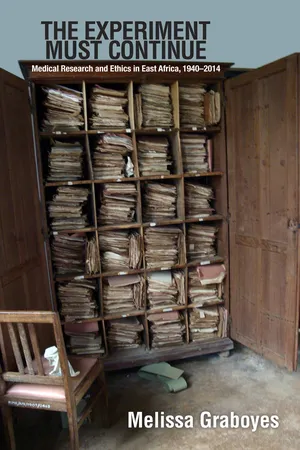
The Experiment Must Continue
Medical Research and Ethics in East Africa, 1940–2014
- 336 pages
- English
- ePUB (mobile friendly)
- Available on iOS & Android
eBook - ePub
About this book
Information
NOTES
Preface
1. East African Medical Survey Annual Report, 1952, 1.
2. Stanley George Browne, “The Indigenous Medical Evangelist in Congo,” International Review of Mission 35, no. 1 (1946): 59–67.
3. In a survey of 650 people, 570 were anemic, 425 were malnourished, over 300 had malaria, and 159 had tuberculosis. Parliamentary Debates, H.C. (5th ser.) (1937), vol. 324, col. 1115, quoted in Robert Pearce, The Turning Point in Africa: British Colonial Policy, 1938–1948 (London: Frank Cass, 1982), 15.
4. R. M. Murray-Lyon, “Important Diseases Affecting West African Native Troops,” Transactions of the Royal Society of Tropical Medicine and Hygiene 37, no. 5 (1944): 287–96.
5. Adriana Petryna, When Experiments Travel: Clinical Trials and the Global Search for Human Subjects (Princeton: Princeton University Press, 2009), 18.
6. Christopher Pinney and Nicolas Peterson, eds., Photography’s Other Histories (Durham: Duke University Press, 2003), 10.
7. Margaret Liu and Kate Davis, A Clinical Trials Manual from the Duke Clinical Research Institute: Lessons from a Horse Named Jim, 2nd ed. (Durham: Duke Clinical Research Institute, 2010), 17–20.
8. It’s likely that Amani is the longest-used research station in the East Africa region. Andrew Zimmerman, “‘What Do You Really Want in German East Africa, Herr Professor?’: Counterinsurgency and the Science Effect in Colonial Tanzania,” Society for Comparative Study of Society and History 48, no. 2 (April 2006): 437; Christopher Conte, “Imperial Science, Tropical Ecology and Indigenous History: Tropical Research Stations in Northwestern German East Africa, 1896 to the Present,” in Colonialism and the Modern World, ed. Gregory Blue, Martin Bunton, and Ralph Crozier (Armonk, NY: ME Sharpe, 2002), 246–61.
9. A rough catalog of the materials in Amani is available for download on my website, http://pages.uoregon.edu/graboyes.
Acknowledgments
1. Melissa Graboyes, “Introduction to the Special Issue: Incorporating Medical Research into the History of Medicine in East Africa,” International Journal of African Historical Studies 47, no. 3 (2014): 379–98. Melissa Graboyes, “‘The Malaria Imbroglio’: Ethics, Eradication, and Endings in Pare Taveta, East Africa, 1959–1960,” International Journal of African Historical Studies 47, no. 3 (2014): 445–72. Melissa Graboyes, “Fines, Orders, Fear . . . and Consent? Medical Research in East Africa, c. 1950s,” Developing World Bioethics 10, no. 1 (2010): 34–41.
THE EXPERIMENT BEGINS
Chapter 1: Medical Research Past and Present
1. East African Medical Survey, Monograph No. 1, 1954.
2. Donald Low and John Lonsdale, “Introduction: Towards the New Order, 1945–1963,” in History of East Africa, Volume III, ed. Donald Low and Alison Smith (Oxford: Clarendon Press, 1976), 13.
3. Clarke reports that the EAMS was originally conceived as a project to study African workers involved with the ill-fated Groundnut Scheme. This idea was abandoned. Sabine Clarke, “The Research Council System and the Politics of Medical and Agricultural Research for the British Colonial Empire, 1940–52,” Medical History 57, no. 3 (May 30, 2013): 350. The EAMS was originally based in Malya, Tanganyika, but moved to Mwanza in 1954. From the start, the Filariasis Research Unit (FRU) was intimately linked with the EAMS. It, too, was founded in 1949 as a project sponsored by the Medical Research Council and the Secretary of State, shared facilities with the EAMS in Mwanza, and was also directed by Colonel Laurie. With these separate projects sharing facilities and a director, staff also ended up being shared. In addition, there was sharing of research sites such as Ukara Island, where the EAMS did a health survey and the FRU was attempting to eradicate lymphatic filariasis and test a new set of drugs to treat filariasis. Between 1949 and May 1954, large amounts of research were conducted: in Msambweni alone, 150 villages were visited and 50,000 night blood samples were collected. The EAMS combined with the FRU in 1954 and was renamed the East African Institute for Medical Research.
4. Director Colonial Medical Research to Dr. Lewthwaite, cc Col. Davidson, “Integration of Laboratories of Medical Survey and Filariasis Unit,” September 14, 1949. East African Medical Survey, NIMR, Mwanza.
5. Trant to EAMS Director, April 12, 1950, Dr. Trant Files, NIMR, Mwanza.
6. Trant to Laurie, December 4, 1953, Dr. Trant Files, NIMR, Mwanza.
7. Laurie, “Field Medical Staff East African Medical Survey, Work 1952,” n.d. [July–August 1952, Dr. Trant Files, NIMR, Mwanza.
8. Vaughan to Anderson, April 16, 1952, MOH/22/15, KNA.
9. East African Medical Survey Annual Report, 1953.
10. Unknown author and recipient, “Personal and Confidential,” August 25, 1955, NIMR, Mwanza, Emphasis added.
11. Helen Tilley, Africa as a Living Laboratory: Empire, Development, and the Problem of Scientific Knowledge, 1870–1950 (Chicago: University of Chicago Press, 2011).
12. John Iliffe, East African Doctors: A History of the Modern Profession (Cambridge: Cambridge University Press, 1988); Johanna Crane, Scrambling for Africa: AIDS, Expertise, and the Rise of American Global Health Science (Ithaca: Cornell University Press, 2013).
13. During the project’s final years, it was discovered in experiments outside of Africa that low, continuous doses of chloroquine could lead to blindness; it does not appear this information was ever shared with Mto wa Mbu community members. Tanganyika Medical Department Annual Reports, 1961, 1962; East African Institute of Malaria and Vector-Borne Diseases Annual Reports 1968, 1969, 1971, 1972–73.
14. W. S. Haynes, “The Treatment of Pulmonary Tuberculosis in Kenya Africans with Thiacetazone,” East African Medical Journal 29, no. 9 (September 1952): 339–55.
15. Mwangi to Director of Medical Services, Kenya, “King George VI Hospital,” August 14, 1961, BY/22/49, KNA.
16. Udo Schuklenk, “Protecting the Vulnerable: Testing Times for Clinical Research Ethics,” Social Science & Medicine 51, no. 6 (2000): 969.
17. N. A. Christakis, “Ethics Are Local: Engaging Cross-Cultural Variation in the Ethics for Clinical Research,” Social Science & Medicine 35, no. 9 (1982): 1080.
18. Maryinez Lyons, The Colonial Disease: A Social History of Sleeping Sickness in Northern Zaire, 1900–1940 (Cambridge: Cambridge University Press, 1992): 110. Emphasis in original.
19. Itesio Leprosarium Patients [about six, signatures unreadable] to Director of Medical Services, Kenya, “Petition for the Better Treatment are Required by the Sick-Patients of Leprosy,” November 13, 1957, BY/42/8, KNA.
20. This definition of medical research is in accord with that given by groups such as the National Institute of Health (US), the General Medical Council (UK), and the Medical Research Council (UK). One of the weaknesses of this definition is that it does not acknowledge the vast middle space between curative medicine (proven therapies given by doctors to patients with the goal of improving individual health) and medical research on humans (experiments run by researchers on subjects with the goal of collecting data and generating generalizable knowledge). In between treating patients and experimenting on human subjects are activities that can be harder to define, which some scholars refer to as “experimental treatment,” “innovative therapy,” “non-validated innovative treatment,” or “therapeutic research.” These terms emphasize the fact that research does sometimes benefit an individual participant. But, on the whole, I believe these terms—and this general category—obscure more than they reveal, since the goals of doctoring and researching are in tension.
21. This is a low estimate based only on the references to trials I’ve personally seen. I have only counted trials that were clear about the number of subjects they included, and have used the researchers’ own numbers. An Excel file with the quantitative data is available online at: http://pages.uoregon.edu/graboyes.
22. East African Medical Survey and Research Institute Annual Report, 1954–55; Tanganyika Medical Department Annual Report, 1950.
23. These consisted of 5,900 blood samples in 1951 and 14,000 samples from the general population and 5,000 from hospital patients in 1952. East African Medical Survey Annual Reports 1951, 1952.
24. Colonial Medical Research Committee Tenth Annual Report, 1954–55. The Filariasis Research Unit was subsequently absorbed into the East African Medical Survey.
25. Tanganyika Medical Department Annual Reports, 1941, 1944, 1949, 1950.
26. Trant is quoting Dr. Donald Bagster Wilson. Trant to Bozman and Holmes, May 22, 1955, Dr. Hope Trant Files, NIMR Mwanza.
27. “Sleeping Sickness and Reclamation Kigoma and Kasulu Districts,” 523A/M.11/2, TNA. Thanks to Julie Weiskopf for sharing this citation.
28. Tanganyika Medical Department, Western Region Annual Report, 1950, 450/1501/4, TNA. Thanks to Julie Weiskopf for sharing this citation.
29. Vicki Marsh et al., “Working with Concepts: The Role of Community in International Collaborative Biomedical Research,” Public Health Ethics 4, no. 1 (2011): 37.
30. Ibid., 36.
31. Ibid., 31.
32. Melissa Grab...
Table of contents
- Cover
- Series Page
- Title Page
- Copyright
- Dedication
- Contents
- List of Illustrations
- Preface
- Acknowledgments
- Abbreviations
- The Experiment Begins
- Perceptions
- Researchers Arrive
- Consent or Coercion?
- Balancing Risks and Benefits
- Exits and Longer-Term Obligations
- The Experiment Ends?
- Appendix A. Swahili Glossary
- Appendix B. Further Reading on Global Medical Research
- Notes
- Bibliography
- Index
Trusted by 375,005 students
Access to over 1.5 million titles for a fair monthly price.
Study more efficiently using our study tools.
Frequently asked questions
Yes, you can cancel anytime from the Subscription tab in your account settings on the Perlego website. Your subscription will stay active until the end of your current billing period. Learn how to cancel your subscription
No, books cannot be downloaded as external files, such as PDFs, for use outside of Perlego. However, you can download books within the Perlego app for offline reading on mobile or tablet. Learn how to download books offline
Perlego offers two plans: Essential and Complete
- Essential is ideal for learners and professionals who enjoy exploring a wide range of subjects. Access the Essential Library with 800,000+ trusted titles and best-sellers across business, personal growth, and the humanities. Includes unlimited reading time and Standard Read Aloud voice.
- Complete: Perfect for advanced learners and researchers needing full, unrestricted access. Unlock 1.5M+ books across hundreds of subjects, including academic and specialized titles. The Complete Plan also includes advanced features like Premium Read Aloud and Research Assistant.
We are an online textbook subscription service, where you can get access to an entire online library for less than the price of a single book per month. With over 1.5 million books across 990+ topics, we’ve got you covered! Learn about our mission
Look out for the read-aloud symbol on your next book to see if you can listen to it. The read-aloud tool reads text aloud for you, highlighting the text as it is being read. You can pause it, speed it up and slow it down. Learn more about Read Aloud
Yes! You can use the Perlego app on both iOS and Android devices to read anytime, anywhere — even offline. Perfect for commutes or when you’re on the go.
Please note we cannot support devices running on iOS 13 and Android 7 or earlier. Learn more about using the app
Please note we cannot support devices running on iOS 13 and Android 7 or earlier. Learn more about using the app
Yes, you can access The Experiment Must Continue by Melissa Graboyes in PDF and/or ePUB format, as well as other popular books in History & Public Health, Administration & Care. We have over 1.5 million books available in our catalogue for you to explore.