Black rebellion has returned, with dramatic protests in scores of cities and campuses, bringing with it a renewed engagement with the history of Black radical movements and thought. Here, key scholarly voices from a wide array of disciplines recalls the powerful tradition of Black radicalism as it developed in the nineteenth and twentieth centuries while defining new directions for Black radical thought.
In a time when activists in Ferguson, Palestine, Baltimore, and Hong Kong immediately make connections between their movements, this book makes clear that new Black radical politics are thoroughly internationalist and redraws the links between Black resistance and anti-capitalism. Featuring the key voices in the new intellectual wave of Black radical thinking, this collection outlines one of the most vibrant areas of thought today.
With contributions from Cedric Robinson, Elizabeth Robinson, Steven Osuna, Nikhil Pal Singh, Damien Sojoyner, Fran?oise Verg?s, Fred Moten, Stefano Harney, Jordan T. Camp, Christina Heatherton, George Lipsitz, Greg Burris, Paul Ortiz, Darryl C. Thomas, Avery Gordon, Shana L. Redmond, Kwame M. Phillips, Ruth Wilson Gilmore, Angela Davis, and Robin D. G. Kelley.
eBook - ePub
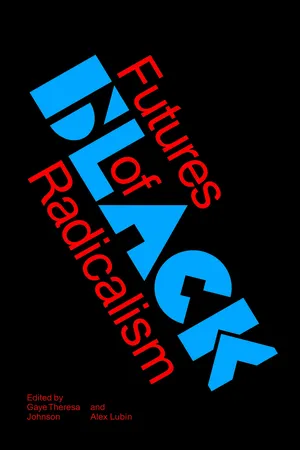
Futures of Black Radicalism
- 272 pages
- English
- ePUB (mobile friendly)
- Available on iOS & Android
eBook - ePub
Futures of Black Radicalism
About this book
Information
Part One
Racial Capitalism
Chapter 1
Class Suicide
The Black Radical Tradition, Radical Scholarship,
and the Neoliberal Turn
and the Neoliberal Turn
Steven Osuna
Each generation must discover its mission, fulfill it or betray it, in relative opacity.—Frantz Fanon, The Wretched of the Earth1The shared past is precious, not for itself, but because it is the basis of consciousness, of knowing, of being.—Cedric J. Robinson, Black Marxism 2
I write this in a state of urgency—one troubled by the decadence of a capitalist system that is undermining and exhausting the ability of many to live a dignified life. As you read this, Mexican and Central American women, including trans-women and youth are fleeing their countries due to the violence of economic restructuring, only to be detained at the US border and sent to private detention facilities. Drone strikes in the global “war on terror” in countries such as Pakistan have made children fear the beauty of clear, blue skies. Across the United States, state-sanctioned violence in the form of police terror is producing an unrelenting crisis in Black and brown communities, leaving many without their mothers, fathers, sisters, and brothers. All these atrocities emerge in the process of protecting and maintaining a social organism that accumulates wealth and privilege at one pole and misery, degradation, and the torment of labor (or the lack thereof) at the other. As this unfolds, aggrieved communities organize, fight back, and walk tall—a continuous dialectical struggle.
While the movements and voices of these communities are rarely heard or taken seriously, the capitalist state’s repressive response to them constantly legitimates itself through political, economic, and ideological apparatuses. As Stuart Hall reminds us, keeping hegemony in place is hard work, and those with an interest in maintaining order will go to great lengths to defend it. One apparatus that does this work is the academic institution. Schools, colleges, and universities reproduce the social relations of oppression and exploitation. The struggle in these terrains to shape interpretations, solutions, and responses to public concerns is, therefore, of the upmost importance. Interventions from radical scholarship that identify the root causes and structural conditions of exploitation and oppression and that prioritize the interests of aggrieved communities are vital, and will occur only if scholars and intellectuals are in conversation with these communities. This is easier said than done, however. Professionalization in academic institutions distances many scholars and intellectuals from people and communities in radical social movements who are struggling against oppression. Instead of engaging and building with social movements that are seeking solutions and strategies to combat the ravages of racial capitalism, scholars and intellectuals remain entangled in bourgeois academia. This has worked in concert with the “neoliberal turn” of the university and social life in general.3
At a 2013 academic conference in Chicago, Cedric J. Robinson shared his generation’s experience of entering the academy and producing radical scholarship. He argued that many who entered academic institutions in the late 1960s disrupted an academy that had been purged of social justice. They challenged the normalization of brutality that oppressed communities faced in the United States and around the globe. Newly emerging Black Studies, Chicana/o Studies, and Native American Studies functioned as spaces to unsettle the normativity of the white academy. “We came into the academy in the 1960s and we began for a moment, to redeem it,” Robinson argued, “but the period of redemption is now under enormous threat by … the further incorporation of the academy.”4 The intervention of radical scholarship was crucial for the advancement of social justice and liberatory struggles for aggrieved communities within bourgeois academic institutions. But attacks by reactionary forces from outside and within the academy and the neoliberal subjectivity of many scholars have thwarted their relationship to the public and social movements. Robinson argued that radical and critical scholarship was urgently needed, and that radical scholars and intellectuals needed to be rooted with the people struggling against oppression and exploitation. “We are not possible,” he argued, “without the encouragement, the urgency, and the requirement that we be here by those who are in fact being trampled on, being imprisoned.”5
In his intervention, Robinson provided a suggestion for how radical scholarship engaged with aggrieved communities might endure during the current neoliberal turn. Describing his work on radicalism from the vantage point of American slaves, Robinson reminded the audience of the slaves’ revolutionary visions—that they had never experienced or succumbed to what some have called “social death.” “That’s nonsense,” he argued, “because they were something more than what was expected of them—they could invent, manufacture, conspire, and organize way beyond the possibilities.”6 Robinson noted that the slaves’ visions of liberation are evident in spirituals, or what Frederick Douglass and W. E. B. Du Bois termed the “sorrow songs,”7 whose import was commonly overlooked by whites at the time.8 The spirituals were a cultural formation created by slaves to express their religious faith and provide guidance, instruction, and critiques on how to survive and make sense of their conditions. They were a framework for imagining possibilities beyond the brutality and barbarism of slavery. White supremacy viewed them simply as noise. Robinson concluded: “What is the noise of 2013? That’s what we have to ask today … Record the noise.”9
This mandate provides a radical framework for scholars and intellectuals in our current moment, urging us to listen to the sounds, visions, and cries of the aggrieved, oppressed, and exploited who struggle every day while maintaining their dignity. What are the noises emerging under racial capitalism during the neoliberal turn? How can academics and intellectuals drop the “megaphone,” put on the “hearing aid,” and join the collective struggle?10 This undertaking requires a commitment to ending racial capitalism and the numerous oppressive conditions it upholds and reproduces. A key site from which to develop this commitment, I argue, is the Black Radical Tradition. As Robinson notes, the Black Radical Tradition is an “accretion, over generations, of collective intelligence gathered from struggle,”11 which compels us to address the contradictions of racial capitalism and the neoliberal turn that has only exacerbated the brutality that so many face. The Black Radical Tradition reveals the shared history of struggle that is a basis not only of consciousness, but of knowledge and being. Awareness of this history is necessary for the future of radical scholarship and struggles for liberation.
In this essay I want to focus, for a moment, on the academic labor of scholars and intellectuals, not to privilege them but rather to suggest and heed a call to action. I ask what scholars and intellectuals—the petit bourgeois intellectual12, in other words—can learn from the Black Radical Tradition in order to challenge the neoliberal turn of social life, avoid acting as mandarins for white supremacy and the capitalist classes, and instead join the global struggle against racial capitalism. 13 To work through these questions, this chapter returns to the radical analysis and process described by many Black radicals, including Walter Rodney, Amilcar Cabral, and Frantz Fanon. For the petit bourgeois intellectuals and scholars to challenge the seductions of neoliberalism and transform their consciousness and being, they must commit “suicide as a class”14—a process that speaks to the urgent need to struggle with and for aggrieved, oppressed, and exploited communities. It challenges the petit bourgeois intellectual and scholar to disinvest from their social positions, produce radical scholarship whose research, arguments, and conclusions have a preferential option for the poor, and be informed by the sounds and visions emerging from the trenches of racial capitalism. Class suicide challenges the professionalization process that disconnects the intellectual and scholar from aggrieved communities, the neoliberalization of academic scholarship, and the brutality of racial capitalism. Revisiting the liberatory praxis of Rodney, Cabral, Fanon, and Robinson will be instructive in this endeavor.
THE NEOLIBERAL TURN AND INTELLECTUAL LABOR
The current era has seen rapid acceleration in the unequal distribution of global wealth and resources and in damage to the planet’s ability to replenish itself. An ecological, ideological, political, and economic crisis is unfolding, while demands from the global majority are met with repressive, and increasingly normalized, transnational social control. This crisis of global capitalism has unleashed rampant barbarism on the masses of the world even as they continue to fight back.15 Fueling an increasingly uneven distribution of wealth and resources, the system is, at its core, profoundly unstable. As of October 2015, the wealthiest 1 percent of the global population owned half of all household wealth.16 Roughly sixty-two individuals around the world have the same wealth as 3.6 billion people. Income for the poorest 10 percent of the world has increased only $3 a year for almost a quarter of a century.17 This unequal distribution of wealth is endemic throughout the United States and has increased racial oppression and exploitation, particularly since the financial crisis of 2008. The Institute for Policy Studies has calculated that the twenty richest Americans own more wealth than the bottom half of the US population combined, a total of 152 million people in 57 million households. The richest tenth of the richest 1 percent in the United States, in the second decade of the twenty-first century, has seen even greater income and wealth gains. For example, the billionaires on the Forbes 400 list now have as much wealth as all Black households and more than one-third of the US Latina/o population combined. Blacks make up 13.2 percent of the US population yet control only 2.5 percent of the nation’s wealth, while Latina/os make up 17 percent of the population and control 2.9 percent of the wealth.18
In Los Angeles County, where I live, 28 percent of working Angelenos earn poverty pay, while 40 percent live “in what only can be called misery.”19 There is a 10 percent unemployment rate and jobs have been declining since 1990. In 2007 the poverty rate was 13.3 percent; by 2012 it was 17 percent. If Los Angeles County were a country, it would be the nineteenth largest economic power in the world. The Los Angeles region is the trade leader in the United States, with 44 percent of the nation’s cargo passing through its ports. Despite these numbers, the poverty rate in Los Angeles County is higher than that of the nation as a whole. Over 1.47 million, or 15 percent, of Angelenos are living in poverty. Nearly 30 percent of full-time workers earn less than $25,000 a year. Four in ten people live in extreme poverty, defined as living on less than $5,400 a year for a single person, or about $11,000 for a family of four. One in five children live in poverty. It is estimated that 11 percent of Asians, 19 percent of Blacks, and 20 percent of Latina/os—and only 8 percent of whites—live in poverty. The percentage of working poor in the county is higher than in the United States as a whole. Adjusted for inflation, in the past twenty years, the average worker actually saw income fall nearly $2 an hour, while the top 1 percent of salaried workers saw significant income growth. In the early 2000s, 14,000 new housing units were built in the city of Los Angeles, but 90 percent of them were affordable only to those earning $135,000 a year or more.20 The right to housing in Los Angeles is nonexistent, leaving many on the streets to fend for themselves and face the criminalization and surveillance of poverty.
The unequal distribution of the world’s wealth produces the misery, starvation, and degradation that we see on our television and computer screens and every day on the streets. These are the savage results of what Robinson called the historical development of a racialized social structure emerging from capitalism. 21 Racism and capitalism must be analyzed as intimately linked concepts. As sociologist Kyra R. Greene argues, scholars and activists must study and highlight how the material realities of the political economy exacerbate racialized inequality, thus demonstrating the continued significance of race under capitalism as racism produces a “consistent disadvantage” for racially oppressed communities. The exploitation wrought by capitalism is racialized.22 “Like the impact of Hurricane Katrina,” Greene contends, “it may be raining on all Americans, but people of color are drowning.”23
Racial capitalism has assumed a distinct shape under the neoliberal turn.24 The term “neoliberalism” has been used to describe the social formation that emerged once capital broke free from the nation-state in the 1970s. This term, Hall argues, does not satisfactorily describe the complexity and specificities that have materialized in the last four decades. He notes, however, that neoliberalism provides a useful, provisional “conceptual identity” for consistent underlying features of the global political economy.25 Primarily, neoliberalism signifies an ensemble of economic policies that promote structural adjustment, austerity, free markets, private property, and free trade through deregulation of industry and capital flows and the privatization of public goods—effecting a restoration of class power for global economic elites.26 Yet, beyond economic policy, neoliberalism is also a culture, philosophy, and worldview that expands neoclassical economics beyond the economic realm. According to Wendy Brown, neoliberalism is also “an order of normative reason” that has taken shape as “a governing rationality extending a specific formulation of economic values, practices, and metrics to every dimension of human life.”27 This strategy has gone global, starting with its implementation in Chile following the 1973 coup d’etat and subsequent execution in the United States and Britain in the 1980s while the International Monetary Fund (IMF) and World Bank (WB) promoted and enforced it throughout the Global South.
The neoliberal turn has exacerbated the inequalities produced by racial capitalism. Instead of providing public housing, unemployment insurance, living wages, and public infrastructure through a social wage, public policy under the neoliberal turn has enforced and encouraged government dismantling of these resources and opened them to market and entrepreneurial forces. As Lester K. Spence highlights, “Under the neoliberal turn progressive policies like welfare, public housing, and unemployment insurance are either slashed or attacked, as these policies are viewed to make people less entrepreneurial and less responsible for their own choices.”28 In this context race and racism have worked in tandem with class exploitation. United for a Fair Economy argues, for example, that the US subprime mortgage crisis that led to the global financial collapse in 2008 caused the “greatest loss of wealth to people of color in modern US history.”29
The neoliberal turn has created a precarious condition for working-class communities, and should be attacked and critiqued by the intellectual labor of scholars, academics, activists, and organizers. But it is also a “governing rationality” that spreads market values to every sphere of social life, and the academy and activist spaces are no exception. As Brown notes, “Knowledge, thought, and training are valued and desired almost exclusively for the contribution to capital enhancement.”30 Academic scholarship, for one, has become a form of human capital that offers rewards and status—including foundation grants, money, and prestige—that isolate the intellectual from those struggling to remain alive. As Marx notes in the Communist Manifesto, the petit bourgeois intellectual belongs to a conservative middle class that acts as a buffer between capitalists and the working classes and endeavors to keep from extinction. “If by chance they are revolutionary,” Marx notes, “they are so only in view of their impending transfer into the proletariat, they thus defend not their present, but their future interests.”31
With other middle classes, the intellectual often acts as a reactionary in contrast to those striving for liberation from racial capitalism. Ideologically, intellectuals are more inclined to maintain their position in the class-stratified society than destroy it. An agent who emerged from liberal bourgeois academic institutions, the petit bourgeois intellectual’s role has been to legitimate the social order. As the Gulbenkian Commission on the Restructuring of the Social Sciences notes, “The intellectual history of the nineteenth century is marked above all by disciplinarization and professionalization of knowledge, that is to say, by the creation of permanent institutional structures designed both to produce new knowledge and to reproduce the producers of knowledge.”32 Through a raciali...
Table of contents
- Cover Page
- Halftitle Page
- Title Page
- Copyright Page
- Contents
- Preface
- Introduction
- Part One: Racial Capitalism
- Part Two: The Black Radical Tradition
- Part Three: Imagining the Future
- Part Four: Afterwords
- Notes
- Acknowledgements
- Contributor Bios
Trusted by 375,005 students
Access to over 1.5 million titles for a fair monthly price.
Study more efficiently using our study tools.
Frequently asked questions
Yes, you can cancel anytime from the Subscription tab in your account settings on the Perlego website. Your subscription will stay active until the end of your current billing period. Learn how to cancel your subscription
No, books cannot be downloaded as external files, such as PDFs, for use outside of Perlego. However, you can download books within the Perlego app for offline reading on mobile or tablet. Learn how to download books offline
Perlego offers two plans: Essential and Complete
- Essential is ideal for learners and professionals who enjoy exploring a wide range of subjects. Access the Essential Library with 800,000+ trusted titles and best-sellers across business, personal growth, and the humanities. Includes unlimited reading time and Standard Read Aloud voice.
- Complete: Perfect for advanced learners and researchers needing full, unrestricted access. Unlock 1.5M+ books across hundreds of subjects, including academic and specialized titles. The Complete Plan also includes advanced features like Premium Read Aloud and Research Assistant.
We are an online textbook subscription service, where you can get access to an entire online library for less than the price of a single book per month. With over 1.5 million books across 990+ topics, we’ve got you covered! Learn about our mission
Look out for the read-aloud symbol on your next book to see if you can listen to it. The read-aloud tool reads text aloud for you, highlighting the text as it is being read. You can pause it, speed it up and slow it down. Learn more about Read Aloud
Yes! You can use the Perlego app on both iOS and Android devices to read anytime, anywhere — even offline. Perfect for commutes or when you’re on the go.
Please note we cannot support devices running on iOS 13 and Android 7 or earlier. Learn more about using the app
Please note we cannot support devices running on iOS 13 and Android 7 or earlier. Learn more about using the app
Yes, you can access Futures of Black Radicalism by Gaye Theresa Johnson, Alex Lubin, Gaye Theresa Johnson,Alex Lubin in PDF and/or ePUB format, as well as other popular books in Social Sciences & Political History & Theory. We have over 1.5 million books available in our catalogue for you to explore.