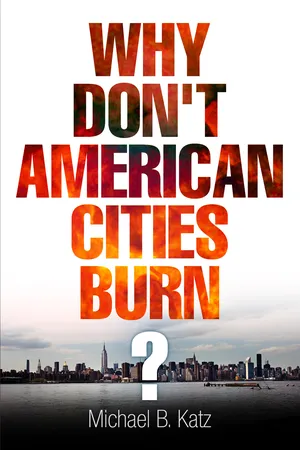
At 1:27 on the morning of August 4, 2005, Herbert Manes fatally stabbed Robert Monroe, known as Shorty, in a dispute over five dollars. It was a horrific yet mundane incident for the poor, heavily African American neighborhood of North Philadelphia—one of seven homicides to occur in the city that day and yet not make the major newspapers. For Michael B. Katz, an urban historian and a juror on the murder trial, the story of Manes and Shorty exemplified the marginalization, social isolation, and indifference that plague American cities.
Introduced by the gripping narrative of this murder and its circumstances, Why Don't American Cities Burn? charts the emergence of the urban forms that underlie such events. Katz traces the collision of urban transformation with the rightward-moving social politics of late twentieth- and early twenty-first-century America. He shows how the bifurcation of black social structures produced a new African American inequality and traces the shift from images of a pathological black "underclass" to praise of the entrepreneurial poor who take advantage of new technologies of poverty work to find the beginning of the path to the middle class. He explores the reasons American cities since the early 1970s have remained relatively free of collective violence while black men in bleak inner-city neighborhoods have turned their rage inward on one another rather than on the agents and symbols of a culture and political economy that exclude them.
The book ends with a meditation on how the political left and right have come to believe that urban transformation is inevitably one of failure and decline abetted by the response of government to deindustrialization, poverty, and race. How, Katz asks, can we construct a new narrative that acknowledges the dark side of urban history even as it demonstrates the capacity of government to address the problems of cities and their residents? How can we create a politics of modest hope?
- 224 pages
- English
- ePUB (mobile friendly)
- Available on iOS & Android
eBook - ePub
Why Don't American Cities Burn?
About this book
Information
Index
Note: Page numbers in italics represent figures.
Abu-Lughod, Janet L., 81, 83
ACORN (the Association of Community Organizations for Reform), 146–47
affirmative action: and educational attainment, 66, 174n.72; and employment, 59; and selective incorporation, 86–87, 96; and social citizenship, 48
African American economic inequality, 47–77, 134; and differentiation, 49, 51, 73–77, 159; and distribution, 50–51, 57–66; and educational attainment, 50, 63–66, 75; and gender, 49–50; and geography, 37–38, 51–52, 74,169n.18; the Hacker-Thernstrom debate over black progress, 48–49; history over twentieth century, 48–50; and homeownership, 72–73, 134; industrial and occupational history, 57–60, 74; and institutionalization/incarceration, 54–56, 55; and labor force participation, 50–51, 52–57, 54, 74, 81, 170nn.25–26; and mobility (individual and group), 49–50, 57, 87; and occupation, 53, 60–63, 74–75; poverty rates, 67–68, 81–82, 153; and racism, 48, 50; rewards (earnings and income), 60, 62–63, 66–73, 75, 134; structural durability of, 49
African American political power: city governments, 84–85, 87–88; police chiefs, 84–85
African Americans and the management of marginalization: the black consumer, 88–91; depoliticization, 93–97; indirect rule and black-run city governments, 87–88; repression and surveillance, 91–94; selective incorporation, 86–87, 96
agency, balancing structure and, 160–161
agricultural employment, decline of, 24, 50, 57–58, 60–61, 75, 76, 152
Aguiar, Gretchen, 59
Aid to Dependent Children (ADC), 106
Aid to Families with Dependent Children
(AFDC), 82, 106, 153 AIG (American International Group), 144
America in Black and White: One Nation, Indivisible (Thernstrom and Thernstrom), 48–49
American Apartheid (Massey and Denton), 82 American Dream Demonstration (ADA), 137
American Saving for Personal Investment, Retirement, and Education Act (the ASPIRE Act), 135–36
American Sociological Association, 110–11 anchor institutions, 28, 158
Anderson, Elijah, 112
Andhra Pradesh, microcredit crisis in, 129–30
Annie E. Casey Foundation, 144
anthropology: poverty research, 106–8; urban ethnographic work, 11, 112. See also social science research
antipoverty programs. See market-based technologies of poverty work
Aspen Institute, 126
asset-building movement, 131–38; “asset effects,” 132; the CFED, 136–37; community-based organiza...
Table of contents
- Cover
- Title
- Copyright
- Contents
- Chapter1
- Chapter 2
- Chapter3
- Chapter4
- Epilogue
- Note
- Index
- Acknowledgments
Trusted by 375,005 students
Access to over 1.5 million titles for a fair monthly price.
Study more efficiently using our study tools.
Frequently asked questions
Yes, you can cancel anytime from the Subscription tab in your account settings on the Perlego website. Your subscription will stay active until the end of your current billing period. Learn how to cancel your subscription
No, books cannot be downloaded as external files, such as PDFs, for use outside of Perlego. However, you can download books within the Perlego app for offline reading on mobile or tablet. Learn how to download books offline
Perlego offers two plans: Essential and Complete
- Essential is ideal for learners and professionals who enjoy exploring a wide range of subjects. Access the Essential Library with 800,000+ trusted titles and best-sellers across business, personal growth, and the humanities. Includes unlimited reading time and Standard Read Aloud voice.
- Complete: Perfect for advanced learners and researchers needing full, unrestricted access. Unlock 1.5M+ books across hundreds of subjects, including academic and specialized titles. The Complete Plan also includes advanced features like Premium Read Aloud and Research Assistant.
We are an online textbook subscription service, where you can get access to an entire online library for less than the price of a single book per month. With over 1.5 million books across 990+ topics, we’ve got you covered! Learn about our mission
Look out for the read-aloud symbol on your next book to see if you can listen to it. The read-aloud tool reads text aloud for you, highlighting the text as it is being read. You can pause it, speed it up and slow it down. Learn more about Read Aloud
Yes! You can use the Perlego app on both iOS and Android devices to read anytime, anywhere — even offline. Perfect for commutes or when you’re on the go.
Please note we cannot support devices running on iOS 13 and Android 7 or earlier. Learn more about using the app
Please note we cannot support devices running on iOS 13 and Android 7 or earlier. Learn more about using the app
Yes, you can access Why Don't American Cities Burn? by Michael B. Katz in PDF and/or ePUB format, as well as other popular books in Social Sciences & Political Economy. We have over 1.5 million books available in our catalogue for you to explore.