New Times in Modern Japan concerns the transformation of time--the reckoning of time--during Japan's Meiji period, specifically from around 1870 to 1900. Time literally changed as the archipelago synchronized with the Western imperialists' reckoning of time. The solar calendar and clock became standard timekeeping devices, and society adapted to the abstractions inherent in modern notions of time. This set off a cascade of changes that completely reconfigured how humans interacted with each other and with their environment--a process whose analysis carries implications for other non-Western societies as well.
By examining topics ranging from geology, ghosts, childhood, art history, and architecture to nature as a whole, Stefan Tanaka explores how changing conceptions of time destabilized inherited knowledge and practices and ultimately facilitated the reconfiguration of the archipelago's heterogeneous communities into the liberal-capitalist nation-state, Japan. However, this revolutionary transformation--where, in the words of Lewis Mumford, "the clock, not the steam engine," is the key mechanism of the industrial age--has received little more than a footnote in the history of Japan.
This book's innovative focus on time not only shifts attention away from debates about the failure (or success) of "modernization" toward how individuals interact with the overlay of abstract concepts upon their lives; it also illuminates the roles of history as discourse and as practice in this reconfiguration of society. In doing so, it will influence discussions about modernity well beyond the borders of Japan.
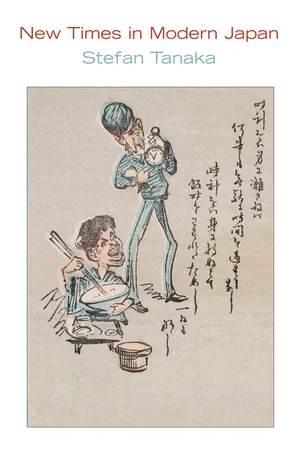
- 240 pages
- English
- ePUB (mobile friendly)
- Available on iOS & Android
eBook - ePub
New Times in Modern Japan
About this book
Information
Publisher
Princeton University PressYear
2009Print ISBN
9780691128016
9780691117744
eBook ISBN
9781400826247
Table of contents
- Table of Contents
- ACKNOWLEDGMENTS
- PRELUDGE: TIME, PASTS, HISTORY
- CHAPTER 1 DISCOVERY OF PASTS
- CHAPTER 2 “NOTHING IS THE WAY IT SHOULD BE”
- CHAPTER 3 NATURALIZATION OF NATION:
- CHAPTER 4 NATURALIZATION OF NATION:
- CHAPTER 5 SOCIALIZATION OF SOCIETY
- CHAPTER 6 SOCIALIZATION OF NATURE:MUSEUMIFICATION
- EPILOGUE
- WORKS CITED
Trusted by 375,005 students
Access to over 1.5 million titles for a fair monthly price.
Study more efficiently using our study tools.
Frequently asked questions
Yes, you can cancel anytime from the Subscription tab in your account settings on the Perlego website. Your subscription will stay active until the end of your current billing period. Learn how to cancel your subscription
No, books cannot be downloaded as external files, such as PDFs, for use outside of Perlego. However, you can download books within the Perlego app for offline reading on mobile or tablet. Learn how to download books offline
Perlego offers two plans: Essential and Complete
- Essential is ideal for learners and professionals who enjoy exploring a wide range of subjects. Access the Essential Library with 800,000+ trusted titles and best-sellers across business, personal growth, and the humanities. Includes unlimited reading time and Standard Read Aloud voice.
- Complete: Perfect for advanced learners and researchers needing full, unrestricted access. Unlock 1.5M+ books across hundreds of subjects, including academic and specialized titles. The Complete Plan also includes advanced features like Premium Read Aloud and Research Assistant.
We are an online textbook subscription service, where you can get access to an entire online library for less than the price of a single book per month. With over 1.5 million books across 990+ topics, we’ve got you covered! Learn about our mission
Look out for the read-aloud symbol on your next book to see if you can listen to it. The read-aloud tool reads text aloud for you, highlighting the text as it is being read. You can pause it, speed it up and slow it down. Learn more about Read Aloud
Yes! You can use the Perlego app on both iOS and Android devices to read anytime, anywhere — even offline. Perfect for commutes or when you’re on the go.
Please note we cannot support devices running on iOS 13 and Android 7 or earlier. Learn more about using the app
Please note we cannot support devices running on iOS 13 and Android 7 or earlier. Learn more about using the app
Yes, you can access New Times in Modern Japan by Stefan Tanaka in PDF and/or ePUB format, as well as other popular books in History & Japanese History. We have over 1.5 million books available in our catalogue for you to explore.