In recent years, scholarship on translation has moved well beyond the technicalities of converting one language into another and beyond conventional translation theory. With new technologies blurring distinctions between "the original" and its reproductions, and with globalization redefining national and cultural boundaries, "translation" is now emerging as a reformulated subject of lively, interdisciplinary debate. Nation, Language, and the Ethics of Translation enters the heart of this debate. It covers an exceptional range of topics, from simultaneous translation to legal theory, from the language of exile to the language of new nations, from the press to the cinema; and cultures and languages from contemporary Bengal to ancient Japan, from translations of Homer to the work of Don DeLillo.
All twenty-two essays, by leading voices including Gayatri Spivak and the late Edward Said, are provocative and persuasive. The book's four sections--"Translation as Medium and across Media," "The Ethics of Translation," "Translation and Difference," and "Beyond the Nation"--together provide a comprehensive view of current thinking on nationality and translation, one that will be widely consulted for years to come.
The contributors are Jonathan E. Abel, Emily Apter, Sandra Bermann, Vilashini Cooppan, Stanley Corngold, David Damrosch, Robert Eaglestone, Stathis Gourgouris, Pierre Legrand, Jacques Lezra, Françoise Lionnet, Sylvia Molloy, Yopie Prins, Edward Said, Azade Seyhan, Gayatri Chakravorty Spivak, Henry Staten, Lawrence Venuti, Lynn Visson, Gauri Viswanathan, Samuel Weber, and Michael Wood.
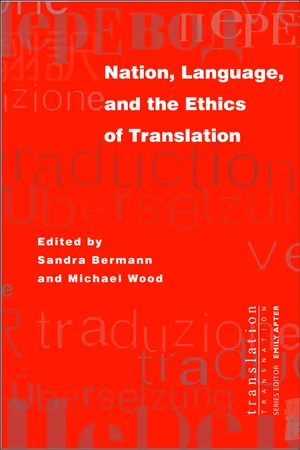
eBook - ePub
Nation, Language, and the Ethics of Translation
- 424 pages
- English
- ePUB (mobile friendly)
- Available on iOS & Android
eBook - ePub
Nation, Language, and the Ethics of Translation
About this book
Information
Publisher
Princeton University PressYear
2005Print ISBN
9780691116099
9780691116082
eBook ISBN
9781400826681
PART ONE
Translation as Medium and Across Media
In the very last note of Minima Moralia, Adorno suggests that the only responsible philosophical answer to despair is “to contemplate all things as they would present themselves from the standpoint of redemption.”1 The essays in the first section of this book all situate themselves at some distance from despair, but they do consistently register difficulty, and they do have redemption firmly in mind. The essays concern the role of the intellectual as translator of what gets forgotten in the contemporary world, the possibility of translating law from culture to culture, the actual practice of simultaneous translation, the translatability and untranslatability of film as a medium, and the problematic but indispensable notion of “origin” in the theory of translation.
“For whom then does one write,” Edward Said asks, “if it is difficult to specify the audience with any sort of precision?” The answer is that one writes for the audience one needs, the audience who must be there if we are not to despair. “The idea of an imagined community,” Said continues, “has suddenly acquired a very literal, if virtual, dimension,” and it is through our participation in this community, our willingness to imagine it into reality, that we can best serve those “less powerful interests threatened with frustration, silence, incorporation, or extinction by the powerful.” If music for Adorno is a “silent witness to the inhumanity all around,” then for Said the intellectual is the unsilenced translator, the person who lends voice to the unvoiced and half-voiced needs of the oppressed. He points out too that “film and photography, along with all the arts of writing, can be aspects of this activity.”
Pierre Legrand argues eloquently against the “strategies of simplification” at work in the integrationist view of European law, which rests on the blunt or naive claim that “there is very little difference between European laws,” that is, very little difference from culture to culture and nation to nation. This view is “irredeemably suburban,” Legrand says, a violent refusal of “contextual knowledge,” but all is not lost, and he himself shows us how to “redeem local knowledge,” which is best described, he says, “in terms of its plasticity, pliability, diversity, and adaptability.” Indeed, he suggests that justice itself can be redeemed if we respect the gaps between laws, just as literary translation respects the gaps between languages, a process that “inscribes alterity at the heart of identity through the new forms it creates,” and reveals thereby, as Legrand subtly says, “the genuine nature of hospitality,” which cannot exist without risks. We are close again to the imagined community of intellectuals.
Continuing this line of thought, but in an intensely practical context, Lynn Visson reminds us that “words which characterize the life, culture and historical development of any given country often have no precise equivalents in other languages.” She offers a detailed list (often amusing) of elusive words and phrases in Russian, and describes in lucid detail the preferred rhetorical instruments of the simultaneous interpreter: “condensation, deliberate omission and addition, synecdoche and metonymy, antonymic constructions, grammatical inversion and the use of semantic equivalents,” and other devices. Her crucial point, though, is that the interpreter is just that: a translator not only of language but of context, a person who, if she cannot redeem local knowledge, can give it all the depth that time allows. Visson too writes of difficulty and its overcoming. “Hardest of all is the search for cultural rather than for purely linguistic or semantic equivalents, for though these are often vastly different in the two languages, the role of an interpreter of culture is the interpreter’s most important and most difficult function.”
Samuel Weber makes an important distinction between “language” and “instance”: “translation always involves not merely the movement from one language to another, but from one instance—a text already existing in one language—to another instance, that does not previously exist, but that is brought into being in the other language.” This phrasing allows for translation of instances both within a single language and between different ones, and Weber has some subtle thoughts on these topics. His main project, however, is to display creation as it is described in Genesis as “almost a translation,” because on close reading it appears as neither “an absolute beginning nor a pure performance”—only “almost a translation” because there is as yet only one place and only one language. Translation becomes “inevitable but also impossible” with the building and ruin of the Tower of Babel, and Weber now brilliantly glosses Walter Benjamin’s conception of an origin as “the insistent but unachievable attempt to restore an anterior state.” From the standpoint of redemption the attempt would still perhaps be unachievable but it would look toward the future rather than the past, toward the world it remains for us to imagine.
Michael Wood’s essay seeks to understand, through a study of sound and silence in films from very different cultures, something of what translation can mean in the cinema: which images seem to travel without need of translation and which images do not, what visual translation looks like when it happens, how national film cultures separate and intersect, and what is the role of music in the language of film. We get a clear sense of the importance of translation in this medium when, prompted by Sergei Eisenstein,2 we remember that what in English is called a close-up is in other languages called a shot in large scale. In both cases a visual perception is translated into words, but the implied story is very different. English-speaking cultures emphasize the mimetic effect of the technique, the apparent shortening of a distance. Other cultures stress the technical fact, the actual alteration in the size of the figures or objects in the frame. Many implications lurk in such a difference.
NOTES
1. Theodor W. Adorno, Minima Moralia (Frankfurt: Suhrhamp, 1951, 1993), p. 333; trans. E.F.N Jephcott (London: Verso, 1974, 1996), p. 247.
2. Sergei Eisenstein, Film Form: Essays in Film Theory, ed. and trans. Jan Leyda (New York: Harcourt Brace, 1949, 1977), pp. 237–38.
The Public Role of Writers and Intellectuals
EDWARD SAID
Twenty-one years ago, The Nation magazine convened a congress of writers in New York by putting out notices for the event and, as I understood the tactic, leaving open the question of who was a writer and why he or she qualified to attend. The result was that literally hundreds of people showed up, crowding the main ballroom of a midtown Manhattan hotel almost to the ceiling. The occasion itself was intended as a response by the intellectual and artistic communities to the immediate onset of the Reagan era. As I recall the proceedings, a debate raged for a long period of time over the definition of a writer in the hope that some of the people there would be selected out or, in plain English, forced to leave. The reason for that was twofold: first of all, to decide who had a vote and who did not, and second, to form a writer’s union. Not much occurred in the way of reduced and manageable numbers; the hearteningly large mass of people simply remained immense and unwieldy, since it was quite clear that everyone who came as a writer who opposed Reaganism stayed on as a writer who opposed Reaganism.
I remember clearly that at one point someone sensibly suggested that we should adopt what was said to be the Soviet position on defining a writer, that is, a writer is someone who says that he or she is a writer. And, I think that is where matters seem to have rested, even though a National Writer’s Union was formed but restricted its functions to technical professional matters like fairer standardized contracts between publishers and writers. An American Writer’s Congress to deal with expressly political issues was also formed, but was derailed by people who in effect wanted it for one or another specific political agenda that could not get a consensus.
Since that time, an immense amount of change has taken place in the world of writers and intellectuals and, if anything, the definition of who or what a writer and intellectual is has become more confusing and difficult to pin down. I tried my hand at it in my 1993 Reith Lectures, but there have been major political and economic transformations since that time, and in writing this essay I have found myself revising a great deal and adding to some of my earlier views. Central to the changes has been the deepening of an unresolved tension as to whether writers and intellectuals can ever be what is called nonpolitical or not, and if so, how and in what measure. The difficulty of the tension for the individual writer and intellectual has been paradoxically that the realm of the political and public has expanded so much as to be virtually without borders. Consider that the bipolar world of the Cold War has been reconfigured and dissolved in several different ways, all of them first of all providing what seems to be an infinite number of variations on the location or position, physical and metaphorical, of the writer and, second of all, opening up the possibility of divergent roles for him or her to play if, that is, the notion of writer or intellectual itself can be said to have any coherent and definably separate meaning or existence at all. The role of the American writer in the post–9/11 period has certainly amplified the pertinence of what is written about “us” to an enormous degree.
A version of this essay appeared in The Nation in 2001; another in Edward Said, Humanism and Democratic Criticism (Columbia University Press), 2004.
Yet, despite the spate of books and articles saying that intellectuals no longer exist and that the end of the Cold War, the opening up of the mainly American university to legions of writers and intellectuals, the age of specialization, and the commercialization and commodification of everything in the newly globalized economy have simply done away with the old somewhat romantic-heroic notion of the solitary writer-intellectual (I shall provisionally connect the two terms for purposes of convenience here, then go on to explain my reasons for doing so in a moment), there still seems to be a great deal of life in the ideas and the practices of writer-intellectuals that touch on, and are very much a part of, the public realm. Their role most recently in opposing (as well, alas, as supporting the Anglo-American war in Iraq) is very much a case in point.
In the three or four quite distinct contemporary language cultures that I know something about, the importance of writers and intellectuals is eminently, indeed overwhelmingly, true in part because many people still feel the need to look at the writer-intellectual as someone who ought to be listened to as a guide to the confusing present, and also as a leader of a faction, tendency, or group vying for more power and influence. The Gramscian provenance of both these ideas about the role of an intellectual is evident.
Now in the Arab-Islamic world, the two words used for intellectual are muthaqqaf, or mufakir, the first derived from thaqafa or culture (hence, a man of culture), the second from fikr or thought (hence, a man of thought). In both instances the prestige of those meanings is enhanced and amplified by implied comparison with government, which is now widely regarded as without credibility and popularity, or culture and thought. So in the moral vacancy created, for example, by dynastic republican governments like those of Egypt, Iraq, Libya, or Syria, many people turn either to religious or secular intellectuals for the leadership no longer provided by political authority, even though governments have been adept at co-opting intellectuals as mouthpieces for them. But the search for authentic intellectuals goes on, as does the struggle.
In the French-speaking domains the word intellectuel unfailingly carries with it some residue of the public realm in which recently deceased figures like Sartre, Foucault, Bourdieu, and Aron debated and put forward their views for very large audiences indeed. By the early 1980s when most of the maîtres penseurs had disappeared, a certain gloating and relief accompanied their absence, as if the new redundancy gave a lot of little people a chance to have their say for the first time since Zola. Today, with what seems like a Sartre revival in evidence and with Pierre Bourdieu or his ideas appearing almost to the day of his death in every other issue of Le Monde and Libération, a considerably aroused taste for public intellectuals has gripped many people, I think. From a distance, debate about social and economic policy seems pretty lively, and is not quite as one-sided as it is in the United States.
Raymond Williams’s succinct presentation in Keywords of the force field of mostly negative connotations for the word “intellectual” is about as good a starting point for understanding the historical semantics of the word as we have for England.1 Excellent subsequent work by Stefan Collini, John Carey, and others has considerably deepened and refined the field of practice where intellectuals and writers have been located. Williams himself has gone on to indicate that, after the mid-twentieth century, the word takes on a new somewhat wider set of associations, many of them having to do with ideology, cultural production, and the capacity for organized thought and learning. This suggests that English usage has expanded to take in some of the meanings and uses that have been quite common in the F...
Table of contents
- Cover Page
- Title Page
- Copyright Page
- Contents
- Acknowledgments
- Introduction
- Part I: Translation as Medium and Across Media
- Part II: The Ethics of Translation
- Part III: Translation and Difference
- Part IV: Beyond the Nation
- List of Contributors
- Index
Trusted by 375,005 students
Access to over 1.5 million titles for a fair monthly price.
Study more efficiently using our study tools.
Frequently asked questions
Yes, you can cancel anytime from the Subscription tab in your account settings on the Perlego website. Your subscription will stay active until the end of your current billing period. Learn how to cancel your subscription
No, books cannot be downloaded as external files, such as PDFs, for use outside of Perlego. However, you can download books within the Perlego app for offline reading on mobile or tablet. Learn how to download books offline
Perlego offers two plans: Essential and Complete
- Essential is ideal for learners and professionals who enjoy exploring a wide range of subjects. Access the Essential Library with 800,000+ trusted titles and best-sellers across business, personal growth, and the humanities. Includes unlimited reading time and Standard Read Aloud voice.
- Complete: Perfect for advanced learners and researchers needing full, unrestricted access. Unlock 1.5M+ books across hundreds of subjects, including academic and specialized titles. The Complete Plan also includes advanced features like Premium Read Aloud and Research Assistant.
We are an online textbook subscription service, where you can get access to an entire online library for less than the price of a single book per month. With over 1.5 million books across 990+ topics, we’ve got you covered! Learn about our mission
Look out for the read-aloud symbol on your next book to see if you can listen to it. The read-aloud tool reads text aloud for you, highlighting the text as it is being read. You can pause it, speed it up and slow it down. Learn more about Read Aloud
Yes! You can use the Perlego app on both iOS and Android devices to read anytime, anywhere — even offline. Perfect for commutes or when you’re on the go.
Please note we cannot support devices running on iOS 13 and Android 7 or earlier. Learn more about using the app
Please note we cannot support devices running on iOS 13 and Android 7 or earlier. Learn more about using the app
Yes, you can access Nation, Language, and the Ethics of Translation by Sandra Bermann, Michael Wood, Sandra Bermann,Michael Wood in PDF and/or ePUB format, as well as other popular books in Literature & Translating & Interpreting. We have over 1.5 million books available in our catalogue for you to explore.