Biological Sciences

Bacteriophage
Bacteriophages are viruses that specifically infect and replicate within bacteria. They consist of a protein coat surrounding genetic material, and they use their tail fibers to attach to and inject their DNA into bacterial cells. This process ultimately leads to the destruction of the host bacterium as new phages are produced.
Written by Perlego with AI-assistance
Related key terms
1 of 5
11 Key excerpts on "Bacteriophage"
 eBook - ePub
Foodomics
Omic Strategies and Applications in Food Science
- Jorge Barros-Velázquez(Author)
- 2021(Publication Date)
- Royal Society of Chemistry(Publisher)
Chapter 6 Omics for the Investigation of Bacteriophages in Foodborne BacteriaP. Calo-Mataa , Ana G. Abril,b , J. Barros Velázqueza and T. G. Villa,ba Department of Food Science and Technology, University of Santiago de CompostelaLugoSpain[email protected]b Department of Microbiology, Faculty of Pharmacy, University of Santiago de CompostelaSantiago de CompostelaSpainBacteriophages are viruses that infect bacteria that can be found in foods, food preparation surfaces and the environment as virus particles or virions. Once they infect the specifically targeted bacterial cell, they can enter the lysogenic state, integrating into the genome of the host, or produce new phages that cause the lysis of the cell, releasing the new phages. Lytic or lysogenic phages can be detected in different manners. Lytic phages can be isolated and amplified in the specific host and analyzed by different techniques, such as electron microscopy, genomic or proteomic methodologies. Lysogenic phages are usually identified by analyzing the bacterial genome by means of genomic or proteomic methodologies. The use of omic methodologies, bioinformatic tools and specialized platforms will keep continuously transforming knowledge of the plasticity of foodborne pathogenic bacteria and their lytic and lysogenic phages, their inter-relationships and intra-relationships and the interactions with the surrounding environment, conferring the ability to create new tools for fast and accurate detection and typing and subtyping of problematic spoilage and pathogenic foodborne strains.6.1 Bacteriophages: Definition, Structure and Classification
Bacterial viruses, Bacteriophages, phages or bacterioviruses are viruses that infect bacteria. Bacteriophages can stay viable outside the bacterial cells as virus particles called virions.1 ,2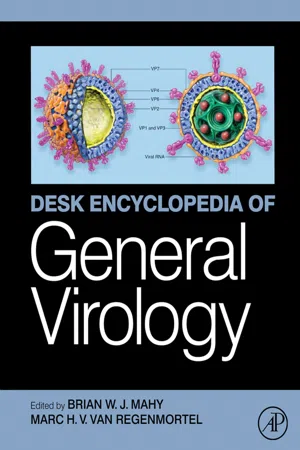 eBook - PDF
- Marc H.V. van Regenmortel, Brian W.J. Mahy(Authors)
- 2010(Publication Date)
- Academic Press(Publisher)
GENERAL TOPICS This page intentionally left blank History of Virology: Bacteriophages H-W Ackermann, Laval University, Quebec, QC, Canada ã 2008 Elsevier Ltd. All rights reserved. Glossary Bacteriophage ‘Eater of bacteria’ (Greek, phagein). Eclipse Invisible phase during phage replication. Lysogenic (1) Bacterium harboring a prophage. (2) Bacteriophage produced by such a bacterium. Lysogeny Carriage of a prophage. Metagenomics Sequencing of total genomic material from an environmental sample. One-step growth Single cycle of phage multiplication. Phage typing Testing bacteria with a set of phages of different host ranges. Prophage Latent Bacteriophage genome in a lysogenic bacterium. T-even Phage of the T-series with an even number (T2, T4, T6). Introduction Phages or Bacteriophages, also referred to as bacterial viruses, include eubacterial and archaeal viruses and are now more appropriately called ‘viruses of prokaryotes’. Phages are ubiquitous in nature and may be the most numerous viruses on this planet. They have a long evolu-tionary history, are considerably diverse, and include some highly evolved and complex viruses. Approximately 5500 phages have been examined in the electron microscope and they constitute the largest of all virus groups. The present system of phage taxonomy comprises 13 officially recognized families. Following the discovery of phages, their study entered a symbiosis with the nascent science of molecular biology and then expanded to cover a multitude of subjects. The knowledge on phages grew by accretion and represents the efforts of thousands of scientists. For example, it took over 50 years and hundreds of publications to establish the genome map and sequence of coliphage T4. Phage literature is voluminous and comprises over 11 400 pub-lications for the years 1915–65 and, to the author’s reckoning, about 45 000 for 1965 to today. eBook - ePub
- Christon J. Hurst(Author)
- 2000(Publication Date)
- Academic Press(Publisher)
Section II Viruses of Other Microorganisms Passage contains an image
5
Passage contains an image
5
Ecology of Bacteriophages in Nature
JOHN H. PAUL and CHRISTINA A. KELLOGG, Department of Marine Science, University of South Florida, St. Petersburg, Florida 33701I. Introduction II. Distribution III. Ecosystem DynamicsA. Phage Production and Decay B. Reactivation of Phages Damaged by UV Radiation C. Contribution of Viruses to Food WebsIV. Molecular EcologyA. Genetic Diversity B. Lysogeny C. Pseudolysogeny D. Gene TransferV. Non-Indigenous PhageA. Coliphages as Fecal Indicators B. Viral TracersVI. Summary ReferencesI. INTRODUCTION
The role of Bacteriophages (viruses that infect bacteria) in the environment has been the subject of intense investigation over the past several years. The development of techniques to study natural viral populations in situ has progressed tremendously. Various aspects of Bacteriophage ecology in nature — including abundance, role in microbial mortality and water column trophodynamics, viral decay rates, repair mechanisms, and lysogeny — are now becoming or are nearly understood. However, most of these studies have been performed in aquatic environments. Thus, this review will mainly be limited to a discussion of aquatic environments. For reviews of the earlier literature, the reader is referred to Moebus (1987) ,Goyal et al. (1987), Fuhrman and Suttle (1993) , Ackermann and DuBow (1987) , and Proctor (1997) .II. DISTRIBUTION
Not long after the discovery of phages by d’Herelle in 1917, viruses from aquatic environments were isolated, but usually on enteric bacterial hosts (Zobell, 1946 ). For the first 50 years, the study of Bacteriophages in nature was sporadic. Studies could be divided into those just describing the presence of one or several phage isolates from the environment (Spencer, 1955 ; Wiebe and Liston, 1968 ;Sklarow et al. , 1973) and exhaustive surveys where large numbers of bacteria were screened for phage susceptibility (Hidaka, 1977 ;Baross et al. , 1978). In all of these studies, phages were seldom isolated from unenriched seawater, but required enrichment by nutrient stimulation of the endogenous hosts (Moebus, 1980 , 1992 ; Ackermann and Nguyen, 1983 ) or addition of mixtures of host cultures (Spencer, 1955 ). In fact, filter-feeding invertebrates (mollusks and shellfish) were observed to concentrate vibriophages and provide an environment for their replication (Baross et al. eBook - PDF
Bacteriophages
Perspectives and Future
- Renos Savva(Author)
- 2020(Publication Date)
- IntechOpen(Publisher)
The relationship between bacteria and Bacteriophages is similarly constrained. The emergence (or availability) of bacterial cells capable of establishing a rich internal environment (compared to the outside of the cell) creates the possibility for other organisms to evolve predatory or parasitic survival strategies, including Bacteriophages. Once phages emerge, they alter the dynamics of the ecological niche and create an advantage to bacterial hosts that can reduce the success of phage infection—whether by hindering phage access to the cell cytoplasm, by interfering with phage survival or replication in the cell or by interfering with phage matura-tion and release [3]. Bacterial defences arise from any function already available in the host (e.g. uracil-DNA glycosylase involved in DNA repair) or that can be co-opted from available genetic resources in the cell or in the environment Bacteriophages - Perspectives and Future 40 (e.g. restriction-modification systems). Defences can also emerge from loss of function (e.g. mutations to the maltose porin LamB in E. coli , which make it resistant to Bacteriophage λ infections [4]). Given the prevalence of bacteria and phages in the environment, and given the evolutionary scale time of their arms race, the variety, complexity and efficiency of these attack and defence strategies are huge and can range from silent integration into the host genome (i.e. lysogeny) to enacting a hostile molecular takeover of the bacte-rial host cell. Despite our current efforts to map the genetic diversity available on Earth, it remains likely that new strategies are still to be identified and characterised. Nonetheless, many of these defence and attack strategies have also been harnessed for biotechnology applications, significantly beyond the simple use of Bacteriophages (or Bacteriophage proteins) as bacterial control agents [5–7]. eBook - PDF
- Carlos Tello Lacal(Author)
- 2019(Publication Date)
- Delve Publishing(Publisher)
Bacterial genome sequencing has revealed that the genome elements of Bacteriophages are important sources of the diversity of sequences and has the ability to evolution of bacteria as well as pathogenicity. The quantity of Bacteriophages that have been isolated and characterized to date is equal to only a small fraction of the total number of Bacteriophages that are available on earth. Since animal cell viruses and Bacteriophages have many similarities, the Bacteriophages are used instead of animal cell viruses when studies are conducted on the life cycle of viruses and to understand the manner in which the genes of a bacterium can be transferred from one bacterium to another. 4.2.2 The Discovery of Bacteriophages It is more than a century since Bacteriophages were discovered. Ernest Hanbury Hankin (1865–1939) who was a British bacteriologist in 1896 gave a report that there was something in the Indian rivers that had antibacterial properties that were not expected. According to his report, the properties had the ability to fight cholera and that the water could go through a fine filter of porcelain without losing this distinctive characteristic. Nevertheless, even after giving the report, Hankin did not pursue his findings. Therefore, Frederick Twort, a British bacteriologist, in 1915, discovered that there was a small agent that could kill colonies of bacteria that was grown in culture. Replication 91 Twort published his findings but lack of funding and the first World War interrupted his work. In 1917, Felix d’Herelle independently discovered the agent that was able to kill bacteria at the Pasteur Institute in France. Felix d’Herelle observed that when a bacteria-free filtrate which had been obtained from sewage was added to cultures of bacteria, the bacteria would disappear. He then published his discovery. In Tbilisi Georgia, the Eliava Institute was opened in 1923. The main objective of its opening was to study Bacteriophages and to come up with their therapy. eBook - ePub
Bone and Joint Infections
From Microbiology to Diagnostics and Treatment
- Werner Zimmerli(Author)
- 2021(Publication Date)
- Wiley-Blackwell(Publisher)
7 ].The emergence of multidrug‐resistant bacterial infections has led to recent efforts investigating and promoting phage therapy to treat a multitude of infections. Despite the costly and time‐consuming requirements for the production of Bacteriophages under current guidelines in the United States and the European Union, some countries are trying to accelerate the implementation of phage therapy through the so‐called “Magistral Approach.” Belgium, for instance, is currently implementing a pragmatic framework on phage therapy that centers on magistral preparation of individual therapeutic Bacteriophages by pharmacies, and although the final products will not fully comply with the European requirements for medicinal products for human use (Directive 2001/83/EC), such magistral phage preparations can be used to treat patients in Belgium [8 ].Principles of Bacteriophage Therapy
Molecular Background
Bacteriophages (also referred as phages) are viruses that specifically infect bacteria. Phages are the most abundant organisms on Earth, with an estimation of about 1031 particles distributed over all ecosystems on our planet. A phage is usually conformed by its genome (single or double‐stranded DNA or RNA) encapsulated in a protein capsid, which is sometimes completed with a tail and more or less complex appendages (e.g. spikes, tail fibers, etc.) (Figure 5.1 ) [9 , 10 ]. As nonliving microorganisms, they rely on the bacterial cellular machinery to reproduce. The viral infection begins by attachment of the phage to its bacterial host through specific recognition of one or more receptors on the bacterial cell. These receptors can be found in the cell wall, bacterial capsules, slime layers, pili, or flagella, often consisting of proteins, lipopolysaccharides, teichoic acids, and other cell surface structures serving as irreversible phage‐binding receptors [11 eBook - PDF
- J.R. Spkatch(Author)
- 2014(Publication Date)
- Academic Press(Publisher)
THE BACTERIA, VOL VII C HAPTER 8 Bacteriophage and Bacteria: Friend and Foe H ARRISON E CHOLS I. Introduction 487 II. Comments on the Existence of Phage 488 A. Why Are There Bacterial Viruses? 488 B. Predator-Prey 488 C. Phage as a Friend 489 D. Where Do Bacterial Viruses Come from? 490 III. Some General Characteristics of Bacteriophage Growth 491 A. Classification by Nucleic Acid Structure and Growth Pattern 491 B. Features of Productive Growth 492 C. Features of Lysogenic Development 496 D. Transduction and Lysogenic Conversion 499 IV. Specific Examples of Bacteriophage Growth 501 A. Phage λ— Variety in Life Style 501 B. The Virulent Phage T4, T7, and Μ13 507 V. Conclusions 512 References 3 I. Introduction Every reader of this chapter is undoubtedl y aware of the centra l role of bacteriophag e in the recent rapid progres in molecular biology. The rela-tively small and easily isolated genome of the phage has made these crea-tures ideal for the combined genetic and biochemica l study that has been so successful in revealing mechanisms of gene expression , replication , and regulation utilized by the phage and their bacteria l hosts. One biological feature that has been critical for these endeavors is the remarkabl e diversity of the phage population . Thus, the small RNA viruses have provided a packaged messenger RNA for the analysis of protein synthesis, the small DNA viruses an ideal substrat e for the study of DNA replication , and the large DNA viruses a wealth of control systems optimal for the study of gene activation and repression . Despite the detailed analysis of the life cycle of a number of different phage, the broader biological questions remain: How has this diverse collection of phage species evolved? What evolutionary pressures retain them (out of the hands of the friendl y molecular biologist)? 1 will attempt 487 Copyright* 1979 by Academic Press. Inc. All rights of reproduction in any form reserved. ISBN 0-12-307207-7 eBook - PDF
- Valery Petrenko, George P Smith, Valery Petrenko, George P Smith, Harold Craighead, Harry Kroto(Authors)
- 2011(Publication Date)
- Royal Society of Chemistry(Publisher)
5–7 Exchanges involving these constant domains can replace the endogenous specificity determinants, thus mediating acquisition of determinants allowing a phage to cross species boundaries and infect taxonomically distant hosts. 8 Mutations affecting the host range of tailed -phage map to these regions and specific mutagenesis within the hypervariable domains has, in the past, been used on T4 phage active against Escherichia coli to generate host range mutants redirected towards Yersinia pseudotuberculosis . 9 Bacteriophage are probably the most abundant biological entities on the planet 10 with a global population estimated at 10 31 . It is simply not know when bacterial viruses evolved, that is, whether or not they pre-date modern bacteria and represent remnants of former cellular life-forms that lost the competition against the modern forms and persisted only as dependent parasites of modern bacterial life. However, there is ample evidence for continued exchange of genetic elements between phage, bacterial genomes and various other mobile genetic elements. This may explain the sometimes fuzzy distinction between phage, plasmids and pathogenicity islands and the chimeric nature of some phage. 11 Phage are known in over 140 bacterial genera. They occur in archaea and eubacteria, in cyanobacteria, in exospore and endospore formers, spirochetes, mycoplasmas and chlamydias, in aerobes, anaerobes, budding, gliding, rami-fied, sheathed and stalked bacteria. Podovirus particles have even been found within bacterial endosymbionts of paramecia. 12 Tailed phage appear to be monophyletic and constitute the oldest known virus group, representing at least 96% (4950 phage) of all known Bacteriophage. Of these phage, about 80% possess dsDNA genomes packaged within an icosahedral head connected to a long ( B 50–200 nm) tail.
- Kumar, Har Darshan(Authors)
- 2021(Publication Date)
- Daya Publishing House(Publisher)
For the large cytoplasmic DNA viruses, however, recognition by elements of the aggresome pathway may provide a site for replication (Wileman, 2006). At least some viruses replicate on (or within) structures used by cells to remove protein aggregates. This could be important for virus replication– virus yields fall if the structures are not made or if viruses are denied access to them. Genetic Exchange Among Terrestrial Bacteriophages According to Hendrix (2002), microbes are the most numerous entities in This ebook is exclusively for this university only. Cannot be resold/distributed. the biosphere, with Bacteriophages constituting the majority of these organisms. Although mechanisms of genetic exchange between individual microbes have been well-investigated, the importance of these processes in structuring virus populations is not clear. The rate of genetic exchange in virus populations has been estimated to be relatively low (see Lin et al ., 2004; Lindstrom et al ., 2004; McCullers et al ., 2004; Silander et al ., 2005), but only a few medically or agriculturally important viruses have been studied. Bacteriophages happen to be the most numerous entities in the biosphere and yet, not much is known about their genetic structure. Phages often control the population sizes of their hosts and hence influence large-scale ecological and biogeochemical processes attributed to bacteria (Fuhrman, 1999). Sex seems to be generally favoured as it promotes linkage equilibrium which, besides de novo mutations, provides the genetic variability so important for natural selection (Otto and Lenormand, 2002). This points to the importance of estimating the rate of genetic exchange in phages and to know whether sexual processes act to structure biological populations that comprise a major portion of our global ecosystem. eBook - ePub
Marine Microbiology
Ecology & Applications
- Colin Munn, Colin B. Munn(Authors)
- 2019(Publication Date)
- CRC Press(Publisher)
For example, some cyanophages have been shown to infect both Synechococcus and Prochlorococcus and some vibriophages infect several species of Vibrio. If correct, this has significant implications for the possibility of genetic exchange between different organisms and for the role of phages in determining bacterial community structure. Very little is known about the nature of the receptors for phage adsorption to marine bacteria. It is possible that broad host range phages target conserved amino acid sequences of proteins on the cell surface of different bacterial types and that the tail fibers can recognize more than one type of receptor. Recent work suggests that some phages exploit membrane proteins of host cells as a mechanism for entry (see p.237). In most cases, enzymes in the tail or capsid of the phage attack the bacterial cell wall, forming a small pore through which its nucleic acid enters. The phage genetic material then remains in the cytoplasm or is integrated into the host cell genome. In the lytic cycle (Figure 7.5a), this is followed by expression of phage proteins, phage genome replication, and formation of the capsids and other parts of the virion. When assembly is complete, most phages cause lysis of the host cell by producing enzymes that damage the cytoplasmic membrane and hydrolyze the peptidoglycan in the cell wall. Figure 7.5 Possible outcomes of infection of a bacterial cell by a DNA phage. a) In the lytic cycle, viral genes are expressed, DNA is replicated, and host machinery is used to make the components of the virus particles. These self-assemble into mature virions which are released. b) The DNA of temperate phages may be incorporated and replicated with the host genome as a prophage. The host cell is said to be lysogenic because it may be triggered to enter the lytic cycle under certain conditions. c) In pseudolysogeny, the phage genome remains unintegrated for an extended period, usually due to nutrient depletion eBook - PDF
Virus
An Illustrated Guide to 101 Incredible Microbes
- Marilyn J. Roossinck(Author)
- 2016(Publication Date)
- Princeton University Press(Publisher)
This is just one example of how viruses are responsible for many of the diseases caused by bacteria. This can happen because viruses move genes, encode for toxins, or activate genes in the bacteria that are responsible for disease. Enterobacteria phage H-19B is just one of several related bacterial viruses that can be involved in moving the toxin, known as shiga toxin, into E. coli . GROUP ORDER FAMILY GENUS GENOME GEOGRAPHY HOSTS HOST EFFECTS TRANSMISSION I Caudovirales Siphoviridae Lambdalikevirus Linear, single-component, double-stranded DNA of about 18,000 nucleotides, encoding about 17 proteins Worldwide Escherichia coli strain HO157 Can be lethal Diffusion and injection of DNA into cell ENTEROBACTERIA PHAGE H-19B A Cross-section B External view 1 Capsid decoration 2 Coat protein 3 Double-stranded genomic DNA 4 Head to tail attachment 5 Tail tube 6 Tail fibers 7 Tail tip 1 2 2 3 4 4 5 5 6 6 7 7 A B 240 Bacterial and archaeal viruses The virus that opened up the world to cloning A filamentous virus allows the addition of DNA Bacterial viruses, or phage, were critical in the development of tools for molecular biology, but perhaps none were more important than Enterobacteria phage M13. The structure of the virus, a long filament, made it possible to add DNA to the virus. Other viruses, such as Enterobacteria phage phiX174, were characterized earlier, but had the problem of an icosahedral virus particle. This highly structured shape could not really get any larger, so nothing could be added to the virus and still allow it to fit into its particle. M13, however, could just get longer, and many things were added sequentially to the M13 system to allow the addition of novel DNA. Another advantage was that M13 did not lyse the bacterial host but rather was released from the cells and could be collected from the liquid culture medium. This was the beginning of cloning, a process in which a piece of DNA of interest is inserted into something that can replicate in E.
Index pages curate the most relevant extracts from our library of academic textbooks. They’ve been created using an in-house natural language model (NLM), each adding context and meaning to key research topics.

