Biological Sciences

Root Knot Nematode
Root Knot Nematode is a parasitic roundworm that infects the roots of plants, causing the formation of characteristic swellings or galls. These nematodes can significantly reduce crop yields and are a major concern in agriculture. They are difficult to control and can persist in the soil for several years, making them a persistent threat to plant health.
Written by Perlego with AI-assistance
Related key terms
1 of 5
11 Key excerpts on "Root Knot Nematode"
 eBook - PDF
Sustainable Agriculture
Nanotechnology and Biotechnology for Crop Production and Protection
- Vishnu D. Rajput, Abhishek Singh, Karen Ghazaryan, Tatiana M. Minkina, Abdel Rahman M. Al-Tawaha(Authors)
- 2024(Publication Date)
- De Gruyter(Publisher)
The extensive wounds left by these nematodes act as entry points for secondary pathogens such as bacteria and fungi, further damaging the root system [32]. Exam- Chapter 24 Pathogenesis of soil-borne nematode: an overview 457 ples of migratory endoparasitic nematodes include Pratylenchus (lesion nematode), Radopholus (burrowing nematodes), and Hirschmanniella (rice root nematode). Sedentary endoparasitic nematodes, on the other hand, establish a permanent feed- ing site within the root tissue of the host plant and are considered the most damaging nematodes globally. The main groups in this category are the root-knot nematodes (Me- loiIdogyne spp.) and the cyst nematodes (Globodera spp. and Heterodera spp.). The in- fective-stage juveniles (J2s) of both types enter the roots and migrate towards the vascular tissue using different strategies. The J2s of root-knot nematodes move between plant cells (intercellularly) during invasion, while the J2s of cyst nematodes pierce and enter cells individually (intracellularly), causing more damage to the host tissue. Once they reach the vascular cylinder, the J2s of both nematode groups secrete substances to induce the formation of specialized feeding structures. Root-knot nematodes induce the development of multicellular coenocytic giant cells, while cyst nematodes induce the formation of a syncytium, which is created through the fusion of hundreds of root cells [33]. These specialized feeding structures enable the nematodes to obtain nutrients non- destructively throughout their life cycle. The juvenile nematodes become sedentary once the feeding structures are formed, as their somatic muscles atrophy, and they exclu- sively feed from these structures to ensure a continuous supply of nutrients throughout their life cycle. eBook - PDF
- Prasad, D(Authors)
- 2021(Publication Date)
- Daya Publishing House(Publisher)
Infection occurs, while the stem is still soft i.e. during the first six months, immediately below the surface crust. (Bordoloi and Baruah, 1970). Damage of Root Knot Nematode and fungal pathogens are more common in the early stage of growth particularly in nurseries where seedlings are grown in containers which are being used for planting and replanting This ebook is exclusively for this university only. Cannot be resold/distributed. programme. The reason for such as: 1.Availability of sufficient numbers of succulent roots which provides abundant food for nematodes. 2.Nursery soil often contains soil borne fungi which together with nematodes results in more severe damage than would be caused by other pathogens alone. 3.Irrigation, cultivation and fertility of soils may favour the nematode and fungal activity into several folds. Although, these two organisms occur independently producing distinct disease symptoms, but most vital and significant events take place when these two groups of pathogens interact together in the seedling rhizosphere and put forwarded a valid complex which have real economic consequences. Hence, several soil borne pathogens causing wilt, collar rot, and damping off on tea seedlings however, cannot be ascribed to the activities of a single pathogen and generally are attributed to the affects of disease complexes. There is an increasing amount of evidences that root-knot nematode facilitate entry and establishment of pathogenic fungi and bacteria (Pitcher, 1965; Powell, 1971). There are extensive amount of literatures available on interactions of root-knot nematode and plant pathogenic fungi and bacteria which have been reviewed by Powell (1963) and Pitcher (1963). The root-knot nematode feeds on tender roots and cause wounds. These wounded roots are predisposed to the infection of several soil borne fungi and thereby increasing the wilt and other disease incidence.
- Prasad, D(Authors)
- 2021(Publication Date)
- Biotech(Publisher)
An in-depth understanding is needed of the molecular basis of how and why plants are susceptible to nematodes. New progress is being made in studying changes in gene expression during the infection of plants in nematode -host interactions where feeding sites are formed. The research on identifying the promising biocontrol agents, their mass production, application techniques and their This ebook is exclusively for this university only. Cannot be resold/distributed. behavior in the soil under varying agro-climatic conditions need to be intensified. Also investigations on plant constituents, which may alter nematode behavior and development, serve as nematicides, or disrupt molting; hatching and other hormonally regulated process needs to be expanded. There is also a need to develop environmentally safe and economical nematicides which can not only be put to use by commercial farmers but also by poor or subsistence farmers of our country. The information on yield loss, which are greatly influenced due to the interaction of abiotic and biotic factors, need to be further augmented. Future, nematode management must employ sustainable agricultural practices that take into account beneficial, detrimental and other nematode species in the rhizosphere and in soil. More data need to be generated in identifying suitable cropping systems, which are realistic to the needs as well as acceptable to the farmers including cover crops, antagonistic crops, green manure crops etc. References Abdel-Momem, S. M. and Starr, J.L., 1998. Meloidogyne javanica – Rhizoctonia solani disease complex of peanut. Fund Appl. Nematol . 21: 611–616. Abrantes, I.M.O. and Volavas, I., 1988. A note on parasitism of phytonematodes, Meloidogyne spp. and Heterodera fici by Pasteuria penetrans. Canadian Journal of Zoology 66: 2852–2854. Akhtar, M., 1995. Biological control of root–knot nematode, Meloidogyne incognita in tomato by the predatory nematode Mononchus aquaticus. eBook - ePub
Biotic Stress Management in Rice
Molecular Approaches
- Md. Shamim, K.N. Singh, Md. Shamim, K.N. Singh(Authors)
- 2017(Publication Date)
- Apple Academic Press(Publisher)
In deepwater rice, root-knot nematode infected seedlings remain stunted; unable to grow above flood water and perish due to continuous submergence the juveniles cause disruption, hypertrophy, and hyperplasia of cortical cells by intracellular migration and releasing esophageal gland secretions. This chapter reviews research on root-knot disease of rice and its pathogen M. graminicola during the past years in relation to etiology, host range, host–pathogen relationship and management through cultural and biological and biotechnological approaches. 7.1 INTRODUCTION Rice (Oryza sativa L.) is one of the most widely consumed staple foods for a large part of the world’s human population, especially in Asia and African countries. In these countries, there is a very high consumption of rice that annually exceeds 100 kg/capita (Seck et al., 2012). Among the biotic stresses, plant–parasitic nematodes are one of the major constraints in the rice production (Soriano et al., 1999) causing 10–25% yield losses (Bridge et al., 2005). Among the different plant–parasitic nematodes, Meloidogyne spp., belongs to a group of root-knot nematodes (RKNs), is represented by over 90 species that have been described so far (Moens et al., 2009). M. graminicola is one of the most important species of RKN associated with root of rice crop (De Waele & Elsen, 2007). This nematode species is an obligate sedentary endoparasite that settles in roots and completes their life cycle taking nutrition by feeding on host cells (Williamson & Gleason, 2003) and causes extensive damage to plant growth and yield of rice. The RKN causes the formation of galls on the rice roots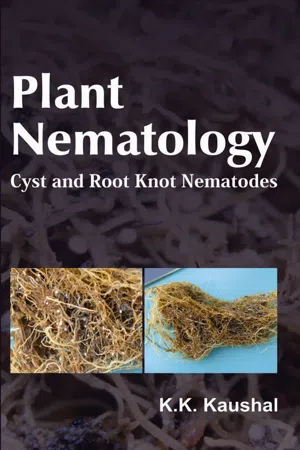
- Kaushal, K K(Authors)
- 2021(Publication Date)
- Biotech(Publisher)
Cannot be resold/distributed. recorded in local regions, depending on the genus, population level (Ornat and Sorribas, 2008). Sikora and Fernandez (2005) reported yield losses of over 30 per cent in three highly susceptible vegetable crops (egg-plant, tomato and melon). Plants affected by root-knot nematodes are characteristically stunted and yellow and appear in irregular patches within a field. Root knot is most easily identified by the knots or galls which develop on the roots of infected plants. These galls vary from pinhead size to many times thicker than the normal root. They are irregular in shape but are usually either spindle-shaped or spherical. Affected plants wilt rapidly during dry weather and may even wilt in the presence of adequate soil moisture. Plants infected with root knot often exhibit symptoms of drought or nutritional stress. Severely affected plants may die. Other soil-borne diseases such as fungal and bacterial diseases are often more severe when Root Knot Nematodes are present. 8.6 Species Distribution Most populations of root-knot nematodes consist of one or more of the species originally described by Chitwood (1949). These species are all highly polyphagous and have a wide geographical distribution with the exception of the type species, M. exigua, which apparently has a more restricted host range and distribution. This becomes obvious when the world literature on Meloidogyne is consulted. Nearly 90 per cent of the references dealing with Meloidogyne in literature between 1949 and 2010 refer to Chitwood’s species. Accepting the synonymization of M . incognita and M. incognita acrita proposed by Triantaphyllou and Sasser (1960) one concludes that at present the species most widely distributed, polyphagous and amenable to selection and adaptive variation are: M. incognita, M. javanica, M. arenaria and M. hapta. One clue for this wide adaptation may be in the variable chromosomal complement of isolates of agiven species. eBook - PDF
- Sarma, Brinchi Kuamr(Authors)
- 2018(Publication Date)
- Biotech(Publisher)
Plant-parasitic nematodes attack all type of plants- herbs, shrubs, trees, and wild and cultivated crop species. They are characterized by the possession of a needle-like stylet or spear at their anterior end which is used to puncture the plant cells and ingest the cell contents (Tunlid and Ahren, 2011, Gravato-Nobre and Hodgkin; 2011, Singh et al., 2012) . However, from an ecological perspective, this group of nematodes is simply one component in a vast array of organisms that live in soil. Generally roots are attacked, but some nematodes feed on stems, leaves and inflorescence. Plant-parasitic nematodes include several groups causing severe crop losses. The most common genera are Aphelenchoides (foliar nematodes), Ditylenchus, Globodera (potato cyst nematodes), Heterodera (soybean cyst nematodes), Longidorus, Meloidogyne (root-knot nematodes) Nacobbus, Pratylenchus (lesion nematodes), Trichodorus and Xiphinema (dagger nematodes) (Walia and Bajaj, 2003) (Table 8.1). Several phytoparasitic nematode species cause histological damages to roots, including the formation of visible galls (e.g. by root-knot nematodes) (Singh et al., 2012a, b, 2013 a), which are useful characters for their diagnostic in the field. Some nematode species transmit plant viruses through their feeding activity on roots (Agrios, 2005; Singh, 2009). One of them is Xiphinema index, vector of Grapevine fan leaf virus, an important disease of grapes, another one is Xiphinema diversicaudatum, vector of Arabis mosaic virus (Agrios, 2005). Other group of nematodes attack barks and forest trees. The most important representative of this group is Bursaphelenchus xylophilus , the pine wood nematode, present in Asia and America and recently discovered in Europe (Walia and Bajaj, 2003). This ebook is exclusively for this university only. Cannot be resold/distributed. 8.1: Biotic and Abiotic Factors Affecting Nematode Activities in the Soil Systems (Walia and Bajaj, 2003).
- Vaish, Shyam Saran(Authors)
- 2018(Publication Date)
- Biotech(Publisher)
Chapter 7: Prospects for the Biological Control of Plant Parasitic Nematodes V.K. Singh* 1 and R.K. Gupta 2 1 Division of Plant Pathology, S.K. University of Agricultural Sciences and Technology, Dhiansar – 181 133, Jammu, J&K 2 Faculty of Basic Sciences, S.K. University of Agricultural Sciences and Technology, Chatha – 180 009, Jammu, J&K Introduction Biological control is defined here as the management of plant diseases and pests with the aid of living organisms. This definition includes predators and parasites of organisms that kill or damage their hosts and also microbes that indirectly influence the establishment, function and survival of pathogens and pests. In plant disease control, (Garret,1970) defined biocontrol as “any condition under which or practice whereby survival or activity of a pathogen is reduced through the agency of any other living organism (except man himself) with the result that there is a reduction in the incidence of the disease caused by that pathogen”. This definition excluded the role of the host in reducing disease and also the role of man. Biological control is more inconsistent, less effective and slower acting than control normally achieved with chemicals. Although improvements in performance might be expected from more research on individual agents, it seems likely that these limitations are inherent in most biological control agents and that their successful application will depend on integration with other control measures. The studied on natural management of a plant-parasitic nematode concerns the decline of populations of the cereal-cyst nematode, Heterodera avenae, under monocultures of susceptible cereals in many soils throughout northern Europe (Kerry, 1982). This is an example of an induced suppression in which This ebook is exclusively for this university only. Cannot be resold/distributed. eBook - PDF
- Peter, K V(Authors)
- 2021(Publication Date)
- Daya Publishing House(Publisher)
The magnitude of the losses range from 28 to 48 per cent in tomato, 26 to 50 per cent in brinjal, 18- 33 per cent in chillies, 6 to 90 per cent in okra and 38 to 47 per cent in bittergourd (Reddy 1989). Some of the plant parasitic nematodes act as a vector for carrying the plant diseases. Only the species of Dorylaimoid genera, Xiphinema, Longidorus, Paralongidorus, Paratrichodorus and Trichodorus are implicated as vectors. Presence of galls on the root system of vegetables is seen in Root Knot Nematode. Potato cyst nematode ( Globodera pallida ) infects and damages tomato and egg plant. Stem nematode severely damages onion and garlic. Also, several species of stunt nematodes are often found This ebook is exclusively for this university only. Cannot be resold/distributed. associated with vegetables. Potato The most important nematode threat to potato production is potato cyst nematode, which causes severe damage to the crop. Two species of cyst nematodes infect potatoes - Globodera rostochiensis (the “golden” nematode) and G. pallida. The golden nematode is found in several countries. Yield loss up to 80 per cent is reported in some potato growing areas of the tropics where infestation levels due to golden nematode are high. Other major nematode parasites of potatoes are root-knot ( Meloidogyne ), false root-knot ( Nacobbus ), bulb and stem ( Ditylenchus dipsaci ), potato rot ( Ditylenchus destructor ) and lesion nematodes ( Pratylenchus ). The potato rot or tuber nematode and potato stem nematode are reported from temperate climates. Potato stem nematode is a parasite of foliage and attacks leaves, petioles and also injures tubers. The potato rot nematode mainly damages tubers and is a major pest of quarantine importance. The Columbia root-knot nematode ( M. chitwoodi ), decreases the quality of potato tubers by causing brown spots on the surface, rendering tubers unacceptable.
- Muthukumaran Gunasekaran, Darrell Jack Weber(Authors)
- 2020(Publication Date)
- CRC Press(Publisher)
5The Role of Molecular Biology in Developing Biological Controls for Plant Parasitic Nematodes
Graham R. Stirling, Lois Eden and Elizabeth AitkenTABLE OF CONTENTS
I. Introduction II. Resolution of Taxonomic Problems A. Improving Species Identification and Understanding Phylogeny B. Assessing Variability within Species III. Understanding Host Specificity IV. Monitoring Introduced Biological Control Agents A. Detection Using Reporter Genes B. Detection Using DNA Probes V. Determining Mechanisms of Action VI. Manipulation of Useful Genes VII. Concluding Remarks ReferencesI. Introduction
Plant parasitic nematodes are ubiquitous in their distribution but because of their small size and cryptic habitat, their economic importance is frequently underestimated. Nevertheless, nematode population densities reach damaging levels in manyagricultural cropping systems and the problems they initiate cause losses worth billions of dollars to the world’s food and fiber crops.1 Effective controls have not been developed for all crops, but losses from nematodes are sometimes reduced through strategies such as crop rotation and cultivar resistance. Chemical nematicides are also widely used, particularly in intensively managed horticultural and ornamental crops, but their future is uncertain because of health and environmental concerns2 and community demands for more environmentally friendly pest and disease control practices.Plant parasitic nematodes spend most, if not all, of their lives in soil, where they co-exist with a wide range of other soil organisms. Since some of these organisms parasitise or prey on nematodes, or have the capacity to influence nematode behaviour, they are therefore of interest to those involved in the development of biological control strategies for nematodes. A broad overview of the parasites and predators of nematodes is available in several texts,3 ,4 and5 but the most important antagonists are the nematophagous fungi, obligately parasitic bacteria in the genus Pasteuria , predatory mites, predacious nematodes, and a number of miscellaneous organisms (mainly bacteria) whose mechanisms of action are still to be determined. Many of these biological control agents, particularly the nematode-trapping and egg-parasitic fungi and the bacterium Pasteuria penetrans (Thorne) Sayre & Starr, have been tested for activity against nematodes in small-scale tests in the laboratory, glasshouse, and field,5
- Prasad, D(Authors)
- 2021(Publication Date)
- Biotech(Publisher)
Biology and Life-Cycle of Potato Root Nematode ( Ditylenchus destractor ) Thorne, 1945 This ebook is exclusively for this university only. Cannot be resold/distributed. The nematode can survive at temperature as low as -28°C. It can develop and multiply in 60-80 days at temperature varying between 5-34°C. It is not very tolerant to drought conditions. USSR conditions are suitable for its survival. The nematode multiplication is favoured by ammonium nitrate (NH 4 NO 3 ) fertilizer but amide form (-CO-NH 2 ) of fertilizers depresses reproduction. It can be cultured on fungi like Alternaria tenuis, A. solani, etc and in nature, it survives by feeding on the fungi, in absence of host plants. Biology and Life-Cycle of Burrowing Nematode ( Radopholus (Cobb, 1893) Thorne, 1949 The generic name Radopholus is derived form two Greek worlds: radix -= root, and phelien = loving; denoting the enodparasitic mode of life. The common name ‘burrowing nematode’ is coined because it causes extensive cavity formation in roots due to migratory behaviour. This nematode was first observed by Cobb I 1890-91 while investigating a banana disease in Fiji, but a complete description of the species was published by him in 1915 under the name Tylenchus similis. Thorne (1949) created the new genus Radopholus to include T. similis as well other species. It causes ‘spread decline’ of citrus and ‘pepper yellows’ in the black pepper. It is a migratory endoparasite and capable of spend the entire life in the roots. All larval stages and females infest healthy, succulent feeder root tips. Sexual dimorphism is apparent with degenerate, non-parasitic adult males. The second stage male and female juveniles are differentiated by the presence of four specialized ventral chord nuclei, opposite to the primordium. This is exhibited in the females not in the males. In the third stage juveniles, general increase in size and further differentiation of gonad cells occur. eBook - ePub
Diseases Of Nematodes
Volume II
- George O Poinar(Author)
- 2019(Publication Date)
- CRC Press(Publisher)
Although they can be weakly parasitic on nematodes, 49 they more commonly promote nematode tolerance in plants 161 and might be used to offset the damage caused by nematodes. In the past, little consideration has been given to the life cycle of particular groups of plant-parasitic nematodes and the types of antagonists most likely to succeed against them. Many of the early attempts to achieve biological control of root-knot and cyst nematodes were doomed to failure because they involved the use of antagonists which attacked free-living, second-stage juveniles in soil. This stage of the nematode is motile, dispersed, and transient, and probably is the most difficult stage in the life cycle for an antagonist to locate and kill in large numbers. In fact, on some Meloidogyne -susceptible host plants an organism preying on second-stage juveniles in soil may never make contact with its prey because succeeding generations of juveniles reinfect galled tissue without ever migrating through soil. Since Meloidogyne females are also relatively immune to parasitism and predation because they are protected by the root, the egg is obviously the stage in the life cycle most vulnerable to antagonism. Eggs are located on the root surface and even under ideal environmental conditions they take at least 10 days to develop and hatch. Because they are aggregated in an egg mass, an effective antagonist established in that vicinity could be expected to eliminate all the eggs produced by an individual nematode. This is an important consideration because Meloidogyne females produce as many as 2000 eggs, and populations can continue to increase even when juveniles or eggs suffer high mortality
Index pages curate the most relevant extracts from our library of academic textbooks. They’ve been created using an in-house natural language model (NLM), each adding context and meaning to key research topics.

