Biological Sciences

Translational Regulation
Translational regulation refers to the control of gene expression at the level of protein synthesis. It involves the modulation of the rate at which mRNA is translated into proteins, often through the action of regulatory proteins or non-coding RNAs. This process plays a crucial role in regulating cellular functions and responses to environmental changes.
Written by Perlego with AI-assistance
Related key terms
1 of 5
11 Key excerpts on "Translational Regulation"
 eBook - ePub
- S.C. Makrides(Author)
- 2003(Publication Date)
- Elsevier Science(Publisher)
Translational Regulation in mammalian cellsMarilyn KozakAbstract Publisher SummaryDepartment of Biochemistry, Robert Wood Johnson Medical School, University of Medicine and Dentistry of New Jersey, 675 Hoes Lane, Piscataway, NJ 08854, USA; Tel.: +1-732-235-5355; Fax: +1-732-235-5356E-mail address: [email protected]Translational Regulation is important in determining when and where a protein is produced, how much is made, and in some cases, the actual structure of the protein. Because most control mechanisms operate during the early steps wherein the ribosome/factor complex assembles on the mRNA and selects the AUG start codon, the chapter focuses on the initiation phase of translation. It describes some regulatory mechanisms that operate during the elongation and termination phases. The simplest indication that translation might be regulated, i.e. a discrepancy between mRNA and protein levels, turns out sometimes to result from post-translational control mechanisms. These and other complications are discussed in the chapter.Abbreviations• eIF eukaryotic initiation factor • ER endoplasmic reticulum • 4E-BP1 eIF4E-binding protein 1 • FMRP fragile X mental retardation protein • HRI heme-regulated inhibitor • IRE iron response element • IRES internal ribosome entry sequence • IRP iron regulatory protein • LOX 15-lipoxygenase • m7G 7-methylguanosine • mTOR mammalian target of rapamycin • OGP osteogenic growth peptide • ORF(s) open reading frame(s) • PABP poly(A) binding protein • PERK ER-resident protein kinase • PKR double-stranded RNA activated protein kinase • rpS6 ribosomal protein S6 • S6K1 kinase targeted to rpS6 • TPO thrombopoietin • upORF(s) upstream open reading frame(s) • UTR untranslated region1 Introduction
Translational Regulation is important in determining when and where a protein is produced, how much is made and, in some cases, the actual structure of the protein. Because most control mechanisms operate during the early steps wherein the ribosome/factor complex assembles on the mRNA and selects the AUG start codon, the bulk of this review focuses on the initiation phase of translation. Near the end (Section 6 ), I describe some regulatory mechanisms that operate during the elongation and termination phases. The simplest indication that translation might be regulated, namely a discrepancy between mRNA and protein levels, turns out sometimes to result from post-translational control mechanisms. These and other complications are discussed briefly in the closing section. Translational perturbations that underlie human diseases are the subject of another review [1 eBook - ePub
- David P. Clark(Author)
- 2009(Publication Date)
- Academic Cell(Publisher)
Regulation of gene expression at the level of transcription is most efficient in conserving materials and energy whereas regulation of enzyme activity provides the most rapid response. Since regulation at the level of translation is neither the most efficient nor the most rapid, it is consequently less frequent than these other forms of regulation. Generally, once mRNA has been made, it quickly moves to the ribosome where it is translated. This is especially true in prokaryotic organisms where there is no nuclear membrane restricting access between the transcription machinery and the ribosomes. It used to be thought that Translational Regulation was very rare. Partly this was due to the greater difficulty of measuring translation and associated phenomena such as mRNA stability rather than assaying transcription or protein levels. Consequently, more recent work has revealed a growing number of cases of regulation at the level of translation, especially in eukaryotes. In particular, plants seem to favor Translational Regulation via the use of small regulatory RNA molecules. Nonetheless, there are still significantly fewer known cases of translational than of transcriptional regulation.Regulation at the level of translation is rare in bacteria but more common in higher organisms.In addition to controlling the translation of mRNA after it has been made, there is also the possibility of aborting the synthesis of messenger RNA after transcription has been initiated and only a short stretch of RNA has been made. This somewhat ambiguous mechanism is referred to as transcriptional attenuation. It is sometimes classified as a form of transcriptional regulation. However, it has been included in this chapter as it is closely related to true Translational Regulation in the sense that alternative structures of messenger RNA are involved in both cases.Many of the known cases of Translational Regulation occur as extra steps in highly complex regulatory cascades that also include regulation at the level of transcription and of protein activity. Examples include the heat shock response in both bacteria and animals and the control of cell growth and differentiation in higher animals. In this chapter, we have attempted to illustrate regulation at the RNA level using examples where other regulatory mechanisms do not overly complicate the issue. eBook - PDF
- Justine Rudner(Author)
- 2013(Publication Date)
- IntechOpen(Publisher)
Chapter 3 © 2013 Arcari et al., licensee InTech. This is an open access chapter distributed under the terms of the Creative Commons Attribution License (http://creativecommons.org/licenses/by/3.0), which permits unrestricted use, distribution, and reproduction in any medium, provided the original work is properly cited. Translational Control in Tumour Progression and Drug Resistance Carmen Sanges, Nunzia Migliaccio, Paolo Arcari and Annalisa Lamberti Additional information is available at the end of the chapter http://dx.doi.org/10.5772/54625 1. Introduction Protein biosynthesis is a multi-step process that starts with the transcription of nuclear DNA, depository of genetic information, into messenger RNA (mRNA) that is used as template for the following polypeptide chain synthesis, also known as translation. Each step of this essential process is highly controlled in order to modulate any specific protein requirement of the cell in response to different stimuli and cellular events. This regulatory process is called translational control. Deregulation of the core signalling network in translational control, the phosphatidyl inositol trisphosphate kinase (PI3K), Protein Kinase B (PKB or Akt), mammalian target of rapamycin (mTOR) and RAS mitogen-activated protein kinase (MAPK)/MAPK-interacting Kinases (MNK) pathways, frequently occurs in human cancers and leads to aberrant modulation of mRNA translation. However, investigations on the contribution of these two pathways to Translational Regulation led to the interesting finding that translation factors are also substrate of signalling molecules. eBook - PDF
- Earl R. Stadtman, P. Boon Chock, Alexander Levitzki(Authors)
- 2014(Publication Date)
- Academic Press(Publisher)
CURRENT TOPICS IN CELLULAR REGULATION, VOLUME 32 Protein Phosphorylation ¡n Translational Control I CHRISTOPHER G. PROUD I Department of Biochemistry I School of Medical Sciences I University of Bristol I Bristol BS8 1TD, England I. Introduction Over the past two decades, it has become increasingly clear that mRNA translation represents an important control point in gene ex-pression. This realization has run in parallel with rapid advances in our understanding of the mechanism of translation in eukaryotic cells and of the complex mechanisms involved in regulating other cellular functions in these organisms. Foremost among these regulatory de-vices is protein phosphorylation, which is now known to control cellu-lar processes ranging from carbohydrate metabolism (in investigations of which its regulatory potential was first discovered) to cell division and differentiation (where a great deal of interest is now justifiably fo-cused). The purpose of this review is to address the role played by pro-tein phosphorylation in the control of translation. Since research has continued to center on its role in the regulation of translation in mam-malian cells there is an unavoidable bias toward that direction. Never-theless, it is very probable that similar, and no doubt additional, regu-latory mechanisms operate in most other eukaryotic species. The proteins whose phosphorylation we shall be discussing are in-cluded in the now considerable number of proteins which are compo-nents of the translational machinery in eukaryotes: they include the translational initiation and elongation factors, and protein compo-nents of the ribosome itself, as well as the aminoacyl-tRNA syn-thetases and proteins which interact with mRNA molecules. In this re-view the nomenclature used is in general that proposed by the Nomenclature Committee of the International Union of Biochemistry (see Safer, 1989).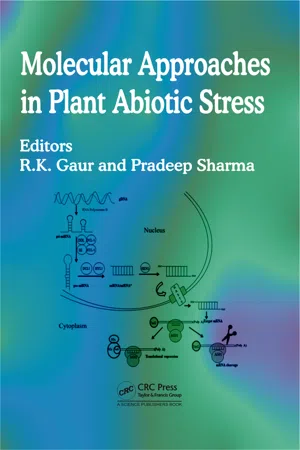 eBook - PDF
- Rajarshi Kumar Gaur, Pradeep Sharma(Authors)
- 2013(Publication Date)
- CRC Press(Publisher)
As a consequence, deep Regulation of Regulation of T T ranslation as ranslation as R R esponse to esponse to A A biotic biotic S S tress tress 111 understanding of the signal transduction and mechanisms of control for the different phases of the translational process seems essential, and in this regard many questions specific for plant biology remain to be solved. For instance, some regulatory events at the level of translation initiation present in animal cells have not been found so far in plant cells suggesting functional diversification of the translational machinery among eukaryotes (Hernández et al. 2012). In this chapter we summarize the current knowledge of the different phases of translation in plants and their roles under abiotic stress. The emerging studies underscoring the importance of mRNA sequestration in ribonucleoprotein complexes such as stress granules and processing bodies have been also summarized. Finally, the increasing importance of the translation in the chloroplast in response to environmental stimuli has also deserved consideration. Tight Control at the Initiation Phase of Translation Under Stress Conditions In eukaryotes, canonical cap-dependent translation begins with the eIF4E recognition of the cap structure (7-methyl guanosine) placed at the 5’-end of the mRNAs. The subsequent interaction of eIF4E with eIF4G and eIF4A allows the formation of the cap binding complex, called eIF4F. Once eIF4F is formed, eIF4B and the preinitiation complex 43S, which consists of the small ribosomal subunit 40S, the ternary complex eIF2/GTP/tRNA i met , and the factors eIF3, eIF1 and eIF1A, are recruited. Circularization of mRNA is afforded by interaction between the poly(A) binding proteins (PABPs) and eIF4G and eIF4B. Then, the 43S preinitiation complex scans the mRNAs in the 5’-3’ direction until an initiation codon is found. At that point, the ribosomal subunit 60S is loaded, and the elongation phase begins (Fig. 1) (Jakson et al. 2010). eBook - PDF
- Zdravko Lorkovic(Author)
- 2012(Publication Date)
- CRC Press(Publisher)
C hapter 4 Subcellular RNA Localization and Translational Control: Mechanisms and Biological Significance in the Vertebrate Nervous System Alessandro Quattrone ,1 Ralf Dahm 2 and Paolo Macchi **1 Abstract E ukaryotic cells adopt different mechanisms to control gene expression: Transcriptional regulation, post-transcriptional control o f m RNA translation and turnover, and post-Translational Regulation o f proteins. Another mechanism, the localization of RNAs, is emerging as an important process to restrict certain messages and proteins to specific subcellular domains and thus spatially control the expression o f genes within cells. Messenger RNA localization has been studied in many organisms and cell types and research over the last decade has shown that homologues of key components of the mRNA localization machinery are conserved from yeast to mammals. In mammalian neurons, local translation of mRNAs in dendrites as well as growth cones allows for de novo synapse formation, the morphological re-arrangement o f dendritic spines and for the regulation of the efficacy in the strength, e.g., electrical properties o f existing synapses. There are various mechanisms by which RNA translation may be regulated during transport. RNA stability control, translational repression, regulatory molecule recruitment and transport control have been implicated as molecular processes by which different RNA binding proteins exert their biological function in different species. In this chapter we will highlight the biological relevance o f mRNA transport and localized translation in the mammalian nervous system, the molecular players—RNAs and proteins— involved in this process and we will discuss the current state of knowledge concerning these mechanisms. Introduction Nothing is more revealing than movement. —Martha Graham Neurons are among the cell types with the most complex morphology. eBook - ePub
Molecular Endocrinology
Genetic Analysis of Hormones and their Receptors
- Gill Rumsby, Dr Sheelagh Farrow(Authors)
- 2020(Publication Date)
- Garland Science(Publisher)
Early studies in endocrinology were restricted to the measurement of hormone secretion. The subsequent rapid expansion of molecular biology has led to the identification and characterization of many of the genes involved. It has also provided an insight into the mechanisms by which these genes are regulated. The primary goal of this chapter has been to give an overview of some of the mechanisms which are important in the regulation of protein synthesis. Some of the processes involved are only beginning to be understood, but it is certain that the continuing development of new techniques and approaches to research will ensure rapid progress.ReferencesAdamo ML, Ben-Hur H, CT RobertsJr, LeRoith D. (1991) Regulation of start site usage in the leader exons of the rat insulin-like growth factor-I gene by development, fasting, and diabetes. Mol. Endocrinol. 5: 1677–1686.Adema GJ, van Hulst RAL, Baas PD. (1990) Uridine branch acceptor is a cis-acting element involved in regulation of the alternative processing of calcitonin/CGRP-I pre-mRNA. Nucl. Acid Res. 18: 5365–5372.Attardi B, Winters SJ. (1993) Decay of follicle-stimulating hormone-β messenger RNA in the presence of transcriptional inhibitors and/or inhibin, activin or follistatin. Mol. Endocrinol. 7: 668–680.Bachvarova RE (1992) A maternal tail of poly(A): the long and the short of it. Cell 69: 895–897.Bennett VD, Adams SL. (1990) Identification of a cartilage-specific promoter within intron 2 of the chick α2(I) collagen gene. J. Biol. Chem. 265: 2223–2230.Bennett VD, Weiss IM, Adams SL. (1989) Cartilage-specific 5′ end of chick alpha2(I) collagen mRNAs. J. Biol. Chem. 264: 8402–8409.Billis WM, Delidow BC, White BA. (1992) Posttranscriptional regulation of prolactin (PRL) gene expression in PRL-deficient pituitary tumor cells. Mol. Endocrinol. 6: 1277–1284.Bracey LT, Paigen K. (1987) Changes in translational yield regulate tissue-specific expression of β-glucuronidase. Proc. Natl Acad. Sci. USA 84 eBook - PDF
Functional Metabolism
Regulation and Adaptation
- Kenneth B. Storey(Author)
- 2005(Publication Date)
- Wiley-Liss(Publisher)
This regulation can come from elements proximal to the translational start site or as distal as the poly(A) tail of the mRNA. Distal regulation of translation involves circularization of the mRNA, a theme that is becoming increasingly prevalent in the control of translation. Regulation at the Level of mRNA Regulation of mRNA function can involve inherent struc- tures present within the transcript, cis-acting elements that bind to it, or differential processing from pre-mRNA to produce different final end products. In general, regu- lation derives from noncoding elements present in the message. These include the 5’ cap, introns, UTRs, and the poly(A) tail. Even transcription itself can be considered to be regulation by noncoding sequences since the process is regulated by the noncoding promoter and enhan- cer regions present in the genomic deoxyribonucleic acid (DNA). Regulation at the level of the mRNA transcript can derive from (1) elements present in the primary struc- ture of the mRNA, (2) binding of proteins to the mRNA, (3) alternative splicing of exons present in the pre- mRNA, (4) transport of mRNA from the nucleus to the cytosol, and ( 5 ) frameshifting. Regulation Derived from mRNA Primary Structure Re- gulation by the primary structure of the mRNA could include elements present in (a) the noncoding 5‘ or 3’UTRs of both the pre- and the mature mRNAs or (b) the poly(A) tail of the mature mRNA. These are discussed in detail below. Control by the S‘UTR Eukaryotic mRNAs have 5’- untranslated regions that are between 20 and 100 nucleo- tides in length. Genes with 5’UTRs that are shorter than 12 nucleotides cannot be effectively “loaded” onto the ribo- some for translation, whereas 5’UTRs that are very long can attach readily to the ribosome and have an increased chance of containing upstream start codons (uAUGs), short upstream open reading frames (uORFs), or secondary RNA structures (stem loops) that control translation. eBook - PDF
- Julianne Zedalis, John Eggebrecht(Authors)
- 2018(Publication Date)
- Openstax(Publisher)
Enduring Understanding 4.A Interactions within biological systems lead to complex properties. Essential Knowledge 4.A.3 Interactions between external stimuli and regulated gene expression result in specialization of cells, tissues and organs. Science Practice 1.3 The student can refine representations and models of natural or man-made phenomena and systems in the domain. Learning Objective 4.7 The student is able to refine representations to illustrate how interactions between external stimuli and gene expression result in specialization of cells, tissues, and organs. After the RNA has been transported to the cytoplasm, it is translated into protein. Control of this process is largely dependent on the RNA molecule. As previously discussed, the stability of the RNA will have a large impact on its translation into a protein. As the stability changes, the amount of time that it is available for translation also changes. Chapter 16 | Gene Regulation 657 The Initiation Complex and Translation Rate Like transcription, translation is controlled by proteins that bind and initiate the process. In translation, the complex that assembles to start the process is referred to as the initiation complex. The first protein to bind to the RNA to initiate translation is the eukaryotic initiation factor-2 (eIF-2). The eIF-2 protein is active when it binds to the high-energy molecule guanosine triphosphate (GTP). GTP provides the energy to start the reaction by giving up a phosphate and becoming guanosine diphosphate (GDP). The eIF-2 protein bound to GTP binds to the small 40S ribosomal subunit. When bound, the methionine initiator tRNA associates with the eIF-2/40S ribosome complex, bringing along with it the mRNA to be translated. At this point, when the initiator complex is assembled, the GTP is converted into GDP and energy is released. The phosphate and the eIF-2 protein are released from the complex and the large 60S ribosomal subunit binds to translate the RNA. eBook - PDF
- Gerald Karp, Janet Iwasa, Wallace Marshall(Authors)
- 2021(Publication Date)
- Wiley(Publisher)
A number of mechanisms have been discovered that reg- ulate the rate of translation of mRNAs in response to chang- ing cellular requirements. Some of these mechanisms can be considered to act globally because they affect translation of all messages. When a human cell is subjected to certain stressful stimuli, a protein kinase is activated that phosphorylates the initiation factor eIF2, which blocks further protein synthesis. As discussed in Section 11.10, eIF2-GTP delivers the initiator tRNA to the small ribosomal subunit, after which it is converted to eIF2-GDP and released. The phosphorylated version of eIF2 cannot exchange its GDP for GTP, which is required for eIF2 to become engaged in another round of initiation of translation. It is interesting to note that four different protein kinases have been identified that phosphorylate the same Ser residue of the eIF2 subunit to trigger translational inhibition. Each of these kinases becomes activated after a different type of cel- lular stress, including heat shock, viral infection, the presence of unfolded proteins, or amino acid starvation. Thus at least four different stress pathways converge to induce the same response. Other mechanisms influence the rate of translation of specific mRNAs through the action of proteins that recognize specific elements in the UTRs of those mRNAs. One of the best studied examples involves the mRNA that encodes the protein P PAP PABP eIF4G PABP Coding region UUUUAU AAUAAA–AAAAAAAAAAAAAAAAAAA UUUUAU AAUAAA–A –Cap 3 ′ UTR 5 ′ UTR eIF4E –Cap eIF4E eIF3 4OS CPEB CPEB CPSF Maskin Maskin PAP PABP eIF4G PABP Coding region UUUUAU AAUAAA–AAAAAAAAAAAAAAAAAAA –Cap eIF4E –Cap eIF4E eIF3 4OS CPEB CPEB CPSF Maskin Maskin Source: Adapted from R. D. Mendez and J. D. Richter, Nature Reviews Mol. Cell. Biol. 2:514, 2001, Nature Reviews Molecular Cell Biology by Nature Publishing Group. FIGURE 12.61 A model for the mechanism of translational activation of mRNAs following fertilization of a Xenopus egg. eBook - ePub
Eukaryotic Gene Regulation
Volume I
- Gerald M. Kolodny(Author)
- 2018(Publication Date)
- CRC Press(Publisher)
The problem encountered in cascade regulation has two aspects: (1) how is the regulative equilibrium of a given information carrier controlled at a specific level of transfer, and (2) what are the repercussions of such local regulative intervention on the whole system, not only “downstream” controlling the final expression of a given message, but also “upstream” in direction of the central memory. It is quite evident that although the flow of structural information is unidirectional, from the DNA to the protein, regulative information must be sent back to adjust, at any level of transfer, the rate and direction of flow as a function of demand at the periphery, i.e., in response to metabolic and physiological changes, whether they be programmed internally by the cell or imposed by the environment.Within the system of cascade regulation, a given message at any moment of its transfer through the cell must be able to receive signals which relate to the expression of its information and direct its further progress. Thus, retroactive controlling loops have not only to embrace phenotypic function and central memory but also the integrality of peripheral memories, i.e., the message during processing and transport. The local systems, i.e., the agents of control and their addressing sites in information-carrying molecules, must form local circuits which are interlinked in a manner that propagates throughout the whole system the repercussions of any disturbance in an individual local regulative equilibrium.A relatively well-known example of such circuits are the feedback mechanisms of control in prokaryotic cells. Present also in the machinery of bacterial protein synthesis due to the close coupling of transcription and translation in the DNA-mRNA-ribosome complex, these mechanisms allow not only the repressor/operator equilibirium to control translation but, reciprocally, allows any interference with peptide bond formation to have direct biochemical effects on transcription.24In view of the dissociation of the unique transcription/translation complex in the eukaryotic cell, the biochemical formulation of such feedback loops becomes correspondingly more difficult. Indeed, they would have to embrace, in spite of physical and temporal separation, all the consecutive biochemical reactions involved in transcription, processing, transport, and translation.
Index pages curate the most relevant extracts from our library of academic textbooks. They’ve been created using an in-house natural language model (NLM), each adding context and meaning to key research topics.

