Chemistry

Diastereomers
Diastereomers are a type of stereoisomer that have different spatial arrangements of atoms and are not mirror images of each other. They have different physical and chemical properties, such as melting points and solubilities. Diastereomers arise when a molecule has two or more stereocenters and can have multiple non-superimposable structures.
Written by Perlego with AI-assistance
10 Key excerpts on "Diastereomers"
 eBook - ePub
Stereochemistry and Stereoselective Synthesis
An Introduction
- Mihály Nógrádi, László Poppe, József Nagy, Gábor Hornyánszky, Zoltán Boros(Authors)
- 2016(Publication Date)
- Wiley-VCH(Publisher)
14Enantiomer: one among those nonsuperposable stereoisomers that are related as mirror images (enantiomers thus form pairs of mirror images). Enantiomers must be chiral. Scalar physical properties of enantiomers are identical; they only differ in vectorial physical properties, such as optical rotation. Their chemical behavior toward achiral agents is identical, while it may differ toward chiral agents [2–4].[This definition is in accord with IUPAC recommendation [2–4] on stereochemistry stating that enantiomers are pairs of molecular entities, which are not superposable and are related as mirror images.]15Possible forms of isomerism.Figure 2.6Conformation/configuration and isomeric relationships are illustrated by the isomers of cyclohexane (C6 H12 ) (Figure 2.7 ). It follows from the definitions and examples in Figure 2.7 that it depends on the type of isomerism under which conditions components of a mixture of isomers can be separated. Constitutional isomers and Diastereomers are differing in most of their chemical and physical properties, while enantiomers can only be differentiated by direction-dependent (vectorial) properties and exhibit different chemical reactivities only toward chiral partners. Examples in Figure 2.7 well illustrate the necessity of giving exact definitions and justify taking into consideration the criterion of isolability.Conformation, configuration, and various types of isomerism. The molecules shown all have the same molecular formula (C6 H12 ). Molecules placed into a common box are either identical (≡) or exist as a set of conformations capable to interconversion ( ). (c.i.: constitutional isomers; D: Diastereomers; and E: enantiomers).Figure 2.7By the example of cyclohexane shown in Figure 2.7 , it can be seen that its different conformational states cannot be isolated and are not separable molecular entities. Here, the imprecision of the IUPAC definition of conformation becomes apparent since the three states differ not only by rotation around single bonds. In the chair and the half-chair conformations, C–C–C bond angles are also different. The two states of methylcyclopentane shown are related as mirror images, but these are superposable and therefore achiral eBook - PDF
Drug Stereochemistry
Analytical Methods and Pharmacology, Third Edition
- Krzysztof Jozwiak, W. J. Lough, Irving W. Wainer, Krzysztof Jozwiak, W. J. Lough, Irving W. Wainer(Authors)
- 2012(Publication Date)
- CRC Press(Publisher)
Such modern aspects of stereochemistry are the focal point of this volume. TYPES OF STEREOISOMERS When molecules composed of the same constituents have the same structural formulae but differ only with respect to the spatial arrangement of certain atoms or groups of atoms, they are defined as stereoisomers. Chiral stereoisomers are those that are optically active. A group of chiral stereoisomers constitutes at least one pair of enantiomers: nonsuperimposable molecules, which relates to each other as their mirror images. Stereoisomers that are not related to each other as enantiomers are Diastereomers or diastereoisomers. In some cases, a diaster-eoisomer may acquire an element of symmetry forbidden for a chiral molecule and, thus, lose its optical activity. Enantiomers The largest class of chiral molecules is compounds in which the asymmetric center (called a center of chirality) is a tetravalent carbon atom, as in Figure 2.2. The tetrahedral orientation of the bonds to a tetravalent carbon is such that when four nonidentical ligands are present, the mirror image of the molecule is nonsuperimposable, the molecule is enantiomeric and chiral. When two of the moieties are identical, the mirror image is superimposable, and the molecule is achiral. Several examples of chiral drug molecules are presented in Figure 2.4. 20 DRUG STEREOCHEMISTRY: ANALYTICAL METHODS AND PHARMACOLOGY Chirality is not necessarily associated with tetrahedral hybridization of valencies. Interesting example is the metal-complex compound tris(2,2’-bipyr-idine)ruthenium(II) (Fig. 2.4). In this case the octahedral Ru 2 þ cation is a center of chirality. It coordinates three planar and achiral bipyridine molecules and the spatial arrangement of these planes predicates dissymmetry of the complex. The structure resembles a three-winged propeller with two possible rotations: clock-wise (the D enantiomer) or counterclockwise (the L enantiomer). eBook - PDF
- Allan Blackman, Steven E. Bottle, Siegbert Schmid, Mauro Mocerino, Uta Wille(Authors)
- 2022(Publication Date)
- Wiley(Publisher)
trans-1,2-dimethylcyclopentane H 3 C CH 3 H 3 C CH 3 cis-1,2-dimethylcyclopentane 878 Chemistry FIGURE 17.10 Relationships among isomers. (Note: This description excludes conformers, which can interconvert without breaking bonds.) Isomers different compounds with the same molecular formula. Bonds would have to be broken and reformed to convert from one to another. Constitutional isomers isomers with a different order of attachment of their atoms Stereoisomers isomers with the same order of attachment of atoms, but a different orientation of their atoms in space Enantiomers stereoisomers that are nonsuperimposable mirror images of each other Diastereomers stereoisomers that are not mirror images 17.2 Enantiomerism LEARNING OBJECTIVE 17.2 Recognise enantiomers as non-equivalent mirror images. As we have learned above, enantiomers are stereoisomers that are nonsuperimposable mirror images of each other. Except for inorganic compounds and a few simple organic compounds, the vast majority of molecules in the biological world show enantiomerism, including carbohydrates, lipids, amino acids and proteins, and nucleic acids. Further, approximately half of all pharmaceuticals show enantiomerism. To understand the significance of enantiomerism, recall that enantiomers have some different properties. While they have the same boiling points, melting points and solubilities, each of a pair of enantiomers reacts differently towards other chiral molecules. This is especially important in biology. For example, one form of thalidomide acts in the body to produce a sedative/hypnotic effect that controls the symptoms of morning sickness, whereas the other form acts to produce birth defects or to destroy some types of rapidly growing cancer cells. As the structure of thalidomide is relatively complicated, we will start by looking at a simpler example. eBook - PDF
- Harry G. Brittain(Author)
- 2018(Publication Date)
- CRC Press(Publisher)
When the mirror images of a compound are not superimposable, these mirror images are denoted as enantiomers. Numerous techniques exist that permit the physical separation of enantiomers in a mixture (8), and such methodologies have become important in the large-scale preparation of separated enantiomers for pharmaceutical purposes. Individual enantiomeric molecules are completely equivalent in their molecular properties, with the exception of their interaction with circularly polarized light. An equimolar mixture of two enantiomers is termed a racemic mixture. The generally accepted configurational nomenclature for tetrahedral carbon enantiomers was devised by Cahn, Ingold, and Prelog, and is based on sequencing rules (9). Enantiomers are identified as being either R or S , depending on the direction (clockwise or counterclockwise) of substituents after they have been arranged according to increasing atomic mass. Compounds con-taining more than one center of dissymmetry are identified as Diastereomers, and in compounds containing n dissymmetric centers the number of Diastereomers will equal 2 n . Although not quite fitting the formal definition of polymorphic solids, the relationship between racemic mixtures and resolved enantiomers presents an intriguing parallel. By virtue of symmetry constraints, a resolved enantiomer must crystallize in a non-centrosymmetric space group. Racemic mixtures are under no 15 Structural Aspects of Molecular Dissymmetry 561 analogous constraint, but over 90% of all racemic mixtures (which are merely equimolar mixtures of the enantiomers) are found to crystallize in a centrosymmetric space group (10). This consequence of molecular dissymmetry results in the situa-tion where differing crystal structures can be obtained for the same chemical com-pound, depending only on the degree of resolution.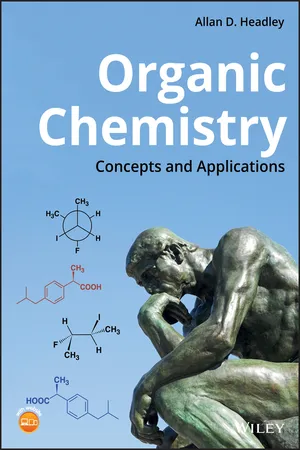 eBook - ePub
Organic Chemistry
Concepts and Applications
- Allan D. Headley(Author)
- 2019(Publication Date)
- Wiley(Publisher)
Figure 5.2 .The molecules shown in Figure 5.2 differ from each other only in the spatial arrangements of the four different groups around the central carbon. This central carbon of compounds that have four different groups is known as a stereogenic carbon. Thus, a stereogenic carbon is a carbon that is bonded to four different groups. An examination of a slightly different molecule, which has the same two atoms or groups bonded to a carbon and two different atoms or groups, gives a totally different outcome, as shown in the molecules in Figure 5.3 .L ‐Alanine and D ‐alanine are different molecules; they are mirror images of each other and are not superimposable on each other.Figure 5.1Nonsuperimposable mirror images, also known as enantiomers.Figure 5.2Superimposable mirror images, or same molecules.Figure 5.3An example of a symmetrical molecule, which is not a stereogenic molecule.Figure 5.4Even though these compounds are mirror images of each other, they are superimposable on each other and hence they are not enantiomers, but instead they are the same molecules. Note that for these molecules there is a plane of reflection through the carbon, chlorine, and fluorine atoms, as shown in Figure 5.4 . That is, the two hydrogen atoms reflect across that plane. Such molecules are referred to as symmetric molecules or have a plane of symmetry. Such molecules are achiral or not stereogenic.5.2.1 Determination of Enantiomerism
The use of an imaginary mirror to assist in the determination of enantiomerism is a very tedious exercise. Some simple observations of the molecules in both examples given above can be made to decide if molecules are stereogenic or not. Molecules that are asymmetric or molecules that do not have a plane of symmetry (as the molecules shown in Figure 5.2 ) are stereogenic and will exhibit enantiomerism. If a molecule has a carbon atom that has four different groups bonded to that carbon, then that molecule is stereogenic. These simple observations will assist in a quick determination of enantiomerism in molecules. Figure 5.5 eBook - ePub
- Robert J. Ouellette, J. David Rawn(Authors)
- 2015(Publication Date)
- Elsevier(Publisher)
n . The following example, 2,3,4-trihydroxybutanal, illustrates the general principle.C-2 and C-3 are chiral. They are nonequivalent because they are not bonded to identical groups. Therefore, the configurations at C-2 and at C-3 can be R or S. Without even drawing the structures, we predict that the four stereoisomers calculated from the 2n rule can be identified as (2R,3R), (2S,3S), (2R,3S), and (2S,3R). Figure 6.10 shows these configurations in Fischer projection formulas.Figure 6.10 Enantiomers and DiastereomersA molecule that contains two nonequivalent chiral centers, such as 2,3-4-trihydroxybutanal, can exist as four stereoisomers. They exist as two pairs of enantiomers. Stereoisomers that are not enantiomers are Diastereomers.The relationships between the stereoisomeric 2,3,4-trihydroxybutanals are established with mirror planes. Imagine a mirror placed between I and II. Structures I and II are nonsuperimposable mirror images; they are enantiomers. Structures III and IV are also nonsuperimposable mirror images. Like all enantiomers, they rotate plane-polarized light in equal and opposite directions.Structures I and III are stereoisomers, but they are not enantiomers.Stereoisomers that are not enantiomers are called Diastereomers.The pairs II and III, I and IV, and II and IV are Diastereomers. In contrast to enantiomers, which have the same chemical and physical properties, Diastereomers have different chemical and physical properties. For example, the enantiomers I and II both are liquids at room temperature and are very soluble in ethanol. The enantiomers III and IV both melt at 130°C and are only slightly soluble in ethanol.Nomenclature of Diastereomers
The name of a compound with two or more stereogenic centers must indicate the configuration of every center. The configuration of each stereogenic carbon atom is indicated by a number, which corresponds to its position in the carbon chain, and the letter R or S, separated by commas. Figure 6.10 eBook - PDF
- William H. Brown, Thomas Poon(Authors)
- 2016(Publication Date)
- Wiley(Publisher)
6.1 Stereoisomers Isomers that have the same molecular formula and the same connectivity, but different orientations of their atoms in space. cis -2-Butene or Z -2-Butene trans -2-Butene or E -2-Butene CH 3 H C C CH 3 H and H C C H CH 3 CH 3 William H. Brown The horns of this African gazelle show chirality and are mirror images of each other. Isomers Different compounds with the same molecular formula Constitutional Isomers Isomers with a different connectivity of their atoms Stereoisomers Isomers with the same connectivity of their atoms, but a different orientation of their atoms in space Enantiomers Stereoisomers whose molecules are nonsuperposable mirror images Diastereomers Stereoisomers whose molecules are not mirror images OH O OH OH CH 3 CH 3 CH 3 CH 3 FIGURE 6.1 Relationships among isomers and some examples. 6.2 What Are Enantiomers? Enantiomers are stereoisomers that are nonsuperposable mirror images. The signifi- cance of enantiomerism is that, except for inorganic and a few simple organic com- pounds, the vast majority of molecules in the biological world show this type of isomerism, including carbohydrates (Chapter 17), lipids (Chapter 19), amino acids and proteins (Chapter 18), and nucleic acids (DNA and RNA, Chapter 20). Further, approximately one‐half of the medications used in human medicine also show this type of isomerism. 6.2 Enantiomers Stereoisomers that are nonsuperposable mirror images; the term refers to a relationship between pairs of objects. 162 C H A P T E R 6 Chirality: The Handedness of Molecules As an example of a molecule that exhibits enantiomerism, let us consider 2‐butanol. As we go through the discussion of this molecule, we focus on carbon 2, the carbon bearing the OH group. What makes this carbon of interest is that it has four different groups bonded to it. The most common cause of enantiomerism among organic molecules is a carbon bonded to four different groups. eBook - PDF
- William H. Brown, Thomas Poon(Authors)
- 2017(Publication Date)
- Wiley(Publisher)
(6.4) 14. A molecule with three or more stereocenters cannot be meso. (6.6) 15. A molecule with three or more stereocenters must be chiral. (6.6) 16. Each member of a pair of enantiomers will have the same boiling point. (6.7) 17. If a molecule is not superposable on its mirror image, it is chiral. (6.1) 18. For a molecule with two tetrahedral stereocenters, four stereoisomers are possible. (6.2) 19. Constitutional isomers have the same connectivity. (6.1) 20. Enantiomers can be separated by interacting them with the same chiral environment or chemical agent. (6.10) 21. Enzymes are achiral molecules that can differentiate chiral molecules. (6.9) 22. Cis and trans stereoisomers of a cyclic compound can be classified as Diastereomers. (6.5) 23. 3‐Pentanol is the mirror image of 2‐pentanol. (6.2) 24. Diastereomers do not have a mirror image. (6.2) 25. The most common cause of chirality in organic molecules is the presence of a tetrahedral carbon atom with four differ- ent groups bonded to it. (6.1) 26. Each member of a pair of enantiomers will have the same density. (6.7) 27. The carbonyl carbon of an aldehyde or a ketone cannot be a stereocenter. (6.1) 28. For a molecule with three stereocenters, 3 2 = 9 stereoiso- mers are possible. (6.2) 29. Diastereomers can be resolved using traditional methods such as distillation. (6.10) 30. A racemic mixture is optically inactive. (6.8) 31. 2‐Pentanol and 3‐pentanol are chiral and show enantiom- erism. (6.2) 32. A diastereomer of a chiral molecule must also be chiral. (6.2) 33. In order to designate the configuration of a stereocenter, the priority of groups must be read in a clockwise or counter- clockwise fashion after the lowest priority group is placed fac- ing toward the viewer. (6.3) 34. A compound with n stereocenters will always be one of the 2 n stereoisomers of that compound. (6.4) 35. Each member of a pair of enantiomers could react differ- ently in a chiral environment.
- Frederick Bettelheim, William Brown, Mary Campbell, Shawn Farrell(Authors)
- 2019(Publication Date)
- Cengage Learning EMEA(Publisher)
EXAMPLE 14.4 Enantiomers and Diastereomers 1,2,3-Butanetriol has two stereocenters (carbon 2 and 3); thus, 2 2 5 4 ste-reoisomers are possible for it. Following are three-dimensional represen-tations for each. C HO H C H OH CH 2 OH CH 3 (1) C H OH C H OH CH 2 OH CH 3 (2) C HO H C HO H CH 2 OH CH 3 (3) C H OH C HO H CH 2 OH CH 3 (4) 1 2 3 4 (a) Which stereoisomers are pairs of enantiomers? (b) Which stereoisomers are Diastereomers? STRATEGY First, identify those structures that are mirror images. These, then, are the pairs of enantiomers. All other pairs of structures are Diastereomers. SOLUTION (a) Enantiomers are stereoisomers that are nonsuperposable mirror images. Compounds (1) and (4) are one pair of enantiomers and compounds (2) and (3) are a second pair of enantiomers. (b) Diastereomers are stereoisomers that are not mirror images. Compounds (1) and (2), (1) and (3), (2) and (4), and (3) and (4) are Diastereomers. The diagram shows the relationship among these four stereoisomers. Diastereomers Diastereomers Diastereomers Diastereomers Enantiomers Enantiomers 1 2 3 4 ■ QUICK CHECK 14.4 3-Amino-2-butanol has two stereocenters (carbons 2 and 3); thus, 2 2 5 4 stereoisomers are possible for it. C H 2 N H C H OH CH 3 CH 3 (1) C H NH 2 C H OH CH 3 CH 3 (2) C H NH 2 C HO H CH 3 CH 3 (3) C H 2 N H C HO H CH 3 CH 3 (4) 1 2 3 4 Diastereomers Stereoisomers that are not mirror images 424 | Chapter 14 Chirality: The Handedness of Molecules Copyright 2020 Cengage Learning. All Rights Reserved. May not be copied, scanned, or duplicated, in whole or in part. Due to electronic rights, some third party content may be suppressed from the eBook and/or eChapter(s). Editorial review has deemed that any suppressed content does not materially affect the overall learning experience. Cengage Learning reserves the right to remove additional content at any time if subsequent rights restrictions require it. eBook - ePub
- Andrew Clark, Russ Kitson, Nimesh Mistry, Paul Taylor, Matthew Taylor, Michael Lloyd, Caroline Akamune(Authors)
- 2020(Publication Date)
- Royal Society of Chemistry(Publisher)
CHAPTERBy the End of This Chapter You Will: •Understand what makes molecules chiral or achiral.•Be able to assign the configuration of a stereogenic centre as R or S .•Understand the differences in the properties of enantiomers and diastereoisomers.•Understand the definition of pairs of enantiomers, pairs of diastereoisomers, racemates (racemic mixtures) and meso -compounds.•Understand how we measure the optical rotation of compounds.What You Will Get from This Chapter
In this chapter we will look initially at simple molecules containing one stereogenic centre, how we name these molecules and how we define the arrangement of the groups in 3-dimensions. We will then take a similar approach considering slightly more complicated examples with two or more stereogenic centres. Passage contains an image
Stereogenic Centres, Enantiomers and Diastereoisomers
We have a single top tip before you dive into Chapter 3. Get yourself a molecular model kit and use it! Evidence suggests that you can't really grasp stereochemistry until you've built your own models, picked them up, turned them round and really seen the three dimensions we are studying. If a standard model kit isn't right for you, there are some good new virtual tools, but you need to be able to manipulate the molecules yourself to gain this new understanding. Oh, and a small mirror may come in handy!In Chapter 1, we saw that stereochemistry is extremely important, particularly because different arrangements of atoms or substituents in three dimensions can lead to a very different biological response, as in the example of thalidomide. It is therefore essential that we have systematic methods to name and define different types of stereoisomer. In this chapter, we will look initially at simple molecules containing one stereogenic centre
Index pages curate the most relevant extracts from our library of academic textbooks. They’ve been created using an in-house natural language model (NLM), each adding context and meaning to key research topics.

