Chemistry

Stereoisomerism
Stereoisomerism refers to the phenomenon where two or more compounds have the same molecular formula and connectivity of atoms, but differ in the spatial arrangement of their atoms. This results in different physical and chemical properties. Stereoisomers can be further classified as geometric (cis-trans) isomers or optical (enantiomeric) isomers, depending on the nature of their spatial arrangement.
Written by Perlego with AI-assistance
Related key terms
1 of 5
11 Key excerpts on "Stereoisomerism"
 eBook - PDF
- R. S. Cahn, O. C. Dermer(Authors)
- 2013(Publication Date)
- Butterworth-Heinemann(Publisher)
Stereoisomerism Stereochemistry is concerned with the arrangement in space of the constituent atoms of molecules, and those features of it that lead to existence of isomers constitute Stereoisomerism^ Many diverse situations are involved but the nomenclature has been greatly simplified by the ability, acquired only recently, to assign absolute configurations^ and by the promulgation of the sequence rule^ which permits the names of stereoisomers to be differentiated in most situations in organic chemistry. Methods for handling many of the simpler steric relations have been codified by lUPAC* and have proved generally acceptable. However, a new dimension has been introduced by publication^ of methods recently introduced into CA Collective Subject Indexes; its most important features are included in this chapter (see p. 140). Full information on this and other aspects of stereochemical nomenclature can be found in the literature cited. First, however, we should define a few words that are not involved in actual names of compounds but are part of the required vocabulary. There have been variations but we shall follow IUP AC. The term 'structure' is allotted very wide application by lUPAC - to any aspect of the organization of matter ^cf atomic structure, electronic structure, structure of benzene). 'Constitution' is the term to be used to denote the nature and sequence of bonding of atoms in a molecule. Compounds having identical molecular formulas but differing in the nature or sequence of bonding or in arrangement of atoms in space are termed 'isomers'. Isomers differing in the nature or sequence of bonding are 'constitutional isomers' (e.g., 1/2); those differing only in the arrangement of their atoms in space are 'stereoisomers' (e.g., 3a/3b; 4a/4b). The adjective 'stereogenic' is applied to an atom or group in a molecule when interchange of two of the atoms or groups attached to it produces a non-identical compound. 'Stereoparent' is the name 128 eBook - PDF
- David R. Klein(Author)
- 2020(Publication Date)
- Wiley(Publisher)
Such compounds are called stereoiso- mers, and we will explore the connection between Stereoisomerism and drug action. This chapter will focus on the different kinds of stereoisomers. We will learn to identify stereoisomers, and we will learn several drawing styles that will allow us to compare stereoisomers. The upcoming chapters will focus on reactions that produce stereoisomers. 5.1 OVERVIEW OF ISOMERISM The term isomers comes from the Greek words isos and meros, meaning “made of the same parts.” That is, isomers are compounds that are constructed from the same atoms (same molecular formula) but that still differ from each other. We have already seen two kinds of isomers: constitutional isomers (Section 4.3) and stereoisomers (Section 4.14), as illustrated in Figure 5.1. FIGURE 5.1 The main categories of isomers. Isomers Stereoisomers Constitutional isomers Same molecular formula but different constitution (order of connectivity of atoms) Same molecular formula and constitution but different spatial arrangement of atoms DO YOU REMEMBER? Before you go on, be sure you understand the following topics. If necessary, review the suggested sections to prepare for this chapter. • Constitutional Isomerism (Section 1.2) • Tetrahedral Geometry (Section 1.10) • Drawing and Interpreting Bond-Line Structures (Section 2.2) • Three-Dimensional Representations (Section 2.6) Constitutional isomers differ in the connectivity of their atoms; for example: Ethanol Boiling point = 78.4°C C C O H H H H H H Methoxymethane Boiling point = –23°C C O C H H H H H H The two compounds above have the same molecular formula, but they differ in their constitution. As a result, they are different compounds with different physical properties. Stereoisomers are compounds that have the same constitution but differ in the spatial arrange- ment of their atoms. eBook - ePub
- Robert J. Ouellette, J. David Rawn(Authors)
- 2015(Publication Date)
- Elsevier(Publisher)
6Stereochemistry
6.1 Configuration of Molecules
In Chapters 3 and 4 we considered the structures of geometric isomers, which are one of a general class of stereoisomers. Stereoisomers have the same connectivity—the same sequence of bonded atoms—but different arrangements of the atoms in space. The different three-dimensional arrangements of atoms in space determine their configurations. Geometric isomers have different configurations. The configuration of a molecule plays a major role in its biological properties. Stereoisomers often have entirely different biological properties. Geometric isomers invariably elicit different responses in organisms. For example, bombykol, the sex attractant of the male silk-worm moth, has a (Z)/(E) arrangement about the double bonds at C-10 and C-12. It is 109 to 1013 times more potent than the other three possible geometric isomers. Disparlure, the sex attractant of the female gypsy moth, is biologically active only if the alkyl groups bonded to the three-membered ring are in a cis configuration.Geometric isomerism is only one type of Stereoisomerism. Another type of Stereoisomerism is the result of the minor image relationships between molecules, the subject of this chapter. These molecules differ in configuration about an sp3 -hybridized, “tetrahedral carbon” atom bearing four different groups of atoms, which is called a stereogenic center. This phenomenon is not as easily visualized as geometric isomers, but its consequences are even more vital to life processes.6.2 Mirror Images and Chirality
The fact that we live in a three-dimensional world has important personal consequences. In the simple act of looking into a mirror, you see someone who does not actually exist—namely, your mirror image. Every object has a mirror image, but this reflected image need not be identical to the actual object. Let’s consider a few common three-dimensional objects. A simple wooden chair looks exactly like its mirror image (Figure 6.1 ). When an object and its mirror image exactly match, we say that they are superimposable. eBook - PDF
Drug Stereochemistry
Analytical Methods and Pharmacology, Third Edition
- Krzysztof Jozwiak, W. J. Lough, Irving W. Wainer, Krzysztof Jozwiak, W. J. Lough, Irving W. Wainer(Authors)
- 2012(Publication Date)
- CRC Press(Publisher)
2 Stereochemistry—basic terms and concepts Krzysztof Jo ´z ´wiak INTRODUCTION According to the International Union of Pure and Applied Chemistry (IUPAC) definition (1), Stereoisomerism is a type of isomerism that arises from the differences in the spatial arrangement of atoms without any differences in connectivity or bond multiplicity between the isomers. One of the most impor-tant branches of stereochemistry is related to molecular dissymmetry and to the study of chiral molecules. The terminology used to describe stereochemical relationships is often a maze of interchangeable terms (capital D ’s and L ’s, lowercase d ’s and l ’s, mixed in with R ’s, S ’s, ( þ )’s, and ( )’s, to name a few). It is therefore appropriate to address basic stereochemical terms and concepts to lay a foundation for the more technical discussions that follow. This is not meant to be an in-depth treatment of this topic; there are many fine texts on the subject (2,3), which may be consulted if more detailed understanding is required. The chapter is the update to work previously published by I.W. Wainer and A.A. Marcotte in the 2nd edition of this book. SYMMETRY AND DISSYMMETRY Symmetry or the lack of it is one of the interesting features of geometric figures with two or more dimensions. Dissymmetry is very common in real life: it may often be confronted without it being immediately apparent. On the other hand, dissymmetry may become painfully apparent when, for example, someone has to switch from driving on one side of the road to the other while passing the English Channel from France to England or vice versa. The Latin alphabet is very good example containing both symmetrical and asymmetrical two-dimensional letters, some of which have different appearances when they are reflected in a mirror. Six letters and their mirror images are presented in Figure 2.1.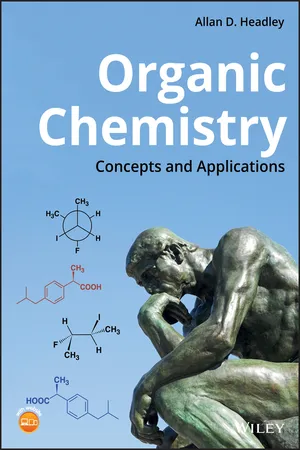 eBook - ePub
Organic Chemistry
Concepts and Applications
- Allan D. Headley(Author)
- 2019(Publication Date)
- Wiley(Publisher)
5 Stereochemistry 5.1 Introduction In a three‐dimensional world, our analysis of atoms and molecules must be from that perspective. In this chapter, a detailed examination of the three‐dimensional arrangement of atoms in a molecule will be carried out. The study of differences in isomers brought about by differences in location of atoms or groups in molecules in three‐dimensional space is called stereochemistry. Geometric and conformational stereoisomers have already been examined in the previous chapter. Geometric isomers differ from each other based on the arrangement of the atoms or groups across a rigid plane, such as a double bond or rigid cyclic ring in the molecule. For example, trans ‐1,2‐dichloroethene is different from cis ‐1,2‐dichloroethene since the chlorine atoms are on different sides of the rigid double bond. On the other hand, conformational isomers differ from each in that groups or atoms in the molecule are in different locations due to rotation about a single bond, typically a carbon–carbon single bond. Thus, the anti‐conformer of 1,2‐dichloroethane is different from the gauche conformer. These conformers are different only in the spatial arrangement of the groups around the carbon–carbon bond; and as a result, their relative energies are different. For some stereoisomers, it is extremely difficult to visualize differences that result in three‐dimensional space for molecules brought about by different spatial arrangements of the atoms or groups, unless a model set is used. Stereochemistry is the study of molecules that have the same atom–atom connectivity, but the spatial arrangement among the groups or atoms is different, resulting in different molecules, known as stereoisomers. Just as a pair of shoes looks similar, but the spatial arrangements in three‐dimensional space are different. Try putting on the left foot of the shoe on your right foot, it just will not fit since it is different from the right foot of a pair of shoes eBook - PDF
Stereochemistry
Basic Concepts and Applications
- M. Nógrádi(Author)
- 2013(Publication Date)
- Pergamon(Publisher)
CHAPTER 1 Static Stereochemistry Those aspects of stereochemistry which are characteristic of the ground state of molecules will be discussed in this chapter. The pathways by which different molecular species interconvert will be dealt with in further chap-ters. In order to distinguish between different molecular species, chemists, and in particular organic chemists, use terms which have a different meaning and emphasis. The fact that compounds having the same molecular formulae may differ chemically has been known since the early 1800s, one of the funda-mental achievements of early chemists being the recognition of constitutional (structural) isomerism. According to this concept, although compounds may have the same molecular formula, the arrangement (interconnection) of their atoms can be different. Differences in constitution or bonding con-nectivity may also be illustrated by two-dimensional formulae without re-course being necessary to expressions indicating direction such as left, right, below, above, etc. For instance the two alcohols with the molecular formula C 8 H 8 0 may be distinguished since in propan-l-ol the carbon atom linked to the oxygen atom is connected to a single carbon atom, whereas in propan-2-ol it is connected to two carbon atoms. Stereochemistry is concerned with isomeric relationships which go beyond constitutional problems, i.e. with differences which cannot be expressed in terms of atomic interconnection. Thus two distinct concepts are important in Stereoisomerism, viz. configuration and conformation. Configuration is essentially a qualitative term which defines the relative arrangement of the atoms of a given molecule in space. Different configurations correspond to different arrangements of these atoms. Different conformations of molecules of the same constitution and configuration differ by their torsion angles around single bonds. Conformational changes may, or may not, affect the configuration.
- Morris Hein, Scott Pattison, Susan Arena, Leo R. Best(Authors)
- 2014(Publication Date)
- Wiley(Publisher)
©Joachim Ladefoged/VII/CORBIS 26.1 Review of Isomerism 26.2 Plane-Polarized Light and Optical Activity 26.3 Fischer Projection Formulas 26.4 Enantiomers 26.5 Racemic Mixtures 26.6 Diastereomers and Meso Compounds Stereoisomerism The mirror image of this children’s ballet class is not superimposable on the class. C H A P T E R O U T L I N E M any of us grew up hearing such comments as “Can’t you tell your left from your right?” Have you ever watched a small child try to differentiate between a right and left shoe? Not surprisingly, the distinction between right and left is difficult. After all, our bodies are reasonably symmetrical. For example, both hands are made up of the same components (four fingers, a thumb, and a palm) ordered in the same way (from thumb through little finger). Yet there is a difference if we try to put a left-handed glove on our right hand or a right shoe on our left foot. Molecules possess similar, subtle structural differences, which can have a major impact on their chemical reactivity. For example, although there are two forms of blood sugar, related as closely as our left and right hands, only one of these structures can be used by our bodies for energy. Stereoisomerism is a subject that attempts to define these subtle differences in molecular structure. Stereoisomerism is an amazing phenomenon; it is where some compounds find a partner—their mirror image. C H A P T E R 26 672 CHAPTER 26 • Stereoisomerism TABLE 26.1 Why Are Stereoisomers Important to Biochemistry? Answer Comment #1 The great majority of biochemicals are stereoisomers. Understanding biochemical structures is difficult without a basic understanding of Stereoisomerism. #2 Metabolism is stereospecific. For example, glucose (blood sugar) is easily metabolized while its enantiomer (see Section 26.4) is not useable. 26.1 REVIEW OF ISOMERISM Distinguish structural isomers from stereoisomers. eBook - ePub
Introductory Organic Chemistry and Hydrocarbons
A Physical Chemistry Approach
- Caio Lima Firme(Author)
- 2019(Publication Date)
- CRC Press(Publisher)
Fig. 13.1(C) ).Stereoisomerism is related to specific arrangements of substituents where two isomers are differentiated by their spacial disposition. Stereo means spacial.GEOMETRIC Stereoisomerism
Geometric stereoisomerm occurs in alkenes or derivatives and in substituted cycloalkanes. They generate two isomers called cis and trans or E and Z.Geometric Stereoisomerism in alkenes is more restricted than in cycloalkanes. In alkenes, two larger substituents (which can be same or different substituents) have to be in each sp2 carbon atom. When they are placed in the same side of the double bond it is called cis or Z, e.g., cis-but-2-ene, and when they are placed in opposite sides of the double bond, e.g., trans-but-2-ene, it is called trans or E. In both cis- and trans-but-2-ene, the largest substituents are methyl group. It is possible to use different substituents, then, only the largest ones are taken into account. For example, cis-2,3-dichloro-but-2-ene and trans-2,3-dichloro-but-2-ene (see Fig. 13.2(A) ). It is possible to have four different substituents and only the largest of each sp2 carbon atom is taken into account, e.g., cis-/trans-2-bromo-3-chloro-pent-2-ene (see Fig. 13.2(A) ).There are some situations in which there is no geometric Stereoisomerism. Firstly, if they are placed in the same sp2 carbon atom: for example, 2-methylpropene. In that case, both methyl groups are at C2 carbon. Secondly, if there is only one substituent (hereafter, we consider hydrogen as a “neutral” substituent) at one of the sp2 carbon atoms, e.g., in propene. Thirdly, if there are three or four equal substituents at sp2 carbon atoms. For example, 2-methyl-but-2-ene and 2,3-dimethyl-but-2-ene, where three or four methyl groups are placed at sp2 carbon atoms Fig. 13.2(C) for the bondline notation of all these molecules.Regarding polyenes or derivatives, each double bond will have E or Z configuration, which must be indicated in their nomenclature. For example, in (2E,4E,6Z,8E)-3,7-dimethyl-9-(2,6,6-trimethyl-1-cyclohenenyl)nona-2,4,6,8-tetraenoic acid, there are four CC double bonds and each one has E or Z configuration (Fig. 13.2(D) eBook - PDF
Mathematical Chemistry and Chemoinformatics
Structure Generation, Elucidation and Quantitative Structure-Property Relationships
- Adalbert Kerber, Reinhard Laue, Markus Meringer, Christoph Rücker, Emma Schymanski(Authors)
- 2013(Publication Date)
- De Gruyter(Publisher)
– Stereoisomers are isomers of identical constitution that differ in the arrangement of their atoms in space. – A molecule’s configuration describes aspects of steric arrangement that are long-lived on a lab -oratory time scale, such as substituent arrangement at double bonds or at tetrahedrally-substi -tuted carbon atoms. – A molecule’s conformation describes details of atom arrangement that are short-lived on a lab -oratory time scale, such as differences due to rotation about single bonds. – A conformer is a conformation that is a global or local potential energy minimum. Conformations of molecules can be changed by (rapid) rotations around single bonds, without affecting the constitution and configuration. The distinction between config-uration and conformation thus depends on the distinction between a single and a double bond, and between long-lived and short-lived, which is ‘somewhat fuzzy’, see [ 65 ], p. 49. In contrast to the definitions above, organic chemists often count different species of identical constitution as stereoisomers only if they can be isolated or at least ob- 4.1 Basic stereochemistry | 133 COOH CH 3 CH 3 A B C Fig. 4.1. Three chiral compounds whose Stereoisomerism cannot be described in terms of stereocen-ters, stereogenic double bonds, or rotatable single bonds. served spectroscopically as distinct species, for practical reasons. Isomers that dif-fer exclusively in torsion angles about single bonds cannot usually be isolated due to rapid interconversion, and are not considered stereoisomers but conformers. Accordingly, traditional attempts to automatically generate all stereoisomers of a given constitution neglected rotation about single bonds. The pioneering work of Nourse [ 227 , 228 , 229 ] as well as Sasaki’s approach [ 1 ] concentrated on finding stere-ocenters (for a discussion of this ill-defined term see [ 64 , 209 , 326 , 342 , 343 ]).
- David R. Klein(Author)
- 2017(Publication Date)
- Wiley(Publisher)
Chapter 5 Stereoisomerism Review of Concepts Fill in the blanks below. To verify that your answers are correct, look in your textbook at the end of Chapter 5. Each of the sentences below appears verbatim in the section entitled Review of Concepts and Vocabulary. ______isomers have the same connectivity of atoms but differ in their spatial arrangement. Chiral objects are not superimposable on their ____________________. The most common source of molecular chirality is the presence of a _______________, a carbon atom bearing ______ different groups. A compound with one chiral center will have one non-superimposable mirror image, called its _______________. The Cahn-Ingold-Prelog system is used to assign the ______________ of a chiral center. A polarimeter is a device used to measure the ability of chiral organic compounds to rotate the plane of ____________________ light. Such compounds are said to be ____________ active. A solution containing equal amounts of both enantiomers is called a __________ mixture. A solution containing a pair of enantiomers in unequal amounts is described in terms of enantiomeric _________ (ee). For a compound with multiple chiral centers, a family of stereoisomers exists. Each stereoisomer will have at most one enantiomer, with the remaining members of the family being ______________. A ______ compound contains multiple chiral centers but is nevertheless achiral because it possesses reflectional symmetry. __________ projections are drawings that convey the configuration of chiral centers, without the use of wedges and dashes. Compounds that contain two adjacent C=C bonds are called ____________, and they are another common class of compounds that can be chiral despite the absence of a chiral center. The stereodescriptors cis and trans are generally reserved for alkenes that are disubstituted. For trisubstituted and tetrasubstituted alkenes, the stereodescriptors ____ and ____ must be used. eBook - PDF
- David R. Klein(Author)
- 2021(Publication Date)
- Wiley(Publisher)
208 CHAPTER 5 Stereoisomerism To help better visualize the relationship between these four compounds, we will use an analogy. Imagine a family with four children (two sets of twins). The first pair of twins are identical to each other in almost every way, except for the placement of one birthmark. One child has the birthmark on the right cheek, while the other child has the birthmark on the left cheek. These twins can be distinguished from each other based on the position of the birthmark. They are nonsuperimposable mirror images of each other. The second pair of twins look very different from the first pair. But the second pair of twins are once again identical to each other in every way, except the position of the birthmark on the cheek. They are nonsuperimposable mirror images of each other. In this family of four children, each child has one twin and two other siblings. The same rela- tionship exists for the four stereoisomers shown above. In this molecular family, each stereoisomer has exactly one enantiomer (mirror-image twin) and two diastereomers (siblings). Now consider a case with three chiral centers: OH Me Cl 1 2 3 Once again, each chiral center can have either the R configuration or the S configuration, giving rise to a family of eight possible stereoisomers: 1R, 2R, 3S 1S, 2S, 3R OH Me Cl OH Me Cl 1R, 2S, 3S 1S, 2R, 3R OH Me Cl OH Me Cl 1R, 2R, 3R 1S, 2S, 3S OH Me Cl OH Me Cl 1R, 2S, 3R 1S, 2R, 3S OH Me Cl OH Me Cl These eight stereoisomers are arranged above as four pairs of enantiomers. To help visualize this, imag- ine a family with eight children (four sets of twins). Each pair of twins are identical to each other with the exception of the birthmark, allowing them to be distinguished from one another. In this family, each child will have one twin and six other siblings. Similarly, in the molecular family shown above, each stereoisomer has exactly one enantiomer (mirror-image twin) and six diastereomers (siblings).
Index pages curate the most relevant extracts from our library of academic textbooks. They’ve been created using an in-house natural language model (NLM), each adding context and meaning to key research topics.

