Chemistry

Functional Isomers
Functional isomers are a type of structural isomer where compounds have the same molecular formula but different functional groups. This means they have different chemical properties and reactivity. For example, propanol and propanone are functional isomers because they have the same molecular formula (C3H8O) but different functional groups (alcohol and ketone, respectively).
Written by Perlego with AI-assistance
Related key terms
1 of 5
8 Key excerpts on "Functional Isomers"
 eBook - ePub
Carbohydrate Chemistry
Fundamentals and Applications
- Raimo Alén(Author)
- 2018(Publication Date)
- WSPC(Publisher)
3. Isomerism
3.1.General
A general molecular formula (e.g., Cx Hy Oz Nn ) expresses the kind and number of the constituent atoms of a compound, but it insufficiently represents the structure of the compound in question. A molecular formula can thus correspond to several compounds (isomers) that normally have different chemical and physical properties. Isomers can be defined as chemical compounds with identical molecular formulas (i.e., contain the same number of atoms of each element) that differ from one another in the arrangements of their atoms. This phenomenon is called “isomerism” (in Greek, “isos” means “equal” and “meros” “part”), and it is divided into two main types (Fig. 3.1 ): (i)constitutional isomerismor structural isomerism and (ii)stereoisomerismor space isomerism. Upon examining certain isomers (such as aldoses with the same number of carbon atoms), one does not necessarily find differences based on constitutional isomerism, and finding the actual differences requires detailed comparison of the stereoisomeric properties of the structures.Constitutional isomerism can be divided into three subgroups: (i)functional group isomerism(“function isomerism”), (ii)chain isomerism(“skeletal isomerism”), and (iii)position isomerism(“regioisomerism”), which are discussed in the next chapters with the help of illustrative examples. The general name “structural isomerism” is traditionally used for “constitutional isomerism”. However, since the structure of the compounds can be thought to cause all isomerism, the use of the former term is not recommended.Fig. 3.1.The main types of isomerism and their subtypes.The branch of organic chemistry that examines the three-dimensional structures of molecules,stereochemistry, has gained importance when striving to understand the physical and chemical properties of various compounds. In carbohydrate chemistry, it is also essential to know the stereochemical structure of the compounds. Stereoisomerism can be seen to generally represent the form of isomerism where compounds with the same chemical structure (i.e., the order of attachment of the atoms involved and the location of the bonds between them) differ from each other only in the spatial direction of their atoms or atom groups. This isomerism is divided into (i)optical isomerism(“physical isomerism”), (ii)conformational isomerism, and (iii)geometric isomerism(“cis/trans eBook - ePub
Understanding Advanced Organic and Analytical Chemistry
The Learner's ApproachRevised Edition
- Kim Seng Chan, Jeanne Tan;;;(Authors)
- 2016(Publication Date)
- WS EDUCATION(Publisher)
CHAPTER 2
Isomerism in Organic Compounds
2.1 Introduction
If a molecule has the molecular formula C4 H8 , does it imply that all the C4 H8 molecules are identical? The alkene, but-1-ene, whose molecule is shown below, has the molecular formula C4 H8 .Yet, C4 H8 also represents the formula for cyclobutane, which belongs to the cycloalkane family:Compounds that have the same molecular formula but different structures are known as isomers. This phenomenon is known as isomerism. The two main types of isomerism are constitutional/ structural isomerism and stereoisomerism. These are further divided into subclasses of which some are discussed in this chapter. Isomers generally have different physical and chemical properties, but they can also have similar chemical properties if they contain the same functional groups. Each specific functional group possesses a characteristic set of chemical reactions.2.2 Constitutional/Structural Isomerism
Constitutional/structural isomers are compounds with the same molecular formula but different structures or structural formulae. Both but-1-ene and cyclobutane constitute a pair of constitutional/structural isomers. The difference in structures can be attributed to either a difference in the arrangement of atoms or due to the presence of different functional groups.Based on the above definitions, constitutional/structural isomerism can be classified into three main types:• chain isomerism;• positional isomerism; and• functional group isomerism.2.2.1 Chain Isomerism
Compounds that exhibit chain isomerism with each other have the same functional group but differ in the way the carbon atoms are connected in the mainskeletal carbon chain of their molecules. In other words, these molecules differ in the degree of branching, hence the term chain isomers eBook - PDF
- David R. Klein(Author)
- 2020(Publication Date)
- Wiley(Publisher)
Such compounds are called stereoiso- mers, and we will explore the connection between stereoisomerism and drug action. This chapter will focus on the different kinds of stereoisomers. We will learn to identify stereoisomers, and we will learn several drawing styles that will allow us to compare stereoisomers. The upcoming chapters will focus on reactions that produce stereoisomers. 5.1 OVERVIEW OF ISOMERISM The term isomers comes from the Greek words isos and meros, meaning “made of the same parts.” That is, isomers are compounds that are constructed from the same atoms (same molecular formula) but that still differ from each other. We have already seen two kinds of isomers: constitutional isomers (Section 4.3) and stereoisomers (Section 4.14), as illustrated in Figure 5.1. FIGURE 5.1 The main categories of isomers. Isomers Stereoisomers Constitutional isomers Same molecular formula but different constitution (order of connectivity of atoms) Same molecular formula and constitution but different spatial arrangement of atoms DO YOU REMEMBER? Before you go on, be sure you understand the following topics. If necessary, review the suggested sections to prepare for this chapter. • Constitutional Isomerism (Section 1.2) • Tetrahedral Geometry (Section 1.10) • Drawing and Interpreting Bond-Line Structures (Section 2.2) • Three-Dimensional Representations (Section 2.6) Constitutional isomers differ in the connectivity of their atoms; for example: Ethanol Boiling point = 78.4°C C C O H H H H H H Methoxymethane Boiling point = –23°C C O C H H H H H H The two compounds above have the same molecular formula, but they differ in their constitution. As a result, they are different compounds with different physical properties. Stereoisomers are compounds that have the same constitution but differ in the spatial arrange- ment of their atoms. eBook - PDF
- David R. Klein(Author)
- 2016(Publication Date)
- Wiley(Publisher)
Such compounds are called stereoisomers, and we will explore the connection between stereoisomerism and drug action. This chapter will focus on the different kinds of stereoisomers. We will learn to identify stereoisomers, and we will learn several drawing styles that will allow us to compare stereoisomers. The upcoming chapters will focus on reactions that produce stereoisomers. 5.1 Overview of Isomerism The term isomers comes from the Greek words isos and meros, meaning “made of the same parts.” That is, isomers are compounds that are constructed from the same atoms (same molecular formula) but that still differ from each other. We have already seen two kinds of isomers: constitutional isomers (Section 4.3) and stereoisomers (Section 4.14), as illustrated in Figure 5.1. FIGURE 5.1 The main categories of isomers. Isomers Stereoisomers Constitutional isomers Same molecular formula but different constitution (order of connectivity of atoms) Same molecular formula and constitution but different spatial arrangement of atoms DO YOU REMEMBER? Before you go on, be sure you understand the following topics. If necessary, review the suggested sections to prepare for this chapter. • Constitutional Isomerism (Section 1.2) • Tetrahedral Geometry (Section 1.10) • Drawing and Interpreting Bond-Line Structures (Section 2.2) • Three-Dimensional Representations (Section 2.6) Take the DO YOU REMEMBER? QUIZ in to check your understanding. Constitutional isomers differ in the connectivity of their atoms; for example: Ethanol Boiling point = 78.4°C C C O H H H H H H Methoxymethane Boiling point = –23°C C O C H H H H H H The two compounds above have the same molecular formula, but they differ in their constitution. As a result, they are different compounds with different physical properties. Stereoisomers are compounds that have the same constitution but differ in the spatial arrange- ment of their atoms. eBook - ePub
- Michael North(Author)
- 2017(Publication Date)
- CRC Press(Publisher)
1.5 respectively. In general, these three isomers will undergo the same types of chemical reaction (benzylic oxidation for example), but will do so at different rates, again illustrating their different chemical properties.There is, however, another type of isomerism, one in which all of the atoms in the two isomers do have the same connectivity. A familiar example is found in 1,2-disubstituted alkenes such as compounds 1.6 and 1.7 . In both of these isomeric compounds, the order in which the carbon atoms are joined together is C𝟙–C𝟚=C𝟛–C𝟜 and the only difference between them is that in isomer 1.6 the two methyl groups are on the same side of the double bond, whilst in isomer 1.7 the two methyl groups are on opposite sides of the double bond. Any pair of isomers which have the same connectivity of their atoms but which differ in the relative orientation of those atoms are called stereoisomers.Stereoisomers are the topic of this book and the following chapters will investigate the different structural features which are responsible for stereoisomerism, and discuss the chemical, biological and physical consequences of the formation of stereoisomers. Both organic and inorganic compounds can exhibit stereoisomerism, and examples of each will be found throughout this book. Essentially, stereochemistry is concerned with the shapes of molecules, and the consequences of a molecule adopting a particular shape.Later in this chapter, the way in which the shape of a molecule may be predicted using Valence Shell Electron Pair Repulsion Theory (VSEPR) will be introduced, and the nature of the bonding found in the most common chemical structures will be discussed. At the end of this chapter, the various classifications of stereoisomers will be introduced and these will be discussed in more detail throughout the remainder of this book. However, many of the structures seen later in this chapter are three dimensional, and before they are discussed it is necessary to understand the conventions used when representing three dimensional structures on a two dimensional piece of paper.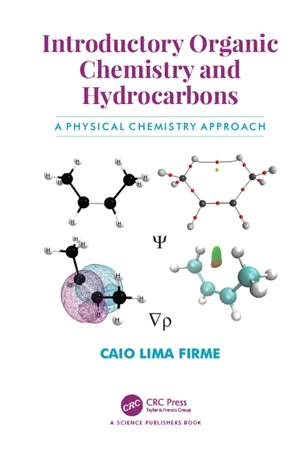 eBook - ePub
Introductory Organic Chemistry and Hydrocarbons
A Physical Chemistry Approach
- Caio Lima Firme(Author)
- 2019(Publication Date)
- CRC Press(Publisher)
Chapter ThirteenIsomerism
ISOMERISM AND TYPES OF ISOMERISM
Isomerism gives rise to isomers that are molecules with the same chemical formula but different structural parameters or different spacial structures (different type of branching or different type of functional group or different position of the same functional group or different arrangement of substituents or different absolute configuration of the asymmetric atom).As for structural isomerism, there are three types: chain isomerism, position isomerism (or regioisomerism), and functional isomerism.The chain isomerism is related to the different position of the branching in its main chain. For example, butane and 2-methyl-propane are isomers (C4 H10 ); pentane, 2-methyl-butane and 2,2-dimethyl-propane are isomers (C5 H12 ); but-1-ene and 2-methyl propene are isomers (C4 H8 ) as well (see Fig. 13.1(A) ).Figure 13.1 Bond line formula of (A) chain isomers, (B) regioisomers, and (C) Functional Isomers.The position isomerism (or regioisomerism) is related to a different position of the substituent group or functional group in the molecule. For example, but-1-ene and but-2-ene are isomers (C4 H8 ), pentan-2-one and pentan-3-one are isomers (C5 H10 O), 2-chloro-propane and 1-chloro-propane are isomers (C3 H7 Cl), orto-dichlorobenzene and para-dichlorobenzene are isomers (C6 H4 Cl2 ) as well (see Fig. 13.1(B) ).Functional isomerism is related to different functional groups with the same molecular formula. For example, propanone and propanal are isomers (C3 H6 O), hexan-1-ene and cyclohexane (C6 H12 ) are isomers as well (see Fig. 13.1(C) ).Stereoisomerism is related to specific arrangements of substituents where two isomers are differentiated by their spacial disposition. Stereo means spacial.GEOMETRIC STEREOISOMERISM
Geometric stereoisomerm occurs in alkenes or derivatives and in substituted cycloalkanes. They generate two isomers called cis and trans or E and Z. eBook - ePub
Pharmacology
A Handbook for Complementary Healthcare Professionals
- Elaine Mary Aldred(Author)
- 2008(Publication Date)
- Churchill Livingstone(Publisher)
Modern medication tends to be known by its brand name, which is likely to be different in each country. For example, the chemical name for the drug Prozac is fluoxetine, but ‘Prozac’ – the brand name – is the name most commonly used. Looking at the chemical structure will leave you in no doubt as to whether you are looking at the same chemical compound.If you are looking at medication in an international context, it is best to search by the chemical name, although several online search mechanisms will look specifically for medication (see Chapter 42 ‘Information gathering’, p. 342 ). Passage contains an image
Chapter 6 IsomersChapter contentsStructural Isomers 35Stereoisomers 36What happens when a compound has more than one chiral centre? 38Alkaloids 39If two compounds have the same molecular formulae (in other words, the same number and types of atoms) but the atoms are arranged differently, they are classed as isomers . Care has to be taken with this definition, however, as the two examples in Figure 6.1 are not isomers but the same molecule bent into a different shape because the mobility that the single bond allows it. In this example, the arrangement of atoms differs by their arrangement in space only.Figure 6.1 Compounds that are not isomers.Bear in mind that a single bond enables a molecule to rotate freely around it, so the apparent change in the shape in the molecule does not make it an isomer (compare this with the limited rotation around a double bond, see Figure 6.5 ).There are several different types of isomer: • Structural isomers: chain isomerism, positional isomerism. • Stereoisomers: enantiomers, diasteroisomers, E-Z isomers.
Passage contains an image
Chapter 6 IsomersChapter contentsStructural Isomers 35Stereoisomers 36What happens when a compound has more than one chiral centre? 38Alkaloids 39If two compounds have the same molecular formulae (in other words, the same number and types of atoms) but the atoms are arranged differently, they are classed as isomers . Care has to be taken with this definition, however, as the two examples in Figure 6.1 are not isomers but the same molecule bent into a different shape because the mobility that the single bond allows it. In this example, the arrangement of atoms differs by their arrangement in space only.Figure 6.1 Compounds that are not isomers.Bear in mind that a single bond enables a molecule to rotate freely around it, so the apparent change in the shape in the molecule does not make it an isomer (compare this with the limited rotation around a double bond, see Figure 6.5 ).There are several different types of isomer: • Structural isomers: chain isomerism, positional isomerism. • Stereoisomers: enantiomers, diasteroisomers, E-Z isomers.Structural Isomers
Chain isomerism
Chain isomers (Figure 6.2(i) ) occur because functional groups can branch off from the main carbon backbone. The number of carbon and hydrogen atoms remains the same but the structures are very different.Figure 6.2 eBook - PDF
Chemistry for Technologists
The Commonwealth and International Library: Electrical Engineering Division
- G. R. Palin, N. Hiller(Authors)
- 2014(Publication Date)
- Pergamon(Publisher)
SECTION V ORGANIC CHEMISTRY This page intentionally left blank CHAPTER 13 Isomerism and Formulae Multiplicity of Organic Compounds The ability of carbon atoms to bond with one another in large numbers, as well as forming bonds with atoms of other elements, has been mentioned in Chapter 1. It was also mentioned that this results in there being an enormous number of carbon containing compounds. Where oxygen only forms two stable compounds with hydrogen, carbon forms millions. Where hydrogen, nitrogen and oxygen form three stable compounds, hydro-gen, nitrogen and carbon form millions, and so on. This has led to the separation of the study of carbon containing compounds from the study of the compounds of the other elements. It has also led to a somewhat different technique for naming compounds and writing formulae, which is necessary because of the widespread occurrence of isomerism amongst organic compounds. Isomers can be defined as compounds with the same molecular formula, but differing in one or more of their chemical or physical properties. Iso-merism does occur in inorganic compounds, but only to a limited extent, and the number of isomers corresponding to a given molecular formula is small. Isomerism occurs in all but the simplest organic compounds, and the number of isomers can be very large. For instance, the relatively simple molecular formula C 8 H 18 applies to eighteen different isomers. Structural Isomerism Structural isomerism occurs when the chemical bonds holding the atoms together in the different molecules, are different. One of the simplest examples of this type of isomerism occurs in the two compounds having the molecular formula C 2 H e O . In both, the carbon is in the sp 3 hybrid state, i.e. it forms four single covalent bonds, tetrahedrally orientated. The oxygen atom forms two covalent bonds, involving the two unpaired 2p electrons, and each hydrogen atom forms one covalent bond, involving the unpaired Is electron.
Index pages curate the most relevant extracts from our library of academic textbooks. They’ve been created using an in-house natural language model (NLM), each adding context and meaning to key research topics.

