Computer Science

Embedded Systems
Embedded systems are specialized computing systems designed to perform specific functions within a larger mechanical or electrical system. They are typically built around microcontrollers or microprocessors and are used in a wide range of applications, from consumer electronics to industrial machinery. These systems are often dedicated to a single task and are designed to be reliable and efficient.
Written by Perlego with AI-assistance
Related key terms
1 of 5

10 Key excerpts on "Embedded Systems"
 eBook - PDF
Embedded Systems Architecture
A Comprehensive Guide for Engineers and Programmers
- Tammy Noergaard(Author)
- 2005(Publication Date)
- Newnes(Publisher)
However, you will find that the definition of “embedded system” is fluid and difficult to pin down, as it constantly evolves with advances in technology and dramatic decreases in the cost of implementing vari-ous hardware and software components. In recent years, the field has outgrown many of its traditional descriptions. Because the reader will likely encounter some of these descriptions and definitions, it is important to understand the reasoning behind them and why they may or may not be accurate today, and to be able to discuss them knowledgeably. Following are a few of the more common descriptions of an embedded system: Embedded Systems are more limited in hardware and/or software functionality than a personal computer (PC). This holds true for a significant subset of the embed-ded systems family of computer systems. In terms of hardware limitations, this can mean limitations in processing performance, power consumption, memory, hardware functionality, and so forth. In software, this typically means limitations relative to a PC—fewer applications, scaled-down applications, no operating system (OS) or a limited OS, or less abstraction-level code. However, this definition is only partially true today as boards and software typically found in PCs of past and present have been repackaged into more complex embedded system designs. An embedded system is designed to perform a dedicated function. Most embedded devices are primarily designed for one specific function. However, we now see devices such as personal data assistant (PDA)/cell phone hybrids, which are embed-ded systems designed to be able to do a variety of primary functions. Also, the latest digital TVs include interactive applications that perform a wide variety of general In This Chapter Define embedded system Introduce the design process Define an Embedded Systems architecture Discuss the impact of architecture Summarize the remaining sections of the book eBook - ePub
Embedded Software System Testing
Automatic Testing Solution Based on Formal Method
- Yongfeng Yin, Bo Jiang(Authors)
- 2023(Publication Date)
- CRC Press(Publisher)
1 Embedded System and SoftwareDOI: 10.1201/9781003390923-2E mbedded system is an application-centered and computer-based special computer system that can adapt to the requirements of different applications on functions, reliability, cost, volume, and power consumption, and it integrates configurable and scalable software and hardware. Embeddedness, specificity, and computer system are the three basic core elements of an embedded system. This chapter summarizes the embedded system and software, so that readers will have a more comprehensive understanding of it.1.1 Overview of Embedded System
1.1.1 Embedded Systems and Real-Time Systems
As one of the greatest inventions of human society in the 20th century, the emergence of computers has gradually brought mankind into the digital age. At the same time, the arrival of the post-PC era makes people increasingly exposed to a new concept: embedded products. An increasing number of complex hardware and software systems are embedded in medical, automotive, industrial control, transportation, communications, aviation, aerospace and modern weapons and equipment, such as NASA’s airborne systems with nearly 500,000 lines of code, excluding 350,000 lines for ground control and processing. In American telecommunications, the total number of source codes of supporting software exceeds 100 million lines. Table 1.1 shows the application of software in aircraft systems.TABLE 1.1Application of Software in Aircraft SystemsYears Aircraft Type The Proportion of Aircraft Systems Functions Realized by Software (%) 1960 F-4/F-100 8 1964 A-7 10 1970 F-111 20 1975 F-15 35 1982 F-16/F-16A 45 1990 B-2 65 2000 F-22 80 2006 F-35 85 In 1990, IEEE (Institute of Electrical and Electronics Engineers) gave the definition of embedded system: An embedded computer system is part of a larger system and performs some of the requirements of that system; for example, a computer system used in an aircraft rapid transit system. Usually, devices used to control, monitor, or assist machines and devices are called Embedded Systems. Embedded Systems generally include a series of hardware and software facilities, and embedded software is the software part of Embedded Systems such as spacecraft control system, aircraft avionics system, mobile phones based on Android, IOS and other systems, set-top boxes, automotive electronics systems, and communication systems routers. In addition, in a broad sense, the control system composed of MCU (STM32), SOC, and other hardware is also called embedded system. The above embedded software often has real-time characteristics, so it is also called real-time embedded system.
- Ahmad Ibrahim(Author)
- 2003(Publication Date)
- Newnes(Publisher)
1 CHAPTER 1 Embedded Systems: An Overview 1.1 Definition and Examples A system whose principal function is not computational but is controlled by a computational system embedded within it is referred to as a computational embedded system, which is usually shortened to embedded system . The word embedded implies that the computational system lies within an overall system. The user of the overall system may not even be aware of the computational system’s existence. The phrase “computational system” refers to computers, micro-processors, microcontrollers, DSP chips, or custom-made hardware along with the software that may be associated with them. Desktop or laptop computers, although they contain microprocessors, are not considered Embedded Systems since their principal function is computational. If such a computer is customized and built permanently into an identifiable system with the sole purpose of controlling that particular system, then one can refer to it as part of an embedded system. Embedded Systems are used in a wide range of applications. They can be loosely categorized as: ■ Consumer Electronics including digital cameras, televisions, cell phones, and camcorders. ■ Home Appliances including microwave ovens, rice cookers, thermostats, washing machines, and drying machines. ■ Business and Office Equipment including alarm systems, card readers, product scanners, cash registers, fax machines, and copiers. ■ Transportation Systems including automobiles (transmission control, fuel injection, antilock brakes, and cruise control), train systems, and avionic systems. ■ Factory Control including machine control, instrumentation, and robotics. ■ Medical Systems including life-support systems, testing systems, and diagnostic systems. The list of embedded system applications is growing continuously and is almost endless. No longer available |Learn more
- (Author)
- 2014(Publication Date)
- Research World(Publisher)
____________________ WORLD TECHNOLOGIES ____________________ Chapter 10 Embedded System Picture of the internals of an ADSL modem/router. A modern example of an embedded system. Labelled parts include a microprocessor (4), RAM (6), and flash memory (7). ____________________ WORLD TECHNOLOGIES ____________________ An embedded system is a computer system designed to perform one or a few dedicated functions often with real-time computing constraints. It is embedded as part of a complete device often including hardware and mechanical parts. By contrast, a general-purpose computer, such as a personal computer (PC), is designed to be flexible and to meet a wide range of end-user needs. Embedded Systems control many devices in common use today. Embedded Systems are controlled by one or more main processing cores that are typically either microcontrollers or digital signal processors (DSP). The key characteristic, however, is being dedicated to handle a particular task, which may require very powerful processors. For example, air traffic control systems may usefully be viewed as embedded, even though they involve mainframe computers and dedicated regional and national networks between airports and radar sites (each radar probably includes one or more Embedded Systems of its own). Since the embedded system is dedicated to specific tasks, design engineers can optimize it to reduce the size and cost of the product and increase the reliability and performance. Some Embedded Systems are mass-produced, benefiting from economies of scale. Physically, Embedded Systems range from portable devices such as digital watches and MP3 players, to large stationary installations like traffic lights, factory controllers, or the systems controlling nuclear power plants. Complexity varies from low, with a single microcontroller chip, to very high with multiple units, peripherals and networks mounted inside a large chassis or enclosure. No longer available |Learn more
- (Author)
- 2014(Publication Date)
- White Word Publications(Publisher)
Some also have real-time performance constraints that must be met, for reasons such as safety and usability; others may have low or no performance requirements, allowing the system hardware to be simplified to reduce costs. 2. Embedded Systems are not always standalone devices. Many Embedded Systems consist of small, computerized parts within a larger device that serves a more general purpose. For example, the Gibson Robot Guitar features an embedded system for tuning the strings, but the overall purpose of the Robot Guitar is, of course, to play music. Similarly, an embedded system in an automobile provides a specific function as a subsystem of the car itself. e-con Systems eSOM270 & eSOM300 Computer on Modules 3. The program instructions written for Embedded Systems are referred to as firmware, and are stored in read-only memory or Flash memory chips. They run with limited computer hardware resources: little memory, small or non-existent keyboard and/or screen. ____________________ WORLD TECHNOLOGIES ____________________ User interface Embedded system text user interface using MicroVGA Embedded Systems range from no user interface at all — dedicated only to one task — to complex graphical user interfaces that resemble modern computer desktop operating systems. Simple embedded devices use buttons, LEDs, graphic or character LCDs (for example popular HD44780 LCD) with a simple menu system. More sophisticated devices use graphical screen with touch sensing or screen-edge buttons provide flexibility while minimizing space used: the meaning of the buttons can change with the screen, and selection involves the natural behavior of pointing at what's desired. Handheld systems often have a screen with a joystick button for a pointing device. Some systems provide user interface remotely with the help of a serial (e.g. RS-232, USB, I²C, etc.) or network (e.g. Ethernet) connection.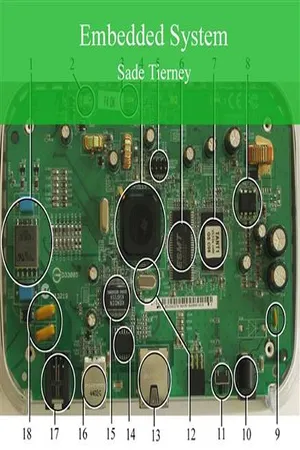 No longer available |Learn more
- (Author)
- 2014(Publication Date)
- The English Press(Publisher)
________________________ WORLD TECHNOLOGIES ________________________ Chapter- 1 Introduction to Embedded System Picture of the internals of an ADSL modem/router. A modern example of an embedded system. Labelled parts include a microprocessor (4), RAM (6), and flash memory (7). An embedded system is a computer system designed to perform one or a few dedicated functions often with real-time computing constraints. It is embedded as part of a complete device often including hardware and mechanical parts. By contrast, a general-purpose computer, such as a personal computer (PC), is designed to be flexible and to meet a wide range of end-user needs. Embedded Systems control many devices in common use today. Embedded Systems are controlled by one or more main processing cores that are typically either microcontrollers or digital signal processors (DSP). The key characteristic, how- ________________________ WORLD TECHNOLOGIES ________________________ ever, is being dedicated to handle a particular task, which may require very powerful processors. For example, air traffic control systems may usefully be viewed as embedded, even though they involve mainframe computers and dedicated regional and national net-works between airports and radar sites (each radar probably includes one or more Embedded Systems of its own). Since the embedded system is dedicated to specific tasks, design engineers can optimize it to reduce the size and cost of the product and increase the reliability and performance. Some Embedded Systems are mass-produced, benefiting from economies of scale. Physically, Embedded Systems range from portable devices such as digital watches and MP3 players, to large stationary installations like traffic lights, factory controllers, or the systems controlling nuclear power plants. Complexity varies from low, with a single microcontroller chip, to very high with multiple units, peripherals and networks mounted inside a large chassis or enclosure. No longer available |Learn more
- (Author)
- 2014(Publication Date)
- College Publishing House(Publisher)
________________________ WORLD TECHNOLOGIES ________________________ Chapter 1 Introduction to Embedded System Picture of the internals of an ADSL modem/router. A modern example of an embedded system. Labelled parts include a microprocessor (4), RAM (6), and flash memory (7). An embedded system is a computer system designed to perform one or a few dedicated functions often with real-time computing constraints. It is embedded as part of a complete device often including hardware and mechanical parts. By contrast, a general-purpose computer, such as a personal computer (PC), is designed to be flexible and to meet a wide range of end-user needs. Embedded Systems control many devices in common use today. Embedded Systems are controlled by one or more main processing cores that are typically either microcontrollers or digital signal processors (DSP). The key characteristic, how- ________________________ WORLD TECHNOLOGIES ________________________ ever, is being dedicated to handle a particular task, which may require very powerful processors. For example, air traffic control systems may usefully be viewed as embedded, even though they involve mainframe computers and dedicated regional and national networks between airports and radar sites (each radar probably includes one or more Embedded Systems of its own). Since the embedded system is dedicated to specific tasks, design engineers can optimize it to reduce the size and cost of the product and increase the reliability and performance. Some Embedded Systems are mass-produced, benefiting from economies of scale. Physically, Embedded Systems range from portable devices such as digital watches and MP3 players, to large stationary installations like traffic lights, factory controllers, or the systems controlling nuclear power plants. Complexity varies from low, with a single microcontroller chip, to very high with multiple units, peripherals and networks mounted inside a large chassis or enclosure. eBook - PDF
Computers as Components
Principles of Embedded Computing System Design
- Marilyn Wolf(Author)
- 2008(Publication Date)
- Morgan Kaufmann(Publisher)
But a fax machine or a clock built from a microprocessor is an embedded computing system. 1 2 CHAPTER 1 Embedded Computing This means that embedded computing system design is a useful skill for many types of product design. Automobiles, cell phones, and even household appliances make extensive use of microprocessors. Designers in many fields must be able to identify where microprocessors can be used, design a hardware platform with I/O devices that can support the required tasks, and implement software that performs the required processing. Computer engineering, like mechanical design or thermo-dynamics,is a fundamental discipline that can be applied in many different domains. But of course, embedded computing system design does not stand alone. Many of the challenges encountered in the design of an embedded computing system are not computer engineering—for example, they may be mechanical or analog electri-cal problems. In this book we are primarily interested in the embedded computer itself, so we will concentrate on the hardware and software that enable the desired functions in the final product. 1.1.1 Embedding Computers Computers have been embedded into applications since the earliest days of com-puting. One example is the Whirlwind, a computer designed at MIT in the late 1940s and early 1950s. Whirlwind was also the first computer designed to support real-time operation and was originally conceived as a mechanism for controlling an aircraft simulator. Even though it was extremely large physically compared to today’s computers (e.g., it contained over 4,000 vacuum tubes), its complete design from components to system was attuned to the needs of real-time embedded com-puting. The utility of computers in replacing mechanical or human controllers was evident from the very beginning of the computer era—for example,computers were proposed to control chemical processes in the late 1940s [Sto95]. eBook - ePub
- Wai-Kai Chen(Author)
- 2003(Publication Date)
- CRC Press(Publisher)
5 Embedded Computing Systems and Hardware/ Software Co-Design
Wayne Wolf Princeton University5.1 Introduction
This chapter describes embedded computing systems that make use of microprocessors to implement part of the system’s function. It also describes hardware/software co-design, which is the process of designing Embedded Systems while simultaneously considering the design of its hardware and software elements.5.2 Uses of Microprocessors
An embedded computing system (or more simply an embedded system) is any system which uses a programmable processor but itself is not a general purpose computer. Thus, a personal computer is not an embedded computing system (though PCs are often used as platforms for building Embedded Systems), but a telephone or automobile which includes a CPU is an embedded system. Embedded Systems may offer some amount of user programmability—3Com’s PalmPilot, for example, allows users to write and download programs even though it is not a general-purpose computer—but Embedded Systems generally run limited sets of programs. The fact that we know the software that we will run on the hardware allows us to optimize both the software and hardware in ways that are not possible in general-purpose computing systems.Microprocessors are generally categorized by their word size, since word size is associated both with maximum program size and data resolution. Commercial microprocessors come in many sizes; the term microcontroller is used to denote a microprocessor which comes with some basic on-chip peripheral devices, such as serial input/output (I/O) ports. Four-bit microcontrollers are extremely simple but capable of some basic functions. Eight-bit microcontrollers are workhorse low-end microprocessors. Sixteen- and 32-bit microprocessors provide significantly more functionality. A 16/32-bit microprocessor may be in the same architectural family as the CPUs used in computer workstations, but microprocessors destined for embedded computing often do not provide memory management hardware. A digital signal processor (DSP) is a microprocessor tuned for signal processing applications. DSPs are often Harvard architectures, meaning that they provide separate data and program memories; Harvard architectures provide higher performance for DSP applications. DSPs may provide integer or floating-point arithmetic. eBook - PDF
High-Performance Embedded Computing
Architectures, Applications, and Methodologies
- Wayne Wolf(Author)
- 2010(Publication Date)
- Morgan Kaufmann(Publisher)
We can see that computers were embedded early in the history of computing: * Many of the dates in this figure were found in Wikipedia; others are from http://www.motofuture.motor-ola.com and http://www.mvista.com . history of embedded computing 4 Chapter 1 Embedded Computing one of the earliest computers, the MIT Whirlwind, was designed for artillery control. As computer science and engineering solidified into a field, early research established basic techniques for real-time computing. Some techniques used today in embedded computing were developed specifically for the prob-lems of Embedded Systems while others, such as those in the following list, were adapted from general-purpose computing techniques. ■ Low-power design began as primarily hardware-oriented but now encom-passes both software and hardware techniques. ■ Programming languages and compilers have provided tools, such as Java and highly optimized code generators, for embedded system designers. ■ Operating systems provide not only schedulers but also file systems and other facilities that are now commonplace in high-performance Embedded Systems. Figure 1-2 Highlights in the history of embedded computing. 1.2 Example Applications 5 ■ Networks are used to create distributed real-time control systems for vehi-cles and many other applications, as well as to create Internet-enabled appliances. ■ Security and reliability are an increasingly important aspect of embedded system design. VLSI components are becoming less reliable at extremely fine geometries while reliability requirements become more stringent. Security threats once restricted to general-purpose systems now loom over Embedded Systems as well. Some knowledge of the applications that will run on an embedded system is of great help to system designers. This section looks at several basic concepts in three common applications: communications/networking, multimedia, and vehicles.
Index pages curate the most relevant extracts from our library of academic textbooks. They’ve been created using an in-house natural language model (NLM), each adding context and meaning to key research topics.

