Geography

Brazil Biofuel Case Study
The Brazil Biofuel Case Study explores the country's use of biofuels as an alternative to fossil fuels. Brazil has been successful in implementing a biofuel program that uses sugarcane ethanol, reducing its dependence on imported oil and promoting sustainable development. However, there are concerns about the impact of biofuel production on land use and food security.
Written by Perlego with AI-assistance
Related key terms
1 of 5

11 Key excerpts on "Brazil Biofuel Case Study"
 eBook - PDF
Socioeconomic and Environmental Impacts of Biofuels
Evidence from Developing Nations
- Alexandros Gasparatos, Per Stromberg(Authors)
- 2012(Publication Date)
- Cambridge University Press(Publisher)
From the former perspective, certification can provide a unique opportunity to harness international pressure to increase the accountability of northeastern elite toward society at large. For those opposed to agricultural capitalism, certification represents little more than whitewashing serving solely the interests of the already powerful. Regardless of whether the integration of these contrasting perspectives turns out to be feasible, the international biofuel certification schemes would do well to pay careful attention to and learn from the history of the sociopolitical conditions in the Northeast of Brazil. 8 Implications of global ethanol expansion on Brazilian regional land use amani elobeid, miguel carriquiry, and jacinto f. fabiosa Iowa State University, Ames, USA Abstract A spatially disaggregated model of Brazilian agriculture is used to assess the impli- cations of global biofuel expansion on Brazilian land use at the regional level. After establishing a baseline, two scenarios are investigated. First, an exogenous increase in the global demand for biofuel is introduced into the model, and the impact is analyzed in terms of land use change and commodity price changes, given baseline assumptions on potential land expansion. Second, the same exogenous biofuel demand shock is implemented with a different responsiveness in area expansion to price signals in Brazil, reflecting varying plausible assumptions on land availability for agricultural expansion. The motivation for this second scenario is derived from the existing uncer- tainties regarding land availability for agricultural expansion and the extent of future enforcement of land use policies in Brazil. We find that most of the global increase in ethanol consumption (other than in the United States) is supplied by Brazilian production expansion, in particular, from the Southeast region of the country. eBook - PDF
The Political Economy of Climate Finance in Brazil
How actors and their ideas shape institutions. The case of the Amazon Fund and the ABC Programme for Low-Carbon Agriculture
- Ursula Flossmann-Kraus(Author)
- 2023(Publication Date)
- LIT Verlag(Publisher)
Chapter 5 Case Study Context The issue areas covered in this chapter provide the relevant context for the following analytical chapters. The chapter draws on academic liter‐ ature on climate finance, and the nexus between land rights, land use and related GHG emissions of the agriculture and forestry sectors, par‐ ticularly from the interior of Brazil. The last section provides a brief and by no means complete overview of relevant conservation initiatives. 5.1 Socio‐Ecological Background Brazil possesses the largest forest carbon and biodiversity stock in the world, the largest reserve of arable land and the third largest stock of freshwater reserves, the largest reserve of hydropower and the most effi‐ cient and second largest ethanol production in the world (Viola and Fran‐ chini 2012). Its continental expanse encompasses five ecological regions: the Amazon rainforest, the Caatinga (scrubland in the semi‐arid North‐ east), the wetlands of the Pantanal in the mid‐south‐west, the Cerrado savannah in the mid‐west and the Atlantic rainforest (Mata Atlântica) along the coast (Zellhuber 2016) (see maps in figure 5.1 and 5.2). The Brazilian ‘Legal Amazon’, on the other hand, is a political concept and en‐ compasses both Amazon and Cerrado biomes (see map in figure 5.3). 107 Figure 5.1: Topographic map of Brazil Source: https://upload.wikimedia.org/wikipedia/commons/8/8f/Sub‐ Bacias_Brasil_Mapa_Altimetria_Policonico.jpg 108 Figure 5.2: Brazilian public forests (federal and state) Source: http://www.florestal.gov.br/images/conteudo/informacoes_florestais/ CNFP/CNFP_2019_FINAL_g.jpg 109 The Amazon Basin spans over six countries and nearly six million km 2 . The Brazilian Amazon biome alone covers 4.2 million km 2 . It has the largest reserve of tropical timber globally, huge stocks of rubber, nuts, fish and minerals, as well as oil and gas reserves (Marcovitch and Cuzziol Pinsky 2014).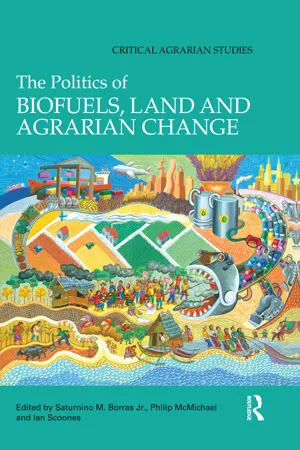
- Saturnino Borras Jr., Philip McMichael, Ian Scoones(Authors)
- 2013(Publication Date)
- Routledge(Publisher)
Biofuels in Brazil: debates and impacts John Wilkinson and Selena HerreraThis article presents an analysis of the two major components of Brazil's biofuels initiatives – ethanol from sugarcane and biodiesel from a variety of raw material sources. With the crisis unleashed at the end of 2008, huge question marks hang over the timetable and the scope of future investments in the sector. Even prior to the current crisis the biofuels debate was suffering a sharp volte-face with earlier euphoria being replaced by sustained critiques from NGOs, social movements, influential representatives of the techno-bureaucracy, and global agrifood firms. As a result governments are currently reviewing their policies, further exacerbating the uncertainties surrounding biofuels. Brazil is already assuming a protagonist role in the promotion of biofuels and its biofuels programs occupy a central place both in global debates on this issue and in the eventual emergence of global biofuels markets.Introduction
Brazil is distinguished by the degree to which renewable resources participate in its energy matrix, accounting for almost half of total production. The table below compares Brazil's renewable/non-renewable mix with the global average. The breakdown of the different energy components shows that Brazil has an overall participation of renewable resources of some 44 percent against 14 percent globally (see Table 1 ). Of these, biomass accounts for 30 percent, compared with 11 percent globally. Sugarcane alone is responsible for some 15 percent of Brazil's total domestic energy supply.At the same time, the total area dedicated to sugar cane production, some seven million hectares in 2006, roughly divided equally between sugar and ethanol, represents a small proportion of Brazil's total cultivable area, calculated at 340 million hectares. Ethanol production accounts for one percent of this total, or five percent of actually cultivated land, estimated at 63 million hectares. eBook - PDF
Brazil as an Economic Superpower?
Understanding Brazil's Changing Role in the Global Economy
- Lael Brainard, Leonardo Martinez-Diaz, Lael Brainard, Leonardo Martinez-Diaz(Authors)
- 2009(Publication Date)
- Brookings Institution Press(Publisher)
Unlike in the past, today nat-ural resources are not used solely by the agricultural sector. These have to be shared with Brazilian society and, increasingly, with the world community. It is hard to deny that Brazil is in a privileged position in the world debate on food versus fuel. With a fuel ethanol program that originated in the 1970s, and with an increasing consumption of ethanol from 2003 onward following the upward trend of flex-fuel cars sales, sugarcane production—the feedstock for Brazilian ethanol—has been demonstrating Brazil as an Agricultural and Agroenergy Superpower 57 a capacity to increase without any harsh competition against cereals and oilseeds. Although this is not the case for all adopters of biofuels, the Brazilian experience can be replicated by many countries. This chapter addresses these questions: Is Brazil ready to be an agricul-tural and energy superpower? Which obstacles must be overcome in seek-ing this position? What are the new challenges faced by Brazilian agriculture? Is Brazil prepared to handle them? The Geography of Brazilian Agriculture To understand the development of Brazilian agriculture, it is important to know how production is distributed around the country. The producing regions can be characterized in the context of the Brazilian biomes. Brazil is divided into six biomes, as can be seen in figure 3-1: South Grassland, Atlantic Forest, Savanna, Pantanal wetland, Steppe, and Amazon Forest. The South Grassland is mainly characterized by irrigated rice production combined with cattle. A typical production system in this region consists of the rotation of rice and grass-fed cattle. Grains and soybeans are also produced in this region, but rice is the predominant crop. The Pantanal is a region with cattle as the main agricultural activity and where the land floods during the rainy season. As with the South Grassland, the Pantanal is a region characterized by low altitude. eBook - ePub
Biofuel Cropping Systems
Carbon, Land and Food
- Hans Langeveld, John Dixon, Herman van Keulen(Authors)
- 2014(Publication Date)
- Routledge(Publisher)
Brazil is the world’s second-largest producer of ethanol (after the USA) and has been the pioneer in developing integrated biofuel policies and infrastructure. Biofuel production and consumption are integrated in the economy to a level not realised elsewhere, making Brazil a model both for developed and developing countries. Ethanol fuel is available throughout the country, both as a blend with gasoline and as a separate fuel (E85). This success is based on a combination of factors, including several decades of a support program, extensive land availability, effective agricultural knowledge, and strong industrial development. Dedicated research has helped Brazil to develop the most successful alternative fuel to date. Its energy efficiency and reduction of greenhouse gases (GHG) has been rewarded the status of ‘advanced biofuel’ by the US Environmental Protection Agency (EPA).The history of ethanol in Brazil is unique and serves as a successful example of biofuel development. Its history and background will be discussed in this chapter, which is organized as follows. First, background data are presented on land availability and land use in Brazil (Section 6.2). Next, market development and economic conditions for biofuel production are discussed (Section 6.3), after which practices of crop cultivation and biomass production are explained (Section 6.5). This is followed by an evaluation of the impacts of biofuel production (Section 6.7) and some conclusions (Section 6.8).6.2 Land resources
Brazil, covering 850 million ha, is nearly the size of the USA. It consists mostly (62%) of forest and agricultural land (31%). The share of ‘other’ land, 60 million ha or 7%, is relatively low. Figure 6.1 depicts a schematic overview of different types of land use in Brazil.Figure 6.1 Schematic overview of land use in BrazilNo geographical representation. Each cell represents 0.25% of land area. Position of the categories was chosen randomly.Source: Calculated from FAOSTAT (2010–2013), http://faostat.fao.orgTable 6.1 Land area and land use in BrazilBrazil has 273 million ha of agricultural land (Table 6.1 eBook - PDF
- Marco Aur�lio dos Santos Bernardes(Author)
- 2011(Publication Date)
- IntechOpen(Publisher)
Although some minor changes can be perceived at a paragraph level, it is important to note what the configuration of a six-clusters analysis at sentences level revealed. In such case, it is possible Economic Effects of Biofuel Production 212 to identify three main clusters: agronomical and environmental; political and legal; and, economical and technological. The findings reveal that Brazilian scientists are interested in agronomical, technological and environmental issues at a general approach, but to develop the knowledge on liquid biofuels they need to put particular emphasis on agronomical-environmental, political-legal, and economical-technological aspects. (a) (b) (c) Note: “a“, in the same document; “b“, in the same paragraph; “c“, in the same sentence Fig. 2. Science document content analysis by dimensions agglomeration order using Jaccard Coefficient The second group of stakeholders to be analyzed is composed by Brazilian journalists. As well established in the literature, the mass media plays an important role both in disseminating the knowledge produced by science, both to the lay public and to policy-makers, as in the discussion of relevant topics on public policies. As the liquid biofuels is a relative emerging sector which needs an intermediation between scientists, policy-makers and the lay public, and the mass media can properly performs this role, it is interesting to investigate how the macro-environment for liquid biofuels have been configured by Brazilian journalists along the time. Compared to science, the macro-environmental configuration done by mass media is more stable. There is not much change between the most frequently used dimensions during the time. In general, Brazilian journalists have focused on four main dimensions when framing liquid biofuels: economical, technological, political and geopolitical (see Table 5). eBook - ePub
Sugarcane Bioenergy for Sustainable Development
Expanding Production in Latin America and Africa
- Luis A. B. Cortez, Manoel Regis L. V. Leal, Luiz A. Horta Nogueira(Authors)
- 2018(Publication Date)
- Routledge(Publisher)
Part IBioenergy overview
The context Passage contains an image
1 The future of fuel ethanol
Rogério Cezar de Cerqueira Leite, Luís A. B. Cortez, Carlos Eduardo Driemeier, Manoel Regis L. V. Leal, and Antonio BonomiDisclaimer
The present analysis focuses on the future of fuel ethanol and of global energy markets. By no means is it oriented to specific countries. It was also not our intention to discuss in detail the technologies that we refer to here, but much less provide assurance as to the precise path they will follow and rather they will converge to some of the possible configurations suggested in our analysis. Finally, it is important to also note that real outcomes may end up diverging considerably from the scenarios under consideration if, for instance, oil prices take an unpredictable course.Introduction: fuel ethanol in Brazil and the US
Brazil, as it is well known, has long been recognized as a leading country in the development and use of sugarcane bioethanol as fuel. It is difficult to say when it started, but the scientific literature presents information that registers several events concerning the adoption of ethanol as fuel since the beginning of the 20th century. The fact that Brazil did not have production and refining of petroleum within its borders until the 1950s, and that sugarcane cultivation has permeated the country’s history since its discovery by the Portuguese provides a good clue as to why such innovations took place there earlier.The success of the Brazilian experience together with the oil crisis of the 1970s created conditions that led to the implementation of the largest renewable fuel project ever since: the National Alcohol Fuel Program, known as Proálcool (The Brazilian Development Bank (BNDES) and CGEE (2008) and Cortez et al. (2016)). The investment of substantial amounts of resources in both agriculture and industry increased significantly the country’s production capacity of ethanol and sugar. Brazil became the world’s largest producer and exporter of cane sugar while producing huge volumes of fuel ethanol as well. In 1979, an agreement between the Federal Government, the sugar and ethanol sector, and the automobile industry sealed the pact for the years to come: to use ethanol in dedicated combustion engines. This was indeed a big step. The motivation then was not the environment per se but simply to reduce the country’s dependence on oil. Two ethanol-based fuels were produced: hydrous ethanol, to be initially used directly in ethanol engines (E100) and later in flex fuel cars, and anhydrous ethanol, to be blended with gasoline (today E27) and used in adapted engines. Presently, ethanol represents about 40% of the overall liquid fuel utilized in light vehicles in Brazil. Ethanol is mainly produced using molasses and higher impurity sugars as inputs. Processing takes place at sugar mills where nearly 50% of the output ends up sold as raw sugar and the remaining 50% further is processed, through fermentation and distillation, and transformed into fuel ethanol. eBook - PDF
Biofuels
Economy, Environment and Sustainability
- Zhen Fang(Author)
- 2013(Publication Date)
- IntechOpen(Publisher)
Sugarcane Production in Brazil per Region Biofuels in Brazil in the Context of South America Energy Policy http://dx.doi.org/10.5772/54419 343 In September 2009, to emphasize the Brazilian Federal Government disposition to preserve its main natural resources from sugarcane expansion, EMBRAPA, its agricultural research agency, published the Agro Ecological Zoning of Sugarcane. In it, EMBRAPA surveys the en‐ tire territory, pointing out the appropriate sites to cultivate sugarcane, from a soil and cli‐ mate standpoint. The survey explicitly excluded any areas within the Amazon Rainforest, the Pantanal Biome (Wetlands), as well as Indian territories and protected areas according to the National System of Conservation Units. The study identified a total of 64.7 Mha of ap‐ propriate land for sugarcane expansion, 37.2 Mha from pasture land. It concludes that those numbers demonstrate the country’s capacity to expand sugarcane production without caus‐ ing deforestation or displacing lands with other crops used for food and feed. Figure 3 shows the resulting map. Source: [37] Figure 3. Brazilian Sugar cane Agroecological Zoning No correlation between expansion of sugar cane and soy beans crops and deforestation has been established, since Brazil’s production of both crops has continuously increased, where‐ as deforestation rates have been decreasing since 2005 [1]. There are two points to be observed about biofuels and deforestation: a. The presence of sugar cane in Center-West region (17%) has an impact on the Brazilian Cerrado, although its savanna type vegetation is less dense than rain forest. Biofuels - Economy, Environment and Sustainability 344 b. Soybean, mainly used for feed, but also for biodiesel, is different, because its presence in the North region is high, although Brazilian biodiesel production is only one-tenth of ethanol’s. eBook - ePub
- Rafael Luque, Carol Sze Ki Lin, Karen Wilson, James Clark(Authors)
- 2016(Publication Date)
- Woodhead Publishing(Publisher)
2.2.2. Brazil
Over the last decades, Brazil has become one of the major biofuels producers. Although regulation on biodiesel entered into force in 2004, Brazilian production of biofuels is mainly centered on ethanol from sugarcane. Contrary to biodiesel, ethanol has been processed since 1975, which makes Brazil the second largest producer for transport fuels over a 30-year period. The abundance of land and proper climate conditions for sugarcane production, and the possibility of transport subsidies ensuring full ethanol distribution within the country, is an asset for the evolution of such industry. Several reasons have been adopted in favor of governmental support for biofuels in Brazil. These vary from purely economic–profit oriented ones to those including environmental concerns, energy security, and rural development. Energy safety was encouraged since the oil crisis during the 1970s, when Brazil had to overcome national debt crisis by borrowing foreign capitals. Ethanol production was then seen as a safe way to reduce import and interest costs. Parallel to the expansion of the ethanol industry, major employment creation occurred in the biofuels sector, favoring the expansion of unskilled workers in rural areas and the formation of more than 60,000 small-sized farmers countrywide (Moreira, 2006 ). The success of the Brazilian experience also lies behind a direct or indirect connection with several synergies, such as those with other economic sectors. In this case, established relationships with the sugar, electricity, and heat-production markets are relevant to address. The sugar market played a primary role in driving the ethanol growth within and outside the country. On the supply side, the degree of price elasticity between sugar and ethanol (eg, 0.20; Elobeid and Tokgoz, 2008 ) and the international volatility of sugar prices pushed Brazilian farmers toward ethanol production. Productivity of the ethanol sector also rose substantially to more than 100% (Moreira, 2006 ) during the 25-year period from 1975 to 2000. The electricity and heat-production industry were also fundamental to boosting biofuels production, as these served both the internal and foreign markets with using by-products from sugarcane. In Brazil, the production of electricity from sugarcane by-products has sharply increased since 2010 (Lopes Silva et al., 2014 ). The Brazilian government played an active role for the enhancement of the biofuels industry. In particular, it provided incentivizing measures (see also Section 2.5 ) throughout the entire biofuels chain production (including support to technological advances in the sector) and to final end users. Most of all, the establishment of a transparent institutional framework has guaranteed full competitiveness within markets. However, it was not until recent years, where consumer habits for switching fuels engine cars increased rapidly, that ethanol production took off considerably. In 2006, 75% of new cars' models were produced with fuel–switch technology engine. In 2010, Brazil accounted for 314 sugar mills for the production of green electricity, and the government projections show an increase of 65% to exported energy by 2019 compared to 2010 (Empresa de Pesquisa Energetica, 2010 eBook - ePub
Brazil’s Emerging Role in Global Governance
Health, Food Security and Bioenergy
- M. Fraundorfer(Author)
- 2015(Publication Date)
- Palgrave Macmillan(Publisher)
Our vision is focused on development. We see bioenergy as a possibility to organise agricultural production in countries which still lack an agricultural production for the production of food. This can be a way of rural development in a variety of developing countries. You create an agricultural system with all the infrastructure, […] create jobs and […] produce food as well. Our motto is ‘food and fuel’, not ‘food vs. fuel’.(High-ranking diplomat of the Energy Department of the Ministry of Foreign Affairs 30 April 2013)Lula da Silva referred to the consequences of climate change, the state of underdevelopment in many African, Latin-American and Asian countries and the North-South divide in the energy question, particularly as far as the consumption of fossil fuels is concerned. As a solution to these existing challenges he suggested the expansion of the production of biofuels, and above all, the Brazilian version. According to his argument, Brazilian biofuels represent a viable economic alternative to fossil fuels because they are supposed to be environmentally friendly, hold tremendous development potential for developed and developing countries alike and might therefore revolutionise the production of energy worldwide. To demonstrate that the solution Lula da Silva offered was credible, he presented his own country as a real role model in the production of sugarcane-based ethanol. Not only did he refer to Brazil’s pioneering role in the production of biofuel worldwide and its position as a leading ethanol producer, he also put emphasis on the recent developments during his own presidency, such as the introduction of the flex-fuel engine and his achievement in further increasing the production of ethanol while at the same time successfully fighting extreme hunger and poverty in Brazil and reducing the deforestation rates in the Amazon rainforest. eBook - PDF
Biofuels
Production and Future Perspectives
- Ram Sarup Singh, Ashok Pandey, Edgard Gnansounou, Ram Sarup Singh, Ashok Pandey, Edgard Gnansounou(Authors)
- 2016(Publication Date)
- CRC Press(Publisher)
48 Biofuels: Production and Future Perspectives worldwide and the environment. Biofuel policies are making an upward pressure on agricultural prices and can also undermine the environment since they encour- age the expansion of agricultural areas at the expenses of rainforests and wilderness (direct and indirect land-use changes). It is important to fully understand the policies issued by the major biofuel producer and consumer countries, because their decisions can have a substantial impact on world markets of both bioenergy and agricultural products. 3.4.1 Brazil Since the 1970s, Brazil has been at the lead to produce biofuels, in particular ethanol from sugarcane. Because of a combination of climate, soil, and 45 years of sustain- able technological research and development, Brazil is currently the lowest-cost pro- ducer of sugarcane to date and, consequently, of ethanol for automotive transport. In 2006, there were 320 combined sugar mills and bioethanol distilleries in the country, with a total installed processing capacity in excess of 430 million tons of sugarcane. Including 51 new plants and expansion of those existing, together they could produce up to 30 million tons of sugar and 18 billion liters of ethanol per year (GBEP 2007). The largest plant in Brazil has a production of just below 330 million liters of ethanol per year. There are about 250 separate producers, but most of them are grouped in two associations that make up 70% of the market. Unlike other countries with substantial biofuel production, Brazil does not offer production subsidies for bioethanol. However, the government has made it manda- tory since 1977 for light vehicles to have the E20 blend, with vehicles running also on using up to E25 blends. Brazilian sugarcane ethanol is the only ethanol that is com- petitive with petroleum, and the E20 mandate causes minimum distortion, because it requires ethanol up to the cost-equivalent level.
Index pages curate the most relevant extracts from our library of academic textbooks. They’ve been created using an in-house natural language model (NLM), each adding context and meaning to key research topics.
