Geography

Infill
Infill refers to the process of developing vacant or underutilized land within an already built-up area. This can involve constructing new buildings or repurposing existing ones. Infill development is often seen as a way to promote more sustainable and efficient land use patterns.
Written by Perlego with AI-assistance
Related key terms
1 of 5

7 Key excerpts on "Infill"
 eBook - ePub
Growing Compact
Urban Form, Density and Sustainability
- Joo Hwa P. Bay, Steffen Lehmann, Joo Hwa P. Bay, Steffen Lehmann(Authors)
- 2017(Publication Date)
- Routledge(Publisher)
For instance, London and Athens have similar population densities; yet, the core densities in Athens are considerably higher than in London. The Athens suburbs, however, are among the least dense in Europe. Similarly, the Essen-Düsseldorf and Milan urban areas have almost identical densities, yet core densities are considerably higher in Milan (Demographia, 2015). Urban designers may encourage a variety of density and housing types in different locations to ensure distinctively different neighbourhoods and a variety of urban characters. Mixed-use describes developments and precincts that combine diverse uses, such as residential, retail, commercial and office uses, clustered together in one project. The different uses can be either layered vertically in a single building, or in a horizontal arrangement in adjacent buildings. Infill is the act of building on a vacant lot (often an underutilized site) within an otherwise developed neighbourhood. Urban Infill development occurs in the established areas of a city and can be a valid densification strategy for unoccupied gaps in already built-up areas. Urban Infill can be a medium-density growth management strategy that uses what is already there to its advantage; Infill has frequently led to thoughtful, innovative housing solutions in urban settings. Urban Infill may use modular prefabrication that allows building components to be manufactured off-site and transported to the site for assembly. Modular construction technologies could allow for entire apartments built in a factory off-site, then trucked to the inner-city site and assembled, including over multiple storeys eBook - ePub
Town and Terraced Housing
For Affordability and Sustainability
- Avi Friedman(Author)
- 2012(Publication Date)
- Routledge(Publisher)
9 Infill Housing Infill housing is built on vacant lots within an already-developed area that was previously occupied or never used. These sites are now taking on additional significance due to the need to limit urban sprawl. Since Infill sites are commonly located in urban areas, townhouses are suitable housing types for such projects. This chapter discusses issues related to the use of townhouses in Infill projects and examines strategies for their integration. Opportunities Infill townhouse projects have environmental, economic and urban benefits. With their high density they can house a large number of people in a relatively small area without introducing tall apartment buildings. By offering an affordable alternative to living in a detached house, these homes may appeal to singles, young couples and empty nesters inclined to buy smaller dwellings (Kinnis 1997; Moyes 1997). A desire to reduce commuting time is causing people to live closer to the city center, making Infill townhouses suitable for those who cannot afford or do not wish to own cars. Homeowners will also benefit from lowered infrastructure costs since these sites are already serviced with roads, utilities, public transportation and commercial amenities. Infill housing can also improve the urban fabric at the building, the block and the neighborhood level (Gutman 1988). They can increase density in a dispersed manner without changing the place’s overall appearance. Another advantage is revitalization. High-density Infill housing allows communities to participate in their own rehabilitation, as was the case in the Benny Farm project in Montréal, Quebec, Canada (Figure 9.1) (Hermanuz et al. 1988). Filling up vacant lots or replacing dilapidated buildings removes community eyesores and increase the property value of adjacent lots eBook - PDF
- Frederick R. Steiner, Kent Butler(Authors)
- 2012(Publication Date)
- Wiley(Publisher)
Banks may be reluctant to lend money, and developers may experience high land costs and potential environ-mental cleanup costs, especially on sites in older communities that have had several uses over the years. An Infill project’s strength lies in the potential to increase the market value of an existing area. Infill projects that receive adequate funding are typically the ones that: • demonstrate the value of an existing neighborhood in terms of its context, safety, and growth potential; • prelease a percentage of the project; • include experienced team members, such as devel-opers who have completed similar projects successfully; • identify any special benefits that may be required during entitlement, such as affordable housing or jobs; and • demonstrate the city’s support for the type of Infill development through adopted policies and other incentives for the developer. Parking Understand the parking requirements for the area. Often, new parking requirements within an already developed area are difficult to satisfy with Infill proj-ects, due to limited land availability. Ensuring a project meets the parking requirements without bur-dening the streets with additional demand for on-street parking can also be an issue. There are a number of strategies to overcome parking issues: • Encouraging shared parking between uses and institutions. • Reducing parking requirements in mixed-use or transit-oriented areas. • Incorporating transit programs into the develop-ment. • Implementing a day/night use of parking, such as allowing parking for businesses in the daytime, than in the evenings for local entertainment venues or residents. Community Concerns Local opposition may pose challenges for Infill development. The level and type of opposition depends on the neighborhood’s character and his-tory, among other factors. eBook - PDF
Terra Incognita
Vacant Land and Urban Strategies
- Ann O'M. Bowman(Author)
- 2004(Publication Date)
- Georgetown University Press(Publisher)
Few cities face the magnitude of the Detroit situation, but the issue remains salient for them as well. Should squatting be legitimized? Would cities be well served to convert some of the unoccupied struc-tures they own into homeless shelters? Answering these questions re-quires rethinking the social imperative, with its emphasis on minimiz-ing disruption and protecting property values. Perhaps when applied to vacant land and abandoned structures, the social imperative can be stretched to cover broader conceptions of social benefit. InfillING AS A SOCIAL STRATEGY Infilling as a Social Strategy Infill serves both revenue and development imperatives, but it also may serve the social imperative. Even as many central cities have lost population relative to the larger metropolitan area, many downtowns have begun to experience residential growth. In three-quarters of the twenty-four cities studied by Rebecca Sohmer and Robert Lang, the downtown population increased during the 1990s. 23 Cities as diverse as Boston, Chicago, Denver, Los Angeles, and Memphis had repopu-lating downtowns. The downtown area growth is attributable to a number of factors, including demographics (e.g., the number of empty nesters and young professionals), distinctiveness (e.g., its his-tory and style offer a sense of place), and geography (e.g., its central location). 24 This increase in habitation has been fueled in most instances by in-filling. The process of Infilling, which is often supported through offi-cial city programs, involves converting vacant or underutilized land into housing. 25 The Infill results in more efficient utilization of infra-structure and increased population density and thus is valued for its antisprawl effects. But Infill programs also may have another effect: in-creases in the number of white residents in the area. Although the 1990–2000 pattern in most large U.S. cities was a loss of white Infilling as a Social Strategy 103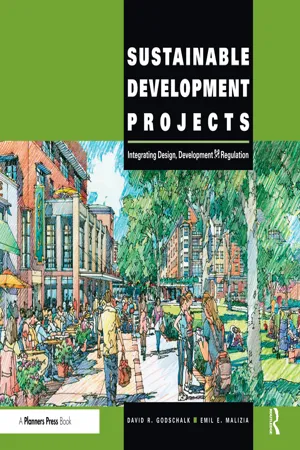 eBook - ePub
Sustainable Development Projects
Integrated Design, Development, and Regulation
- David R. Godschalk, Emil E. Malizia(Authors)
- 2017(Publication Date)
- Routledge(Publisher)
Santana Row is a $450 million, 1.5 million-square-foot mixed use “village within a city” in San Jose, California. The project replaced a 43-acre strip shopping center with a new landscaped urban “main street” center. Opening in 2002 just 80 days after a major fire that caused $130 million in damage, the center has proven to be enormously successful. As of 2012, its pedestrian-friendly sidewalks drew some 30,000 visitors a day for shopping and dining in its 70 shops and 20 restaurants. The four blocks of the 1,500-foot-long main street, lined with arcaded shops and three-to five-story buildings, create a lively, popular “outoor room.” Its mix of uses includes 834 residential units, office space for 350 employees, a movie theater, two parks, and a five-star hotel. Its 2008 LEED Gold six-story office tower, 300 Santana Row, includes 65,000 square feet of Class A space over a two-story retail base, as well as a stand-alone parking structure. Santana Row was named 2010 Project of the Decade by the Silicon Valley Business Journal for its transformational and economic impact on the Silicon Valley area.Infill development and redevelopment are critical components of urban growth. As cities build out their cores and urban growth expands beyond the inner ring suburbs, opportunities arise to intensify development in their centers. More intense central city land use contributes to reduced future sprawl, makes more efficient use of existing infrastructure, and improves overall accessibility. Usually such Infill development or redevelopment replaces existing lower-density or obsolete structures with higher-density, mixed use projects (Dunham-Jones and Williamson 2011).Mixed use Infill development projects are more complex and challenging than single-use and greenfield projects. The design challenge is to create a workable combination of uses that achieves coherence and synergies within the project and is compatible with and connected to the existing context of surrounding neighborhoods and land uses. The development challenge is to create a feasible financial calculus that accounts for investment capital, project costs, and multiple income streams over the life of the project. The planning challenge is to envision, plan, and operate a regulatory process that guides development toward sustainable outcomes. This involves responding to market forces for core-area redevelopment, concerns about neighborhood compatibility and development impacts, and the need for consistency with plans at the small-area, city, and regional scales.This chapter describes and analyzes a case of mixed use Infill redevelopment to show how dynamic financial analysis, presented in chapter 6 eBook - PDF
World Cities Report 2022
Envisaging the Future of Cities
- United Nations Human Settlements Programme(Author)
- 2022(Publication Date)
- UN-HABITAT(Publisher)
It worth noting that population growth within the initial boundaries of a city or a town can be accommodated through planned Infills or densification by building on vacant land within the town or city, replacing low-rise buildings with medium- or high-rise buildings. Planned city Infills can respond to future urban growth in an orderly manner, minimizing expansion through inefficient land-use patterns and leapfrogging that generates wasteful areas as well as avenues for speculation. Infills can also remedy fragmented urban spaces. These density scenarios play out differently for cities in various regions of the world. Medellín, Colombia—with a very high population density at 16,000 inhabitants per sq. km in 2020—is projected to grow its city’s area in the range of 17 per cent and 100 per cent between 2020 and 2050 depending on the scenario. In the low-density scenario, Table 2.2: Population density in three development scenarios Population density in 2015, inhabitants per sq. km Scenario Based on Cities Towns Semi-dense areas Low density Northern America 1,700 900 750 Medium density Northern and Western Europe 3,800 1,300 770 High density Eastern Asia 15,000 5,300 900 Planned city Infills can respond to future urban growth in an orderly manner, minimizing expansion through inefficient land-use patterns and leapfrogging that generates wasteful areas as well as avenues for speculation Scenarios of Urban Futures: Degree of Urbanization 62 its area would double and its density would drop to 9,500 inhabitants per sq. km, which is still high. The high-density scenario (Figure 2.20) would mean no expansion of city land, but density would further increase to 21,000 inhabitants per sq. km. The medium-density scenario strikes a balance between the demand for land and density with a spatial expansion of only 33 per cent and a small reduction in population density to 14,000 inhabitants per sq. eBook - ePub
Open Building for Architects
Professional Knowledge for an Architecture of Everyday Environment
- Stephen H. Kendall, N. John Habraken(Authors)
- 2023(Publication Date)
- Routledge(Publisher)
Infill companies prepare well-organized ‘packages’ or ‘kits’ of parts off-site. The parts and small assemblies are delivered in the correct number, sequence and dimension, using the latest in laser tools for accurate site measurements. These packages, along with the coordinated delivery of other parts straight from manufacturers or suppliers, are bar-coded and delivered to the site and brought into the empty space through a balcony window by a boom truck or, on tall buildings, using a boom lift (also used for window washing) or via the service elevator and through the unit’s front door. Once inside, they are installed by a multiskilled team of workers who stay with the job until it is finished. Only minimal cutting of parts is required, thus producing very little on-site waste, debris and noise. Such companies will compete on their ability to use the latest enterprise management software and the latest consumer-oriented products from the market and their ability to deliver on-time and on-budget. They deliver at various price points and hand over a user’s manual and multiyear maintenance agreement.Working this way means an end to choreographing separate subcontractors, with all the familiar scheduling, blame-shifting and quality-control problems. This new mode of operation means implementing true teamwork into residential construction. Infill company product/service solutions are truly systematic, which does not mean uniform solutions but quite the opposite, because good systems enable rather than block variety.A complete Infill package will include everything making that space habitable – the thousands of discrete parts including parts for making walls, doors, door frames and hardware, all wiring, piping and plumbing fixtures, lighting, cabinets, appropriate heating, air conditioning, ventilation equipment and so on. The space may be rented and the Infill purchased. The Infill may even include the front door as well as part of the building’s façade directly related to each independent dwellings’ floor plan. (see NEXT21 at the beginning of the book)As already noted, social structure and conventions and the local market will dictate which parts of a multifamily residential building will be ‘fixed’ or common and which will be ‘movable’ or decided per dwelling unit.It’s quite reasonable to question how such businesses can operate when a building stock is highly varied. In many countries and regions, building technology (wood-frame vs. concrete vs. heavy timber vs. steel structure, etc.) varies considerably, as do access types and dimensions (e.g., floor-to-floor; column spacing; façade-to-elevator core, etc.). Given these variables, Infill companies will have developed systemic solutions, with variations. Experience world-wide shows that the routing of piping (drainage and domestic water supply), cabling and ventilation ducts within demised spaces requires special attention and offers the best opportunity for systemic product solutions.
Index pages curate the most relevant extracts from our library of academic textbooks. They’ve been created using an in-house natural language model (NLM), each adding context and meaning to key research topics.

